

For a pool service company with an owner and three technicians running 150 pools, the cheapest stack that still does every job is $7,545.52 a year: Skimmer Getting Started ($1,800), PoolOps Team ($1,079.52), Jobber Connect for five users ($2,388), Housecall Pro Essentials ($1,788), and Rosie Professional ($490).Buy the full tiers instead and the same company pays $12,145.52 a year, a difference of $4,600. The two biggest jumps are Skimmer Scaling Up at $3,600 a year against Getting Started at $1,800, and Housecall Pro MAX at $3,588 against Essentials at $1,788.Skimmer Scaling Up at $2 per serviced pool a month ($3,600 a year for 150 pools) is the only tool here built for pool routes first, with route optimisation, an Orenda-powered LSI and dosing calculator, and a LaMotte integration. PoolOps Team at $59.99 a month plus $9.99 per technician ($89.96 a month, $1,079.52 a year) is the cheapest honest way to run the same route, with route optimisation, LSI guidance, and GPS-verified visits — and its price never rises with your pool count.Jobber Connect for five users at $199 a month ($2,388 a year) is the generalist alternative, with quoting, route optimisation, and a voice AI that drafts quotes from spoken notes. Housecall Pro MAX at $299 a month billed annually ($3,588 a year) is the all-in-one alternative, with recurring service plans, route optimisation, and an AI helper.Rosie Scale at $149 a month ($1,490 a year) answers the phone around the clock and books service visits onto your calendar. If the phone barely rings outside the summer rush, Professional at $49 a month ($490 a year) stops the leak for a third of the price.
The phone rings while you are elbow-deep in a skimmer basket, chlorine on your hands, and the caller wants a quote for weekly service on a pool with a green swamp where the water should be. By the time you dry off and call back, they have rung the next pool company on Google. That missed call is not a small leak — for a pool route, it is the whole business, because the customer who calls first usually books first, and then they stay for years.
That is the week these five tools are built for. Two run pool routes and nothing else — one bills you per pool, the other per technician. One is the big generalist that quotes, routes, and takes payments. One is the all-in-one platform with an AI helper. And one answers the phone while your hands are wet.
This guide compares the best AI tools for pool service companies on prices read from the vendors’ own pricing pages on 24 November 2026, for a pool company with an owner and three technicians running 150 pools. The full stack costs $12,145.52 a year; the lean stack costs $7,545.52 and still does every job — a difference of $4,600 a year.
Quick Answer
For a pool service company with an owner and three technicians running 150 pools, the cheapest stack that still does every job is $7,545.52 a year: Skimmer Getting Started ($1,800), PoolOps Team ($1,079.52), Jobber Connect for five users ($2,388), Housecall Pro Essentials ($1,788), and Rosie Professional ($490).
Buy the full tiers instead and the same company pays $12,145.52 a year, a difference of $4,600. The two biggest jumps are Skimmer Scaling Up at $3,600 a year against Getting Started at $1,800, and Housecall Pro MAX at $3,588 against Essentials at $1,788.
Skimmer Scaling Up at $2 per serviced pool a month ($3,600 a year for 150 pools) is the only tool here built for pool routes first, with route optimisation, an Orenda-powered LSI and dosing calculator, and a LaMotte integration. PoolOps Team at $59.99 a month plus $9.99 per technician ($89.96 a month, $1,079.52 a year) is the cheapest honest way to run the same route, with route optimisation, LSI guidance, and GPS-verified visits — and its price never rises with your pool count.
Jobber Connect for five users at $199 a month ($2,388 a year) is the generalist alternative, with quoting, route optimisation, and a voice AI that drafts quotes from spoken notes. Housecall Pro MAX at $299 a month billed annually ($3,588 a year) is the all-in-one alternative, with recurring service plans, route optimisation, and an AI helper.
Rosie Scale at $149 a month ($1,490 a year) answers the phone around the clock and books service visits onto your calendar. If the phone barely rings outside the summer rush, Professional at $49 a month ($490 a year) stops the leak for a third of the price.
In this article
- Best AI tools for pool service companies at a glance
- How we compared them (and what we did not test)
- Skimmer in detail
- PoolOps in detail
- Jobber in detail
- Housecall Pro in detail
- Rosie in detail
- The maths: what a three-technician company pays in one year
- Five traps to check before you pay
- Work out what your stack really costs
- Pros and cons
- Our verdict
- Frequently asked questions
Best AI tools for pool service companies at a glance
| Tool | What it does | Free plan | Plan that does the job | Three techs, 150 pools, one year |
|---|---|---|---|---|
| Skimmer | Pool-only route software, chemistry, billing | First month free | Scaling Up, $2 per pool a month | $3,600 |
| PoolOps | Pool routes, chemistry, GPS-verified visits | 14-day trial | Team, $59.99 + $9.99 per tech a month | $1,079.52 |
| Jobber | Quoting, scheduling, routing, payments | 14-day trial | Connect, 5 users, $199 a month | $2,388 |
| Housecall Pro | All-in-one field service + AI helper | 14-day trial | MAX, $299 a month billed annually | $3,588 |
| Rosie | AI receptionist that books service visits | 7-day trial | Scale, $149 a month ($1,490 a year) | $1,490 |
Skimmer is the only tool here that bills by the pool: 150 pools cost $300 a month on Scaling Up, and the bill rises with every pool you add. PoolOps bills by the technician, so 150 pools cost the same as 15.
Jobber and Housecall Pro bill by the user, and Rosie bills by minutes of talk time, so neither price changes when you add a pool.
How we compared them (and what we did not test)
Every price here was read on the vendor’s own pricing page on 24 November 2026, and every figure is the list price, not a first-year discount. Two Black Friday offers running today are printed next to the list price.
The comparison company is an owner plus three technicians running 150 pools, needing route optimisation, chemistry and dosing tracking, autopay billing, and a phone answered morning and evening. The price printed is the plan that does the job, not the cheapest on the page.
We did not test the tools hands-on, and we did not count features that exist only on a sales call. If a price was not on the vendor’s own pricing page, this guide says so instead of guessing. Two of the five tools are honest automation rather than pure AI — Skimmer and PoolOps sell route software with automated dosing guidance and reminders — and Skimmer’s own AI, the AI Phone add-on, costs $99 a month on top of the plan.
Skimmer in detail
Skimmer is the only tool here built for pool service and nothing else: routes, scheduling, chemistry logs, service reports, invoicing, online payments, and QuickBooks sync, with a customer portal and an offline technician app.
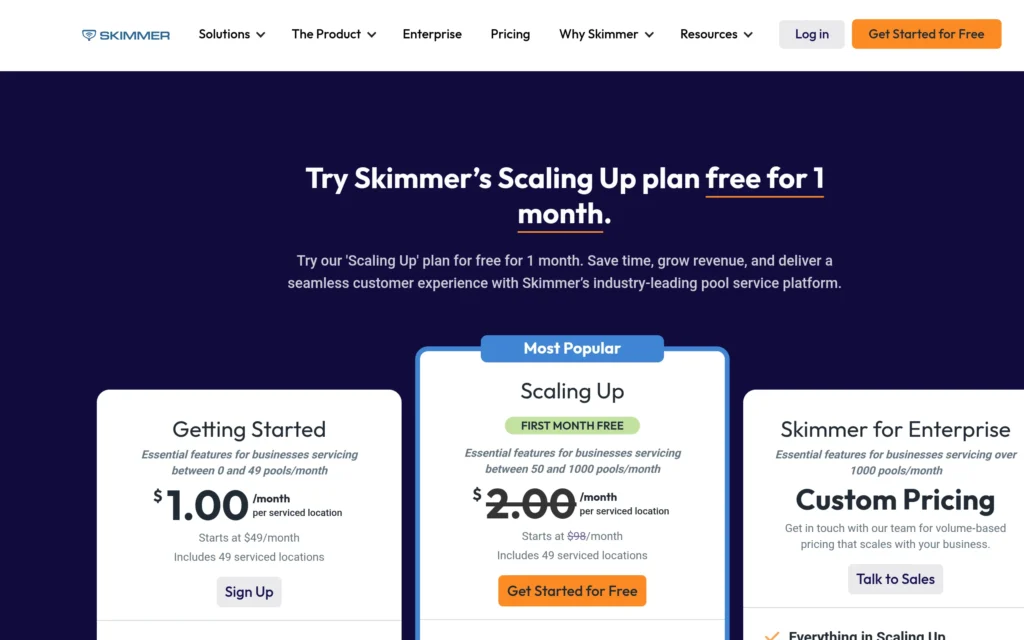
There are two priced plans and one custom tier, and the billing unit is the serviced location — one address, however many times you visit it and however many bodies of water it has. Getting Started costs $1 per serviced location a month, starting at $49 a month, and covers 0 to 49 pools. Scaling Up costs $2 per serviced location a month, starting at $98 a month, and covers 50 to 1,000 pools. Enterprise, above 1,000 pools, is priced by quote.
Both plans include unlimited technicians, admins, customers, and visits per location, and locations you do not service in a month are not billed. Skimmer publishes no annual pricing.
Getting Started includes the Route Builder, one-time work orders, invoicing and online payments, service reports and emails, a customer portal, and five photos per visit. Service texts cost $0.029 per message. Scaling Up adds quotes and estimates, job management, the Schedule, recurring work orders, route optimisation, the LSI and dosing calculator powered by Orenda, the LaMotte integration, unlimited service texts, and twenty photos per visit.
The maths decides the bill, and it has a sharp edge. At 150 pools, Scaling Up costs $300 a month, or $3,600 a year. Getting Started at the same pool count costs $150 a month by the published $1-per-location rate, or $1,800 a year — but Skimmer positions Getting Started for 0 to 49 pools, and it has no route optimisation and no LSI calculator, the two features that make Skimmer worth buying for pool work.
The honest read is that a 150-pool route belongs on Scaling Up, and the $1,800 lean figure is what you pay if you accept the limits. The other sharp edge is the 50-pool jump: at 49 pools Getting Started costs $49 a month, and the 50th pool forces Scaling Up at $100 a month — a $51 jump for one pool.
Skimmer’s AI is an add-on, not a plan feature. AI Phone costs $99 a month on every plan and answers calls for you. Other add-ons: Marketing Suite $150 a month, Bookkeeping from $198 a month, CRM Integrations $49 a month, and Google Calendar $25 a month.
New users get the first month of Scaling Up free, up to 49 locations, plus a 30-day refund guarantee. The official page carries a 4.9 out of 5 rating from 222 reviews.
Who is Skimmer actually best for? A pool company that wants software built for its own trade — chemistry, dosing, and per-pool billing — and runs a route big enough to need route optimisation: at 150 pools, Scaling Up at $300 a month is the buy; under 49 pools, Getting Started at $49 a month does the job, and PoolOps Solo at $29.99 undercuts it.
PoolOps in detail
PoolOps is the cheapest honest way to run a pool route in this guide. It covers routes, water chemistry, service reports, and invoicing for solo operators and small teams, and it charges by the technician — never by the pool.
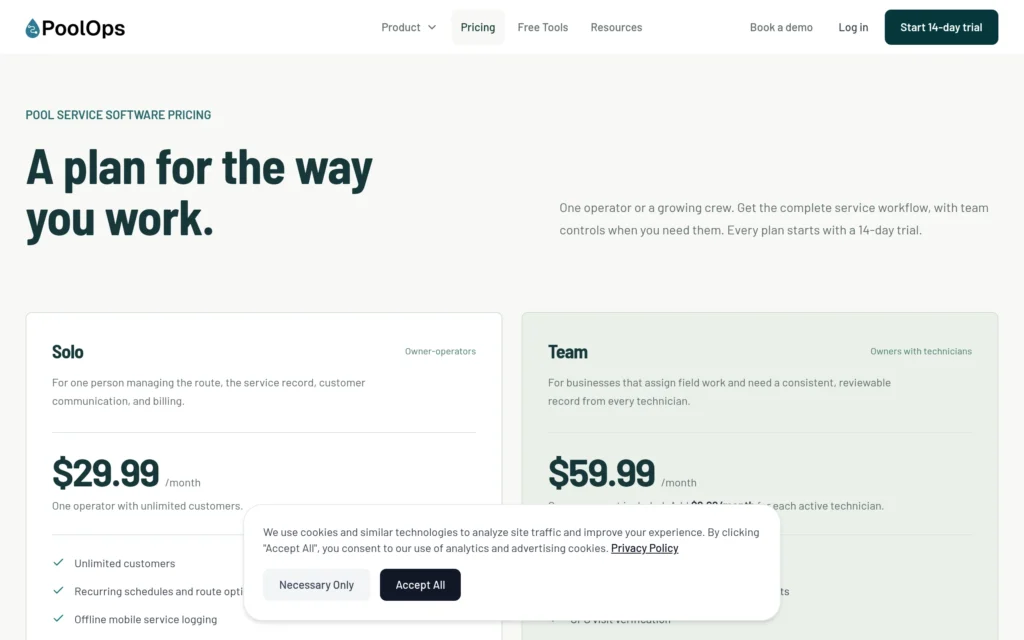
There are two plans. Solo costs $29.99 a month for one operator with unlimited customers — the price does not rise as you add pools. Team costs $59.99 a month for the owner account, plus $9.99 a month for each active technician: $89.96 a month for our company, or $1,079.52 a year. Every plan starts with a 14-day trial, and a card is required: you are not charged until the trial ends. There is no free plan.
Solo includes recurring schedules and route optimisation, chemistry logs with LSI and dosage guidance, visit reports and the homeowner portal, invoicing, online payments and AutoPay, and offline field service logging. Team adds technician assignments, GPS-checked visits, required photo proof, custom checklists, issue flagging, and a team activity dashboard.
The honest catch is the seat count. Solo is one operator only — the moment a second person touches the route, you need Team. PoolOps is also a young, narrow tool: it does the pool route brilliantly and nothing else, so quoting, marketing, and the phone still need another tool.
Who is PoolOps actually best for? A solo operator or a small team that wants the route, the chemistry, and the billing for the lowest honest price: Solo at $29.99 a month is the cheapest start in this guide, and Team at $89.96 a month for an owner plus three technicians is less than a third of Skimmer Scaling Up at the same pool count.
Jobber in detail
Jobber is the big generalist here: quoting, scheduling, dispatch, invoicing, and payments for home-service businesses. The same quoting and routing that landscapers use fits a pool route that sells weekly service by the visit.
There are three plans, priced by team size, and a Black Friday offer of up to 50% off runs until 30 November. Core costs $49 a month for one user, Connect $139, and Grow $199 — those are the list prices. For five users, Connect costs $199 a month and Grow $299. The Black Friday annual offer cuts Connect for one user to $70 a month for twelve months, then $99, and Connect for five users to $105 a month for twelve months, then $149. This guide prices the list rate.
Core covers quoting, scheduling, invoicing, payments, and the client hub. Connect adds route optimisation, GPS tracking, automated reminders, and quoting tools for bigger jobs. Grow adds the sales pipeline and quoting for larger commercial work. Every plan includes the voice AI the vendor calls Jobber Copilot: ask it to create quotes, update schedules, and send messages while you are in the field, using just your voice.
The AI receptionist is a separate add-on, and the pricing page does not publish its price — ask Jobber before you budget for it. The other honest catch is the user count on Core: one user means the owner, not the technicians, so Connect for five users at $199 a month is the real starting price, not the $49 the page leads with.
There is a 14-day free trial, no credit card required.
Who is Jobber actually best for? A pool company that wants one proven platform for quoting, scheduling, and payments, and is happy with generalist software instead of pool-specific chemistry tools. If your technicians already take jobs from a phone, Connect for five users at $199 a month is the buy; if only the office quotes and invoices, Core is enough for one user.

Housecall Pro in detail
Housecall Pro is the other all-in-one platform here: online booking, scheduling and dispatch, estimates and invoicing, payments, and review management for home-service businesses. It does not list pool service as its own industry, but the scheduling, routing, and GPS tracking fit a pool crew exactly.
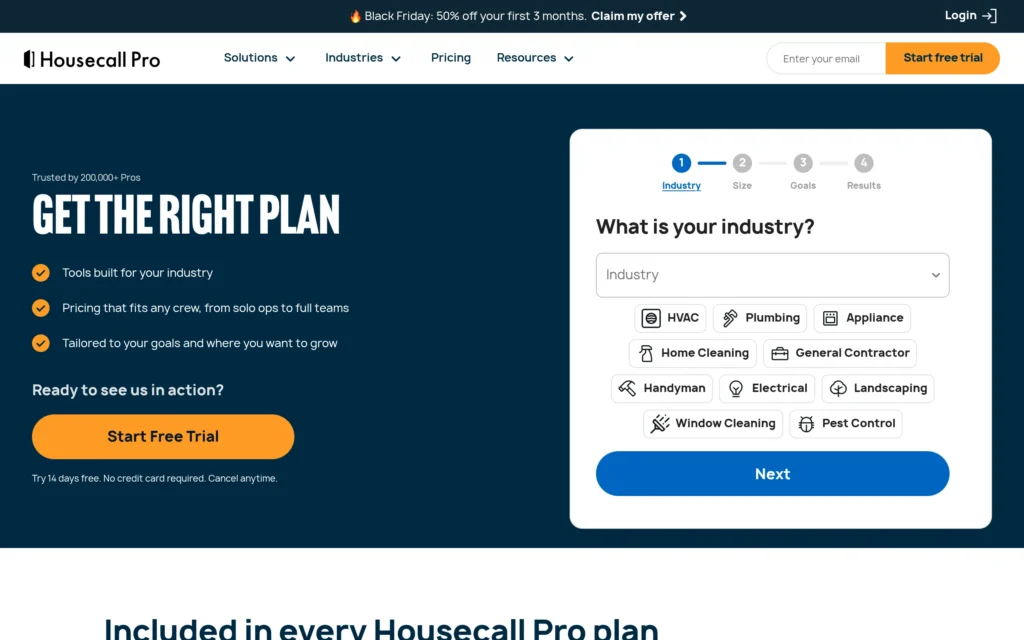
There are three plans, and a Black Friday offer of 50% off your first three months is running today. Basic costs $79 a month, or $59 billed annually, and includes one user. Essentials costs $189 a month, or $149 billed annually, and includes five users. MAX costs $329 a month, or $299 billed annually, and includes eight users, with extra users at $35 a month each. The 50% offer applies to the monthly price — MAX at $164.50 a month instead of $329 — saving $493.50 over the first quarter.
Basic covers online booking, scheduling and dispatch, estimates and invoicing, payments, a price book, and job costing. Essentials adds routes, flat-rate pricing, checklist automations, photo reports, GPS tracking, commissions, and QuickBooks sync. MAX adds a sales proposal tool valued at $40 a month, recurring service plans, route optimisation, open API access, and dedicated onboarding.
The AI is a feature the vendor calls AI team members, included on every plan, but the page does not detail what it does on each plan. What is concrete is that MAX holds the two features a pool route lives on: recurring service plans and route optimisation.
The honest catch is the user count on Basic. One user means the owner, not the crew, so Essentials at $149 a month billed annually is the real starting price, not the $59 the page leads with. The other catch is card processing from 2.59%, with a 1% fee on bank payments.
There is a 14-day free trial of MAX, no credit card required.
Who is Housecall Pro actually best for? A pool company that wants one platform for everything: if you sell weekly service plans that renew automatically, MAX earns its price; if you only need scheduling, invoicing, and GPS tracking, Essentials is enough.
Rosie in detail
Rosie is an AI receptionist: a voice agent that answers the phone around the clock, takes messages, books appointments, and sends you a summary of every call. For a pool company, the job is simple — the phone rings while your hands are wet, and Rosie answers it instead of voicemail, then books the service visit onto your calendar. Rosie’s own demo chat shows the exact use case: a customer asking for a quote to clean a pool this weekend.
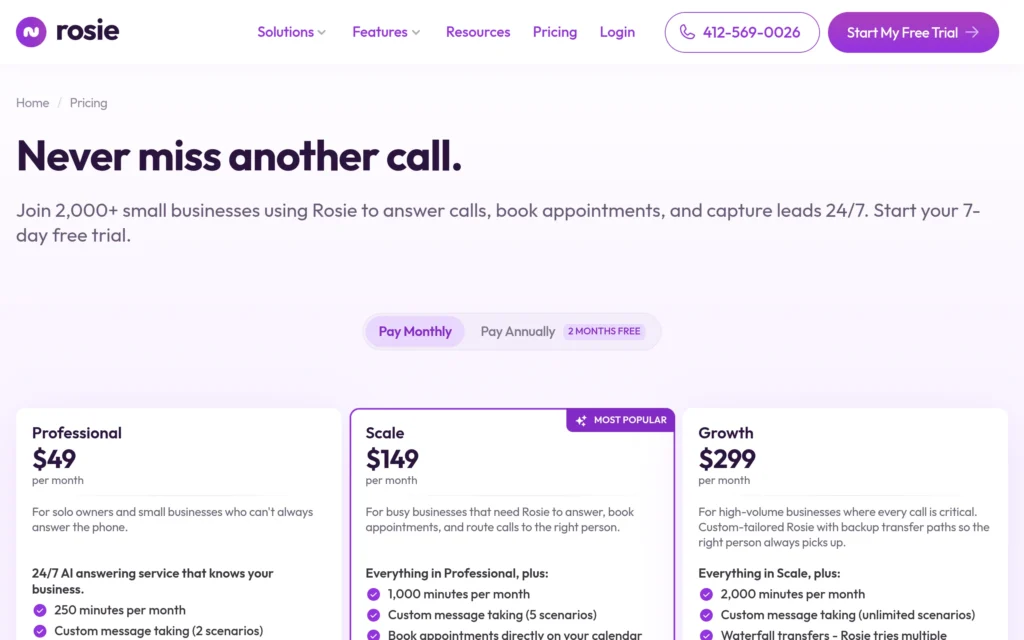
There are three plans, priced by minutes of talk time a month. Professional costs $49 a month for 250 minutes. Scale costs $149 a month for 1,000 minutes and is marked most popular. Growth costs $299 a month for 2,000 minutes. Pay annually and you get two months free: $490 a year for Professional, $1,490 for Scale, and $2,990 for Growth. There is a 7-day free trial.
Professional takes custom messages with two scenarios, sends appointment links by text, and filters spam. Scale adds calendar booking, warm transfers, live call transfers, and texts to callers during the call. Growth adds unlimited message scenarios, waterfall transfers, custom agent training, white-glove onboarding, and priority support.
Every plan includes the same core: 24/7 availability, several calls at once, training from your Google profile and website, custom FAQs, more than ten agent voices, a custom agent name and greeting, English and Spanish, call summaries, transcripts and recordings, and a Zapier integration. Website chat is free with all plans; website texting is a $50-a-month add-on with 25 conversations included.
The honest catch is the minute bucket. Professional’s 250 minutes a month is roughly 60 to 80 calls at three to four minutes each, and a summer algae week can burn through it in days. The page does not print an overage rate, so this guide cannot tell you what the 251st minute costs — ask before you buy, or buy the headroom on Scale.
Who is Rosie actually best for? A pool company that loses jobs to voicemail and wants the phone answered properly, with service visits booked, not just messages taken: if your call volume is steady through the season, Scale at $149 a month does the job; if the phone barely rings outside summer, Professional at $49 stops the leak.
The maths: what a three-technician company pays in one year
All figures below are list prices, billed annually where an annual price exists, for an owner and three technicians running 150 pools. Promotions are shown separately. Skimmer is priced per pool, PoolOps per technician, Jobber and Housecall Pro per user, and Rosie by minutes.
| Tool | Full tier, 3 techs, 150 pools | Lean tier, 3 techs, 150 pools | Saving |
|---|---|---|---|
| Skimmer | Scaling Up, $300 × 12 = $3,600 | Getting Started, $150 × 12 = $1,800 | $1,800 |
| PoolOps | Team, $89.96 × 12 = $1,079.52 | Team, $89.96 × 12 = $1,079.52 | $0 |
| Jobber | Connect, 5 users, $199 × 12 = $2,388 | Connect, 5 users, $199 × 12 = $2,388 | $0 |
| Housecall Pro | MAX, $299 × 12 = $3,588 | Essentials, $149 × 12 = $1,788 | $1,800 |
| Rosie | Scale, $149 × 10 = $1,490 | Professional, $49 × 10 = $490 | $1,000 |
| Total | $12,145.52 | $7,545.52 | $4,600 |
The headline saving is $4,600 a year: the full stack at $12,145.52 minus the lean stack at $7,545.52. Half of it — $1,800 — is Skimmer Scaling Up, and the other $1,800 is Housecall Pro MAX. PoolOps and Jobber show no saving: Team is already the right PoolOps plan, and Jobber has no cheaper tier that covers five users.
Read the Skimmer line with open eyes. The lean $1,800 is correct arithmetic — 150 pools at the published $1 per location — but Getting Started is positioned for 0 to 49 pools and has no route optimisation and no LSI calculator. A 150-pool route that buys Getting Started saves $1,800 and loses the two features that make Skimmer worth buying. The honest middle stack — Scaling Up, PoolOps Team, Jobber Connect, Housecall Pro Essentials, and Rosie Professional — costs $9,345.52 a year, and that is the number most 150-pool companies should budget.
Paying monthly is the quietest leak in the table. Housecall Pro MAX billed monthly is $3,948 a year — a $360 penalty; Essentials $2,268 — a $480 penalty. Rosie Scale billed monthly is $1,788 a year — a $298 penalty, because annual billing gives two months free. Skimmer and PoolOps publish no annual pricing, so the monthly price is the price. Jobber publishes no standard annual discount on the list price — its billed-annually figures today are the Black Friday offer, which ends on 30 November.
Jobber’s Black Friday offer cuts Connect for five users to $105 a month for twelve months ($1,260 in year one, saving $1,128), and Housecall Pro’s cuts MAX to $164.50 a month for three months ($493.50 instead of $987). Skimmer’s first month of Scaling Up free covers up to 49 locations, with the rest billed in arrears.
The lean stack costs $7,545.52 a year, or about $629 a month. One rescued summer week, one service plan that renews instead of lapsing, or one crew day without a gap covers it several times over. The tools are not the expensive part of a pool route. The unanswered phone is.
Five traps to check before you pay
First, Skimmer’s bill grows with every pool you add. At 150 pools, Scaling Up costs $300 a month, and at 300 pools it costs $600. PoolOps Team costs $89.96 a month at 15 pools and at 150 pools alike. If your route is growing, do the maths at 300 pools before you commit to a per-pool tool.
Second, the 50th pool costs $51 a month. Getting Started covers 49 pools for $49 a month, and the 50th pool forces Scaling Up at $100 a month. If your route sits at 48 or 49 pools, that one new customer doubles your Skimmer bill — budget for it, or move to PoolOps before you cross the line.
Third, Jobber Core and Housecall Pro Basic each cover one user only. The $49 and $59 figures look like starting prices, but they buy a single seat. Three technicians need Jobber Connect for five users at $199 a month and Housecall Pro Essentials at $149 a month billed annually, and the $70 and $105 Jobber figures today are a Black Friday annual offer ending 30 November, not the list price.
Fourth, Rosie sells minutes, not unlimited calls. Professional’s 250 minutes is roughly 60 to 80 calls a month, and a summer algae week can burn a month’s bucket in days. Rosie prints no overage rate, so ask what the next minute costs before you sign up, and buy the headroom on Scale.
Fifth, there are two different products called PoolOps. This guide covers poolops.app — Solo $29.99 a month, Team $59.99 plus $9.99 per technician. The other one, poolops.io, is a separate AI-native tool selling founding spots at $99 a month locked for life, then $197, $297, and $497 a month. Search carefully, and check the domain before you pay. The same caution applies to Jobber’s AI receptionist add-on, which has no published price — ask for the number before you budget for it.
Work out what your stack really costs
A subscription price is never the whole bill: the plan, the extra pools or minutes, the card processing on every invoice, the hours your crew spends learning a new tool, and the jobs that go to voicemail while they learn it. Our free AI Cost Calculator adds those pieces up for your own company — put in your team size and the plans you are comparing, and it shows the true yearly cost of each stack.
Pros and cons
Skimmer. Pros: built for pool service, with chemistry, dosing, and per-pool billing; unlimited technicians and admins on every plan; unserviced locations are not billed; first month of Scaling Up free; 30-day refund guarantee. Cons: the bill grows with every pool; route optimisation and the LSI calculator are Scaling Up-only; no annual pricing; AI Phone is a $99-a-month add-on; the 50-pool jump doubles the bill.
PoolOps. Pros: the cheapest honest route software here; the price never rises with your pool count; route optimisation and LSI guidance on every plan; GPS-verified visits and required photos on Team; offline field logging; 14-day trial. Cons: Solo covers one operator only; no quoting or marketing; two different products share the name PoolOps; a card is required for the trial.
Jobber. Pros: one proven platform for quoting, scheduling, routing, and payments; voice AI drafts quotes from spoken notes; 14-day trial with no card; Black Friday offer cuts the first year sharply. Cons: Core covers one user only; the AI receptionist add-on has no published price; card processing 2.9% plus 30 cents online.
Housecall Pro. Pros: one platform for booking, dispatch, invoicing, and payments; AI team members on every plan; 14-day trial of MAX with no card; 50% off the first three months. Cons: Basic covers one user only; recurring plans and route optimisation are MAX-only; card processing from 2.59% plus a 1% bank fee.
Rosie. Pros: answers and books around the clock with no busy signal; warm transfers and calendar booking on Scale; website chat free with all plans; English and Spanish; 7-day trial. Cons: minutes are capped and no overage rate is printed; Professional’s 250 minutes is small for a summer week; it books visits but does not run routes.
Our verdict
For most three-technician pool companies, buy the lean stack first: $7,545.52 a year. Every tool in it can be upgraded later. If your phone rings while your hands are wet, upgrade Rosie to Scale on day one — the $1,000 jump stops jobs going to voicemail.
Pick Skimmer Scaling Up if you want software built for pool service and your route is big enough to need route optimisation: at $3,600 a year for 150 pools, the chemistry and dosing tools are worth it. Pick PoolOps Team if you want the same route for the lowest honest price: at $1,079.52 a year, the GPS-verified visits and flat per-technician price are the point — and the bill never rises when you add a pool.
Pick Jobber Connect if you want one proven platform and your office already quotes well: at $2,388 a year for five users, the quoting and routing are the point — and the Black Friday offer cuts the first year to $1,260 if you sign up before 30 November. Pick Housecall Pro MAX if you want one platform for everything and you sell weekly service plans: at $3,588 a year, the recurring plans and route optimisation are the point. Pick Rosie Scale if you want the phone answered and service visits booked with the least setup.
Pool work is not like other trades: the estimate happens at the kerb, the crew works with wet hands, and the next heatwave decides your week. The tools that win work from a phone, answer while you are cleaning a filter, and price the job before the customer calls the next company. That is the whole test, and this stack passes it for $7,545.52 a year.
Frequently asked questions
What is the best AI tool for pool service companies in 2026?
There is no single winner among the best AI tools for pool service companies, because the five jobs are different. Skimmer is the best software built for pool routes, PoolOps is the cheapest honest route tool, Jobber is the best generalist for quoting and routing, Housecall Pro is the best all-in-one platform, and Rosie is the best receptionist for booking service visits. A company with an owner and three technicians running 150 pools that buys the lean tier of each pays $7,545.52 a year; the full tiers cost $12,145.52.
How much does Skimmer cost per month?
Getting Started costs $1 per serviced location a month, starting at $49 a month for 0 to 49 pools. Scaling Up costs $2 per location a month, starting at $98 a month for 50 to 1,000 pools. At 150 pools, Scaling Up costs $300 a month, or $3,600 a year. Enterprise above 1,000 pools is priced by quote, and Skimmer publishes no annual pricing. New users get the first month of Scaling Up free, up to 49 locations, plus a 30-day refund guarantee.
How much does PoolOps cost per month?
Solo costs $29.99 a month for one operator with unlimited customers. Team costs $59.99 a month for the owner account, plus $9.99 a month for each active technician — $89.96 a month for an owner plus three technicians. The price never rises with your pool count. Every plan starts with a 14-day trial, and a card is required.
Does Jobber work for pool service companies?
Yes. Jobber covers quoting, scheduling, route optimisation, GPS tracking, invoicing, and payments, and the same quoting and routing that landscapers use fits a pool route. Connect for five users at $199 a month is the real starting price, because Core covers one user only. There is a 14-day free trial, and a Black Friday offer cuts Connect for five users to $105 a month for twelve months before 30 November.
What is the cheapest way for a small pool service company to start with AI tools?
Start free: Jobber’s 14-day trial, Housecall Pro’s 14-day trial of MAX, Rosie’s 7-day trial, PoolOps’ 14-day trial, and Skimmer’s first month of Scaling Up free. For most pool companies, the first paid step is the route software, because the route is the business. PoolOps Solo at $29.99 a month is the cheapest honest start, and Rosie Professional at $49 a month stops the phone going to voicemail.
Price note
Price note — updated 24 November 2026: Prices in this post were checked on 24 November 2026. When you are reading this, the price may be lower or higher — always check the official pricing page before you buy.
Prices checked: Skimmer Getting Started $1 per serviced location a month (starts $49 a month, 0–49 pools), Scaling Up $2 per serviced location a month (starts $98 a month, 50–1,000 pools), Enterprise custom, no annual pricing published, AI Phone $99 a month, first month of Scaling Up free up to 49 locations, 30-day refund guarantee; PoolOps Solo $29.99 a month, Team $59.99 a month plus $9.99 per active technician, 14-day trial, card required.
Jobber Core $49, Connect $139, and Grow $199 a month for one user, Connect for five users $199 a month, Black Friday annual offer ending 30 November, 14-day free trial; Housecall Pro Basic $79 a month ($59 billed annually, one user), Essentials $189 ($149 annual, five users), MAX $329 ($299 annual, eight users, $35 per extra user), 14-day free trial, 50% off three months; Rosie Professional $49, Scale $149, and Growth $299 a month, two months free on annual billing, 7-day free trial; card processing: Jobber 2.9% plus 30 cents online, Housecall Pro from 2.59%, Skimmer 2.9% for customer-initiated payments and 3.4% for Autopay per its billing help page.
Prices change — check the official pricing page before you pay.
Sources: Skimmer pricing (getskimmer.com/pricing), PoolOps pricing (poolops.app/pricing), Jobber pricing (getjobber.com/pricing), Housecall Pro pricing (housecallpro.com/pricing), Rosie pricing (heyrosie.com/pricing).
Pros
- Skimmer — built for pool service, with chemistry, dosing, and per-pool billing.
- PoolOps — the cheapest honest route software here; the price never rises with your pool count.
- Jobber — one proven platform for quoting, scheduling, routing, and payments.
- Housecall Pro — one platform for booking, dispatch, invoicing, and payments.
- Rosie — answers and books around the clock with no busy signal.
Cons
- Skimmer — the bill grows with every pool; route optimisation and the LSI calculator are Scaling Up-only.
- PoolOps — Solo covers one operator only; no quoting or marketing.
- Jobber — Core covers one user only; the AI receptionist add-on has no published price.
- Housecall Pro — Basic covers one user only; recurring plans and route optimisation are MAX-only.
- Rosie — minutes are capped and no overage rate is printed.
For most three-technician pool companies, buy the lean stack first: $7,545.52 a year. Every tool in it can be upgraded later. If your phone rings while your hands are wet, upgrade Rosie to Scale on day one — the $1,000 jump stops jobs going to voicemail.Pick Skimmer Scaling Up if you want software built for pool service and your route is big enough to need route optimisation: at $3,600 a year for 150 pools, the chemistry and dosing tools are worth it. Pick PoolOps Team if you want the same route for the lowest honest price: at $1,079.52 a year, the GPS-verified visits and flat per-technician price are the point — and the bill never rises when you add a pool.Pick Jobber Connect if you want one proven platform and your office already quotes well: at $2,388 a year for five users, the quoting and routing are the point — and the Black Friday offer cuts the first year to $1,260 if you sign up before 30 November. Pick Housecall Pro MAX if you want one platform for everything and you sell weekly service plans: at $3,588 a year, the recurring plans and route optimisation are the point. Pick Rosie Scale if you want the phone answered and service visits booked with the least setup.Pool work is not like other trades: the estimate happens at the kerb, the crew works with wet hands, and the next heatwave decides your week. The tools that win work from a phone, answer while you are cleaning a filter, and price the job before the customer calls the next company. That is the whole test, and this stack passes it for $7,545.52 a year.