
For a three-technician pest-control company paying annually, the cheapest stack that still does every job is $4,990 a year: GorillaDesk Basic for three routes ($1,788), Housecall Pro Essentials ($1,788), Kickserv Start ($576), Rosie Professional ($490), and Dialzara Lite ($348).Buy the full tiers instead and the same company pays $9,796.40 a year, a difference of $4,806.40. The single biggest jump is Housecall Pro MAX at $3,588 a year against Essentials at $1,788.GorillaDesk Pro at $99 a month for the first route ($2,388 a year for three routes) is the only tool here built for pest control first, with chemical-use records, trap barcode tracking, and a seasonal freeze. Housecall Pro MAX at $299 a month billed annually ($3,588 a year) is the all-in-one alternative, with routes, flat-rate pricing, GPS tracking, and an AI helper. Kickserv Run at $119 a month ($95.20 a month billed annually, $1,142.40 a year) is the cheapest route software that still dispatches properly, with GPS check-ins and dispatch mapping.Rosie Scale at $149 a month ($1,490 a year) answers the phone around the clock, books appointments onto your calendar, and hands warm transfers to your team. Dialzara Pro at $99 a month ($1,188 a year) does the same job for less money per minute, with warm transfers and calendar sync, plus outbound calling.
The phone rings while you are under a house in a crawl space, gloves on, mask on, and the customer wants to book a quarterly treatment. By the time you climb out and call back, they have rung the next company on Google. That missed call is not a small leak. For a route business, it is the whole business.
That is the week these five tools are built for. One runs the routes, reminders, and billing for a pest-control crew. One does the same with a bigger app store and an AI helper. One is the cheapest honest way to schedule and dispatch. And two answer the phone when no human can.
This guide compares the best AI tools for pest control companies on prices read from the vendors’ own pricing pages on 24 November 2026, for a three-technician company where each technician runs their own route, paying annually. The full stack costs $9,796.40 a year; the lean stack costs $4,990 and still does every job — a difference of $4,806.40 a year.
Quick Answer
For a three-technician pest-control company paying annually, the cheapest stack that still does every job is $4,990 a year: GorillaDesk Basic for three routes ($1,788), Housecall Pro Essentials ($1,788), Kickserv Start ($576), Rosie Professional ($490), and Dialzara Lite ($348).
Buy the full tiers instead and the same company pays $9,796.40 a year, a difference of $4,806.40. The single biggest jump is Housecall Pro MAX at $3,588 a year against Essentials at $1,788.
GorillaDesk Pro at $99 a month for the first route ($2,388 a year for three routes) is the only tool here built for pest control first, with chemical-use records, trap barcode tracking, and a seasonal freeze. Housecall Pro MAX at $299 a month billed annually ($3,588 a year) is the all-in-one alternative, with routes, flat-rate pricing, GPS tracking, and an AI helper. Kickserv Run at $119 a month ($95.20 a month billed annually, $1,142.40 a year) is the cheapest route software that still dispatches properly, with GPS check-ins and dispatch mapping.
Rosie Scale at $149 a month ($1,490 a year) answers the phone around the clock, books appointments onto your calendar, and hands warm transfers to your team. Dialzara Pro at $99 a month ($1,188 a year) does the same job for less money per minute, with warm transfers and calendar sync, plus outbound calling.
In this article
- Best AI tools for pest control companies at a glance
- How we compared them (and what we did not test)
- GorillaDesk in detail
- Housecall Pro in detail
- Kickserv in detail
- Rosie in detail
- Dialzara in detail
- The maths: what a three-technician company pays in one year
- Five traps to check before you pay
- Work out what your stack really costs
- Pros and cons
- Our verdict
- Frequently asked questions
Best AI tools for pest control companies at a glance
| Tool | What it does | Free plan | Plan that does the job | Three techs, one year |
|---|---|---|---|---|
| GorillaDesk | Route software built for pest control | 14-day trial, no free plan | Pro, $99 a month for the first route | $2,388 (3 routes) |
| Housecall Pro | All-in-one field service + AI helper | 14-day trial, no free plan | MAX, $299 a month billed annually | $3,588 |
| Kickserv | Scheduling, dispatch, and reminders | No trial stated | Run, $95.20 a month billed annually | $1,142.40 |
| Rosie | AI receptionist that books appointments | 7-day trial, no free plan | Scale, $149 a month ($1,490 a year) | $1,490 |
| Dialzara | AI receptionist + outbound calling | 7-day trial, no free plan | Pro, $99 a month | $1,188 |
GorillaDesk’s $2,388 buys three routes, not three users — unlimited users are included on every plan. Housecall Pro MAX covers eight users and Kickserv Run ten, so three technicians fit with room to spare. Rosie and Dialzara charge by minutes of talk time, not by seats, so the price does not change when you hire a fourth technician.
How we compared them (and what we did not test)
Every price in this guide was read on the vendor’s own pricing page on 24 November 2026, and every figure below is the list price, not a first-year discount. One vendor is running a Black Friday offer today, printed next to the list price.
The comparison company is three technicians in one small pest-control business, each running their own route, so the company needs three routes. They need recurring-route scheduling, renewal and reminder follow-up, and a phone answered at 7am and 7pm. The price printed is the plan that does the job, not the cheapest plan on the page.
We did not test the tools hands-on, and we did not count features that only exist on a sales call. If a price was not on the vendor’s own pricing page, this guide says so instead of guessing. Two of the five tools are honest automation rather than pure AI — GorillaDesk and Kickserv sell route software with automated reminders and dispatch, not an AI receptionist.
GorillaDesk in detail
GorillaDesk is the only tool in this guide built for pest control first. It is route software: scheduling and dispatch, invoicing and estimates, online payments, recurring billing, and a customer portal, plus pest-specific extras other tools skip.
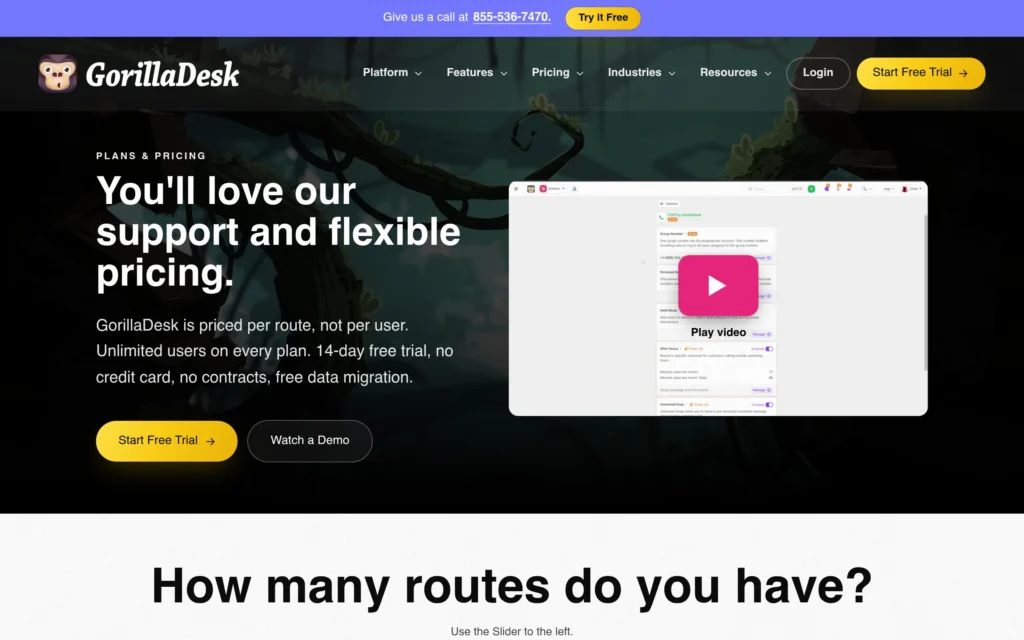
The price is per route, not per user, and unlimited admin, manager, sales, and crew users are included on every plan. Basic costs $49 a month for the first route, Pro costs $99 a month, and Growth costs $149 a month. A route is one technician’s schedule: solo technicians each need their own route, while a crew that rides together shares one. That distinction decides the bill for a three-technician company.
Extra routes cost more. On Basic, routes two and three add $50 a month each, and route four onwards adds $30. On Pro, every added route is $50 a month. On Growth, the second route adds $100, routes three and four add $50 each, and five routes cost $499 a month. For our three-technician company, that means Basic costs $149 a month and Pro $199.
Basic covers scheduling, invoicing, estimates, work orders, route optimisation for up to 25 stops, chemical-use records, automated reminders, and 20 reports. Pro adds the customer portal with 24/7 self-service, online booking, subscription billing, Drive Matrix routing, review requests, digital signing, trap barcode tracking, QuickBooks Online sync, GPS location history, and time tracking. Growth adds property measurements, a sales pipeline, custom job statuses, and multi-branch management.
The honest catch is that GorillaDesk’s AI is thin. The page sells automation — triggers, reminders, routing — not an AI receptionist. If the phone rings while the crew is spraying, GorillaDesk does not answer it, which is why this guide pairs it with Rosie or Dialzara. The other catch is texting: SMS costs $5 a month, and message credits are sold separately at $50 for 1,000, $100 for 2,500, and $200 for 8,000.
There is a 14-day free trial with no credit card required and no contracts. You can freeze the account in the slow season instead of cancelling. The trial includes the full Growth stack.
Who is GorillaDesk actually best for? A pest-control company that wants software built for its own trade — chemical records, trap barcodes, seasonal freeze — and does not want to pay per user. If your technicians ride solo, budget per route; if they ride together, one route covers the crew.
Housecall Pro in detail
Housecall Pro is the big generalist here: the all-in-one field-service platform for home-service businesses. Pest Control is one of the industries in its own pricing quiz.
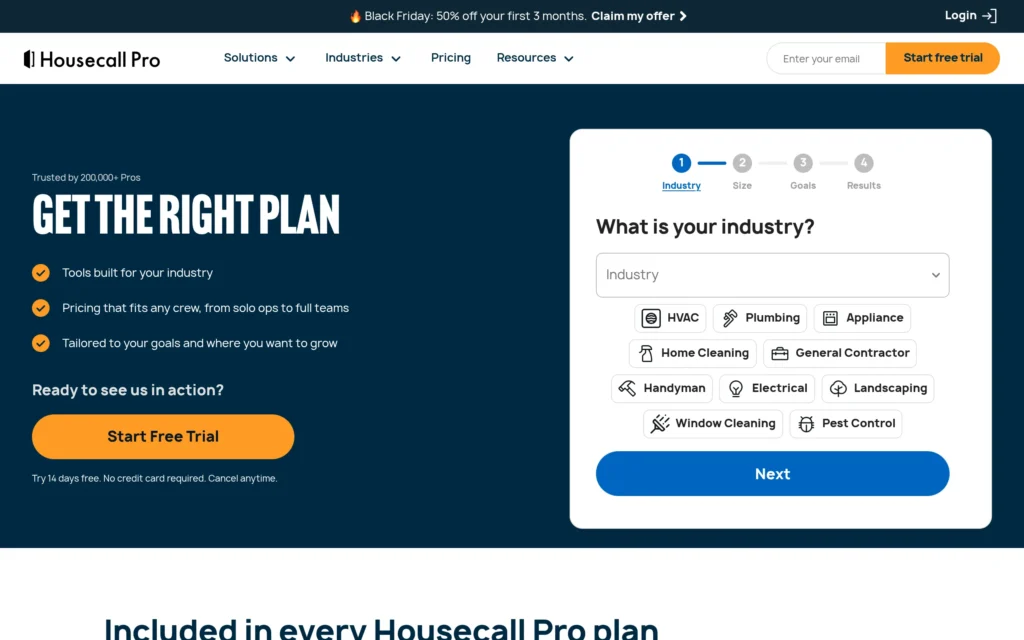
There are three plans, and a Black Friday offer of 50% off your first three months is running today. Basic costs $79 a month, or $59 a month billed annually, and includes one user. Essentials costs $189 a month, or $149 a month billed annually, and includes five users. MAX costs $329 a month, or $299 a month billed annually, and includes eight users. The 50% offer applies to the monthly price — MAX at $164.50 a month instead of $329 — saving $493.50 over the first quarter.
Basic covers online booking, scheduling and dispatch, estimates and invoicing, payments, a price book, job costing, and reviews. Essentials adds routes, flat-rate pricing, checklist automations, photo reports, GPS tracking, commissions, and QuickBooks sync. MAX adds a sales proposal tool the vendor values at $40 a month, recurring service plans, route optimisation, open API access, and dedicated onboarding.
The AI sits in a feature the vendor calls AI team members, included on every plan. The page does not publish a detailed list of what the AI does on each plan. What is concrete is that MAX holds the two features a pest-control route lives on: recurring service plans and route optimisation. Essentials has routes but neither of those.
The honest catch is the user count on Basic. One user means the owner, not the crew, so Essentials at $149 a month billed annually is the real starting price for our company, not the $59 a month the page leads with. The other catch is card processing, which starts at 2.59%, with a 1% fee on bank payments — money that leaves on every invoice.
There is a 14-day free trial of the MAX plan with no credit card required.
Who is Housecall Pro actually best for? A pest-control company that wants one platform for everything and is willing to pay for it. If you take card payments in the field and want the AI helper, MAX earns its price; if you only need scheduling and invoicing, Essentials is enough.
Kickserv in detail
Kickserv is the cheapest honest route software in this guide, and the plainest. It does scheduling, dispatch, invoicing, reminders, and reporting, with no AI receptionist and no grand claims. It is the tool you buy when you want the routes to run and the customers reminded, without paying for features you will never open.
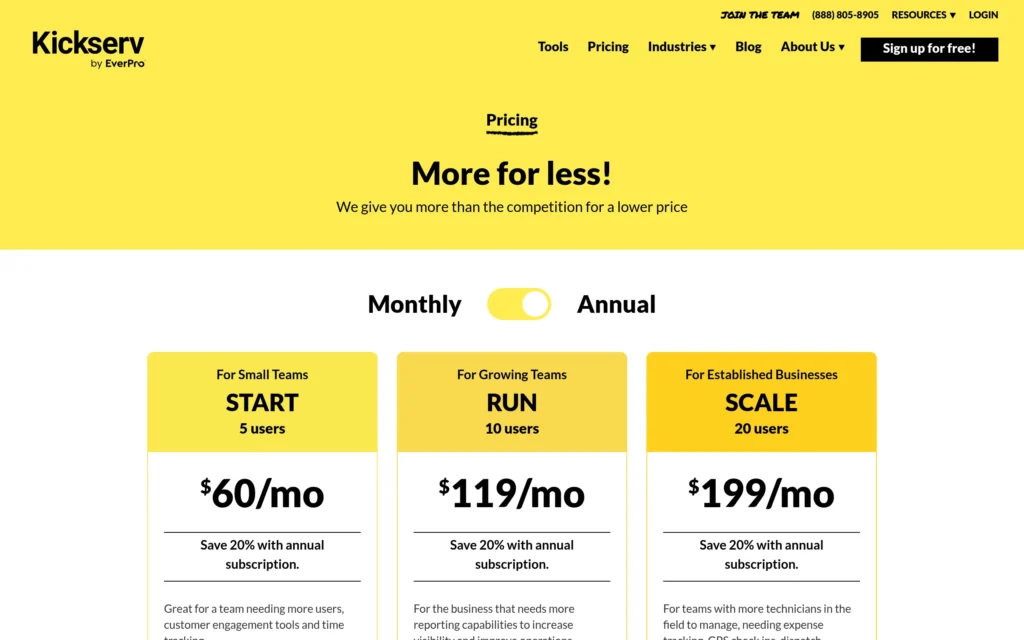
There are three plans, priced by users rather than routes. Start costs $60 a month for five users, Run $119 a month for ten, and Scale $199 a month for twenty. Annual billing saves 20% on every plan: Start drops to $48 a month ($576 a year), Run to $95.20 ($1,142.40 a year), and Scale to $159.20. A fourth plan, Premium, is named in the Kickback section but has no price printed, so this guide does not quote one.
Start covers an embeddable contact form, automated email and text reminders, more than 20 reports, time tracking, expense tracking, and QuickBooks Online integration. Run adds dispatch mapping, GPS check-ins, custom data fields, and custom reports. Scale adds custom templates. QuickBooks Desktop integration costs $50 a month extra on Run.
Kickserv also runs a discount called Kickback: process a minimum amount in online payments each month and you get 5% off your subscription. The minimums are $1,000 a month on Start, $2,000 on Run, and $3,000 on Scale. It is a real saving if you already take most payments online.
The honest catch is the missing trial: the pricing page prints no free trial and no free plan, while every other tool here offers at least seven days. Start monthly first, prove the reminders and dispatch work on your real routes, and only then take the 20% annual discount. The other catch is that Kickserv’s automation is reminders and dispatch, not AI: it will not answer the phone or talk to a customer.
Who is Kickserv actually best for? A small pest-control company that wants the cheapest working dispatch board and does its own phone answering. If your office already answers the phone, Run at $95.20 a month billed annually is hard to beat; if you miss calls, pair it with Rosie or Dialzara.
Rosie in detail
Rosie is an AI receptionist: a voice agent that answers the phone around the clock, takes messages, books appointments, and sends you a summary of every call. For a pest-control company, the job is simple — the phone rings while the crew is on a route, and Rosie answers it instead of voicemail.
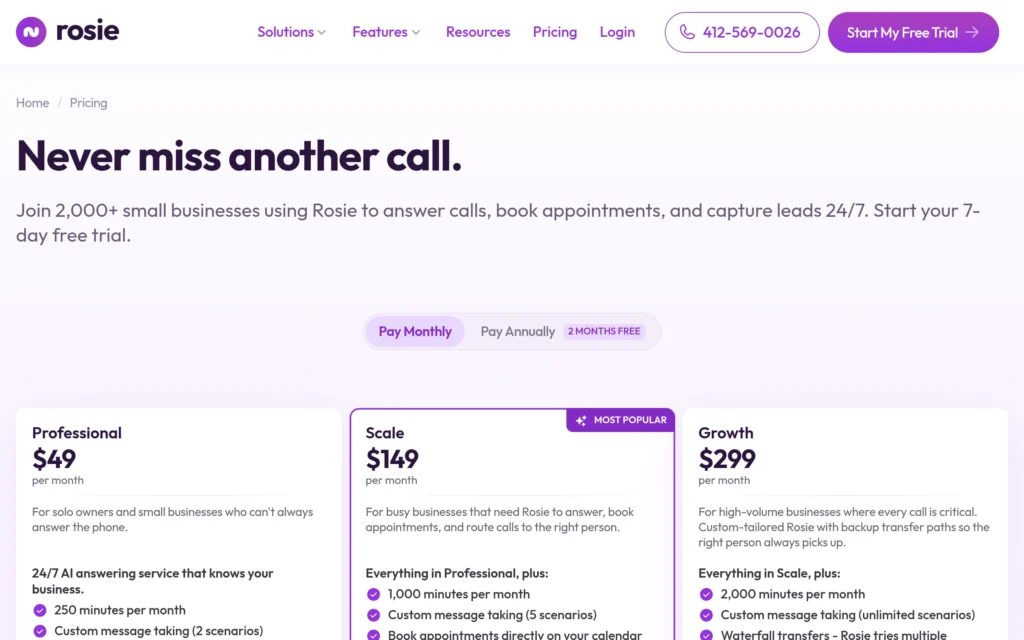
There are three plans, priced by minutes of talk time a month. Professional costs $49 a month for 250 minutes. Scale costs $149 a month for 1,000 minutes and is marked most popular. Growth costs $299 a month for 2,000 minutes. Pay annually and you get two months free: $490 a year for Professional, $1,490 for Scale, and $2,990 for Growth. There is a 7-day free trial.
Professional takes custom messages with two scenarios, sends appointment links by text, and filters spam. Scale adds booking appointments directly on your calendar, warm transfers that brief your team before connecting, live call transfers, and texts to callers during the call. Growth adds unlimited message scenarios, waterfall transfers that try several numbers until someone answers, custom agent training, white-glove onboarding, and priority support.
Every plan includes the same core: 24/7 availability, several calls at once with no busy signal, training from your Google profile and website, custom FAQs, more than ten agent voices, a custom agent name and greeting, English and Spanish, call summaries, transcripts and recordings, and a Zapier integration. Website texting is an add-on at $50 a month, with 25 conversations included.
The honest catch is the minute bucket. Professional’s 250 minutes a month is roughly 60 to 80 calls at three to four minutes each, and a busy spring week can burn through it. The pricing page does not print an overage rate, so this guide cannot tell you what the 251st minute costs — ask before you buy, or buy the headroom on Scale. The other catch is that Rosie books appointments but does not run your routes.
Who is Rosie actually best for? A pest-control company that loses jobs to voicemail and wants the phone answered properly, with appointments booked, not just messages taken. If your call volume is steady, Scale at $149 a month does the job; if the phone barely rings, Professional at $49 stops the leak.
Dialzara in detail
Dialzara is the other AI receptionist in this guide, and the more flexible one. It answers calls, takes messages, transfers to your team, books appointments, and then goes further: it can also call out, text customers, and chat with website visitors. The pricing page carries a 7-day free trial.
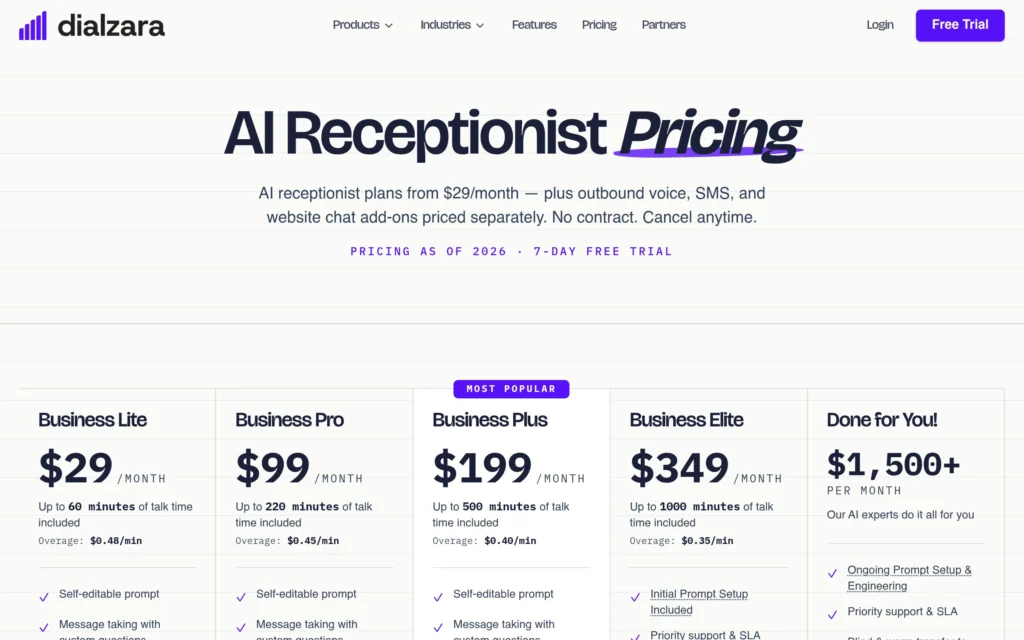
There are four inbound plans, priced by minutes of talk time a month. Business Lite costs $29 a month for 60 minutes, with overage at $0.48 a minute. Business Pro costs $99 a month for 220 minutes, with overage at $0.45. Business Plus costs $199 a month for 500 minutes, with overage at $0.40, and is marked most popular. Business Elite costs $349 a month for 1,000 minutes, with overage at $0.35. The page prints no annual discount, so this guide uses the monthly price times twelve.
Lite takes messages with custom questions and does blind transfers, passing the caller to your team without an introduction. Pro adds warm transfers, where the AI briefs your team before connecting, plus after-hours rules and calendar sync. Plus adds multi-agent and multi-location setup. Elite adds the initial prompt setup done for you, priority support with a service-level agreement, and API access. Every plan includes a US phone number, call recordings and summaries, email and SMS notifications, more than 50 voices, and ten languages.
Dialzara’s extra products are priced separately, and they are the reason to read the whole page. Outbound voice agents for follow-ups, reminders, and reactivation start at $750 a month for 1,500 contacts, Growth at $1,000 for 2,000, and Scale at $1,500 for 3,000. The AI SMS agent costs $19 a month plus $0.05 per AI message, with carrier fees passed through. The website chatbot costs $39 a month on its own, or comes free with any voice plan with 100 sessions a month included.
The honest catch is the minute bucket, again. Lite’s 60 minutes is roughly 15 to 20 calls a month, so a company that gets two calls a day outgrows it in the first week — Pro at $99 is the realistic starting point, not Lite. The other catch is the phone number: a local number costs $3 a month and a toll-free number $5 a month, on top of the plan.
Who is Dialzara actually best for? A pest-control company that wants the cheapest per-minute AI receptionist with warm transfers, and might later want outbound reminder calls for renewals. If you only need the phone answered, Pro at $99 a month is the buy; if you want the AI to chase renewals too, price the outbound plans first.
The maths: what a three-technician company pays in one year
All figures below are list prices, billed annually, for a three-technician company where each technician runs their own route. Promotions are shown separately. GorillaDesk is priced per route, Housecall Pro and Kickserv per user, Rosie and Dialzara by talk-time minutes.
| Tool | Full tier, 3 techs | Lean tier, 3 techs | Saving |
|---|---|---|---|
| GorillaDesk | Pro, 3 routes, $199 × 12 = $2,388 | Basic, 3 routes, $149 × 12 = $1,788 | $600 |
| Housecall Pro | MAX, $299 × 12 = $3,588 | Essentials, $149 × 12 = $1,788 | $1,800 |
| Kickserv | Run, $95.20 × 12 = $1,142.40 | Start, $48 × 12 = $576 | $566.40 |
| Rosie | Scale, $149 × 10 = $1,490 | Professional, $49 × 10 = $490 | $1,000 |
| Dialzara | Pro, $99 × 12 = $1,188 | Lite, $29 × 12 = $348 | $840 |
| Total | $9,796.40 | $4,990 | $4,806.40 |
The headline saving is $4,806.40 a year: the full stack at $9,796.40 minus the lean stack at $4,990. More than a third — $1,800 — is Housecall Pro MAX, the only upgrade that adds recurring service plans and route optimisation. Rosie’s $1,000 is the next biggest jump, buying four times the minutes and calendar booking.
Paying monthly is the quietest leak in the table. Housecall Pro MAX billed monthly costs $329 a month, or $3,948 a year — a $360 penalty against the $3,588 annual price. Essentials billed monthly is $189 a month, or $2,268 a year — a $480 penalty.
Kickserv Run billed monthly is $119 a month, or $1,428 a year — a $285.60 penalty. Rosie Scale billed monthly is $149 a month, or $1,788 a year — a $298 penalty, because annual billing gives two months free. GorillaDesk publishes no annual discount, so there is no penalty for paying monthly. Dialzara says annual pricing is available but prints no discount, so this guide cannot price the saving.
Housecall Pro’s Black Friday offer narrows the MAX gap for one quarter only: at the promotional $164.50 a month, three months cost $493.50 instead of $987, and the price returns to the list price after that.
The lean stack costs $4,990 a year, or about $416 a month. One rescued job a week, one quarterly contract that renews instead of lapsing, or one route day without a gap covers it several times over. The tools are not the expensive part of running a pest-control company. The unanswered phone is.
Five traps to check before you pay
First, GorillaDesk charges per route, not per user. Three solo technicians need three routes, and on Pro that is $199 a month, not $99. A fourth technician is another $50 a month, or $600 a year. If your crew rides together, one route covers them — but do not budget one route and discover the gap on the first busy week.
Second, Housecall Pro Basic covers one user only. The $59 a month annual price looks like the starting point, but it buys a single seat. Three technicians need Essentials at $149 a month billed annually, and the features that make a pest-control route work — recurring service plans and route optimisation — are on MAX at $299 a month.
Third, Rosie and Dialzara sell minutes, not unlimited calls. Rosie Professional’s 250 minutes is roughly 60 to 80 calls a month, and Dialzara Lite’s 60 minutes is roughly 15 to 20. A spring swarm week can burn a month’s bucket in days. Rosie prints no overage rate, so ask what the next minute costs before you sign up, and buy the headroom on Scale or Pro instead of paying overage blind.
Fourth, Kickserv has no trial printed on its pricing page. Do not take the 20% annual discount on day one: pay monthly for a month, run your real routes through it, and only then prepay the year. The same caution applies to Kickback — 5% off is real, but only if you already take most payments online.
Fifth, Dialzara’s headline price is not the whole bill. A local number costs $3 a month and a toll-free number $5 a month, the chatbot is free with a voice plan but $39 a month on its own, and outbound calling starts at $750 a month for 1,500 contacts as a separate plan. Add the number and the channel you need before you compare Dialzara’s $99 with Rosie’s $149.
Work out what your stack really costs
A subscription price is never the whole bill. There is the plan itself, the extra routes or minutes on top of it, the card processing on every invoice, the hours your crew spends learning a new tool, and the jobs that go to voicemail while they learn it. Our free AI Cost Calculator adds those pieces up for your own company — put in your team size and the plans you are comparing, and it shows the true yearly cost of each stack.
Pros and cons
GorillaDesk. Pros: built for pest control, with chemical records and trap barcodes; priced per route with unlimited users; seasonal freeze for slow months; 14-day trial with no card. Cons: per-route pricing punishes solo-technician crews; no AI receptionist; SMS costs extra; the sales pipeline is on Growth only.
Housecall Pro. Pros: one platform for booking, dispatch, invoicing, and payments; Pest Control is a listed industry; AI team members on every plan; 14-day trial of MAX with no card. Cons: Basic covers one user only, so the real starting price is Essentials; recurring plans and route optimisation are MAX-only; card processing starts at 2.59% plus a 1% bank fee.
Kickserv. Pros: the cheapest working dispatch board here; priced by users, not routes; 20% off annual billing; automated reminders and GPS check-ins; Kickback 5% off for online payments. Cons: no trial printed on the pricing page; no AI receptionist; QuickBooks Desktop sync costs $50 a month extra; Premium has no published price.
Rosie. Pros: answers and books around the clock with no busy signal; warm transfers and calendar booking on Scale; website chat free with all plans; English and Spanish; 7-day trial. Cons: minutes are capped and the page prints no overage rate; Professional’s 250 minutes is small for a busy season; it books appointments but does not run routes.
Dialzara. Pros: the cheapest per-minute AI receptionist here, with overage rates printed; warm transfers and calendar sync on Pro; outbound calling, SMS, and chatbot in one account; ten languages. Cons: Lite’s 60 minutes is too small for a real company; the phone number costs extra; no annual discount is published; outbound calling starts at $750 a month.
Our verdict
For most three-technician pest-control companies, buy the lean stack first: $4,990 a year. Every tool in it can be upgraded later. The one upgrade to make on day one, if your phone rings while the crew is on the road, is Rosie Scale or Dialzara Pro — the $1,000 or $840 jump stops jobs going to voicemail.
Pick GorillaDesk Pro if you want software built for pest control and your technicians ride solo: at $2,388 a year for three routes, the chemical records and trap barcodes are worth it. Pick Housecall Pro MAX if you want one platform for everything and you run quarterly service plans: at $3,588 a year, the recurring plans and route optimisation are the point.
Pick Kickserv Run if your office already answers the phone and you just need dispatch that works: at $1,142.40 a year billed annually, it is the cheapest route board that dispatches properly. Pick Rosie Scale if you want the phone answered and appointments booked with the least setup, and Dialzara Pro if you want the cheapest per-minute receptionist and might add outbound renewal calls.
Frequently asked questions
What is the best AI tool for pest control companies in 2026?
There is no single winner among the best AI tools for pest control companies, because the five jobs are different. GorillaDesk is the best route software built for pest control, Housecall Pro is the best all-in-one platform, Kickserv is the cheapest honest dispatch board, Rosie is the best receptionist for booking appointments, and Dialzara is the cheapest per-minute AI receptionist with outbound calling. A three-technician company that buys the lean tier of each pays $4,990 a year; the full tiers cost $9,796.40.
How much does GorillaDesk cost per month?
GorillaDesk Basic costs $49 a month for the first route, Pro $99 a month, and Growth $149 a month, all priced per route with unlimited users included. Extra routes cost more: on Pro, every added route is $50 a month, so three solo technicians on Pro cost $199 a month, or $2,388 a year. On Basic, three routes cost $149 a month, or $1,788 a year. There is a 14-day free trial with no credit card required.
Can Rosie or Dialzara replace a human receptionist?
For after-hours and overflow calls, yes. Rosie answers 24/7, books appointments onto your calendar, and hands warm transfers to your team; Dialzara does the same and adds outbound calls, SMS, and a chatbot. Neither replaces a human for an angry customer, a complicated commercial quote, or a call that needs judgement — they stop the job going to voicemail.
Does Housecall Pro work for pest control?
Yes. Pest Control is one of the industries in Housecall Pro’s own pricing quiz, and it covers the whole job: online booking, scheduling and dispatch, estimates, invoicing, payments, and review management. Essentials at $149 a month billed annually covers five users and adds routes and GPS tracking; MAX at $299 a month billed annually adds recurring service plans and route optimisation.
What is the cheapest way for a small pest-control company to start with AI tools?
Start free: GorillaDesk’s 14-day trial on the full Growth stack, Housecall Pro’s 14-day trial of MAX, Rosie’s 7-day trial, and Dialzara’s 7-day trial. Kickserv prints no trial on its pricing page, so start it monthly and prove the dispatch works before taking the 20% discount. The first paid step should be the tool your company reaches for twice a week — for most pest-control companies, that is the AI receptionist.
Price note
Price note — updated 24 November 2026: Prices in this post were checked on 24 November 2026. When you are reading this, the price may be lower or higher — always check the official pricing page before you buy.
Prices checked: GorillaDesk Basic $49, Pro $99, and Growth $149 a month for the first route, with extra routes from $30 to $100 a month, a 14-day free trial, no card, and SMS from $5 a month plus credits; Housecall Pro Basic $79 a month ($59 a month billed annually, one user), Essentials $189 ($149 annual, five users), MAX $329 ($299 annual, eight users, $35 a month per extra user), with a 14-day free trial and 50% off three months.
Kickserv Start $60, Run $119, and Scale $199 a month, with 20% off annual billing (Start $48, Run $95.20, Scale $159.20) and a 5% Kickback discount; Rosie Professional $49, Scale $149, and Growth $299 a month, with two months free on annual billing and a 7-day free trial; Dialzara Business Lite $29, Pro $99, Plus $199, and Elite $349 a month, with overage from $0.35 to $0.48 a minute, a 7-day free trial, and outbound calling from $750 a month.
Prices change — check the official pricing page before you pay.
Sources: GorillaDesk pricing (gorilladesk.com/pricing), Housecall Pro pricing (housecallpro.com/pricing), Kickserv pricing (kickserv.com/pricing), Rosie pricing (heyrosie.com/pricing), Dialzara pricing (dialzara.com/pricing).
Pros
- GorillaDesk: built for pest control, with chemical records and trap barcodes; priced per route with unlimited users; seasonal freeze for slow months; 14-day trial with no card.
- Housecall Pro: one platform for booking, dispatch, invoicing, and payments; Pest Control is a listed industry; AI team members on every plan; 14-day trial of MAX with no card.
- Kickserv: the cheapest working dispatch board here; priced by users, not routes; 20% off annual billing; automated reminders and GPS check-ins; Kickback 5% off for online payments.
- Rosie: answers and books around the clock with no busy signal; warm transfers and calendar booking on Scale; website chat free with all plans; English and Spanish; 7-day trial.
- Dialzara: the cheapest per-minute AI receptionist here, with overage rates printed; warm transfers and calendar sync on Pro; outbound calling, SMS, and chatbot in one account; ten languages.
Cons
- GorillaDesk: per-route pricing punishes solo-technician crews; no AI receptionist; SMS costs extra; the sales pipeline is on Growth only.
- Housecall Pro: Basic covers one user only, so the real starting price is Essentials; recurring plans and route optimisation are MAX-only; card processing starts at 2.59% plus a 1% bank fee.
- Kickserv: no trial printed on the pricing page; no AI receptionist; QuickBooks Desktop sync costs $50 a month extra; Premium has no published price.
- Rosie: minutes are capped and the page prints no overage rate; Professional's 250 minutes is small for a busy season; it books appointments but does not run routes.
- Dialzara: Lite's 60 minutes is too small for a real company; the phone number costs extra; no annual discount is published; outbound calling starts at $750 a month.
For most three-technician pest-control companies, buy the lean stack first: $4,990 a year. Every tool in it can be upgraded later. The one upgrade to make on day one, if your phone rings while the crew is on the road, is Rosie Scale or Dialzara Pro — the $1,000 or $840 jump stops jobs going to voicemail.Pick GorillaDesk Pro if you want software built for pest control and your technicians ride solo: at $2,388 a year for three routes, the chemical records and trap barcodes are worth it. Pick Housecall Pro MAX if you want one platform for everything and you run quarterly service plans: at $3,588 a year, the recurring plans and route optimisation are the point.Pick Kickserv Run if your office already answers the phone and you just need dispatch that works: at $1,142.40 a year billed annually, it is the cheapest route board that dispatches properly. Pick Rosie Scale if you want the phone answered and appointments booked with the least setup, and Dialzara Pro if you want the cheapest per-minute receptionist and might add outbound renewal calls.