

If you want one answer: buy Contractor Foreman Plus at $166 a month billed annually. You get eight users, time cards, daily logs, crew scheduling, and QuickBooks Online sync for less than Jobber Grow costs for five people — and it is the only tool here with a real AI estimator and AI takeoffs at this price.If you run a one-person shop and want the cheapest honest start, Jobber Core at $29 a month billed annually is the buy: quoting, scheduling, invoicing, and an AI assistant that drafts quotes and answers questions from your own job data. If your jobs live or die on the estimate itself — custom homes, big remodels — JobTread at $199 a month plus $20 per extra user is the most serious estimating and job-costing machine here, with the deepest AI list of all five. Skip Fieldwire unless your crew's real problem is drawings and punch lists in the field; its AI is the thinnest here, and at five users its Business plan costs more than JobTread.
A homeowner calls at 7:40 in the morning while your crew is already on the road. You miss it. By lunch, that caller has booked the remodeler who picked up on the second ring. That is the whole problem in one missed call — and it is why general contractors keep buying software that promises to answer the phone, write the estimate, and track the job cost, all before the coffee gets cold.
The trouble is that “AI for contractors” means five different things depending on which pricing page you are reading. One tool sells you an AI receptionist as a $99 add-on. Another bundles an AI estimator into a $49 plan. A third charges you $199 before a single person logs in, then calls that a bargain because every feature is included. And the cheapest-looking option charges per user, per month — wonderful until your fifth hire doubles the bill.
This guide compares the five AI tools small general contractors actually buy — Jobber, Housecall Pro, JobTread, Contractor Foreman, and Fieldwire — by what each one publishes on its own pricing page: the real price for one person and for a five-person crew, what the AI actually does, and the fees hiding in the fine print. Every figure was checked against the vendor’s own page on 22 November 2026.
Quick Answer
If you want one answer: buy Contractor Foreman Plus at $166 a month billed annually. You get eight users, time cards, daily logs, crew scheduling, and QuickBooks Online sync for less than Jobber Grow costs for five people — and it is the only tool here with a real AI estimator and AI takeoffs at this price.
If you run a one-person shop and want the cheapest honest start, Jobber Core at $29 a month billed annually is the buy: quoting, scheduling, invoicing, and an AI assistant that drafts quotes and answers questions from your own job data. If your jobs live or die on the estimate itself — custom homes, big remodels — JobTread at $199 a month plus $20 per extra user is the most serious estimating and job-costing machine here, with the deepest AI list of all five. Skip Fieldwire unless your crew’s real problem is drawings and punch lists in the field; its AI is the thinnest here, and at five users its Business plan costs more than JobTread.
In this article
- Best AI tools for general contractors at a glance
- How we compared them (and what we did not test)
- Jobber in detail
- Housecall Pro in detail
- JobTread in detail
- Contractor Foreman in detail
- Fieldwire in detail
- The maths: what one person pays, what five people pay
- Eight traps to check before you pay
- Work out what your stack really costs
- Pros and cons
- Our verdict
- Frequently asked questions
- Price note
Best AI tools for general contractors at a glance
| Tool | Entry price | What you get for it | Best for |
|---|---|---|---|
| Jobber | $29/mo billed annually (Core, 1 user) | Quoting, scheduling, invoicing, AI Copilot | Solo GC who wants the cheapest real start |
| Housecall Pro | $79/mo list, $39.50/mo for 3 months (Basic, 1 user) | Booking, estimates, invoicing, AI team members | GCs who live on the phone with customers |
| JobTread | $199/mo + $20 per extra user | Full estimating, job costing, AI takeoff, AIA billing | Remodelers and custom-home builders |
| Contractor Foreman | $49/mo billed annually (Basic, 1 user) | Estimates, AI Estimator, scheduling, financials | Best value for a 3–8 person crew |
| Fieldwire | $0 (Basic, 5 users, 3 projects) | Drawings, tasks, punch lists, photos | Field coordination around plans |
The same five-person crew costs $149 a month on Jobber Connect, $149 a month on Housecall Pro Essentials, $223.20 a month on JobTread, $166 a month on Contractor Foreman Plus, and $195 a month on Fieldwire Pro — all billed annually.
How we compared them (and what we did not test)
Three things decide whether a contractor tool is worth your money, and only one of them is the price.
First, the pricing shape. A per-user tool punishes every hire. A user-band tool punishes you at the band edge — the jump from one user to two can cost $50 a month for a single extra login. A flat-fee tool looks expensive at one person and cheap at eight. We priced every tool twice: for one person working alone, and for a five-person crew (owner, project manager, two field leads, bookkeeper), both on annual billing.
Second, the AI. Every tool here advertises AI, and the word means four different things: drafting an estimate, answering the phone, writing a daily log summary, and reading a drawing. Drafting an estimate from project details is the feature that saves a GC real hours. An AI receptionist that books jobs while you are on a roof is the feature that saves real jobs.
Third, the costs that never appear in the headline: card processing fees on every invoice you collect, the AI add-on that costs more than the plan it sits on, the feature that only unlocks two tiers up, and the trial that is not a trial at all. We counted all of them.
What we did not test: we ran no live jobs through these tools, so ease-of-use claims here are the vendors’ own words and what their pricing pages show. Procore and Buildertrend are not here because they publish no prices at all — a GC cannot compare what a vendor will not print.
Jobber in detail
Jobber is the best-known name in this list, and the easiest to start with. It was built for home-service pros — plumbers, cleaners, landscapers — and general contractors are a smaller slice of its world. That shows in the feature list: quoting and scheduling are excellent, construction-specific tools like AIA billing and takeoffs are absent.
What it costs
Four plans, priced by team size. Core costs $29 a month billed annually, or $49 a month with no commitment, for one user. Connect costs $99 a month billed annually for one user, or $149 a month for five users. Grow costs $149 a month billed annually for one user, or $229 a month for five users. Plus starts at $399 a month billed annually for five users. Every extra user beyond your band costs $29 a month.
The price that matters for a small GC is the jump, not the headline. One person pays $29 a month. The moment a second person needs a login, you are on Connect at $99 a month — $70 more for one extra seat. Five people on Grow cost $229 a month, or $2,748 a year.
Card processing is 2.9% plus 30 cents online, 2.7% plus 30 cents with tap-to-pay, and 1% for ACH. Instant payouts cost an extra 1%. The 14-day trial runs on Grow, so the version you evaluate has features you may not buy.
What you actually get
Jobber Copilot is the AI here, and it is genuinely useful in the field. You talk to it — “create a quote for the Henderson kitchen” — and it drafts from your own job data. It also turns your live business data into custom reports when you ask a question in plain words. The quote tool has a “Draft for me” button that auto-drafts quotes from new requests, and Jobber follows up on unanswered quotes by email or text automatically.
The expensive catch is the add-ons. The AI Receptionist — the feature that answers calls 24/7 and books jobs into your calendar — costs $99 a month on top of your plan. The Marketing Suite is another $99 a month. Pipeline, the sales tracker, is $49 a month. A solo GC on Core who adds the receptionist pays $128 a month, not $29.
Job costing and profit-margin flags live on Grow and above: Jobber shows real-time profitability per job from the materials, labour, and expenses you track, and flags any job that falls below the margin you set. Core does not do that, which is a problem for a GC whose whole business is margin.
Best for: a solo GC or a two-person shop that wants quoting, scheduling, and invoicing in one friendly app. Take Core at $29 a month and add nothing until the phone starts costing you jobs.

Housecall Pro in detail
Housecall Pro is Jobber’s closest rival, and the two pricing pages read like they are arguing with each other. It is also built for home-service pros, but it leans harder on the phone: its pitch is that you will never miss a call again, and its AI is sold as a team of helpers rather than one assistant.
What it costs
Three plans. Basic costs $79 a month at list price, with 50% off for three months — $39.50 a month — and includes one user. Essentials costs $189 a month at list, $94.50 a month for the first three months, or $149 a month billed annually, and includes five users. MAX costs $329 a month at list, $164.50 a month for the first three months, or $299 a month billed annually, and includes eight users, with extra users at $35 a month each.
The 50% off lasts three months; after that the list price applies unless you are on annual billing. A solo GC on Basic pays $829.50 in year one, then $948 a year. Five people on Essentials cost $1,624.50 in year one with the promo, then $1,788 a year.
Card processing starts at 2.59%, and bank payments carry a 1% fee.
What you actually get
The AI here is called the AI team, and it does three jobs: a CSR AI that answers calls and books jobs, an Analyst AI that reads your business data, and HCP Assist, which drafts messages and automates follow-ups. The sales proposal tool, valued at $40 a month, is included on MAX only. Route optimisation, recurring service plans, and the open API are also MAX-only features.
What Housecall Pro does better than Jobber is the phone. Two-way texting, appointment reminders, “on my way” texts, and an answering service are core to the product rather than add-ons. The company claims customers grow revenue 35% in the first year and save eight hours a week — its own numbers, not ours.
The weak spot for a GC is the same as Jobber’s: this is home-service software, not construction software. There is no takeoff tool, no AIA billing, no schedule of values, and no submittal tracking. For small remodels and repairs with a lot of customer contact, that does not matter. For multi-trade jobs with subcontractors and progress billing, it matters a lot.
Best for: a GC whose jobs come from the phone — remodels, repairs, small additions — and who wants the answering and booking handled without buying a separate receptionist add-on. Take Essentials at $149 a month billed annually for a five-person crew.

JobTread in detail
JobTread is the odd one out in the best way: it was built for builders and remodelers, not for plumbers who also do remodels. It is the only tool here where estimating, takeoff, job costing, and AIA payment applications are the core product rather than a feature bolted on later. It is also the only one with a genuinely deep AI list.
What it costs
One plan, one price, no tiers. The base fee is $199 a month and includes one internal user. Each additional internal user costs $20 a month on monthly billing, or $16 a month on annual billing, for users two to ten — then $15 a month for users 11 to 20, $10 for 21 to 30, and $5 beyond that. Annual billing takes 20% off the base too, so the base works out to about $159 a month.
Do the maths for five people. Monthly billing: $199 plus four users at $20 is $279 a month, or $3,348 a year. Annual billing: about $159 plus four users at $16 is $223.20 a month, or $2,678.40 a year. A solo builder pays $199 a month, or about $159 on annual billing — the highest solo price in this guide by a wide margin.
There is no free trial: every client gets a customer success manager and in-depth implementation. Instead there is a 30-day money-back guarantee on the monthly plan. Customers, vendors, subcontractors, and field crew who only upload photos and log daily notes are free and unlimited.
What you actually get
The AI list is the longest here, and it is aimed at the estimate — the document a GC lives or dies by. AI Estimating drafts detailed budgets, AI Budget Builder builds a budget from a description, AI Plan Import names, numbers, and scales plan sheets and counts repeated items, and AI Takeoff pulls quantities straight from the plans. AI Daily Log Summaries condense several days of logs into one progress summary, AI Receipt Scanning pulls the numbers off a photo of a receipt, and an AI Report Builder makes a custom report from a plain-language description.
There is also an AI Connector, which is genuinely unusual: it runs through an MCP server, so your own ChatGPT or Claude can create estimates, build schedules, pull selections, and analyse data inside your JobTread account. It needs your own API key from your AI provider, and JobTread’s own page warns that AI can make mistakes and must be reviewed.
The rest of the product is built around the estimate too: a cost catalog with formulas, on-screen takeoff, bid requests that convert to purchase orders, contracts with e-signatures, change orders, and AIA-style payment applications.
The trade-off is the mobile app — there is not a native one. JobTread is a progressive web app: you save the website to your home screen. It works, but field crews notice the difference. And $199 a month before a second person logs in is a commitment, not a trial purchase.
Best for: a remodeler or custom-home builder whose estimate is the business — five to fifteen people, several jobs at once, and a bookkeeper who needs real job costing. Take the annual plan and put every sub and customer on the free portal.

Contractor Foreman in detail
Contractor Foreman is the value pick in this guide, and it is not close. It is also the most construction-specific tool here after JobTread: it was built for small and mid-sized residential and commercial trade and general contractors, and its feature list reads like a GC’s job file — permits, punch lists, schedule of values, subcontracts, retainage, AIA invoicing, takeoffs, safety meetings, incidents.
What it costs
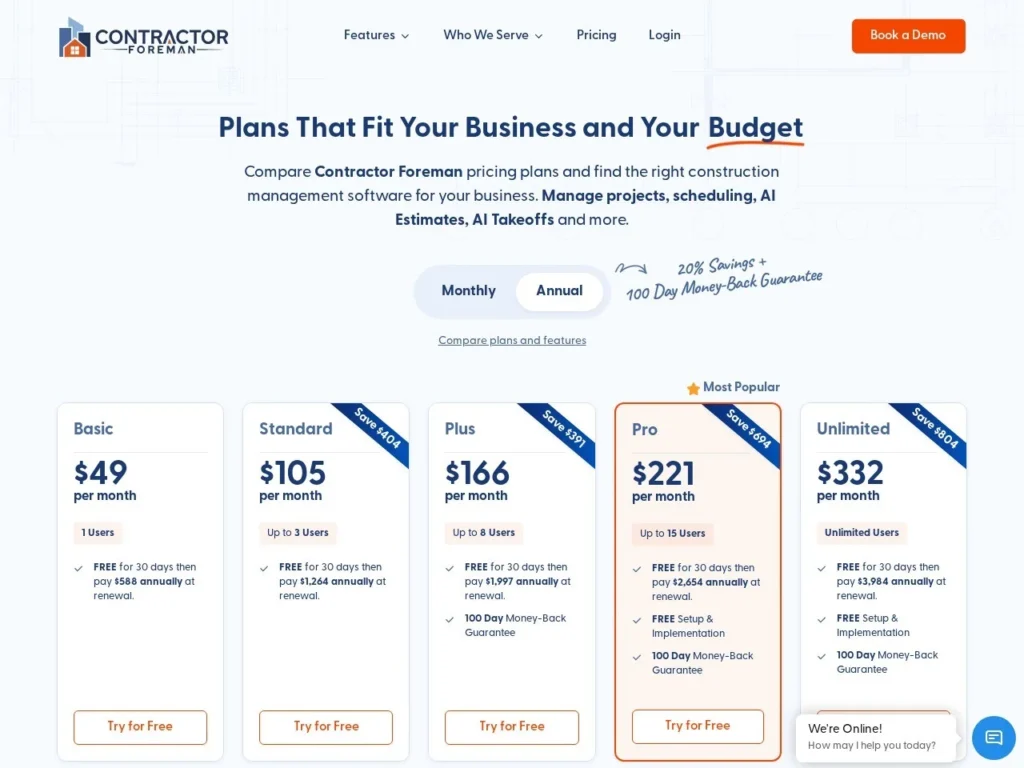
Five plans, priced per company rather than per user, with a user cap on each. Basic costs $49 a month billed annually, for one user, and is not offered month to month. Standard costs $105 a month billed annually, or $139 month to month, for up to three users. Plus costs $166 a month billed annually, or $199 month to month, for up to eight users. Pro costs $221 a month billed annually, or $279 month to month, for up to 15 users. Unlimited costs $332 a month billed annually, or $399 month to month, for unlimited users.
For a five-person crew, Plus at $166 a month billed annually is $1,992 a year — cheaper than Jobber Grow, cheaper than JobTread, cheaper than Fieldwire Pro, and only $204 a year more than Housecall Pro Essentials. A solo GC pays $49 a month, or $588 a year. Every plan includes a 30-day free trial, and annual plans carry a 100-day money-back guarantee — the longest guarantee in this guide.
Read the feature gates before you buy. Time cards, daily logs, crew scheduling, and safety meetings start on Plus. The client portal, AIA G702 and G703 invoicing, takeoffs, and submittals start on Pro. QuickBooks Online sync starts on Plus; QuickBooks Desktop and Zapier need Unlimited. Basic has no bid management, change orders, progress invoicing, subcontracts, or QuickBooks — at $49 a month you get estimates, files, and photos, and not much else.
What you actually get
The AI Estimator is the headline: you enter the project details and it creates a working draft estimate you review, adjust, and send. Takeoffs start on the Pro plan — the honest catch is that the two best AI features are split across two plans, and the takeoff AI costs $221 a month, not $166.
Everything else is construction-native. Progress invoicing in dollars, percent, or quantity, with retainage tracked automatically. AIA-style invoicing that tracks retention with no extra work. Subcontracts with scope, retainage, and billing in one place. Change orders that update contract amounts and budgets automatically. Daily logs that answer the questions that always come later — who was on site, what work happened, what materials showed up. Safety meetings with hundreds of ready-to-use toolbox-talk topics and attendance tracking. Stripe payments cost 2.9% plus 30 cents, and ACH costs 1% plus 30 cents with a cap.
Best for: a three-to-eight-person GC crew that wants real construction management — permits, punch lists, retainage, AIA billing — without paying JobTread or Procore money. Take Plus at $166 a month, and move to Pro at $221 when takeoffs and AIA invoicing start earning their keep.
Fieldwire in detail
Fieldwire is the field tool in this list, and the honest thing to say first is that its AI is the thinnest here. It was bought by Hilti, and it does one job extremely well: it puts the drawings in every worker’s pocket, with tasks, photos, and punch lists pinned to the plan. If your crew’s real problem is “which version of the drawing is current, and who was supposed to fix that outlet,” Fieldwire is the answer. If your problem is winning the job and pricing it right, it is not.
What it costs
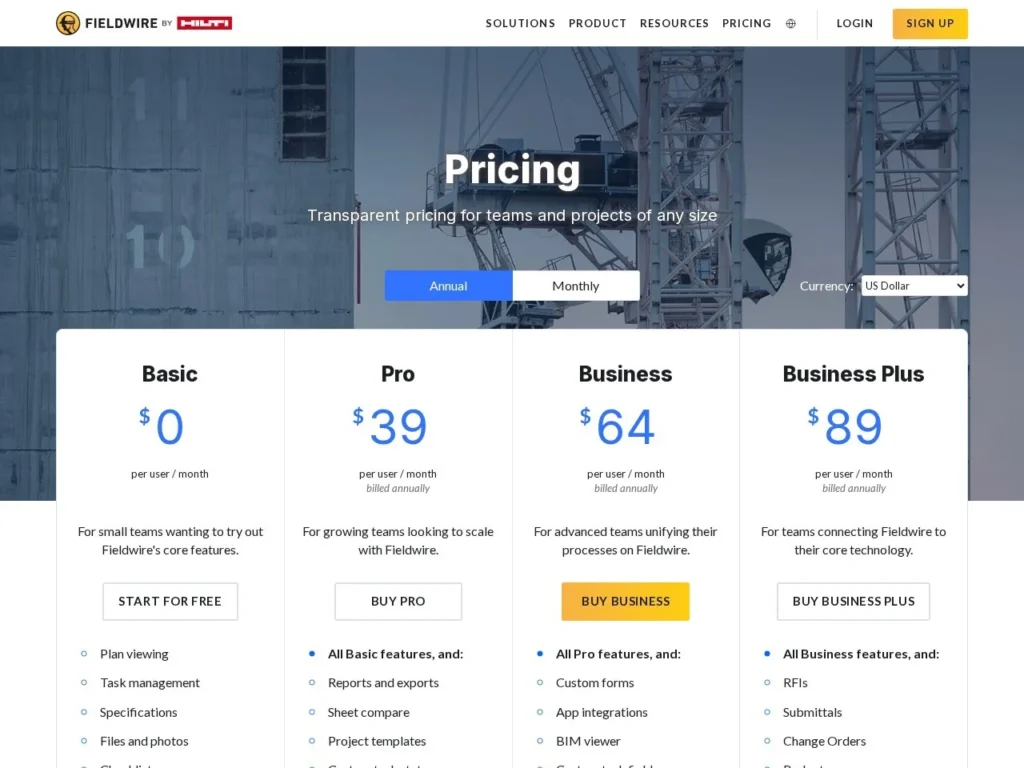
Four plans, priced per user per month. Basic is free — five users, three projects, 100 sheets — with plan viewing, task management, files, photos, and checklists. Pro costs $39 per user per month billed annually, or $54 month to month. Business costs $64 per user per month billed annually, or $79 month to month. Business Plus costs $89 per user per month billed annually, or $104 month to month.
Per-user pricing is where the bill quietly grows. Five people on Pro cost $195 a month billed annually, or $2,340 a year. Five on Business cost $320 a month, or $3,840 a year. Five on Business Plus cost $445 a month, or $5,340 a year — more than any other five-person stack in this guide, and Business Plus is the only plan with RFIs, submittals, change orders, and a budget. Reports and exports start on Pro; custom forms, the BIM viewer, and 360-degree photos start on Business.
There is no free trial, because the free Basic plan is the trial: five users and three projects, forever, with no card.
What you actually get
Plan viewing with sheet compare, so the crew sees what changed between drawing revisions. Tasks pinned to locations on the plan, with photos, checklists, and custom statuses. A submittal extractor on Pro and above. Custom forms and a BIM viewer on Business. RFIs, submittals, change orders, and budgets on Business Plus. Offline work on mobile, which matters when the jobsite has one bar of signal.
What it does not have is the front of the business. No estimating. No quoting. No invoicing. No job costing. No AI receptionist, no AI estimator, no AI report builder. Most GCs who use Fieldwire pair it with something else for the office work, which means paying for two tools. At five users on Pro plus Jobber Core, that is $224 a month before you have invoiced a single job.
Best for: a GC whose office already runs on something else and whose field problem is drawings, tasks, and punch lists — or a small crew that can live inside the free Basic plan. Take Pro at $39 per user per month billed annually, and do not buy Business Plus for the budget feature alone.
The maths: what one person pays, what five people pay
The headline price is never the bill. Here is the same crew priced two ways, all on annual billing, all in US dollars.
One person, working alone
| Tool | Plan | Per month | Per year |
|---|---|---|---|
| Fieldwire | Basic | $0 | $0 |
| Jobber | Core | $29 | $348 |
| Contractor Foreman | Basic | $49 | $588 |
| Housecall Pro | Basic | $79 list ($39.50 for 3 months) | $948 list; $829.50 in year one |
| JobTread | One plan | $199 ($159.20 annual) | $2,388 ($1,910.40 annual) |
Five people — owner, project manager, two field leads, bookkeeper
| Tool | Plan | Per month | Per year |
|---|---|---|---|
| Jobber | Connect, 5 users | $149 | $1,788 |
| Housecall Pro | Essentials, 5 users | $149 | $1,788 ($1,624.50 in year one) |
| Contractor Foreman | Plus, up to 8 users | $166 | $1,992 |
| Fieldwire | Pro, 5 users | $195 | $2,340 |
| JobTread | One plan, 5 users | $223.20 | $2,678.40 |
Read the second table twice, because it is the whole guide in numbers. Jobber and Housecall Pro tie at $1,788 a year for five people — but Jobber Grow, the plan with job costing and two-way texting, costs $2,748 a year for the same five people, and Housecall Pro’s MAX costs $3,588. Contractor Foreman Plus at $1,992 covers eight users, so the sixth, seventh, and eighth hire cost nothing extra. JobTread at $2,678 is the most expensive five-person stack here, and Fieldwire Business Plus at $5,340 is in a different league entirely.
Now the break-even. Say your average job is $20,000 and your gross margin is 20% — that is $4,000 of gross profit per job. One extra job won because the phone was answered, or because the estimate went out the same day instead of three days later, pays for a full year of any stack here except Fieldwire Business Plus. One job lost because the estimate sat in a notebook for a week costs more than the most expensive tool on this page.
Eight traps to check before you pay
First, the trial runs on the expensive plan. Jobber’s 14-day trial runs on Grow, Housecall Pro’s runs on MAX. The version you fall in love with during the trial is not the version you will pay for. Ask what your plan loses before you buy it.
Second, the promo price is not the price. Housecall Pro’s 50% off lasts three months. After that, Basic is $79 a month, not $39.50. Budget the list price, and treat the promo as a discount, not the cost.
Third, the AI receptionist is an add-on. Jobber’s AI Receptionist costs $99 a month on top of the plan. A solo GC on Core plus the receptionist pays $128 a month, not $29. If the phone is your problem, price the receptionist in from the start — or buy Housecall Pro, where answering is closer to core.
Fourth, the second user costs more than the first. Jobber Core is one user only. The jump from one user to two is $70 a month on annual billing. Price the crew you will have in six months, not the crew you have today.
Fifth, the feature you want lives two tiers up. Contractor Foreman’s AI takeoffs and AIA invoicing start on Pro at $221 a month, not Plus at $166. Housecall Pro’s sales proposal tool and API start on MAX at $299 a month. Fieldwire’s RFIs and budgets start on Business Plus at $89 per user per month.
Sixth, per-user pricing punishes growth. Fieldwire Pro is $39 for one person and $195 for five. Contractor Foreman Plus is $166 whether you have three people or eight.
Seventh, card fees are a second subscription. At 2.9% plus 30 cents, a GC collecting $30,000 a month in card payments pays $879 a month in processing — more than any of these tools cost. Push customers to ACH at 1% where you can.
Eighth, JobTread has no free trial and no native mobile app. The 30-day money-back guarantee is the trial, and the app is a saved web page. Neither is a deal-breaker, but both are things you should know before the first $199 leaves your account — and before your field crew discovers the app is not in the app store.
Work out what your stack really costs
Your real cost is the subscription, plus the card fees, plus the add-ons, plus the hours your crew spends in the tool. A $166-a-month plan that saves your project manager four hours a week is cheaper than a $29-a-month plan that costs them four hours a week.
Before you buy, run your own numbers through our free AI Cost Calculator: put in the plan price, the per-user cost, the card fees, and the hours saved, and it shows you the monthly total and the break-even point.
Pros and cons
Pros: every tool here publishes its prices, which is rarer than it should be in construction software. Contractor Foreman and JobTread are genuinely built for GCs, with estimating, job costing, and AIA billing where they belong. Jobber and Housecall Pro are the easiest to start with, and their AI answering features solve the missed-call problem directly. Fieldwire’s free plan is generous enough to run real jobs on. And none of these tools requires a sales call to learn the price.
Cons: none of these tools does everything. Jobber and Housecall Pro are home-service tools wearing a GC costume — no takeoffs, no AIA billing, no schedule of values. JobTread is the most expensive solo buy and has no free trial and no native app. Contractor Foreman gates its best AI and its AIA invoicing behind the Pro plan. Fieldwire has the thinnest AI here and the most expensive five-person bill at the top tier. And every tool in this guide charges card processing on top, which is the largest cost nobody budgets for.
Our verdict
Buy Contractor Foreman Plus at $166 a month billed annually if you run a three-to-eight-person crew and want the most construction software for the least money. It is the only pick where the price, the user cap, and the feature list all point the same way.
Buy JobTread at $199 a month plus $20 per extra user if your estimate is your business — custom homes, big remodels, jobs where a 2% estimating error costs more than a year of software. Its AI is the deepest here, and its job costing is the most serious.
Buy Jobber Core at $29 a month billed annually if you work alone and want the cheapest real start, and add the $99 AI Receptionist the month the phone starts costing you jobs.
Buy Housecall Pro Essentials at $149 a month billed annually if your jobs come from the phone and you want answering and booking built in rather than bolted on.
Buy Fieldwire Pro at $39 per user per month billed annually if your office already runs on something else and your field problem is drawings and punch lists — or start on the free Basic plan and see if you ever need to pay at all.
Frequently asked questions
What is the best AI tool for a small general contractor?
Contractor Foreman Plus at $166 a month billed annually is the best value for a three-to-eight-person crew. For a solo GC, Jobber Core at $29 a month is the cheapest honest start. For estimate-led builders, JobTread’s AI estimating and job costing justify its $199-a-month base fee.
How much does AI software for general contractors cost?
For one person, $0 on Fieldwire Basic to $199 a month on JobTread, with Jobber Core at $29 and Contractor Foreman Basic at $49 in between. For a five-person crew on annual billing, $149 a month on Jobber Connect or Housecall Pro Essentials, $166 on Contractor Foreman Plus, $195 on Fieldwire Pro, and $223.20 on JobTread. Card processing at 2.9% plus 30 cents per payment is a separate cost on top.
Does JobTread have a free trial?
No. JobTread does not offer a free trial because every client gets a customer success manager and in-depth implementation. It offers a 30-day money-back guarantee on the monthly plan instead, so you can sign up, run a real job through it, and cancel inside 30 days for a refund.
Is Fieldwire really free for contractors?
Fieldwire Basic is free for up to five users, three projects, and 100 sheets, with plan viewing, tasks, files, photos, and checklists. Reports, exports, and sheet compare start on Pro at $39 per user per month billed annually, and RFIs, submittals, change orders, and budgets need Business Plus at $89 per user per month.
Can AI really write a construction estimate?
It can draft one. Contractor Foreman’s AI Estimator and JobTread’s AI Estimating both create a working draft from your project details, and JobTread’s AI Takeoff pulls quantities from plans. Every vendor warns — and we agree — that a person must review the draft before it goes to a client: an AI takeoff that misses a beam or a line item is not a rounding error, it is a lost margin.
Price note
Price note — updated 22 November 2026: Prices in this post were checked on 22 November 2026. When you are reading this, the price may be lower or higher — always check the official pricing page before you buy.
Pros
- Every tool publishes its prices
- Contractor Foreman and JobTread are built for GCs
- Jobber and Housecall Pro AI answering solves missed calls
- Fieldwire's free plan runs real jobs
- No sales call needed to learn any price
Cons
- Jobber and Housecall Pro are home-service tools (no takeoffs, no AIA billing)
- JobTread is the priciest solo buy with no trial and no native app
- Contractor Foreman gates AI takeoffs + AIA invoicing behind Pro
- Fieldwire has the thinnest AI and the priciest top tier
- Card processing is charged on top everywhere
Contractor Foreman Plus $166/mo annual best value (3-8 crew); JobTread $199 + $20/user for estimate-led builders; Jobber Core $29 solo (+$99 AI Receptionist when the phone costs jobs); Housecall Pro Essentials $149/mo annual for phone-led work; Fieldwire Pro $39/user/mo annual (or free Basic) for drawings/punch lists.
2 thoughts on “Best AI Tools for General Contractors (2026): 5 Compared by Real Price”