

Short on time? Here's the whole guide to the best ai tools for jewelry stores in 30 seconds. For a three-person jewelry store, Tidio Growth at $63 a month billed annually is the best single buy: its Lyro AI agent answers sizing, engraving and returns questions on your website and Instagram, hands the serious buyers to your team, and its native Shopify actions can check an order without a human touching the keyboard.ManyChat Pro at $29 a month billed annually is the Instagram pick — it turns comments and DMs about a piece into booked consults. Chatbase Basic at $120 a month billed yearly is the most powerful website agent here, but it costs more than the other two chat tools combined. Shopify Grow at $49 a month billed annually, plus POS Pro at $89 a month, is the store-and-website pick. Lightspeed Retail Core at $149 a month billed annually is the inventory pick for one-of-a-kind pieces. A full stack of all five costs $5,982 a year; the lean stack costs $4,362. The difference is $1,620 a year, and most of it sits in one upgrade.
Best AI Tools for Jewelry Stores (2026): 5 Compared by Real Price
It’s a Saturday in December, the busiest month a jewelry store gets, and a young man is standing at your counter holding a ring box he hasn’t opened yet. He has looked at forty rings online. He has one question — whether you can resize the one he likes from a 7 to a 6 before Christmas Eve — and the answer decides whether he buys from you or from the store down the street.
Meanwhile your phone is ringing with someone asking about engraving turnaround, your Instagram inbox has three unanswered messages about a necklace that sold yesterday, and your best salesperson is on her lunch break. That’s the real problem with running a jewelry store in 2026. Selling the ring isn’t the hard part. Answering every question, in every channel, while your hands are full with a customer who is about to spend more on one item than most people spend in a month — that’s what eats your day.
The best ai tools for jewelry stores don’t pick the diamond for you. They answer the sizing question at 11pm, book the quiet engagement-ring consult while you’re with another couple, and write the follow-up email in your salesperson’s voice instead of a robot’s.
This guide compares five tools by their real, published prices: Tidio, ManyChat, Chatbase, Shopify, and Lightspeed Retail. Every price below was checked on the vendor’s own pricing page on 25 November 2026. Nothing here comes from a roundup. And at the end, the maths: what a full stack costs a three-person store for a year, what the lean version costs, and the $1,620 a year between them.
Quick Answer
Short on time? Here’s the whole guide to the best ai tools for jewelry stores in 30 seconds. For a three-person jewelry store, Tidio Growth at $63 a month billed annually is the best single buy: its Lyro AI agent answers sizing, engraving and returns questions on your website and Instagram, hands the serious buyers to your team, and its native Shopify actions can check an order without a human touching the keyboard.
ManyChat Pro at $29 a month billed annually is the Instagram pick — it turns comments and DMs about a piece into booked consults. Chatbase Basic at $120 a month billed yearly is the most powerful website agent here, but it costs more than the other two chat tools combined. Shopify Grow at $49 a month billed annually, plus POS Pro at $89 a month, is the store-and-website pick. Lightspeed Retail Core at $149 a month billed annually is the inventory pick for one-of-a-kind pieces. A full stack of all five costs $5,982 a year; the lean stack costs $4,362. The difference is $1,620 a year, and most of it sits in one upgrade.
In this article
- Quick Answer
- How we compared them
- Tidio — the after-hours answering service
- ManyChat — the Instagram pick
- Chatbase — the most powerful website agent
- Shopify — the store-and-website pick
- Lightspeed Retail — the one-of-a-kind inventory pick
- The maths: what the stack really costs
- 5 traps that cost jewelry stores real money
- What to buy first
- Pros and Cons
- Our verdict
- Frequently asked questions
How we compared them
Every tool in this guide was judged the same way: on the work a real jewelry store does every week. Answering the same five questions — ring sizing, engraving time, returns, repair turnaround, and whether a piece is still in stock — at 11pm, on Instagram, and on the website. Booking a discreet engagement-ring consultation without a phone call. And keeping the website honest about pieces that exist exactly once.
Prices are the starting point, not the whole story. A $14 tool that answers like a robot on the biggest purchase of someone’s life costs you more than a $63 tool that hands off to a human at the right moment. Each section below gives you the price, what the plan actually includes, the hidden cost the pricing page doesn’t shout about, and an honest call on who it’s best for.
The maths section prices a store with an owner and two salespeople — three people — one location, one register, selling in store and online.
| Tool | Starts at | The plan a 3-person store actually needs | Best for | Key limit |
|---|---|---|---|---|
| Tidio | $0 (free plan) | Growth, $63/mo billed annually | After-hours answers + human handoff | Starter covers only 50 conversations a month |
| ManyChat | $0 (free plan) | Pro, $29/mo billed annually | Instagram DMs and comment replies | AI broadcasting is Pro-only |
| Chatbase | $150/mo | Basic, $120/mo billed yearly | A website agent trained on your catalogue | Credits burn fast on booking actions |
| Shopify | $19/mo annual | Grow $ 49/mo annual + POS Pro $89/mo | Store + website on one system | POS Pro needed for full staff controls |
| Lightspeed Retail | $89/mo annual | Core, $149/mo billed annually | One-of-a-kind and serialized inventory | Card rate not published on the pricing page |
Tidio — the after-hours answering service
Tidio is the workhorse of this guide, and the only tool here that is both a live-chat helpdesk and an AI agent in one subscription. It starts with a genuinely useful free plan: 50 human conversations a month, plus a one-time quota of 50 Lyro AI conversations to try the agent before you pay.
Starter is $33 a month billed annually — $390 a year — and covers 50 AI plus human conversations a month. Growth starts at $63 a month billed annually — $750 a year — and covers up to 1,000 conversations. Plus starts at $300 a month plus usage, and Premium is custom-priced. Every paid plan comes with a 7-day free trial, no credit card required, and during the trial you get Growth features with Lyro AI.
What you’re paying for is Lyro, the AI agent that answers on chat and email and hands the conversation to your team when it should. Lyro learns from your website and your FAQs, so it can answer the sizing, engraving and returns questions that arrive at 11pm when the store is dark. The Growth plan adds the features a three-person store actually needs: automatic routing and ticketing workflows, user permissions, advanced analytics, and native Shopify actions, which let the agent check an order’s status without a human opening the admin.
For a three-person store, Growth at $63 a month billed annually is the honest pick. Starter’s 50 conversations a month sounds like plenty until you count them: one busy Saturday in December, with sizing questions, engraving questions, and three Instagram DMs about a necklace, can burn through half of it in a day. Growth’s 1,000-conversation ceiling is the one that survives the holiday season. The catch is that the price is conversation-based: a conversation counts the moment your team or Lyro replies, and if you switch on automatic upgrades at checkout, Tidio moves you to the next tier at 95% of your limit. Budget for December, not for February.
Add-ons cost extra: Flows $24, Help Center $10, Voice $16, and removing Tidio branding $20 a month — none of them are in the headline price.
Who is Tidio actually best for? A store that gets the same five questions in every channel and needs them answered after hours, with a human taking over the moment the customer starts talking about a $3,000 ring. If your store barely gets messages, start on the free plan.
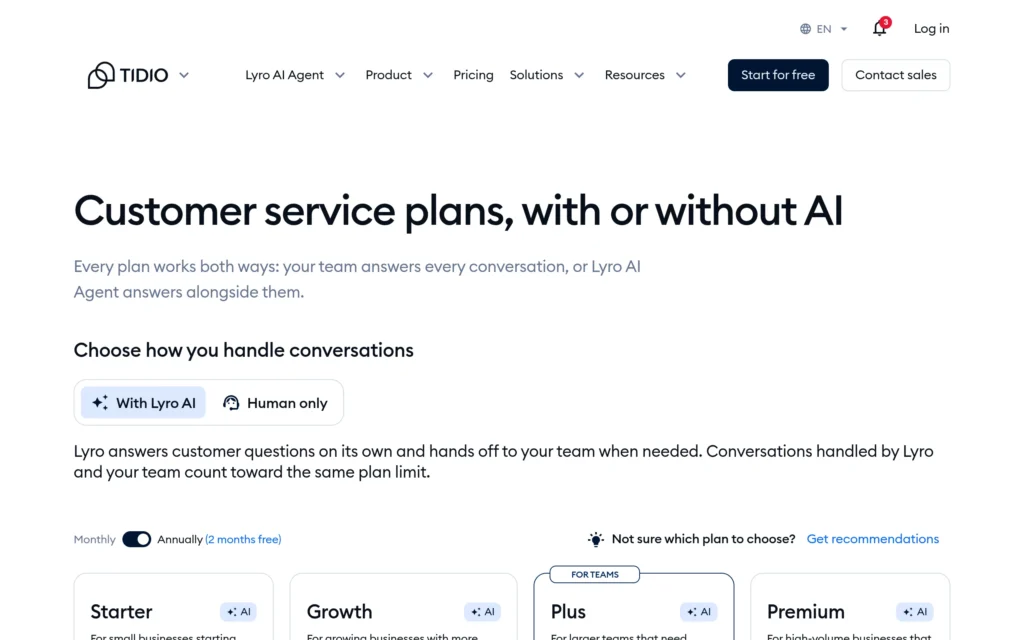
Tidio’s pricing page, 25 November 2026: Starter $33 a month billed annually ($390 a year, 50 conversations); Growth from $63 a month billed annually ($750 a year); Plus from $300 a month plus usage. Monthly-billed rates are not printed on the rendered page. Free plan: 50 human conversations a month, plus 50 one-time Lyro AI conversations; 7-day free trial.
ManyChat — the Instagram pick
ManyChat is the only tool in this guide built for the place your customers actually discover jewelry: Instagram. It starts free — $0, with 25 active contacts a month — and its paid plans are the cheapest here. Essential is $17 a month billed monthly or $14 a month billed annually ($168 a year), with 250 active contacts. Pro is $39 a month billed monthly or $29 a month billed annually ($348 a year), with 2,500 active contacts. Business is $99 a month billed monthly or $69 a month billed annually ($828 a year), with 7,500 contacts.
Advanced is $199 a month billed monthly or $139 a month billed annually ($1,668 a year), with 25,000 contacts. Essential and Pro come with a 14-day free trial. Prices exclude tax, and the final price depends on your billing country.
What you’re paying for is automation on the channels where a jewelry store’s customers live: Instagram, WhatsApp, Messenger, TikTok, Telegram, email, and SMS. A customer comments “price?” under a photo of a necklace, and ManyChat replies in the DM automatically and captures the lead while your salesperson is with a customer at the counter. An “active contact” is one real person you interact with in a month, however many messages you exchange — so a long back-and-forth about an engagement ring costs the same as a one-word reply.
For a three-person store, Pro at $29 a month billed annually is the honest pick. Essential’s 250 active contacts and two channels are enough to test the idea, but the feature that makes ManyChat worth buying for a jewelry store — AI-powered broadcasting, which lets you send a new-arrivals message to people who asked about a piece — sits on Pro, along with a third channel. Business at $69 adds more contacts and priority support, but a single-location store won’t need 7,500 active contacts a month. Pro’s 2,500 is the right size.
The catch is the contact meter. Go over your plan’s active-contact limit and ManyChat charges a small overage fee for each additional contact — $0.10 each on Essential, $0.05 on Pro, $0.025 on Business, billed monthly. That sounds trivial until a viral reel about a $90 pair of earrings brings 2,000 new people into your DMs in a week: on Pro, 2,000 extra contacts at $0.05 is $100 in overage, on top of the plan. You can set an overage threshold to cap it, and upgrading mid-cycle forgives the overage fees so far — but a store that goes viral needs to know the meter exists before the bill arrives.
Who is ManyChat actually best for? A store whose Instagram does the selling — daily posts, reels of new pieces, customers who DM “is this still available?” before they ever visit. If your customers find you on Google and walk in, ManyChat is a second buy, not the first.
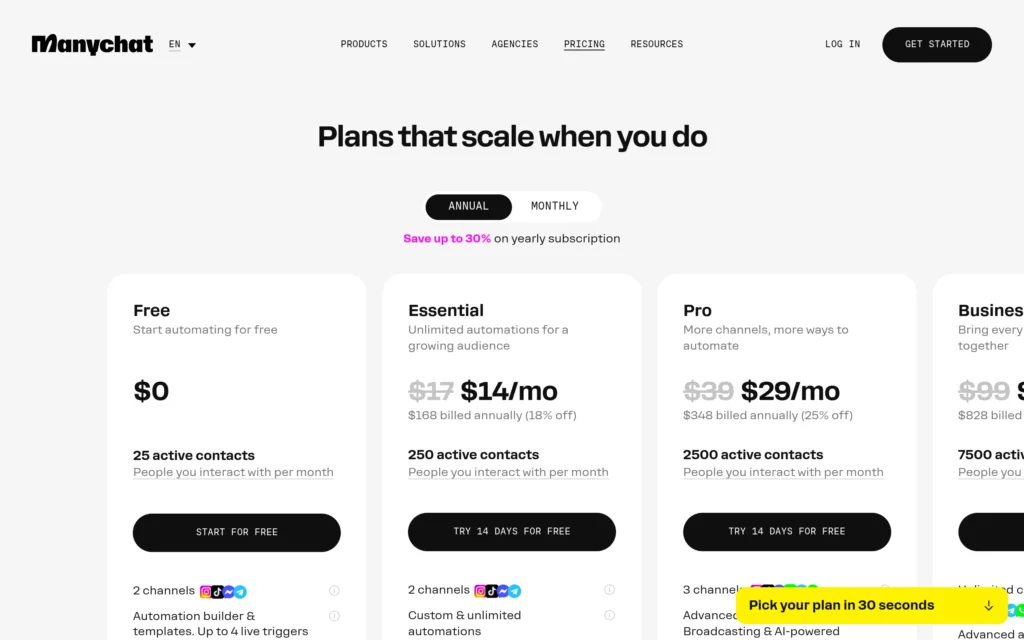
Manychat’s pricing page, 25 November 2026, annual toggle on: Free $0 (25 active contacts), Essential $14 a month billed annually ($168 a year, 250 contacts), Pro $29 a month billed annually ($348 a year, 2,500 contacts). Monthly billing: $17 and $39. 14-day free trial; prices exclude tax.
Chatbase — the most powerful website agent
Chatbase is the most capable agent in this guide, and the most expensive chat tool here by a wide margin. There is no free plan — only a 7-day free trial. Basic is $150 a month billed monthly, or $120 a month billed yearly, which the page frames as “save $360 yearly.” Business is $500 a month billed monthly, or $400 a month billed yearly — “save $1,200 yearly.” Enterprise is custom-priced, with SSO, HIPAA eligibility, audit logs, and a dedicated success manager. Basic includes 4,000 message credits a month; Business includes 15,000. There are no seat fees — unlimited members on every plan.
What you’re paying for is an agent you train on your own material: your catalogue, your repair and sizing guides, your returns policy, your engraving options. It answers from your documents, not from generic knowledge, and it can take actions — checking available consult slots on a calendar, for example — instead of only answering questions. It works across chat, email, and voice, and plugs into Shopify, WhatsApp, Messenger, Instagram, and Slack. For a jewelry store, the honest use is the website agent that knows your actual stock: whether a piece is still in the case, and what it costs, without a salesperson leaving the counter to check.
For a three-person store, Basic at $120 a month billed yearly is the only priced plan that fits — $1,440 a year. Business at $400 a month billed yearly is $4,800 a year, which is more than the rest of this guide’s full stack minus Lightspeed.
Basic’s 4,000 credits sound generous until you read how they burn: each request to the AI model costs credits depending on the model, and if the agent runs an action — like checking a calendar — it makes a second request and spends twice the credits. A booking conversation can cost several times what a simple answer costs, and unused credits do not roll over to next month. Auto-recharge credits, which you buy when the balance runs low, never expire — but they are a separate purchase.
The catch, beyond the price, is that Chatbase is an agent, not a helpdesk. Its helpdesk inbox — shared inbox, ticketing, human shifts — is a separate part of the product, so a store that wants one system for both the AI and the humans should check what is included before paying. And at $1,440 a year for the cheapest plan, it costs more than Tidio Growth and ManyChat Pro combined — $1,098 a year for both. That is the comparison that matters: Chatbase has to earn its premium by answering the questions the cheaper tools can’t, like the ones that need your real catalogue.
Who is Chatbase actually best for? A store with a large online catalogue and a website that does real selling — hundreds of pieces, customers who browse at midnight and expect the agent to know the stock. If your website is mostly a brochure, Tidio answers the same questions for a fifth of the price.
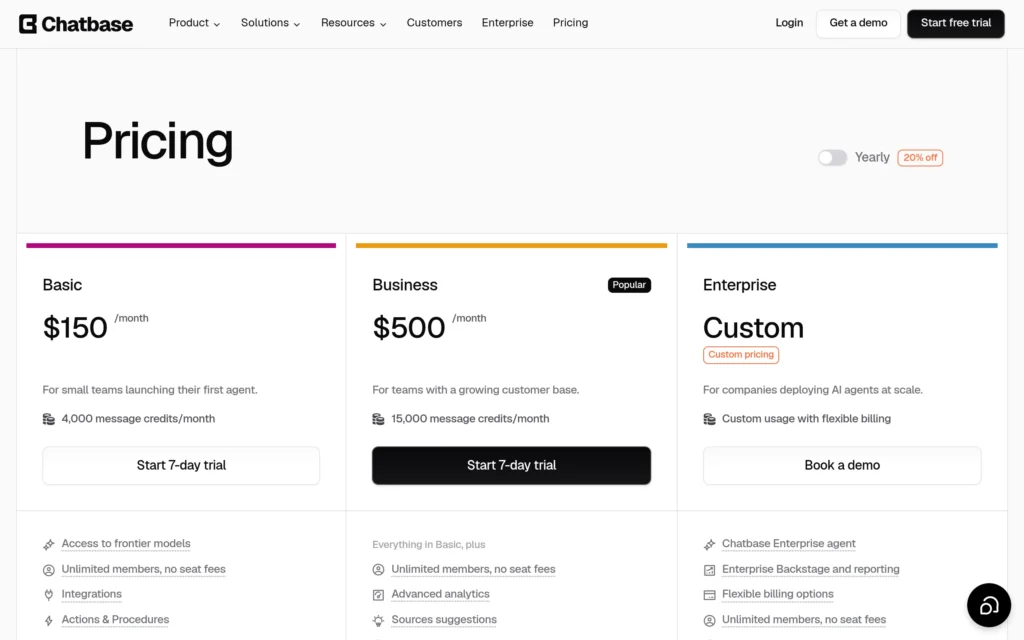
Chatbase’s pricing page, 25 November 2026, monthly toggle: Basic $150 a month (4,000 credits), Business $500 a month (15,000 credits). On the yearly toggle: $120 and $400 a month. 7-day free trial; no free plan.
Shopify — the store-and-website pick
Shopify is the tool your customers already know, and the one that ties the counter to the website. Basic is $25 a month billed monthly or $19 billed annually. Grow is $65 monthly or $49 annually. Advanced is $399 monthly or $299 annually. Plus starts at $2,300 a month. Every plan starts with 3 days free, then $1 a month for 3 months. And the POS add-on that matters here, POS Pro, is $89 a month per location on any plan.
That add-on is not optional for a three-person store. The basic POS that comes with every plan is casual in-person selling: limited staff access, simple customer profiles, returns only at the original location. POS Pro adds unlimited staff accounts with roles and permissions, in-store inventory management, professional retail reports, and returns and exchanges at any location. A store with three people behind the counter needs staff permissions — otherwise everyone can see everything, including your margins. It also matters for jewelry specifically: POS Pro’s inventory management is what stops the website selling a ring that your salesperson just sold at the counter.
For a three-person store, Grow at $49 a month billed annually plus POS Pro at $89 is the honest pick: $138 a month, or $1,656 a year. Grow also raises your staff accounts to five and cuts the third-party payment-provider fee from 2% on Basic to 1%. On $20,000 a month taken through a third-party provider, that’s $200 a month — $2,400 a year — though it only applies if you don’t use Shopify Payments. Grow also includes Shopify’s built-in AI assistant, Sidekick, on every plan, which drafts product descriptions and answers “how do I” questions in plain language.
The honest weaknesses: Shopify is a general retail platform, not a jewelry system. It has no native repair tracking for the ring left for resizing, no certificate or appraisal document storage, and no way to mark a piece as one-of-a-kind without an app — and apps cost money every month. And the $1-a-month intro is genuinely cheap, but it ends after three months, so budget the real price from month four. We compared Shopify’s alternatives separately if you want the wider field.
Who is Shopify actually best for? A store whose online shop matters as much as the counter — strong Instagram sales, customers who buy online and collect in store, a website that actually sells. If your store is mostly walk-in, Lightspeed handles the counter better.
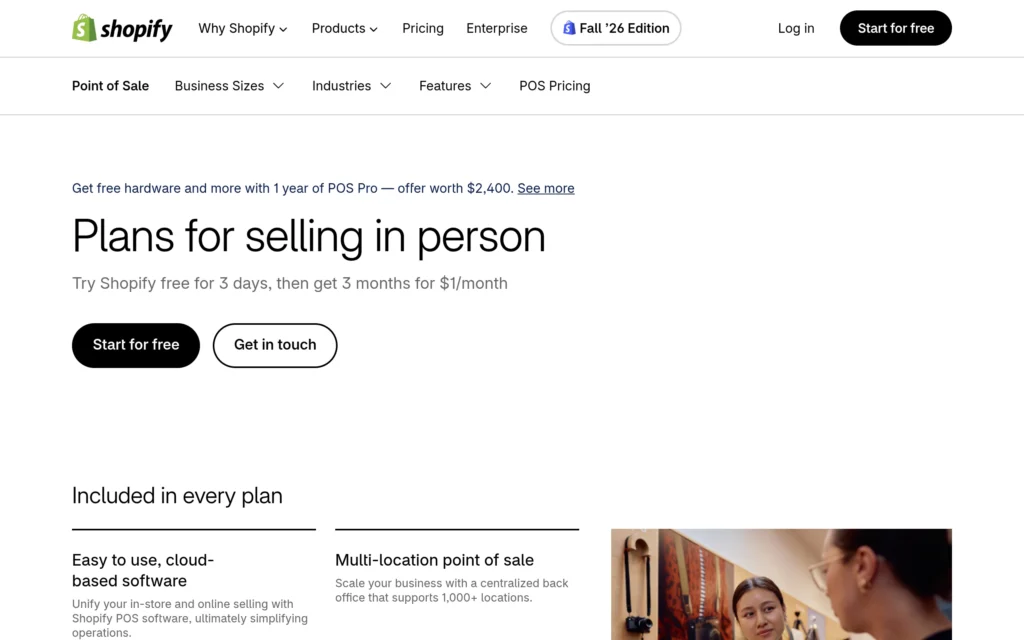
Shopify’s POS pricing page, 25 November 2026: 3 days free, then $1 a month for 3 months. POS Pro $89 a month per location; base plans Basic $25 ($19 annual), Grow $65 ($49 annual), Advanced $399 ($299 annual).
Lightspeed Retail — the one-of-a-kind inventory pick
Lightspeed Retail is the serious end of this guide. It starts at $89 a month billed annually on Basic, or $109 a month if you pay monthly. Core is $149 a month billed annually ($179 monthly), and Plus is $289 a month billed annually ($339 monthly). The page offers a free trial, but it doesn’t state how many days it lasts — check before you sign up.
What you’re paying for is inventory control that understands pieces that exist exactly once. A 1.2-carat oval solitaire in white gold, size 6, with a GIA certificate, is one specific ring — and when it sells, it must disappear from the website, the counter, and the Instagram shop at the same moment. Lightspeed’s inventory matrix handles variants like that — metal, stone, size, certificate — without turning into a spreadsheet you maintain by hand, and its serial tracking follows an individual piece from supplier to sale. Basic includes one register and built-in Lightspeed eCommerce at the basic level, so the website and the till share one stock count.
For a three-person store, Core at $149 a month billed annually is the honest pick. It adds in-store and online loyalty, advanced sales, staff and inventory reports, accounting, ecommerce and marketing integrations, and the Mobile Scanner POS App. Plus at $289 adds AI Doc Import, which pulls supplier invoices into the system, plus Insights: forecasting, order recommendations, and custom reporting. That forecasting is the closest thing to AI in this guide that actually saves a jewelry store money — it tells you which pieces to reorder before the December rush, instead of after.
The catch is the payment processing. The pricing page as rendered doesn’t publish a card-present rate at all — there’s no payment-rate row in the comparison table. You’ll find out what Lightspeed Payments costs when you talk to them, which is exactly the kind of friction this guide exists to flag. And the annual discount is real but modest: Core costs $360 a year more on monthly billing, Basic $240 more.
Who is Lightspeed Retail actually best for? A store where the inventory is the business — one-of-a-kind pieces, certificates, repairs sitting in the safe, a website that must never sell what the counter already sold. If your store is mostly a small counter with a website that doesn’t sell, it’s more tool than you need.
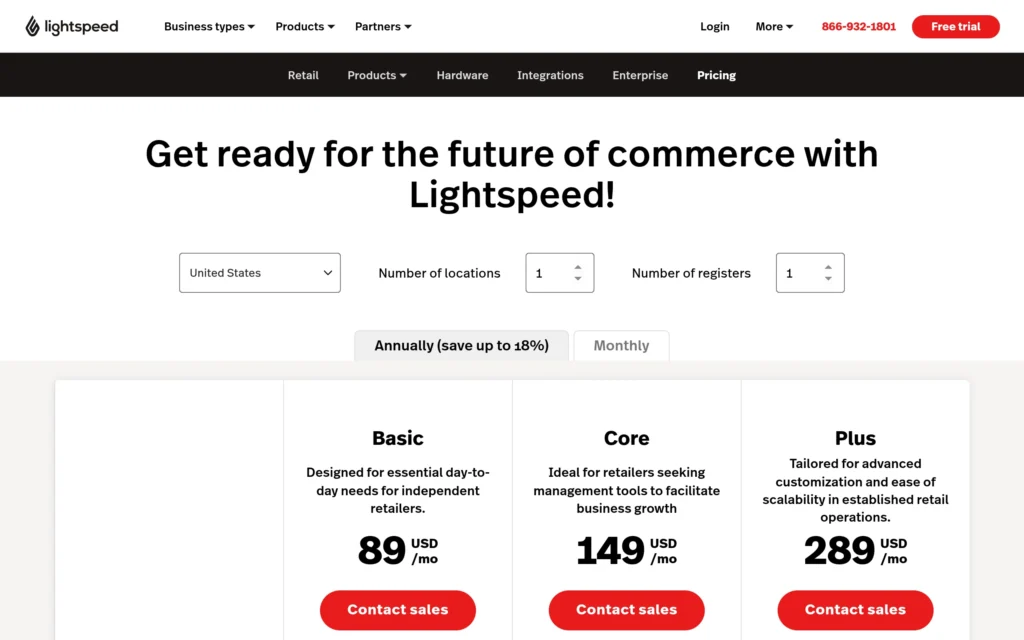
Lightspeed’s pricing page, 25 November 2026: Basic $89, Core $149 and Plus $289 a month billed annually (1 location, 1 register). Monthly billing: $109, $179 and $339. No card rate is published.
The maths: what the stack really costs
Here’s the part most guides skip: what all of this costs together, for one realistic store. The scenario is an owner and two salespeople — three people — one location, one register, on annual billing where the vendor publishes it, at list prices.
| Tool | Full stack | Lean stack | Saving |
|---|---|---|---|
| Tidio | Growth $750/yr | Starter $390/yr | $360 |
| ManyChat | Pro $348/yr | Essential $168/yr | $180 |
| Chatbase | Basic $1,440/yr | Basic $1,440/yr | $0 |
| Shopify | Grow + POS Pro $1,656/yr | Basic + POS Pro $1,296/yr | $360 |
| Lightspeed Retail | Core $1,788/yr | Basic $1,068/yr | $720 |
| Total | $5,982/yr | $4,362/yr | $1,620 |
The full stack costs $5,982 a year, or about $499 a month. The lean stack costs $4,362 a year, or about $364 a month. The gap is $1,620 a year. Chatbase saves you nothing between the two stacks, because Basic is the only priced plan a small store can buy. The entire saving comes from four downgrades: Lightspeed Core to Basic ($720), Tidio Growth to Starter ($360), Shopify Grow to Basic ($360), and ManyChat Pro to Essential ($180).
The honest middle stack is $5,262 a year: everything from the full stack, but Lightspeed Basic instead of Core. Most three-person stores should budget this number — Core’s forecasting isn’t worth $720 a year until a miscount costs you a sale.
Monthly billing costs more where an annual discount exists. Chatbase Basic on monthly billing is $360 a year more than yearly, ManyChat Pro $120 a year more, Lightspeed Core $360 a year more, Basic $240 more, Shopify Grow $192 a year more, Basic $72 more. Tidio’s page shows only annual-billed figures — $33 and $63 a month — and prints no monthly-billed rate.
And the break-even, because software should pay for itself: at a $150 average sale, the full stack costs about 40 sales a year — roughly three or four a month. The lean stack costs about 29 sales a year. The $1,620 saving between them is about 11 sales. If the tools save you one lost sale a month — a sizing question answered at 11pm, a ring the website didn’t sell twice — they’ve paid for themselves before Valentine’s Day.
5 traps that cost jewelry stores real money
1. Buying the cheapest headline price. Tidio Starter at $33 a month looks like a bargain until December burns through its 50 conversations in a week. ManyChat Essential at $14 looks cheaper still until you realise AI broadcasting is Pro-only. Always price the plan that fits your busiest month, not your quietest.
2. Paying for a feature that lives on a higher tier. Tidio’s native Shopify actions, which let the agent check an order without a human, need Growth. ManyChat’s AI broadcasting needs Pro. Chatbase’s helpdesk inbox is a separate part of the product from its agent. If a feature is the reason you’re buying the tool, confirm which plan it’s on, and what that plan costs, before you pay.
3. Forgetting the meter. The subscription is only part of the bill. Tidio charges by conversation, ManyChat by active contact with overage fees, Chatbase by message credit — and a booking conversation on Chatbase can cost several times what a simple answer costs, because each action is a second request. On a viral week, the meter is the bill. Set overage caps before you go viral, not after.
4. The website that sells what you don’t have. A one-of-a-kind ring exists exactly once. A website that doesn’t share the till’s stock count will sell the ring your salesperson sold an hour ago, and the apology email costs you more than the sale was worth. Every tool in this guide claims in-store and online stock in sync — but only if you actually run the website on that tool. A Shopify store with a Lightspeed till, or a website you never update, breaks the promise.
5. Letting the robot propose. An engagement ring is the most emotional purchase most people ever make, and the moment a customer starts talking about a $3,000 ring is the moment the AI should hand over to a human. Set every agent in this guide to hand off fast — a short answer, then a person. An AI that tries to close the sale itself doesn’t sound efficient. It sounds like you don’t care.
What to buy first
Don’t buy all five. Buy one, run it on real customers for two weeks, and see what breaks. For most jewelry stores, that’s Tidio Growth: it covers the website and Instagram questions, it hands the serious buyers to your team, and the 7-day free trial is long enough to run a full week of real questions through it.
Before you commit to a stack, run the numbers for your own store. Our free AI Cost Calculator adds up the real starting prices of the tools you pick, so you can see the yearly total before you hand over a card.
Pros and Cons
Pros
- Every tool here publishes real prices on its core plans — no quote-only walls except Chatbase Enterprise and Tidio Premium.
- Two genuinely free plans (Tidio and ManyChat) mean you can test AI answering on real customers before paying anything.
- The lean stack saves $1,620 a year against the full stack without losing the till, the website, or the after-hours answers.
Cons
- No single tool does everything: the best answering service (Tidio) has no Instagram automation as strong as ManyChat’s, and the strongest agent (Chatbase) costs more than the other two chat tools combined.
- Chatbase has no free plan and no cheaper tier — Basic is $1,440 a year, take it or leave it.
- The meters — conversations, contacts, credits — all sit outside the headline prices, and all three bite hardest in your busiest month.
- Lightspeed publishes no card rate, Tidio’s monthly-billed rates aren’t printed on the rendered page, and Chatbase’s credits don’t roll over — three reminders to check the live page before you buy.
Our verdict
For most three-person jewelry stores, Tidio Growth at $63 a month billed annually is the buy. It’s the only tool that answers the sizing question at 11pm, hands the $3,000 buyer to a human at the right moment, and checks an order in Shopify without a person touching the keyboard. Start with its free plan and upgrade when December proves you need the 1,000-conversation ceiling.
If your Instagram does the selling, ManyChat Pro at $29 a month billed annually is the second buy, and its 14-day trial is the cheapest way to test it. If your website sells hundreds of pieces and the agent needs to know your real catalogue, Chatbase Basic at $120 a month billed yearly is the powerful pick — but only after you’ve outgrown what Tidio can answer.
If the counter and the website must tell the same story, Shopify Grow at $49 a month billed annually plus POS Pro at $89 is the flexible pick, and its $1-a-month intro for three months is the cheapest way to start. And if one-of-a-kind inventory is your whole business, Lightspeed Retail Core at $149 a month billed annually is the inventory king.
First step: trial Tidio Growth and ManyChat Pro side by side for one week, on real questions. The one your team actually opens at the counter is the one to keep.
Frequently asked questions
What are the best ai tools for jewelry stores for a small shop?
Tidio Growth, for most small shops. At $63 a month billed annually it answers sizing, engraving and returns questions after hours, hands serious buyers to your team, and its native Shopify actions can check an order without a human. ManyChat Pro is the better pick if your Instagram does the selling.
How much does jewelry store software cost per month?
From $0 on the Tidio and ManyChat free plans to $149 a month for Lightspeed Core, and $138 for Shopify Grow with POS Pro. A realistic three-person stack runs about $364 a month lean or $499 a month full, before overage fees, add-ons, and payment processing.
Can AI answer questions about ring sizing and engraving?
Yes — if you train it on your own answers. Tidio’s Lyro learns from your website and FAQs, and Chatbase trains on your catalogue and guides, so both can answer whether a ring can be resized and how long engraving takes. Set them to hand off to a human the moment the customer asks about a custom piece or a price.
Do I need a jewelry-specific POS, or will Shopify work?
Shopify works if your store sells online as well as at the counter — it has no native repair tracking or certificate storage, but POS Pro’s inventory management keeps the website and the till in sync. If your stock is mostly one-of-a-kind pieces with certificates, Lightspeed’s serialized inventory fits the work better.
Is there free jewelry store software?
Yes, for the answering side. Tidio’s free plan covers 50 human conversations a month plus 50 one-time Lyro AI conversations, and ManyChat’s free plan covers 25 active contacts a month. Chatbase has no free plan — only a 7-day trial on Basic and Business. Lightspeed and Shopify have no free plans either, though Shopify gives 3 days free then $1 a month for 3 months.
Price note — updated 25 November 2026: Prices in this post were checked on 25 November 2026. When you are reading this, the price may be lower or higher — always check the official pricing page before you buy. Tidio’s page shows annual-billed figures on the rendered page and does not print monthly-billed rates. ManyChat’s prices exclude tax and depend on your billing country. Chatbase’s message credits do not roll over, and a booking action can cost several times the credits of a simple answer.
Sources: Tidio pricing — https://www.tidio.com/pricing/ · ManyChat pricing — https://manychat.com/pricing/ · Chatbase pricing — https://www.chatbase.co/pricing · Shopify pricing — https://www.shopify.com/pricing · Lightspeed Retail pricing — https://www.lightspeedhq.com/pos/retail/pricing/
Pros
- Every tool here publishes real prices on its core plans — no quote-only walls except Chatbase Enterprise and Tidio Premium.
- Two genuinely free plans (Tidio and ManyChat) mean you can test AI answering on real customers before paying anything.
- The lean stack saves $1,620 a year against the full stack without losing the till, the website, or the after-hours answers.
Cons
- No single tool does everything: the best answering service (Tidio) has no Instagram automation as strong as ManyChat's, and the strongest agent (Chatbase) costs more than the other two chat tools combined.
- Chatbase has no free plan and no cheaper tier — Basic is $1,440 a year, take it or leave it.
- The meters — conversations, contacts, credits — all sit outside the headline prices, and all three bite hardest in your busiest month.
- Lightspeed publishes no card rate, Tidio's monthly-billed rates aren't printed on the rendered page, and Chatbase's credits don't roll over — three reminders to check the live page before you buy.
For most three-person jewelry stores, Tidio Growth at $63 a month billed annually is the buy. It's the only tool that answers the sizing question at 11pm, hands the $3,000 buyer to a human at the right moment, and checks an order in Shopify without a person touching the keyboard. Start with its free plan and upgrade when December proves you need the 1,000-conversation ceiling.