
For a three-person bike shop, Lightspeed Retail Core at $149 a month billed annually is the best single buy: it handles the size-and-colour SKU nightmare, keeps in-store and online stock in sync, and its AI forecasting tells you what to reorder before you run out. Shopify Grow at $49 a month billed annually, plus POS Pro at $89 a month, is the flexible pick if you want the best online store attached to your till. Rain POS Startup at $99 a month is the specialist's choice for repair-heavy shops, with one honest catch: its work-order plan has no published price. Workstand Plus at $299 a month, plus $99 for ecommerce, is the bike-industry native that syncs supplier catalogues. Sprocket Pro at $99 a month is the cheapest purpose-built bike POS — but it's still on a waitlist. A full stack of all five costs $10,596 a year; the lean stack costs $6,516. The difference is $4,080 a year, and most of it sits in one upgrade.
It’s Saturday morning, the first warm one of spring, and your shop already has a queue. Three bikes on stands, two more leaning by the door, and a customer on the phone asking whether his e-bike will be ready by noon. Meanwhile your best mechanic is rebuilding a fork, your register is full of parts you can’t find in the system, and the website says a helmet is in stock that you sold yesterday.
That’s the real problem with running a bike shop in 2026. Fixing bikes isn’t the hard part. Knowing what’s on the shelf, what’s on the stand, who’s picking up what and when, and whether the website is selling things you don’t have — that’s what eats your day. The best ai tools for bike shops don’t true a wheel for you. They keep the till, the bench, and the website telling the same story, and they answer the customer while your hands are covered in chain lube.
This guide compares five tools by their real, published prices: Lightspeed Retail, Shopify POS, Rain POS, Workstand, and Sprocket. Every price below was checked on the vendor’s own pricing page on 25 November 2026. Nothing here comes from a roundup. And at the end, the maths: what a full stack costs a three-person shop for a year, what the lean version costs, and the $4,080 a year between them.
Quick Answer
Short on time? Here’s the whole guide to the best ai tools for bike shops in 30 seconds. For a three-person bike shop, Lightspeed Retail Core at $149 a month billed annually is the best single buy: it handles the size-and-colour SKU nightmare, keeps in-store and online stock in sync, and its AI forecasting tells you what to reorder before you run out. Shopify Grow at $49 a month billed annually, plus POS Pro at $89 a month, is the flexible pick if you want the best online store attached to your till. Rain POS Startup at $99 a month is the specialist’s choice for repair-heavy shops, with one honest catch: its work-order plan has no published price.
Workstand Plus at $299 a month, plus $99 for ecommerce, is the bike-industry native that syncs supplier catalogues. Sprocket Pro at $99 a month is the cheapest purpose-built bike POS — but it’s still on a waitlist. A full stack of all five costs $10,596 a year; the lean stack costs $6,516. The difference is $4,080 a year, and most of it sits in one upgrade.
In this article
- Quick Answer
- How we compared them
- Lightspeed Retail — the inventory heavyweight
- Shopify POS — the online-store pick
- Rain POS — the repair-shop specialist
- Workstand — the bike-industry native
- Sprocket — the budget bike POS
- The maths: what the stack really costs
- 5 traps that cost bike shops real money
- What to buy first
- Pros and Cons
- Our verdict
- Frequently asked questions
How we compared them
Every tool in this guide was judged the same way: on the work a real bike shop does every week. Selling a bike that comes in five sizes and three colours. Finding a part for a ten-year-old drivetrain without phoning the supplier. Running a repair from drop-off to “ready for pickup” text without losing the ticket. Keeping the website’s stock honest. And taking a deposit before you order a part you can’t return.
Prices are the starting point, not the whole story. A $49 tool that can’t track serial numbers costs you more than a $149 tool that can. So each section below gives you the price, what the plan actually includes, the hidden cost the pricing page doesn’t shout about, and an honest call on who it’s best for.
The scenario for the maths section is a shop with an owner and two mechanics — three people — one location, one register, doing repairs and retail side by side. If your shop is bigger or smaller, the per-tool prices still hold; only the seat and register counts change.
| Tool | Starts at | The plan a 3-person shop actually needs | Best for | Key limit |
|---|---|---|---|---|
| Lightspeed Retail | $89/mo | Core, $149/mo billed annually | Shops drowning in SKUs | Card rate not published on the pricing page |
| Shopify POS | $19/mo | Grow $49/mo annual + POS Pro $89/mo | Shops that live or die by their online store | POS Pro needed for full staff controls |
| Rain POS | $99/mo | Startup, $99/mo | Repair-heavy shops | Work-order plan price not published |
| Workstand | $99/mo | Plus $299/mo + ecommerce $99/mo | Shops that want supplier catalogues synced | Pro is $659/mo; no annual discount published |
| Sprocket | $49/mo | Pro, $99/mo | Small shops that want bike-specific software cheap | Still on a waitlist; no free trial stated |
Lightspeed Retail — the inventory heavyweight
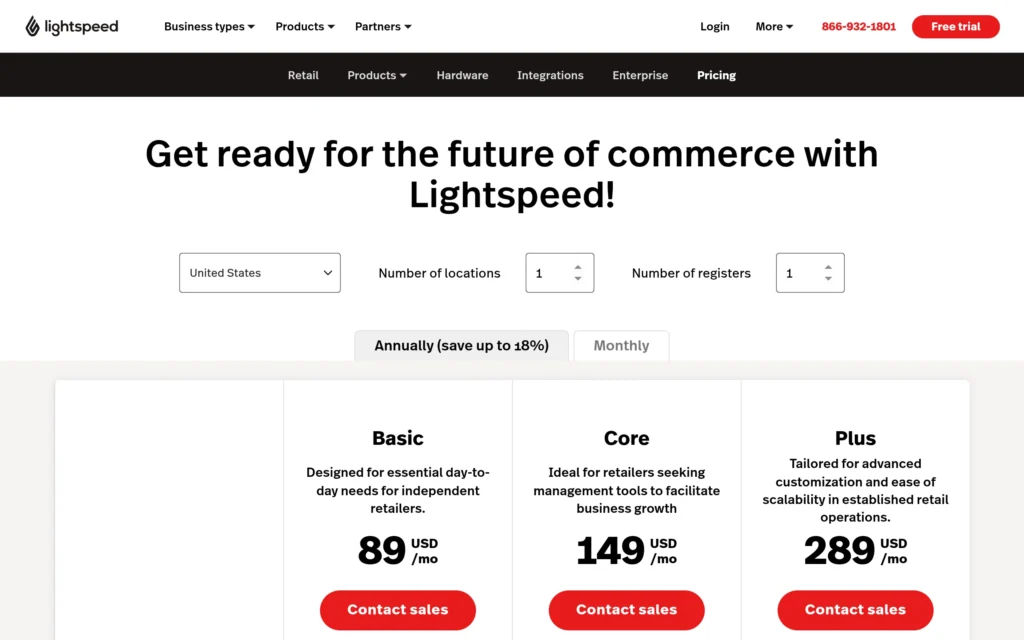
Lightspeed Retail is the serious end of this guide. It starts at $89 a month billed annually on Basic, or $109 a month if you pay monthly. Core is $149 a month billed annually ($179 monthly), and Plus is $289 a month billed annually ($339 monthly). The page offers a free trial, but it doesn’t state how many days it lasts — check before you sign up.
What you’re paying for is inventory control that understands bikes. One model in five sizes and three colours is fifteen SKUs, and a shop with forty models is carrying six hundred SKUs before it counts a single chain or brake pad. Lightspeed’s inventory matrix handles variants like that without turning into a spreadsheet you maintain by hand, and it moves stock between locations when you add a second shop. Basic includes one register and built-in Lightspeed eCommerce at the basic level, so the website and the till share one stock count.
For a three-person shop, Core at $149 a month billed annually is the honest pick. It adds in-store and online loyalty, advanced sales, staff and inventory reports, accounting, ecommerce and marketing integrations, and the Mobile Scanner POS App — the last one being the thing that stops your staff scanning the wrong barcode in a hurry. Plus at $289 adds AI Doc Import, which pulls supplier invoices into the system, plus Insights: forecasting, order recommendations, and custom reporting. That forecasting is the closest thing to AI in this guide that actually saves a bike shop money — it tells you which parts to reorder before the spring rush, instead of after.
The catch is the payment processing. The pricing page as rendered doesn’t publish a card-present rate at all — there’s no payment-rate row in the comparison table. You’ll find out what Lightspeed Payments costs when you talk to them, which is exactly the kind of friction this guide exists to flag. And the annual discount is real but modest: Core costs $360 a year more on monthly billing, Basic $240 more.
Who is Lightspeed Retail actually best for? A shop where inventory is the business — big parts walls, multiple suppliers, bikes in every size. If your shop is mostly a workbench with a small retail corner, it’s more tool than you need.
Shopify POS — the online-store pick
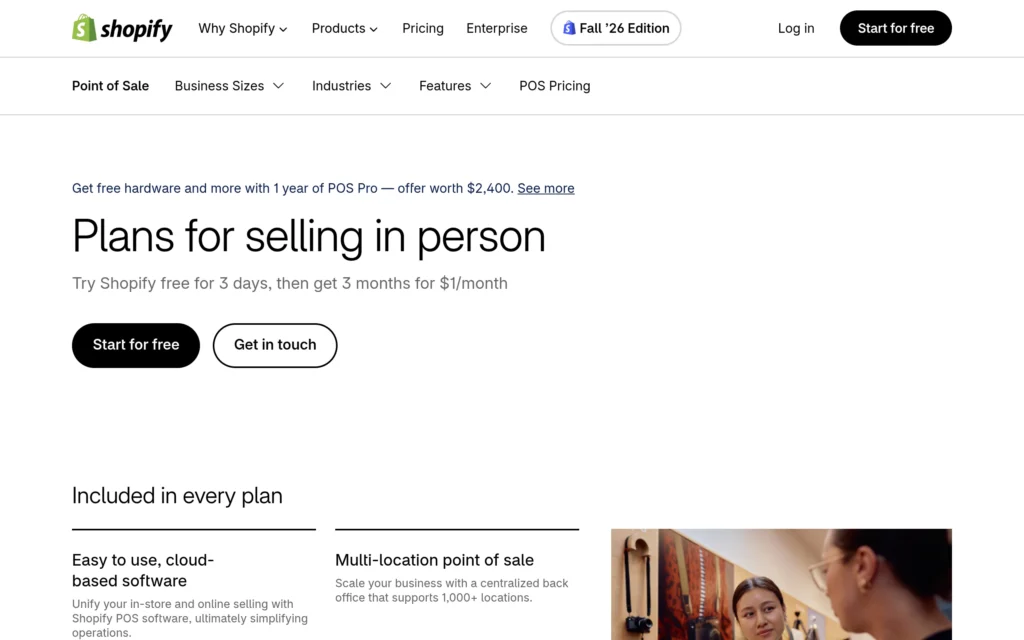
Shopify is the tool your customers already know, and its pricing is the clearest in this guide. Basic is $25 a month billed monthly or $19 billed annually. Grow is $65 monthly or $49 annually. Advanced is $399 monthly or $299 annually. Every plan starts with 3 days free, then $1 a month for 3 months. And the POS add-on that matters here, POS Pro, is $89 a month per location on any plan.
That add-on is not optional for a three-person shop. The basic POS that comes with every plan is casual in-person selling: limited staff access, simple customer profiles, returns only at the original location. POS Pro adds unlimited staff accounts with roles and permissions, inventory management, professional retail reports, and returns and exchanges at any location. A shop with three people behind the counter needs staff permissions — otherwise everyone can see everything, including your margins.
For a three-person shop, Grow at $49 a month billed annually plus POS Pro at $89 is the honest pick: $138 a month, or $1,656 a year. Grow also raises your staff accounts to five and cuts the third-party payment-provider fee from 2% on Basic to 1%. On $20,000 a month taken through a third-party provider, that’s $200 a month — $2,400 a year — though it only applies if you don’t use Shopify Payments. Grow also includes Shopify’s built-in AI assistant, Sidekick, on every plan, which drafts product descriptions and answers “how do I” questions in plain language.
The honest weaknesses: Shopify is a general retail platform, not a bike system. It has no native repair work-order flow, no serial-number tracking for bikes, and no supplier catalogue sync — you’d bolt those on with apps, and apps cost money every month. And the $1-a-month intro is genuinely cheap, but it ends after three months, so budget the real price from month four.
Who is Shopify POS actually best for? A shop whose online store matters as much as the till — strong Instagram sales, mail-order parts, customers who buy online and collect in store. If your shop is mostly walk-in repairs, the other tools fit better. We compared Shopify’s alternatives separately if you want the wider field.
Rain POS — the repair-shop specialist
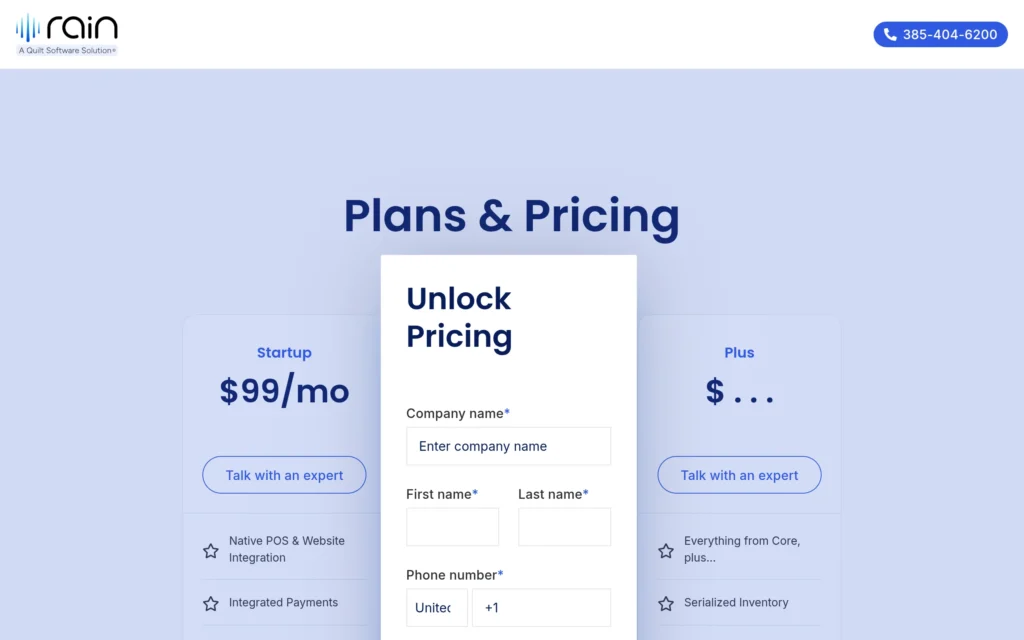
Rain POS is the specialist in this guide, built for the kind of shop where the workbench earns more than the showroom. It publishes exactly one price: Startup is $99 a month. That’s it. The next two plans, Core and Plus, show “$ . . .” where the price should be, and the middle of the page is covered by a “Pricing Configurator” form asking for your company name, your name, your phone number, your email, and your industry before it will tell you anything.
That matters more than it sounds, because the feature a bike shop actually needs from Rain sits on the plan with no price. Work Orders — the repair-ticket system that tracks a bike from drop-off to pickup — is a Plus feature. Serialized inventory, which tracks individual bikes by serial number, is also Plus. Core adds multi-location, consignment, rentals, loaner tracking, trade-ins, and QuickBooks integration. Startup itself is no lightweight: native POS and website integration, integrated payments, unlimited phone and email support, unlimited users and products, basic reports, e-commerce order fulfilment, pooled inventory tracking, customer invoicing, and quote management.
For a three-person shop, Startup at $99 a month is the only plan you can actually price today — $1,188 a year, with unlimited users, so your whole crew is covered. That’s the honest pick, and it’s a good one if your repair flow can live with Startup’s toolset. But if work orders are the reason you’d buy Rain, you have to fill in the form and get a quote first, and you should do that before you commit to anything else.
The catch, beyond the hidden prices, is the website. Rain’s e-commerce runs on its own website builder, and you’re tied to it — you can’t just plug Rain into a site you already love. And the page states no free trial at all, so ask for a demo before you pay.
Who is Rain POS actually best for? A repair-heavy shop that wants one system for the till, the bench, and the website, and doesn’t mind asking sales for the real price of the work-order plan. If you need work orders on day one and you need the price today, look at Sprocket first.
Workstand — the bike-industry native
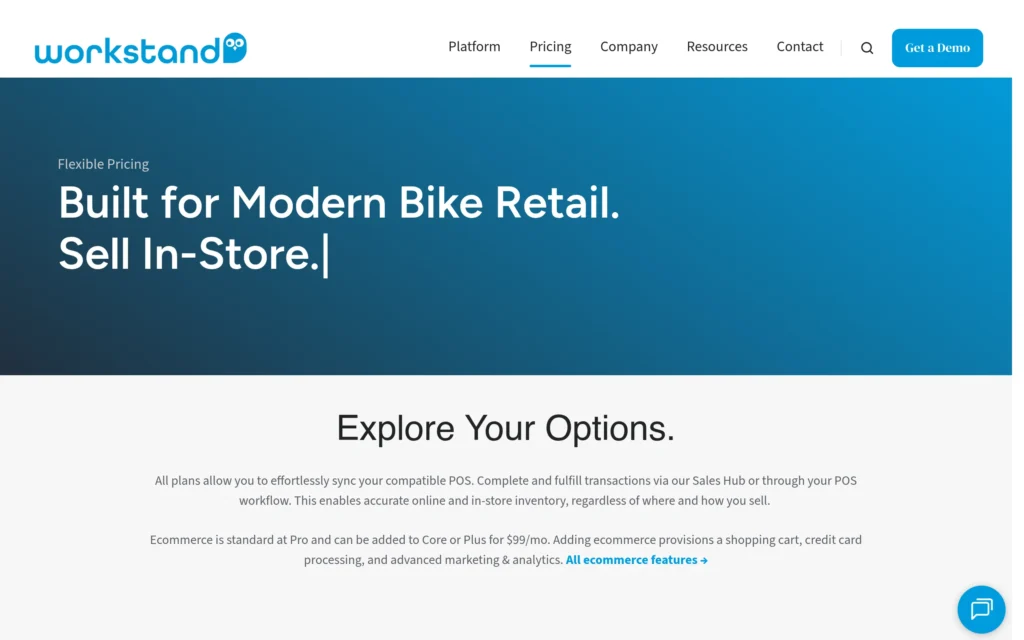
Workstand is the only tool here built specifically for bike retail, and it shows in the catalogue. Core is $99 a month, Plus is $299 a month, and Pro is $659 a month. Ecommerce costs $99 a month extra on Core and Plus, and it’s included in Pro. The page publishes no annual prices at all, and it states no free trial — the way in is a demo.
What makes Workstand different is the supplier catalogue. Core syncs your in-stock bikes from your POS and puts them online. Plus adds in-stock parts and accessories. Pro goes further: the full supplier catalogue across more than 800 brands, whether you stock the item or not, with live supplier data filling in colour and size options. For a shop that special-orders half its sales, that’s the difference between phoning a supplier and clicking a button.
For a three-person shop, Plus at $299 a month plus $99 for ecommerce is the honest pick: $398 a month, or $4,776 a year. Core at $99 plus $99 for ecommerce — $198 a month — is the cheaper way in, and it’s enough if your online catalogue only needs the bikes you already stock. Pro at $659 a month is a different league: full catalogue, warehouse items, priority support, multi-location, and card processing at 3.1% instead of 3.3%. On $20,000 a month of card payments, that 0.2% difference is $40 a month — $480 a year — which barely dents the $360-a-month jump from Plus.
The catch is the price of being bike-specific. Plus with ecommerce costs more than Lightspeed Core and Shopify Grow with POS Pro put together, and there’s no annual discount published to soften it. Multi-location is a $49-a-month add-on on Plus and Pro. And with no trial stated on the page, you’re buying on the strength of a demo.
Who is Workstand actually best for? A shop that lives on special orders and supplier catalogues — the kind of shop where the customer asks for a bike you don’t stock, and you want it on the website and ordered before they leave. If your shop mostly sells what’s on the floor, Core is enough.
Sprocket — the budget bike POS
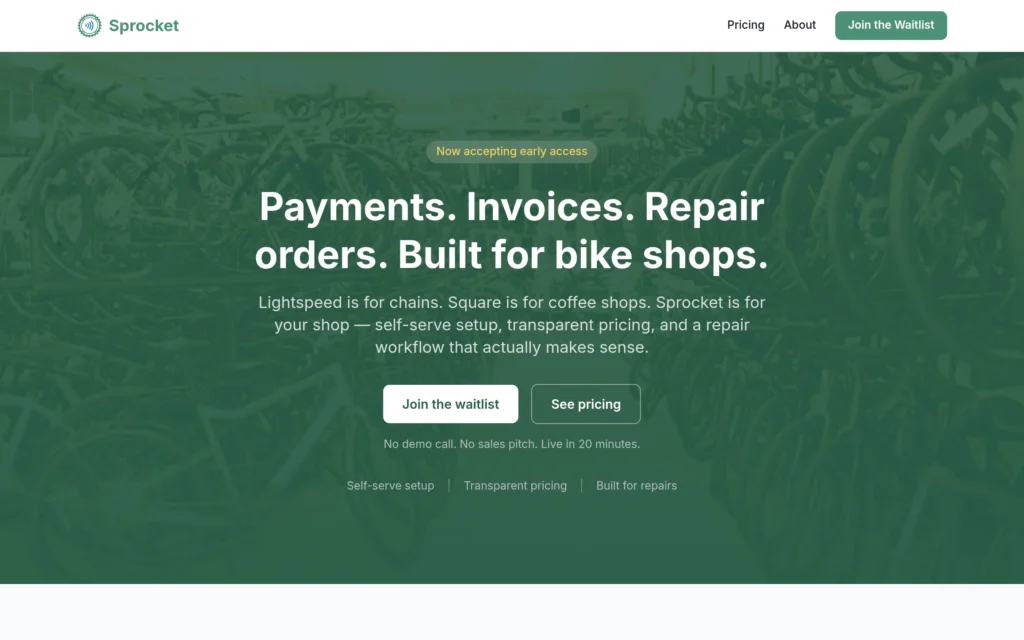
Sprocket is the new kid in this guide, and the cheapest purpose-built bike POS here. Starter is $49 a month, Pro is $99 a month, and Scale is $199 a month. There are no annual contracts and no annual prices — monthly is the price, and you can cancel any time. The page states no free trial.
What you’re buying is a system that was designed for a bike shop’s day, not adapted to it. Repair order management is built in on every plan, not an add-on. Pro, the most popular plan, adds SMS status updates so customers get a text when their bike is ready, deposit and partial billing, recurring service plans, advanced reporting, and up to three locations. Scale adds unlimited locations, API access, priority support, and custom onboarding. The page’s own comparison table puts it plainly: repair order workflow built in, deposit and partial billing built in, SMS customer updates included.
For a three-person shop, Pro at $99 a month is the honest pick: $1,188 a year, with SMS updates and deposits included — the two features that stop the “is my bike ready?” phone calls and the “I ordered a part and the customer vanished” losses. Starter at $49 covers POS, payments, repair orders, and basic invoicing for a solo operator.
Now the honest warning, and it matters: Sprocket is still in early access. The homepage says “Now accepting early access” and the main button is “Join the waitlist” — so the “live in 20 minutes” promise sits next to a queue you have to join first. You may not be able to buy it today. Join the waitlist, and judge it when your invite arrives; don’t plan a shop migration around a tool you can’t sign up for yet.
Who is Sprocket actually best for? A small shop that wants bike-specific software at a small-shop price and can wait for an invite. If you need to switch systems this month, it’s not your pick yet — Lightspeed or Shopify will take you today.
The maths: what the stack really costs
Here’s the part most guides skip: what all of this costs together, for one realistic shop. The scenario is an owner and two mechanics — three people — one location, one register, on annual billing where the vendor publishes it, at list prices.
| Tool | Full stack | Lean stack | Saving |
|---|---|---|---|
| Lightspeed Retail | Core $1,788/yr | Basic $1,068/yr | $720 |
| Shopify POS | Grow + POS Pro $1,656/yr | Basic + POS Pro $1,296/yr | $360 |
| Rain POS | Startup $1,188/yr | Startup $1,188/yr | $0 |
| Workstand | Plus + ecommerce $4,776/yr | Core + ecommerce $2,376/yr | $2,400 |
| Sprocket | Pro $1,188/yr | Starter $588/yr | $600 |
| Total | $10,596/yr | $6,516/yr | $4,080 |
The full stack costs $10,596 a year, or about $883 a month. The lean stack costs $6,516 a year, or about $543 a month. The gap is $4,080 a year — and notice where it sits. Rain saves you nothing between the two stacks, because Startup is the only plan with a published price. The entire saving comes from four downgrades: Workstand Plus to Core ($2,400), Lightspeed Core to Basic ($720), Sprocket Pro to Starter ($600), and Shopify Grow to Basic ($360).
The honest middle stack is $8,196 a year: everything from the full stack, but Workstand Core instead of Plus. Most three-person shops should budget this number. Plus’s expanded catalogue is genuinely useful, but it’s not worth $2,400 a year until special orders are a big share of your sales.
Monthly billing costs more where an annual discount exists. Lightspeed Core on monthly billing is $360 a year more than annual, Basic $240 more. Shopify Grow costs $192 a year more monthly, Basic $72 more. Workstand, Rain, and Sprocket publish no annual prices, so monthly is the price — there’s no discount to miss.
And the break-even, because software should pay for itself: at a $75 average repair, the full stack costs about 141 repairs a year — roughly twelve a month. The lean stack costs about 87 repairs a year, or just over seven a month. The $4,080 saving between them is about 54 repairs. If the tools save you one lost sale a week — a bike the website said was in stock when it wasn’t, a repair that sat finished for three days because nobody called the customer — they’ve paid for themselves by spring.
5 traps that cost bike shops real money
1. Buying the cheapest headline price. Lightspeed Basic at $89 a month annually looks like a bargain until you need loyalty, advanced reports, or the scanner app — all Core features. Shopify Basic at $19 looks cheaper still until you add POS Pro and realise the staff limits. Always price the plan that fits your crew, not the one with the smallest number on the page.
2. Paying for a feature that lives on a higher tier. Rain’s work orders — the feature most repair shops would buy Rain for — sit on Plus, and Plus has no published price at all. Workstand’s full supplier catalogue only exists on Pro at $659 a month. If a feature is the reason you’re buying the tool, confirm which plan it’s actually on, and what that plan costs, before you pay.
3. Forgetting the payment processing. The subscription is only part of the bill. Workstand charges 3.3% on Core and Plus and 3.1% on Pro; Shopify’s third-party provider fee is 2% on Basic and 1% on Grow; Lightspeed’s pricing page doesn’t publish a card rate at all. On $20,000 a month of card payments, the difference between Workstand’s 3.3% and 3.1% is $40 a month — $480 a year — and it never appears on any pricing page’s headline.
4. The website that sells what you don’t have. A bike in five sizes and three colours is fifteen SKUs, and a website that doesn’t share the till’s stock count will sell the size you sold yesterday. Every tool in this guide claims in-store and online stock in sync — but only if you actually run the website on that tool. A Shopify store with a Lightspeed till, or a Rain website you never update, breaks the promise.
5. Planning a migration around a waitlist. Sprocket is the cheapest bike-specific tool here, and you can’t buy it today — it’s in early access behind a waitlist. Don’t plan a system switch around a tool that hasn’t invited you in yet. Join the list, keep running what you have, and judge it when your invite arrives.
What to buy first
Don’t buy all five. Buy one, run it on real jobs for two weeks, and see what breaks. For most bike shops, that’s Lightspeed Retail Core: it covers the till, the stock, and the website in a single subscription, and the free trial is long enough to run a full week of real sales through it.
Before you commit to a stack, run the numbers for your own shop. Our free AI Cost Calculator adds up the real starting prices of the tools you pick — annual or monthly — so you can see the yearly total before you hand over a card. It’s the same maths as this guide, with your crew size and your tools.
Pros and Cons
Pros
- Every tool here publishes real prices on its core plans — except Rain’s Core and Plus, which hide behind a form.
- Bike-specific features are real, not marketing: repair work orders, serial tracking, and supplier catalogues exist in these tools.
- Free trials or cheap intros on Lightspeed and Shopify mean you can test on real jobs before paying.
- The lean stack saves $4,080 a year against the full stack without losing the till, the bench, or the website.
Cons
- No single tool does everything: the best inventory system (Lightspeed) has no repair work orders, and the best repair system (Rain) won’t publish its work-order price.
- Workstand Plus with ecommerce costs more than Lightspeed Core and Shopify Grow with POS Pro combined.
- Payment processing, add-ons, and the ecommerce fee all sit outside the headline prices.
- Sprocket is waitlisted, Rain hides two prices behind a form, and Lightspeed publishes no card rate — three reminders to check the live page before you buy.
Our verdict
For most three-person bike shops, Lightspeed Retail Core at $149 a month billed annually is the buy. It’s the only tool that treats a wall of parts and a floor of bikes as one inventory problem, its AI forecasting actually helps you reorder, and it handles the whole shop from till to website. Start with its free trial.
If your online store matters as much as your till, Shopify Grow at $49 a month billed annually plus POS Pro at $89 is the flexible pick, and its $1-a-month intro for three months is the cheapest way to start. If repairs are your business and you don’t mind asking sales for a price, Rain POS Startup at $99 a month is the specialist’s choice — but get the Plus quote before you commit. If special orders run your shop, Workstand Plus at $299 a month plus $99 for ecommerce is the catalogue king. And if you can wait for an invite, Sprocket Pro at $99 a month is the cheapest bike-specific system here.
First step: trial Lightspeed Core and Shopify Grow side by side for one week, on real sales, with real customers. The one your mechanics actually open at the bench is the one to keep.
Frequently asked questions
What are the best ai tools for bike shops for a small shop?
Lightspeed Retail Core, for most small shops. At $149 a month billed annually it handles the size-and-colour SKU problem, keeps in-store and online stock in sync, and its AI forecasting helps you reorder before you run out. Shopify Grow plus POS Pro is the better pick if your online store matters as much as the till.
How much does bike shop software cost per month?
From $49 a month for Sprocket Starter to $149 for Lightspeed Core, and $138 for Shopify Grow with POS Pro. A realistic three-person stack runs about $543 a month lean or $883 a month full, before payment processing and add-ons.
Can AI answer the phone for my bike shop?
Not in the tools in this guide — none of them publishes an AI receptionist. What the AI here does is quieter: Lightspeed’s Insights forecasts demand and recommends orders, Shopify’s Sidekick drafts product descriptions, and Lightspeed’s AI Doc Import reads supplier invoices. If phone answering is what you need, that’s a separate tool, and its price should be judged on its own.
Do I need a bike-specific POS, or will Shopify work?
Shopify works if your shop is mostly retail and your online store matters. It has no native repair work orders, no serial-number tracking, and no supplier catalogue sync. If the bench is your business — repairs, tune-ups, custom builds — a bike-specific system like Rain, Workstand, or Sprocket fits the work better.
Is there free bike shop software?
None of the five tools in this guide has a free plan. Lightspeed offers a free trial without stating the length, Shopify gives 3 days free then $1 a month for 3 months, and Rain, Workstand, and Sprocket state no trial at all on their pricing pages — ask for a demo before you pay.
Price note — updated 25 November 2026: Prices in this post were checked on 25 November 2026. When you are reading this, the price may be lower or higher — always check the official pricing page before you buy. Rain’s Core and Plus prices are not published on its pricing page — both show “$ . . .” behind an “Unlock Pricing” form — and Lightspeed’s pricing page publishes no card-present rate. Sprocket is in early access behind a waitlist, so its plans may change before general release.
Sources: Lightspeed Retail pricing — https://www.lightspeedhq.com/pos/retail/pricing/ · Shopify pricing — https://www.shopify.com/pricing · Rain POS pricing — https://www.rainpos.com/pricing · Workstand pricing — https://workstand.com/pricing/ · Sprocket — https://www.sprocketpos.com/
Pros
- Every tool here publishes real prices on its core plans — except Rain's Core and Plus, which hide behind a form.
- Bike-specific features are real, not marketing: repair work orders, serial tracking, and supplier catalogues exist in these tools.
- Free trials or cheap intros on Lightspeed and Shopify mean you can test on real jobs before paying.
- The lean stack saves $4,080 a year against the full stack without losing the till, the bench, or the website.
Cons
- No single tool does everything: the best inventory system (Lightspeed) has no repair work orders, and the best repair system (Rain) won't publish its work-order price.
- Workstand Plus with ecommerce costs more than Lightspeed Core and Shopify Grow with POS Pro combined.
- Payment processing, add-ons, and the ecommerce fee all sit outside the headline prices.
- Sprocket is waitlisted, Rain hides two prices behind a form, and Lightspeed publishes no card rate — three reminders to check the live page before you buy.
For most three-person bike shops, Lightspeed Retail Core at $149 a month billed annually is the buy. It's the only tool that treats a wall of parts and a floor of bikes as one inventory problem, its AI forecasting actually helps you reorder, and it handles the whole shop from till to website. Start with its free trial.If your online store matters as much as your till, Shopify Grow at $49 a month billed annually plus POS Pro at $89 is the flexible pick, and its $1-a-month intro for three months is the cheapest way to start. If repairs are your business and you don't mind asking sales for a price, Rain POS Startup at $99 a month is the specialist's choice — but get the Plus quote before you commit. If special orders run your shop, Workstand Plus at $299 a month plus $99 for ecommerce is the catalogue king. And if you can wait for an invite, Sprocket Pro at $99 a month is the cheapest bike-specific system here.First step: trial Lightspeed Core and Shopify Grow side by side for one week, on real sales, with real customers. The one your mechanics actually open at the bench is the one to keep.