
MuleSoft pricing starts at $2,000 a month, billed annually — $24,000 a year. That is the only dollar figure MuleSoft itself publishes. Every package above that starting point is quote-only, sold through a Salesforce sales rep. What buyers actually pay is much higher. Buyer data from Vendr puts the median MuleSoft contract at $68,695 a year, with a range from about $8,000 to more than $281,000. Add implementation ($75,000–$300,000 is typical) and the first year routinely passes $200,000. There are two pricing worlds. New customers buy usage-based packages priced in Mule Credits. Existing customers are still on the old vCore model (Gold, Platinum, Titanium tiers) — and vCores are no longer sold to new customers at all. For most small businesses, the honest answer is no. Zapier Pro costs $19.99 a month billed annually. Workato's self-service Pro starts at $75 a month. MuleSoft's floor is 100 times Zapier's Pro price — and that is before implementation, premium connectors, and a specialist developer's salary. Who should buy it: a Salesforce-heavy enterprise with a dedicated integration team, complex API governance needs, and six figures to spend. Everyone else should read the comparison table near the end first.
MuleSoft Pricing (2026): The $24,000 Floor, the $68,695 Reality, and What Small Businesses Should Buy Instead
You open MuleSoft’s pricing page expecting a neat row of plans with dollar signs, the way Zapier or Make lays it out, and instead you get five package names, a new currency called “Mule Credits,” and exactly one hard number. Everything else is a polite invitation to “talk to sales.” If you have ever sat through one of those calls, you know the demo is lovely and the quote arrives three meetings later.
This guide gives you the number MuleSoft does publish, the numbers real buyers actually pay, the hidden costs nobody puts on the pricing page, and an honest answer to the only question that matters: should a small business buy this at all?
Quick Answer Box
- MuleSoft pricing starts at $2,000 a month, billed annually — $24,000 a year. That is the only dollar figure MuleSoft itself publishes. Every package above that starting point is quote-only, sold through a Salesforce sales rep.
- What buyers actually pay is much higher. Buyer data from Vendr puts the median MuleSoft contract at $68,695 a year, with a range from about $8,000 to more than $281,000. Add implementation ($75,000–$300,000 is typical) and the first year routinely passes $200,000.
- There are two pricing worlds. New customers buy usage-based packages priced in Mule Credits. Existing customers are still on the old vCore model (Gold, Platinum, Titanium tiers) — and vCores are no longer sold to new customers at all.
- For most small businesses, the honest answer is no. Zapier Pro costs $19.99 a month billed annually. Workato’s self-service Pro starts at $75 a month. MuleSoft’s floor is 100 times Zapier’s Pro price — and that is before implementation, premium connectors, and a specialist developer’s salary.
- Who should buy it: a Salesforce-heavy enterprise with a dedicated integration team, complex API governance needs, and six figures to spend. Everyone else should read the comparison table near the end first.
In This Article
- Quick Answer Box
- The Two Pricing Worlds: Mule Credits vs vCores
- What Is a vCore? The Plain-English Version
- The Five Mule Credits Packages
- The Three Ways to Buy MuleSoft
- The Hidden Costs and Gotchas
- The Competition: Workato Pricing and Reality Check
- The Competition: Tray.ai Pricing and Reality Check
- The Competition: Zapier, the Small-Business Baseline
- Head-to-Head Comparison Table
- Cost-Maths: What a Full Stack Actually Costs
- Who Is Each Tool Actually Best For?
- Make Smarter Software Decisions
- Pros and Cons
- Our Verdict
- Frequently Asked Questions
- Price Note
The Two Pricing Worlds: Mule Credits vs vCores
Here is the first thing that trips up almost every buyer searching for MuleSoft pricing in 2026: you find two completely different answers, and most articles mash them together without telling you.
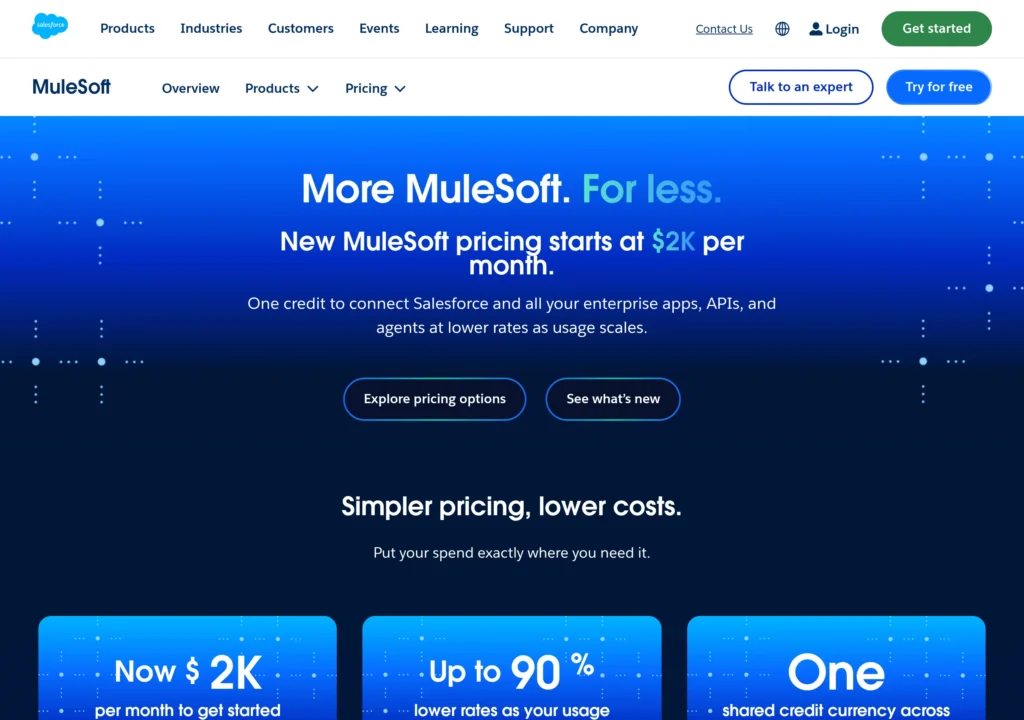
World one is the new model. Since 2026, new customers buy Anypoint Platform packages priced in Mule Credits, a shared consumption currency you spend across integrations, API management, automation, and AI agents. The storefront lists five packages, a starting price of $2,000 a month billed annually, and nothing else with a dollar sign on it. The per-credit rate is not published. The price of each individual package is not published. You pick a package, you talk to sales, you get a quote.
World two is the legacy vCore model. Existing customers still pay for vCores — virtual processor cores that run their integrations on CloudHub — in Gold, Platinum, and Titanium tiers. This is the model most of the older pricing guides describe, and it is the one with all those wild dollar figures floating around the internet. But MuleSoft no longer sells vCores to new customers. If you are buying for the first time, the vCore price list is history, not a menu.
Why does this matter? Because a quote from a 2024 blog post about vCores tells you nothing about what you will pay in 2026, and a 2026 article that lists a vCore price without saying “third-party estimate” is passing off a guess as a fact. This guide keeps the two worlds separate, and labels every figure as either published by MuleSoft or reported by a third party.
One more warning before we dive in: even MuleSoft’s own pricing page moved. The old address, mulesoft.com/platform/pricing, returned a 404 when we checked it on 17 November 2026. The $2,000-a-month figure below is reported consistently by six independent sources that read the official page in October and November 2026, including Zapier’s own pricing guide, updated 11 November 2026. We re-check the live page again before publishing, and the price note at the end of this article tells you exactly what was verified and when.
What Is a vCore? The Plain-English Version
Think of a vCore as a rented slice of a computer. One vCore is roughly one virtual processor core on MuleSoft’s CloudHub, and your integrations — the little programs that move data between Salesforce, your accounting tool, and your warehouse — run on those cores.
You do not buy vCores per user. You buy capacity. A small deployment might run on two vCores. A mid-size company might need eight. A large enterprise might run sixteen or more. And here is the catch that makes veterans groan: you commit to a fixed number of vCores for the whole contract term, and you pay for them whether you use them or not.
The tiers gate what you get around the cores. Gold is the core platform with a single environment and standard support. Platinum adds multiple environments, advanced monitoring, and a stronger service-level agreement. Titanium adds dedicated CloudHub infrastructure, a 99.99% uptime SLA, premium support, and a Technical Account Manager — a named human at Salesforce who actually answers.
So what does one vCore cost? MuleSoft publishes no list price, and the third-party estimates disagree by roughly ten times. Reveal Compliance puts Gold at about $1,250 per vCore per month, roughly $15,000 a year. Redress Compliance, working from benchmarked engagements, puts a production vCore at Platinum at about $8,000 a year. VendorBenchmark lists $40,000–$60,000 per production vCore per year, with a headline “average list price” of $80,000 a year, and notes that discounts of 45–65% off list are routinely negotiated. Another source cites $50,000–$70,000 per vCore per year.
Read that spread again: $8,000 to $80,000 for the same unit. That is not a rounding error. That is what happens when the vendor never publishes a price and every buyer negotiates in private. The honest way to present vCore pricing is as a range with named sources, never as a single confident number — and any article that gives you one tidy vCore price without a source is guessing.
The practical takeaway for a new buyer is simpler: you cannot buy vCores anymore anyway. The old model matters to you only in one way — it explains why the MuleSoft bill your enterprise friend complains about is six figures, and why the sales rep keeps steering the conversation toward “value” instead of a number.
The Five Mule Credits Packages
The new storefront sells five starting packages. Each one is a bundle of capabilities priced in Mule Credits, and each one covers a different job. This is the heart of MuleSoft pricing in 2026: five bundles, one published number. What follows is what MuleSoft’s page lists; the dollar price of each package beyond the $2,000-a-month floor is not published.
1. Govern APIs and AI
This is the API-management package: publish APIs, enforce policies, set token budgets for AI models. MuleSoft says it covers 70 million or more API and model calls a year. If your company has dozens of APIs and a governance headache, this is the door in.
2. Manage Agents
The AI-agent package: discover agents, orchestrate them, govern what they can touch, and set token budgets. It covers 180 million or more agent actions a year. This is MuleSoft’s Agent Fabric play — a registry and control layer for agents built anywhere, not just inside Salesforce.
3. Connect Apps
The classic integration package: connect applications, use prebuilt connectors, move data between systems. It covers 40 million or more records moved a year. If you pictured “MuleSoft connects Salesforce to NetSuite,” this is that package.
4. Process Documents
Document automation with intelligent document processing (IDP) plus low-code workflows. Think invoices, forms, and contracts that arrive as PDFs and need to become structured data. IDP is billed in Mule Credits too — third-party checks put it at 45 credits per page at the base tier, dropping to 27, then 10.8, then 4.32 credits per page at higher monthly volumes. No price per credit is published, so you still cannot turn that into dollars without a quote.
5. Access Everything
The full portfolio in one package: 340 million or more calls a year across apps, APIs, and agents. This is the “stop picking, take it all” option, priced accordingly — which is to say, priced in a sales meeting.
Two things to notice. First, the coverage numbers (70 million calls, 40 million records) sound enormous, and they are — but they are ceilings for the package, not promises about your bill. Your bill depends on the credit rate, which is unpublished, and the rate falls as volume grows, “by up to 90%” according to MuleSoft. Second, there is a 30-day free trial of Anypoint Platform that needs no credit card and opens the full portfolio. That trial is genuinely useful: it is the only way to touch the product before a sales call.
The Three Ways to Buy MuleSoft
Even after you pick a package, you still have to pick a buying model. There are three, and they change the bill in ways the pricing page does not spell out.
Pre-Purchase. You buy a package plus a block of credits up front. There is no minimum credit purchase. This is the simplest model: pay first, spend down the credits. The risk is obvious — buy too many credits and you have prepaid for capacity you never use.
Pre-Commit. You commit to a yearly baseline and pay monthly as credits are drawn down. The catch is the minimum: a $50,000 annual commitment. That is more than double the $24,000-a-year starting price, which tells you something important about who this model is for. Pre-Commit is not a small-business model. It is a mid-market-and-up model with a five-figure floor.
Unlimited. A custom fixed annual price with uncapped credits and full portfolio access. MuleSoft says rates drop as usage grows, by up to 90%. “Unlimited” sounds reassuring until you remember the price is custom, which means it is whatever the negotiation produces — and whatever it produces, it will not be small.
None of these models lets you forecast your bill from public information, because the per-credit rate is unpublished. That is the single biggest practical difference between MuleSoft and the tools in the comparison table below. With Zapier, you can do the maths on a napkin: $19.99 a month, 750 tasks, done. With MuleSoft, the maths requires a sales rep.
The Hidden Costs and Gotchas
The subscription is the headline. The total cost of ownership is the story. Here is what the pricing page does not tell you, drawn from buyer guides and benchmarked engagements published in 2026.
Unused capacity is the quietest leak. Benchmarked engagements found that committed vCores ran 40–70% above peak production consumption. In plain English: for every 100 vCores a company paid for, roughly 29 to 41 sat idle. At the $8,000-a-year Platinum rate, that is $232,000 to $328,000 a year wasted. The new credit model has the same trap in a different shape: flows are billed on the highest number deployed in any single hour of the month, multiplied by workers and replicas — run two workers per app and the count doubles.
Renewal uplift is baked in. Renewals default to about 7% a year, and some accounts have seen 12%. At 7%, a $68,695 contract costs about $73,504 in year two and $78,649 in year three — $220,848 over three years for the subscription alone. Multi-year “ramp” deals cap the uplift but lock the quantity, so there is no true-down: unused capacity stays on the bill for the whole term.
Implementation is a second invoice. Typical implementation runs $75,000 to $300,000, and mid-market first-year total cost of ownership — subscription plus implementation plus specialist developers — is commonly $350,000 to $600,000 or more. One case study tells the story brutally: a $300,000 MuleSoft implementation replacing a 200-record-a-day sync that Salesforce Flow could have done in about 30 minutes. Flow costs $0, because it is included in Salesforce.
Specialist staffing is a permanent cost. Anypoint Studio needs Java and XML skills, and MuleSoft/DataWeave developers command $113,000 to $175,000 in salary, according to Glassdoor figures cited in January 2026. MuleSoft Composer, the no-code builder, is “very very limited” for advanced work, according to practitioners — teams build in Composer, hit its limits, and revert to Studio. Either way, you are hiring or contracting a specialist.
Premium connectors cost extra. Connectors for SAP, Oracle, and similar enterprise systems carry separate licensing. Third-party estimates put a premium connector at roughly $10,000 to $15,000 a year each, and one buyer guide puts the uplift at 15–40% on top of the platform tier. If your integration list includes two or three premium systems, that is a second subscription hiding inside the first.
Support is gated by tier. Your support level depends on your edition — Gold gets standard support, Titanium gets premium support plus a Technical Account Manager. Premium support is bundled into the negotiated price, not published separately, so you cannot price it and you cannot decline it.
Bundling hides the price. Folding MuleSoft into a Sales Cloud or Service Cloud renewal obscured its unit price by 20–35%, according to one buyer guide. That is convenient for the vendor and terrible for you, because you cannot tell whether the MuleSoft line item went up, down, or sideways at renewal time.
And the exit is not free either. Switching off MuleSoft means rebuilding your DataWeave transformations and APIs somewhere else. Nobody publishes a migration cost, because it is a project, not a line item. Budget it as one.
One more 2026 note: MuleSoft RPA reached end of sale on 17 February 2026. If an old proposal still lists RPA as a line item, it is selling you a dead product.
The Competition: Workato Pricing and Reality Check
Workato is the closest enterprise rival, and it is the first place a MuleSoft shopper should look — because Workato actually publishes prices.
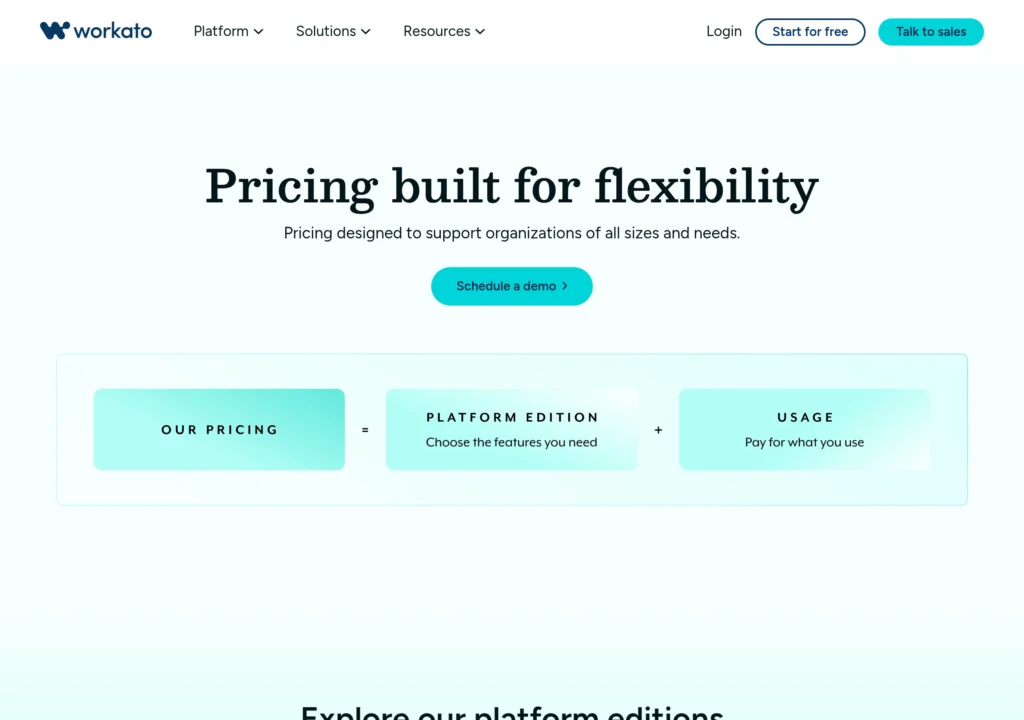
Workato‘s self-service Pro tiers, sold by card with a three-user cap per workspace, are $75 a month for 2,500 credits, $100 for 3,500, $275 for 10,000, $780 for 30,000, and $1,275 for 50,000 credits. There is also a Free plan: $0, with a one-time grant of 50,000 credits. Unused credits expire monthly — use them or lose them.
Above Pro, the enterprise editions (Standard, Business MCP, Enterprise MCP, and Workato ONE) are quote-only, with a platform fee plus usage plus add-ons. Third-party estimates put mid-enterprise Workato at $30,000 to $150,000 a year, and large enterprise at $200,000 to $500,000. Those are big numbers — but notice the difference: Workato gives you a $75-a-month front door. MuleSoft’s front door is $2,000 a month.
Workato has its own gotcha, and it is a serious one: Workato does not publish how many credits one task or action consumes. You know the price of the credits, but you cannot convert credits into a cost per task in advance. You learn it by running the thing and watching the meter. Still, a published credit price beats an unpublished one — you can at least do rough maths before the sales call.
Buyer data sharpens the comparison. Vendr’s median for Workato is $64,544 a year, close to MuleSoft’s $68,695 median. The medians are similar; the floors are not. A small team can start on Workato Pro at $75 a month and grow. On MuleSoft, the smallest possible start is $2,000 a month.
Who is Workato actually best for? Mid-size companies that need enterprise-grade integration and can afford a four-figure monthly bill, but want to start small and see the price before they commit. It is not a small-business tool either — but it is a much cheaper on-ramp to the same neighbourhood.
The Competition: Tray.ai Pricing and Reality Check
Tray.ai (formerly Tray.io) is the second rival, and it is a useful cautionary tale about reading pricing pages carefully.
Tray’s iPaaS plans — Pro, Team, and Enterprise — are all quote-only, with “sized to your needs” where the price should be. The plans differ in workspaces (Pro gets 3, Team gets 20, Enterprise is unlimited), insight history (7 days, 30 days, 180 days), and enterprise features like SSO, HIPAA, and regional hosting on the top tier.
Here is the trap: Tray’s pricing page also shows a $50-a-month figure, and plenty of roundups quote it as “Tray pricing.” That $50 is Tray HELIX Builder Edition — $50 per workspace per month plus usage — a separate product for building AI apps. It is not the iPaaS price. Presenting $50 as the cost of Tray’s integration platform is wrong, and we flag it here so you do not repeat the mistake.
What Tray does publish is its meter. A task is counted when a trigger fires (one task), when each connector or service step runs (one task each), and when each loop or boolean pass executes (one task each). Retries are free. There are no per-user, per-connection, or per-runtime fees. The annual volume commitment is a fixed annual cost, and overage is settled at a “true-up” at the end of the term. There is a 30-day free trial with one million tasks, no credit card, and no sales call required — the most generous trial in this comparison.
Who is Tray.ai actually best for? Teams that run high-volume, step-heavy automations and want the meter spelled out in advance. The trial alone makes it worth testing before you sign anything with MuleSoft.
The Competition: Zapier, the Small-Business Baseline
Zapier is the baseline every small business already knows, and it is the yardstick that makes MuleSoft’s price legible.
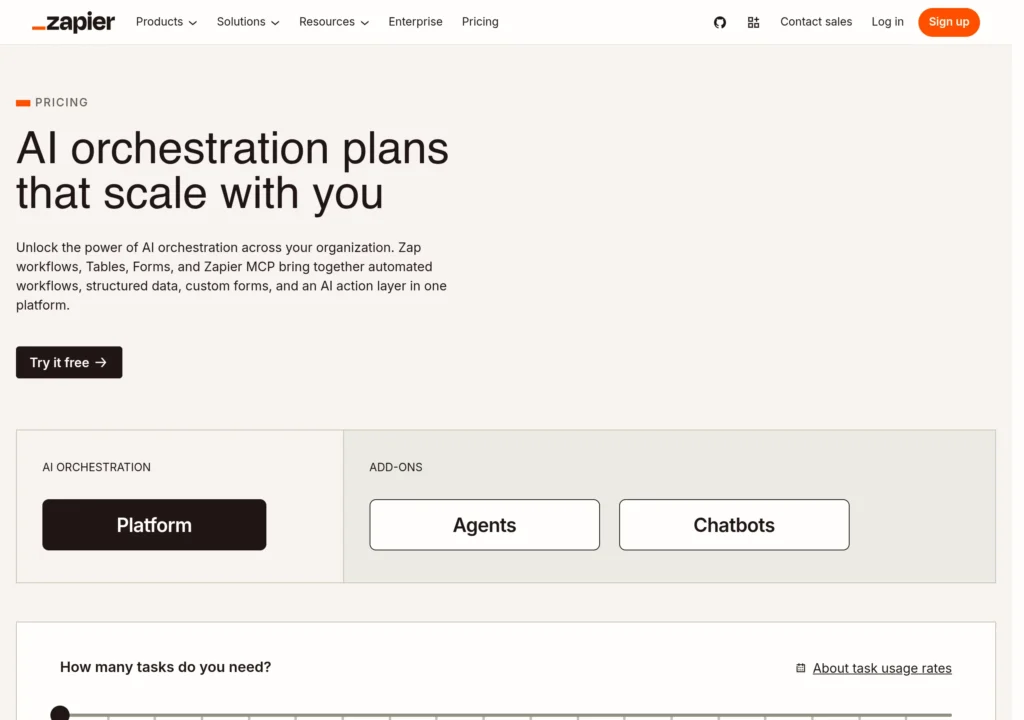
Zapier’s Free plan gives you 100 tasks a month, no credit card, no expiry. Professional is $19.99 a month billed annually for 750 tasks. Team is $69 a month billed annually for up to 25 users and 2,000 tasks. Enterprise is custom. And Zapier counts only completed tasks — triggers, filters, and branching do not count against your allowance.
Do the comparison that matters: Zapier Pro at $19.99 a month versus MuleSoft’s floor at $2,000 a month. That is a 100-times gap, for the same basic job of moving data between two apps. Zapier will not govern a hundred APIs or run a dedicated runtime. It was never built to. But if your job is “when a new order lands in Shopify, create an invoice in QuickBooks,” Zapier does it this afternoon, for twenty dollars, with no sales call and no implementation partner.
Who is Zapier actually best for? Almost every small business reading this blog. It is the default answer, and the burden of proof sits on the tool that costs 100 times more.
Head-to-Head Comparison Table
Here is MuleSoft pricing next to the three alternatives, at a glance.
| Tool | Starting price | Free option | Pricing model | Best for |
|---|---|---|---|---|
| MuleSoft | $2,000/mo billed annually ($24,000/yr) | 30-day trial, no free tier | Mule Credits (rate unpublished); quote-only above the floor | Salesforce-heavy enterprises with a dedicated integration team |
| Workato | $75/mo (Pro, 2,500 credits) | Free, one-time 50,000 credits | Credits per month; enterprise quote-only | Mid-size companies that want enterprise integration with a visible price |
| Tray.ai | Quote-only (iPaaS) | 30-day trial, 1M tasks | Tasks; annual commitment + true-up | High-volume automation teams that want the meter spelled out |
| Zapier | Free (100 tasks/mo); Pro $19.99/mo billed annually | Free forever, 100 tasks/mo | Completed tasks only | Small businesses that need automation today |
Cost-Maths: What a Full Stack Actually Costs
Prices only mean something at a fixed volume. Here is the same job priced four ways, using the figures verified for this article.
Scenario A — One small business, ten simple automations. Zapier Pro at $19.99 a month billed annually costs $239.88 a year. MuleSoft’s floor costs $24,000 a year. Same ten automations, 100 times the price, before a single hour of implementation. The gap is the whole story in one line.
Scenario B — The median MuleSoft buyer, year one. Vendr’s median contract is $68,695 a year. Add a mid-range implementation of $150,000 (the middle of the typical $75,000–$300,000 range) and year one costs $218,695. That is the number to put in front of your CFO, not the $24,000 floor.
Scenario C — The same contract, three years, with renewal uplift. At the default 7% annual uplift, the subscription alone costs $68,695 in year one, about $73,504 in year two, and about $78,649 in year three — $220,848 over three years, before implementation, premium connectors, or a single developer salary. At a 12% uplift, which some accounts have seen, the three-year subscription total rises to about $231,000.
Scenario D — The Workato on-ramp. Workato Pro at 10,000 credits costs $275 a month, or $3,300 a year. That is roughly one-eighth of MuleSoft’s $24,000 floor, for a tool that does enterprise integration with a published price and a self-service checkout. The trade-off is the unpublished credit-to-task conversion — you cannot price a single task in advance — but the order of magnitude is not in doubt.
Scenario E — What MuleSoft must earn back. At the $24,000-a-year floor, MuleSoft has to save or earn $2,000 a month to break even. If a staff hour costs your business $35, that is about 686 hours a year, or roughly 13 hours a week, every week, of genuinely eliminated work. At the $68,695 median, the break-even is about 1,963 hours a year — essentially one full-time employee’s entire year. If you cannot name the 13 hours a week (or the full-time role) that MuleSoft removes, you are buying a platform, not a saving.
Run these numbers through our AI Cost Calculator before you sign anything — it is free, and it will do this exact break-even maths for your own stack.
Who Is Each Tool Actually Best For?
MuleSoft is best for a Salesforce-heavy enterprise with a dedicated integration team, dozens of APIs to govern, and a six-figure budget that nobody has to justify line by line. If you have a DataWeave developer on staff and a compliance team asking for API policies, MuleSoft is genuinely the right tool. If you do not have those things, it is a very expensive way to learn that.
Workato is best for a mid-size company that needs enterprise-grade integration, wants to see a price before the sales call, and can start at $75 a month and grow into a negotiated enterprise deal. It is the sensible middle of this table.
Tray.ai is best for a team running high-volume, step-heavy automations that wants the meter explained in advance and a million-task trial to test with. The quote-only iPaaS pricing is a real drawback, but the trial is the most generous here.
Zapier is best for almost every small business. If your automations number in the tens rather than the hundreds, and your integrations number in the single digits, Zapier Pro at $19.99 a month is the answer, and the remaining $23,760 a year stays in your business.
Make Smarter Software Decisions
Here is the uncomfortable truth this whole teardown points to: the most expensive part of MuleSoft is not the subscription. It is the decision to buy a platform built for a 500-person integration team when your company has five people and a spreadsheet.
Before you take a sales call, do the maths on your own stack. Our free AI Cost Calculator adds up what your current tools cost, what the new tool would cost at your real volume, and what it has to save to pay for itself — the same break-even test from Scenario E, with your numbers instead of ours. If MuleSoft still wins after that, take the call with confidence. If it does not, you just saved yourself a quarter and a six-figure contract.
Pros and Cons
Pros of MuleSoft
- The most complete API governance platform in this comparison: policies, token budgets, agent orchestration, and a 30-day free trial of the full portfolio.
- Deep Salesforce integration — it is a Salesforce product, and inside a Salesforce-heavy stack that matters.
- Genuinely enterprise-grade runtime: dedicated infrastructure, 99.99% SLA at the top tier, and a named Technical Account Manager.
- The new Mule Credits model is at least a step toward usage-based pricing, and the five packages map cleanly to real jobs.
Cons of MuleSoft
- The $2,000-a-month floor is 100 times Zapier Pro, and the median buyer pays $68,695 a year — before implementation.
- Almost nothing above the floor has a published price, so you cannot forecast your bill without a sales rep.
- Implementation typically costs $75,000–$300,000, and you will likely need a specialist developer at $113,000–$175,000 a year.
- Renewal uplift of about 7% a year, no true-down on multi-year deals, and premium connectors at roughly $10,000–$15,000 a year each.
- No free tier, and the vCore model most old guides quote is no longer sold to new customers.
Our Verdict
Buy MuleSoft if you are a Salesforce-heavy enterprise with a dedicated integration team, complex API governance needs, and a budget that starts at six figures. In that world, it is the right tool, and the price is the price of admission.
Do not buy it if you are a small business. The floor alone — $24,000 a year — is more than most small businesses spend on all their software combined, and the median buyer’s $68,695-a-year reality, plus implementation, puts it in a different universe from the $19.99-a-month Zapier Pro plan that does the same ten automations.
Start with Zapier. If you outgrow it, look at Workato Pro at $75 a month. Take the MuleSoft sales call only when you can name the full-time role, or the 13 hours a week, that it eliminates. And before any of that, run your own numbers through the AI Cost Calculator — it takes five minutes and it has saved more than one reader from a very expensive quarter.
Frequently Asked Questions
How much does MuleSoft cost?
MuleSoft pricing starts at $2,000 a month billed annually, or $24,000 a year. Buyer data from Vendr puts the median contract at $68,695 a year, with a range from about $8,000 to more than $281,000. Implementation typically adds $75,000 to $300,000 in the first year.
Does MuleSoft have a free plan?
No. There is no free tier. There is a 30-day free trial of Anypoint Platform that needs no credit card and opens the full portfolio. By contrast, Zapier has a free plan forever (100 tasks a month) and Workato has a free plan with a one-time grant of 50,000 credits.
What is a vCore, and do I need to buy one?
A vCore is roughly one virtual processor core on MuleSoft’s CloudHub that runs your integrations — you buy capacity, not users. New customers do not buy vCores at all: MuleSoft stopped selling them to new customers in 2026, and new contracts use Mule Credits packages instead. The Gold, Platinum, and Titanium vCore tiers remain only for existing customers.
Is MuleSoft worth it for a small business?
For almost every small business, no. The $2,000-a-month floor is 100 times Zapier Pro at $19.99 a month, and the median buyer pays $68,695 a year before implementation and staffing. MuleSoft is built for enterprises with dedicated integration teams. A small business should start with Zapier, and look at Workato Pro at $75 a month if it outgrows Zapier.
Why is MuleSoft so expensive?
Three reasons. First, it is enterprise API infrastructure with dedicated runtime, governance, and a 99.99% SLA — not a workflow tool. Second, almost everything above the starting price is negotiated, and enterprise sales processes produce enterprise prices. Third, the total cost includes implementation ($75,000–$300,000 typical) and specialist developers ($113,000–$175,000 salary), which the subscription price never shows.
Price Note
Price note — updated 17 November 2026: Prices in this post were checked on 17 November 2026. When you are reading this, the price may be lower or higher — always check the official pricing page before you buy. Only the $2,000-a-month starting price comes from MuleSoft’s own pricing page, as reported by multiple independent sources; every other MuleSoft figure in this post is a third-party estimate or buyer dataset, and the sources are named where the figure appears.
Pros
- The most complete API governance platform in this comparison: policies, token budgets, agent orchestration, and a 30-day free trial of the full portfolio.
- Deep Salesforce integration — it is a Salesforce product, and inside a Salesforce-heavy stack that matters.
- Genuinely enterprise-grade runtime: dedicated infrastructure, 99.99% SLA at the top tier, and a named Technical Account Manager.
- The new Mule Credits model is at least a step toward usage-based pricing, and the five packages map cleanly to real jobs.
Cons
- The $2,000-a-month floor is 100 times Zapier Pro, and the median buyer pays $68,695 a year — before implementation.
- Almost nothing above the floor has a published price, so you cannot forecast your bill without a sales rep.
- Implementation typically costs $75,000–$300,000, and you will likely need a specialist developer at $113,000–$175,000 a year.
- Renewal uplift of about 7% a year, no true-down on multi-year deals, and premium connectors at roughly $10,000–$15,000 a year each.
- No free tier, and the vCore model most old guides quote is no longer sold to new customers.
Buy MuleSoft if you are a Salesforce-heavy enterprise with a dedicated integration team, complex API governance needs, and a budget that starts at six figures. In that world, it is the right tool, and the price is the price of admission. Do not buy it if you are a small business. The floor alone — $24,000 a year — is more than most small businesses spend on all their software combined, and the median buyer's $68,695-a-year reality, plus implementation, puts it in a different universe from the $19.99-a-month Zapier Pro plan that does the same ten automations. Start with Zapier. If you outgrow it, look at Workato Pro at $75 a month. Take the MuleSoft sales call only when you can name the full-time role, or the 13 hours a week, that it eliminates. And before any of that, run your own numbers through the AI Cost Calculator — it takes five minutes and it has saved more than one reader from a very expensive quarter.