

For a solo business coach running 12 clients and 24 sessions a month, Satori's Blaze plan is the coaching-specific first buy: $97 a month, or $1,164 a year, with session analysis, proposals, scheduling, billing, and a client portal in one login. Paperbell costs $970 a year with unlimited clients and a full website, but names no AI assistant. Fathom Premium adds advanced session summaries for $192 a year. Calendly Standard books the calls for $120 a year. Claude Pro drafts recaps and offers for $200 a year.
A business coach rarely loses the evening inside the session. The leak starts after it: the recap typed from memory at 9pm, the action steps half-remembered, the discovery call that never got a follow-up because the notes are still sitting in a notebook.
That is the work the best ai tools for business coaches are meant to absorb. The honest version is narrower than the badges suggest. One tool records and summarises every session. One runs the whole coaching business behind a website but names no AI assistant. One analyses your sessions and feeds the insights back into your offers. One books the calls and, on its Plus plans, takes the notes too. One drafts the recaps and program material between sessions.
We compared five tools for the same solo business coach and checked every price on the vendor’s own page on 26 November 2026. No roundup prices, and no tool here pays us anything. Where a vendor does not print a fee or a trial term, we say so instead of filling the gap with a guess.
Quick Answer
For a solo business coach running 12 clients and 24 sessions a month, Satori’s Blaze plan is the coaching-specific first buy: $97 a month, or $1,164 a year, with session analysis, proposals, scheduling, billing, and a client portal in one login. Paperbell costs $970 a year with unlimited clients and a full website, but names no AI assistant. Fathom Premium adds advanced session summaries for $192 a year. Calendly Standard books the calls for $120 a year. Claude Pro drafts recaps and offers for $200 a year.
In this article
- How we compared the best ai tools for business coaches
- The five tools at a glance
- Fathom: session notes that start free
- Paperbell: the whole coaching business, with no AI badge
- Satori: session analysis priced by the month
- Calendly: booking first, AI notes on Plus
- Claude: drafting between sessions, metered by usage
- The maths: what five tools really cost a solo business coach
- Five traps that catch business coaches
- What to buy first
- Pros and cons
- Our verdict
- Frequently asked questions
How we compared the best ai tools for business coaches
Every price in this guide is for the same imaginary practice: one solo business coach, 12 active clients, two sessions per client each month. That is 24 sessions a month and 288 sessions a year. Where a vendor charges per user, per client, or per analysed session, we run those same 24 monthly sessions through the formula.
We judged each tool on five things: year-one cost at 24 sessions a month; whether the AI is real and which plan unlocks it; whether notes, scheduling, payments, and the client portal live in one system; how price moves as the client list grows; and which fees stay unprinted.
One honesty note before the numbers. These five tools do three different jobs. Fathom and Claude work on the session itself: capture, summaries, and drafting. Paperbell and Satori run the practice: website or portal, scheduling, packages, and billing. Calendly books the calls. You would run one practice platform, add capture or drafting where the work demands it, and never pay for two practice platforms at once.
The AI labels also vary in honesty. Fathom sells AI summaries and action items. Satori’s Insights layer analyses sessions and discovery calls. Calendly’s Notetaker and Callie sit on its Plus plans. Claude is a general AI assistant with usage limits instead of a session meter. Paperbell’s pricing and FAQ pages name no AI assistant at all. We price each tool for the job it actually does, not the badge on the homepage.
One more question runs under every price here, because coaches keep asking it: consent. A session recording holds a client’s business, money, and doubts. Before any notetaker joins a call, the client should know it is there, what it captures, and how to say no. We flag each tool’s controls where the vendor prints them.
The five tools at a glance
| Tool | Best for | Starting price | Free plan or trial | Year-one cost at 24 sessions a month |
|---|---|---|---|---|
| Fathom | Session recording, summaries, and action items | Free; Premium $16 a month billed annually | Free forever; free trial on Premium | Premium $192 a year |
| Paperbell | Website, packages, payments, and client portal | $97 a month, or $970 a year | Free account, no credit card required | $970 a year on annual billing |
| Satori | Session analysis plus proposals and billing | Spark $9 a month for first two clients | No free plan printed on the pricing page | Blaze $1,164 a year for 24 analysed sessions |
| Calendly | Booking, reminders, and payments at booking | Free; Standard $10 a seat billed yearly | Free plan; 14-day trial | Standard $120 a year for one seat |
| Claude | Recaps, offers, and program drafting | Free; Pro $17 a month billed annually | Free plan with usage limits | Pro $200 a year |
The table hides the two numbers that decide most real bills. The first is the meter: Satori counts analysed sessions, Calendly counts seats, and Claude counts usage in five-hour and weekly windows. The second is overlap: Paperbell, Satori, and Calendly all schedule sessions, so buying all three means paying three times to fill one calendar. The sections below price both.
Fathom: session notes that start free
Fathom is an AI notetaker for Zoom, Google Meet, and Microsoft Teams calls. For a business coach, the chain is short: the session is recorded and transcribed, an AI summary lands after the call, and the recap you used to type from memory starts as a draft you correct instead of a blank page you fill.
The free plan is the headline, and it is real. Fathom’s pricing page lists Free at $0, free forever, with unlimited recordings and transcriptions, instant AI call summaries, and clips, playlists, and search across your calls. You choose bot-free capture, still in beta, or bot capture. For a coach testing whether clients accept a notetaker at all, that free tier answers the question before any card comes out.
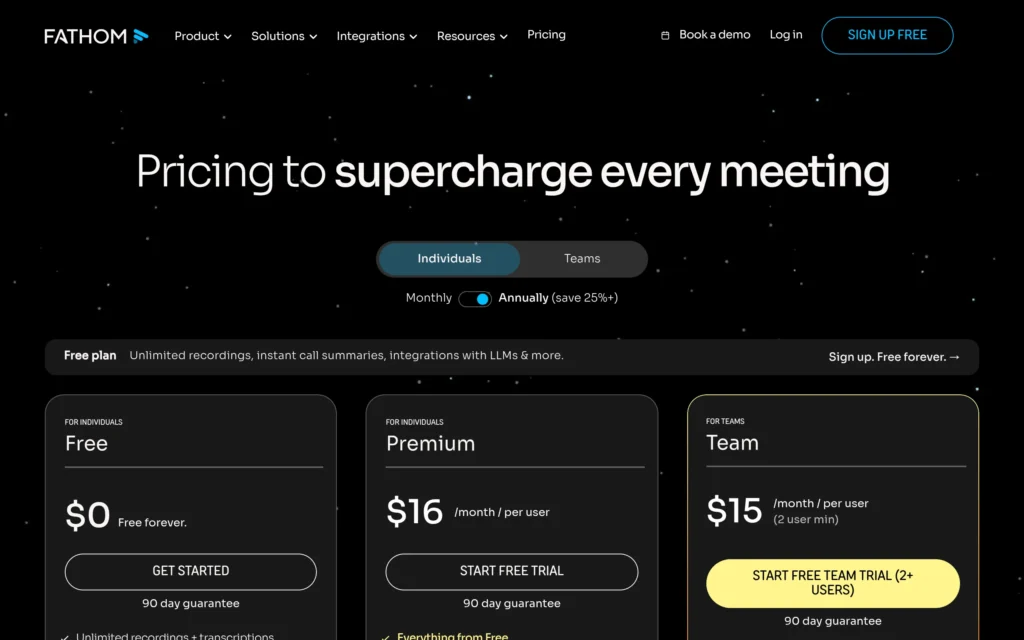
Premium is where the summaries grow up. The page lists Premium at $16 a month per user on annual billing, or $20 month-to-month. Premium adds advanced call summaries, AI-generated action items, a conversational meeting assistant you can question about a call, and integrations with your AI tools. At $192 a year on annual billing, Premium costs $0.67 per session across 288 sessions. Month-to-month billing makes it $240 a year, so the annual toggle is worth $48.
The trap sits on the card beside it. Team costs $15 a month per user on annual billing, which looks cheaper than Premium until you read the small print: two users minimum. A solo coach cannot buy one Team seat. The smallest Team bill is $360 a year, nearly double Premium. Business, with CRM sync and coaching scorecards, starts at $25 a month per user on annual billing, also with a two-user minimum. The solo price is Premium, whatever the Team card suggests.
On consent, Fathom gives you a choice of capture: a visible bot, or bot-free capture in beta. Either way, the recording exists, and your coaching agreement should say so before the first session. The pricing page also shows a free trial button and a 90-day guarantee on Premium, though the page we checked does not print the trial length. Fathom does one job, session capture, and does not book calls, sell packages, or hold a client portal. Pair it with a practice platform and the notes finally have somewhere to live.
Paperbell: the whole coaching business, with no AI badge
Paperbell is an all-in-one platform built for one-person coaching businesses. A client finds your Paperbell website, picks a package, books a session, signs the contract, and pays in one checkout. You see every appointment, payment, and remaining session in one dashboard. For a coach tired of stitching a website builder, a scheduler, a payment tool, and a contract tool together, that consolidation is the product.
Pricing is the simplest on this page: one plan, $97 a month, or $970 a year with two months free. Both include unlimited clients, unlimited packages, unlimited contracts, unlimited appointments, and unlimited traffic. There is no per-client fee and no upgrade when client thirteen arrives. Payments run through your own Stripe or PayPal account, and Paperbell states it adds no extra transaction fees on top. Your processor’s own fees still apply, and Paperbell’s pages do not print that rate, so confirm it with Stripe or PayPal before you price a package.
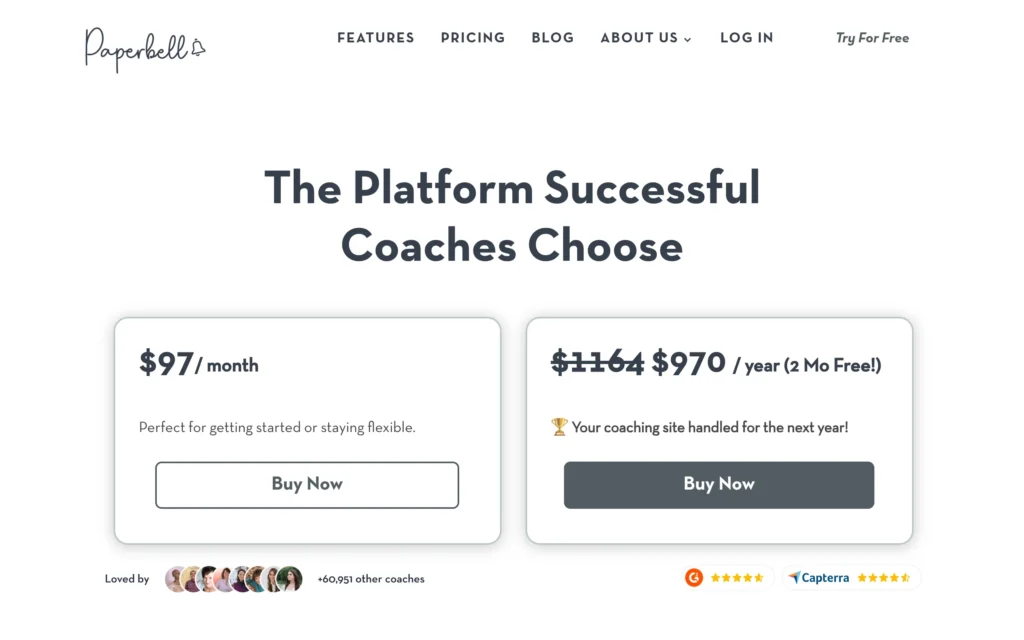
The details a coach feels weekly are all included. Scheduling handles time zones, buffer times, and reminder emails, with two-way sync to Google Calendar, Outlook, and Apple iCal. Contracts run through Dropbox Sign with no separate account. Intake surveys sit inside onboarding. Payment plans and monthly subscriptions charge automatically through Stripe. A free account, no credit card required, lets you build the site and packages before choosing a paid plan.
Two limits are printed plainly, and both matter. Paperbell is not HIPAA compliant, which rarely binds a business coach but rules it out for health-adjacent work with protected information. Each account serves one coach, so a two-coach practice buys two accounts, with a 15% discount on extra accounts for the same company. There is also no native mobile app; it works in a mobile browser.
On AI, honesty matters. Paperbell’s pricing and FAQ pages name no AI assistant. Nothing here records your session, drafts your recap, or analyses your discovery calls. At $970 a year, Paperbell costs $3.37 per session across 288 sessions, and every cent buys business infrastructure: website, booking, checkout, contracts, and portal. That is a fair price for that job. It is the wrong purchase if the buying reason was AI session notes, because that job belongs to Fathom or Satori in this comparison.
Satori: session analysis priced by the month
Satori is a coaching platform with an AI layer called Insights, and it is the only tool here built around the session itself. Every plan includes the full platform: Insights, proposals, enrolment, scheduling, billing, and a client portal. The plans differ only in capacity, which makes the pricing page unusually easy to read.
Insights is the AI claim, and it is specific. A visible notetaker joins your session to record and transcribe the conversation. Satori then surfaces what matters from each conversation, reads discovery calls for clarity, urgency, alignment, and readiness, helps shape an offer around what a prospect values, and tracks each client’s growth across sessions through insights, breakthroughs, and wins. It also gives feedback on your coaching approach. For a business coach, that discovery-call reading is the feature no other tool here sells.
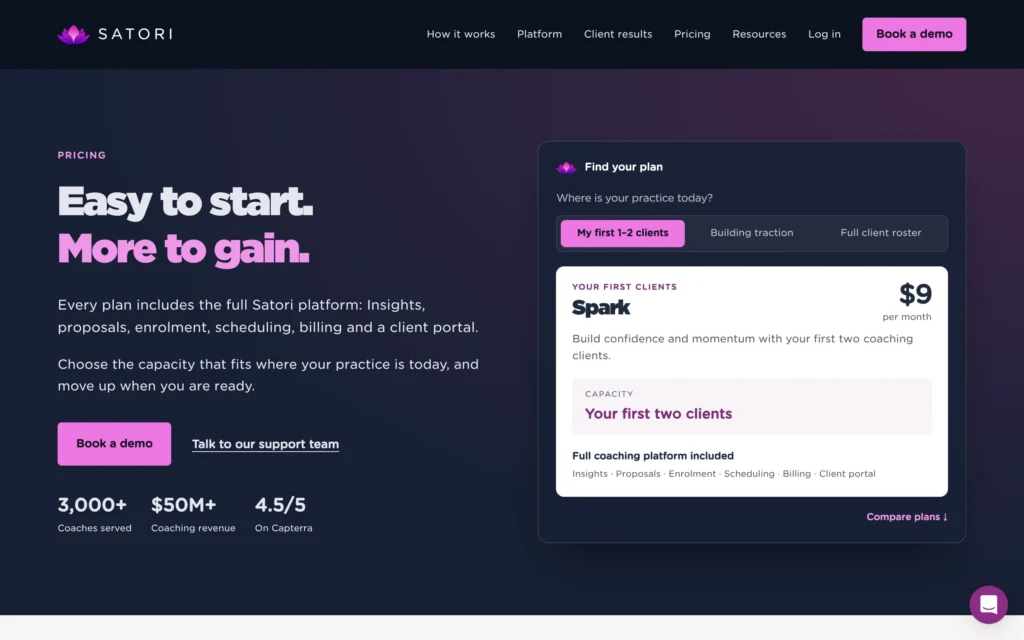
The meter is analysed sessions. Spark costs $9 a month for your first two coaching clients, with unlimited discovery sessions included. Kindle costs $57 a month for 12 analysed sessions a month. Blaze costs $97 a month for 24 analysed sessions a month. Monthly session limits apply to analysis, not appointment bookings, so a busy booking calendar never blocks a client from scheduling. Prices are monthly in US dollars; the page we checked prints no annual price, so budget on the monthly figure times twelve.
At 24 sessions a month, Blaze fits exactly, and only exactly. Its $1,164 a year works out to $4.04 per session. Kindle at $684 a year covers half your sessions, which suits a coach who analyses discovery calls and milestone sessions but not every weekly check-in. Spark suits a coach with two clients and a plan to move up. Session twenty-five in a month pushes past Blaze, and the page’s answer for higher needs is to talk to their team, so price that conversation before your roster grows into it.
Privacy controls are printed rather than promised. Satori states you choose when Insights is used and can switch it off during a call, that deletion is permanent, and that it does not use your data to train AI models. The notetaker is visible, which helps the consent conversation: the client sees the third presence in the room. The pricing page we checked prints no free plan and no trial length, and pushes a demo instead. Treat that as a question to settle on the demo call, not a term to assume.
Calendly: booking first, AI notes on Plus
Calendly does one job deeply: it fills your calendar without the email tennis. A client picks a time, gets a confirmation, and receives reminders before the session. For a coach, the useful chain is the booking page on your website, the buffer between sessions, and the follow-up automation after a discovery call.
The free plan covers one event type and one connected calendar, with unlimited meetings. That suits a coach with a single discovery-call link. Standard is where it becomes a business tool: unlimited event types, up to six calendars checked for conflicts, group and collective events, automated reminders and follow-ups, and Stripe or PayPal payments at booking. Calendly lists Standard at $10 a seat a month billed yearly, or $12 billed monthly. For one coach, that is $120 a year, or $0.42 per session across 288 sessions.
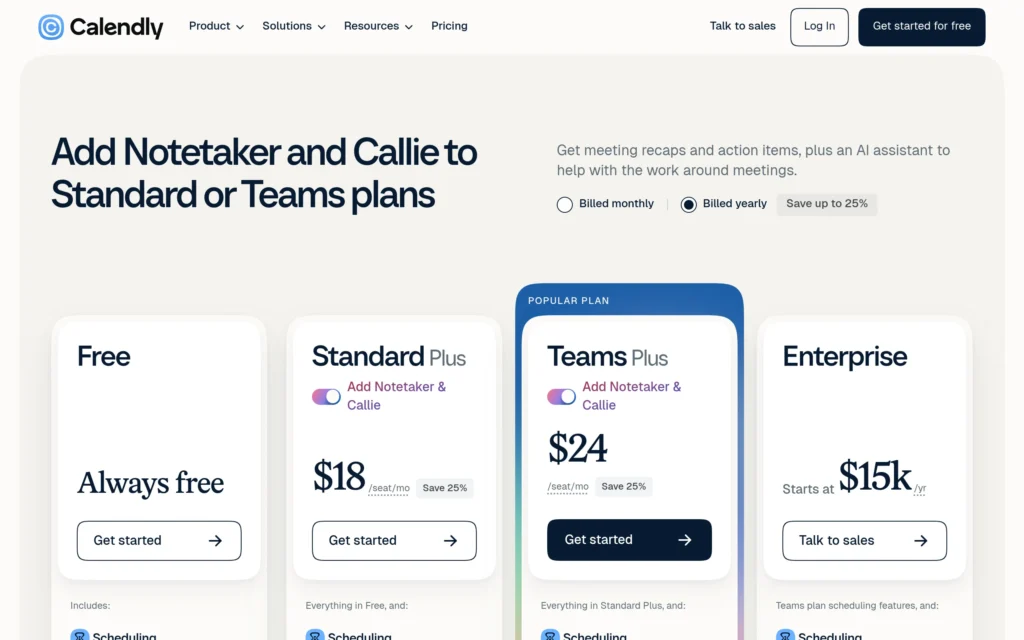
The AI lives on the Plus plans, and the pricing page opens with the AI toggle already on. Standard Plus costs $18 a seat a month billed yearly and adds Notetaker, which records Zoom, Google Meet, and Microsoft Teams meetings and produces recaps with decisions and action items, plus Callie, an AI assistant that coordinates scheduling over email. Teams Plus costs $24 a seat billed yearly and adds round-robin routing and admin controls a solo coach rarely needs. Enterprise starts at $15,000 a year. A 14-day trial downgrades to the Free plan when it ends.
That Plus toggle changes the maths. Standard Plus at $216 a year covers scheduling and AI notes in one seat. Standard plus Fathom Premium costs $312 a year for the same two jobs. If you already live in Calendly, the Plus upgrade is the cheaper route to session notes by $96 a year. If you want Fathom’s deeper summaries and cross-call search, the separate notetaker earns its place.
Calendly’s limit is scope. It books sessions and, on Plus, summarises them. It does not sell coaching packages with session tracking, sign contracts, or hold a client portal with notes and resources. A coach who needs packages and contracts should read the Paperbell and Satori sections first, and treat Calendly as the booking layer it is.
Claude: drafting between sessions, metered by usage
Claude is a general AI assistant, and for a business coach its job sits between sessions. Paste your rough notes and it drafts the recap. Feed it a discovery-call summary and it shapes the follow-up email. Ask it to turn a framework you already teach into a worksheet, and the first version arrives in minutes instead of an evening.
Pricing is per person and published in US dollars, before tax. The free plan costs $0 with limited usage every five hours and every week. Pro costs $17 a month with an annual subscription, $200 billed up front, or $20 billed monthly. Pro adds more usage, Projects to organise chats and documents, Research, access to more models, and Claude Code. Max costs $100 a month for five times Pro’s usage, and Ultra costs $200 a month for ten times the weekly usage with no five-hour limit on verified accounts.
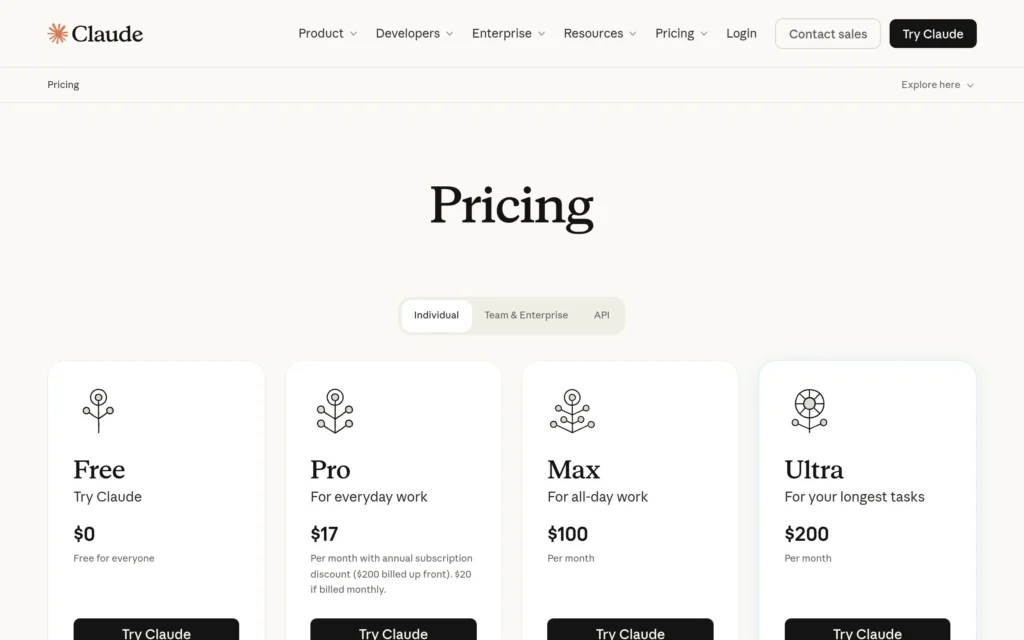
The meter is the part to understand before you build a workflow on it. Anthropic states there is no fixed message count: limits reset on a rolling five-hour window with a weekly cap on top, and how fast you reach them depends on the model, chat length, and file size. Pro gives at least five times more usage per five-hour session than Free. A coach drafting 24 recaps a month in short chats will rarely feel that ceiling. A coach pasting full transcripts and long documents all day might.
At $200 a year on annual billing, Pro costs $0.69 per session across 288 sessions. Month-to-month billing makes it $240, so the annual plan saves $40. The discipline matters more than the price: the draft is Claude’s, the note is yours. A model turns scribbles into tidy paragraphs quickly, and it turns your suggestion into the client’s commitment just as fast. Read every line against what the client actually said before anything enters the file, and keep names, employers, and figures out of prompts where the work allows.
Claude’s limit is scope. It does not join your calls, book your sessions, or hold a client portal. It is the drafting layer, and it pairs with a notetaker or a platform rather than replacing either.
The maths: what five tools really cost a solo business coach
Start with the practice platform, because every coach needs exactly one. Paperbell costs $970 a year on annual billing. Satori Blaze costs $1,164 a year at the monthly rate. Those two overlap on scheduling, billing, and the client portal, so buying both means paying $2,134 a year for two front doors to the same client. Pick the platform whose depth matches the pain: Paperbell for the website and unlimited clients, Satori for session analysis and discovery-call insight.
Per session, at 288 sessions a year, the subscriptions run $0.67 for Fathom Premium, $3.37 for Paperbell, $4.04 for Satori Blaze, $0.42 for Calendly Standard, and $0.69 for Claude Pro. The per-session view is the honest one for a solo coach, because software is a fixed cost spread over however many sessions actually happen. A quiet month does not shrink the subscription. It raises the cost hiding inside every session.
Now add the overlaps the headlines hide. Paperbell plus Fathom Premium costs $1,162 a year. Satori Blaze alone costs $1,164 a year. Two dollars separate a website platform with a separate notetaker from one platform that analyses sessions itself. The choice is not price. It is whether you want a public website and unlimited clients, or discovery-call analysis and growth tracking in the same login as billing.
The stack test shows the real saving. Buying Fathom Premium at $192, Paperbell at $970, Satori Blaze at $1,164, Calendly Standard at $120, and Claude Pro at $200 together costs $2,646 a year, or $9.19 per session. Running Satori Blaze plus Claude Pro instead costs $1,364 a year, or $4.74 per session, and covers session analysis, proposals, scheduling, billing, the client portal, and drafting in two logins. The difference is $1,282 a year, which is the price of the duplicate platform, the second scheduler, and the notetaker you did not buy. Add Paperbell only when the website becomes the bottleneck, and add Fathom only when its summaries beat the analysis you already have.
Growth flips some of the order: analysed-session meters grow with your roster, seat prices grow with your team, and usage caps grow with your drafting habits. Price each tool at next year’s workload.
Five traps that catch business coaches
First, the two-user minimum under the cheaper card. Fathom Team at $15 a month per user looks cheaper than Premium at $16, until the two-user minimum makes the smallest Team bill $360 a year. A solo coach pays the Premium price. Read the minimum before you compare per-user figures.
Second, the analysed-session meter. Satori Blaze covers 24 analysed sessions a month, and session twenty-five pushes past the published tiers into a sales conversation. Kindle covers 12. Count last month’s sessions honestly, including discovery calls you want analysed, before choosing the tier.
Third, the AI toggle on the pricing page. Calendly’s page opens with Notetaker and Callie switched on, showing Standard Plus at $18 a seat. Standard without AI is $10. The feature in the headline and the price in the headline are rarely the same tier. Find the toggle before you compare prices.
Fourth, the unprinted fee. Paperbell states it adds no extra transaction fees, and payments run through your own Stripe or PayPal account. Neither Paperbell nor Satori prints your processor’s rate on the pages we checked. Where a vendor prints no rate, treat the missing number as a cost you have not been shown, not a cost of zero, and confirm it with your processor before you price a package.
Fifth, the consent gap. A notetaker changes the room. Satori’s notetaker is visible and can be switched off during a call, and Fathom offers bot-free capture in beta beside its bot. Neither control replaces telling the client, in your agreement and out loud, that a tool is recording and summarising the session, and what happens if they say no.
What to buy first
Buy one practice platform first, and let the session work decide the rest. A solo coach whose pain is recaps, discovery-call follow-up, and proving client progress should start with Satori, run Spark or Kindle on real sessions, and watch whether the Insights feedback survives contact with paying clients. At 24 sessions a month, budget on Blaze at $97 a month.
A coach whose pain is the missing website, package checkout, and contract chasing should start with Paperbell’s free account, build the site, and add Fathom’s free plan for session notes before paying for either. A coach who only needs booking should start with Calendly Free, move to Standard when one event type stops being enough, and weigh Standard Plus against a separate notetaker. Our Calendly vs Cal.com comparison covers the booking choice in more depth if scheduling is the deciding factor.
Add Claude Pro when drafting becomes weekly work; at $200 a year it is the cheapest upgrade here after Calendly. Whichever platform wins your trial, the discipline is the same: one practice platform, priced at next year’s workload, with consent settled before the first recorded session.
Our free AI Cost Calculator takes the prices above and turns them into a monthly and yearly figure for your own client count and session volume, so you can test the analysed-session meters and seat prices before any trial starts. Run your real numbers there, then trial the cheapest setup that survives your busiest month.
Pros and cons
Fathom. Pros: a genuinely free plan with unlimited recordings and transcriptions; instant AI summaries on every tier; Premium adds advanced summaries, AI action items, and a conversational assistant for $192 a year; a choice of bot or bot-free capture. Cons: the cheaper Team price needs two users minimum, so solo coaches pay Premium; capture and summaries only, with no booking, packages, or client portal; the pricing page we checked does not print the trial length.
Paperbell. Pros: website, scheduling, package checkout, contracts, and client portal in one account; unlimited clients, packages, and contracts on one flat price; payments go to your own Stripe or PayPal with no extra Paperbell transaction fees; a free account with no credit card required. Cons: the pricing and FAQ pages name no AI assistant, so session notes need another tool; not HIPAA compliant; one coach per account; no native mobile app.
Satori. Pros: the full platform on every plan, with session analysis, discovery-call reading, and growth tracking; monthly limits apply to analysis, not bookings; printed privacy controls, including switching Insights off during a call and no training on your data; Spark starts at $9 a month for your first two clients. Cons: Blaze stops at 24 analysed sessions a month, with higher needs handled by their team; no annual price printed on the page we checked; no free plan or trial length printed there either.
Calendly. Pros: a free plan for one event type; Standard adds unlimited event types, six calendars, automations, and payments at booking for $120 a year; Standard Plus bundles Notetaker and Callie for $216 a year; a 14-day trial that downgrades to Free. Cons: AI notes sit on the Plus plans, not Standard; per-seat pricing grows with a team; no packages with session tracking, contracts, or client portal.
Claude. Pros: a free plan for everyday drafting; Pro at $200 a year adds Projects, Research, and more usage; strong drafting for recaps, follow-ups, and program material; cancel anytime. Cons: usage limits reset on five-hour and weekly windows with no fixed message count, so heavy transcript work can hit the ceiling; prices exclude tax; drafting only, with no call capture, booking, or client portal.
Our verdict
Satori Blaze is the best first buy for a solo business coach who wants the session itself to work harder: $1,164 a year for session analysis, discovery-call insight, proposals, scheduling, billing, and a client portal in one login. Its meter is honest and its privacy controls are printed. Paperbell is the better buy when the website and package checkout are the pain, at $970 a year with unlimited clients, provided you accept that session notes come from somewhere else.
Fathom Premium earns its $192 a year the first week recaps stop eating your evenings. Calendly Standard earns its $120 a year when booking friction costs you discovery calls. Claude Pro earns its $200 a year when drafting becomes daily work. Whichever platform wins your trial, buy one, price the meters before the headline, and settle consent before the first recording.
Frequently asked questions
What is the cheapest AI tool for a solo business coach?
Fathom’s free plan is the cheapest way in: $0 for unlimited recordings, transcriptions, and instant AI summaries. Fathom Premium costs $192 a year on annual billing with advanced summaries and AI action items. Calendly Standard costs $120 a year but covers booking, not notes. Satori Spark costs $9 a month for your first two clients, with the full platform and session analysis included.
How much does Satori cost at 24 sessions a month?
Blaze costs $97 a month, or $1,164 a year, for 24 analysed sessions a month. Kindle costs $57 a month for 12 analysed sessions, which covers half of a 24-session month. Spark costs $9 a month for your first two clients with unlimited discovery sessions. Session limits apply to analysis, not appointment bookings, and the page we checked prints monthly US dollar prices with no annual figure.
Does Paperbell include AI session notes?
No. Paperbell’s pricing and FAQ pages name no AI assistant. Paperbell covers the coaching website, scheduling, package checkout, contract signing, intake surveys, and the client portal for $97 a month or $970 a year, with unlimited clients. Session recording and AI summaries need a separate tool such as Fathom, or a platform with analysis built in such as Satori.
Is Calendly Standard Plus cheaper than Calendly plus Fathom?
Yes, at the prices we checked. Standard Plus costs $18 a seat a month billed yearly, or $216 a year, with Notetaker recaps and the Callie assistant included. Calendly Standard at $120 a year plus Fathom Premium at $192 a year costs $312. The Plus route saves $96 a year. Fathom still earns its place if you want its advanced summaries and search across calls.
Do I need client consent to use an AI notetaker?
Yes. Tell clients before the first recorded session that a tool will record and summarise the conversation, what it captures, and what happens if they decline, and put that in your coaching agreement. Satori’s notetaker is visible and can be switched off during a call. Fathom offers a choice of bot or bot-free capture. Either way, consent comes first, and a client who says no gets handwritten notes.
Price note — updated 26 November 2026: Prices in this post were checked on 26 November 2026. When you are reading this, the price may be lower or higher, plans may have changed, and trial terms may differ. Check the official pricing page before you buy, and confirm any unprinted fee, such as a payment processing rate, with the vendor in writing.
Sources
- Fathom pricing: https://www.fathom.ai/pricing?plan=individuals
- Paperbell pricing: https://paperbell.com/pricing/
- Paperbell FAQ: https://paperbell.com/faq/
- Satori pricing: https://satoriapp.com/pricing
- Calendly pricing: https://calendly.com/pricing
- Calendly plan guide: https://calendly.com/help/choose-the-right-calendly-plan-for-your-team
- Claude pricing: https://claude.com/pricing
Pros
- Fathom: a genuinely free plan with unlimited recordings and transcriptions; instant AI summaries on every tier; Premium adds advanced summaries, AI action items, and a conversational assistant for $192 a year; a choice of bot or bot-free capture.
- Paperbell: website, scheduling, package checkout, contracts, and client portal in one account; unlimited clients, packages, and contracts on one flat price; payments go to your own Stripe or PayPal with no extra Paperbell transaction fees; a free account with no credit card required.
- Satori: the full platform on every plan, with session analysis, discovery-call reading, and growth tracking; monthly limits apply to analysis, not bookings; printed privacy controls, including switching Insights off during a call and no training on your data; Spark starts at $9 a month for your first two clients.
- Calendly: a free plan for one event type; Standard adds unlimited event types, six calendars, automations, and payments at booking for $120 a year; Standard Plus bundles Notetaker and Callie for $216 a year; a 14-day trial that downgrades to Free.
- Claude: a free plan for everyday drafting; Pro at $200 a year adds Projects, Research, and more usage; strong drafting for recaps, follow-ups, and program material; cancel anytime.
Cons
- Fathom: the cheaper Team price needs two users minimum, so solo coaches pay Premium; capture and summaries only, with no booking, packages, or client portal; the pricing page we checked does not print the trial length.
- Paperbell: the pricing and FAQ pages name no AI assistant, so session notes need another tool; not HIPAA compliant; one coach per account; no native mobile app.
- Satori: Blaze stops at 24 analysed sessions a month, with higher needs handled by their team; no annual price printed on the page we checked; no free plan or trial length printed there either.
- Calendly: AI notes sit on the Plus plans, not Standard; per-seat pricing grows with a team; no packages with session tracking, contracts, or client portal.
- Claude: usage limits reset on five-hour and weekly windows with no fixed message count, so heavy transcript work can hit the ceiling; prices exclude tax; drafting only, with no call capture, booking, or client portal.
Satori Blaze is the best first buy for a solo business coach who wants the session itself to work harder: $1,164 a year for session analysis, discovery-call insight, proposals, scheduling, billing, and a client portal in one login. Its meter is honest and its privacy controls are printed. Paperbell is the better buy when the website and package checkout are the pain, at $970 a year with unlimited clients, provided you accept that session notes come from somewhere else.Fathom Premium earns its $192 a year the first week recaps stop eating your evenings. Calendly Standard earns its $120 a year when booking friction costs you discovery calls. Claude Pro earns its $200 a year when drafting becomes daily work. Whichever platform wins your trial, buy one, price the meters before the headline, and settle consent before the first recording.