
If you want one answer: keep Square for Retail Free at $0 a month, add Canva Pro at $144 a year for your marketing, and ChatGPT Plus at $20 a month for your writing. That stack costs $32 a month in subscriptions — the only bill that matters is card processing, about $458 a month at our volume.If you want the AI that actually forecasts demand, buy Lightspeed Core at $149 a month — but only after you read the Lightspeed section twice. Its pricing page lists a 1.5% card-present rate, which would make it the cheapest stack here. Its own payments page lists 2.6% plus 10 cents, which would make it the most expensive. That $210-a-month gap is the single most important number in this guide.
It is 9:15 on a Saturday morning and your best customer is standing at the counter asking for the prescription diet her spaniel has eaten for two years. The shelf is empty. You check the back room and find six cases of a novelty chew toy that has not sold since Easter, two bags of a food nobody asked for, and no prescription diet at all. She smiles, says she will try the big-box store, and you both know she probably will not be back.
That is the pet-store version of the leak, and it is not a stocking problem. It is a data problem. The overstock and the stockout happened in the same week, in the same shop, because nobody could see what was actually selling. Research firm AlixPartners found that 66% of consumers leave a store and shop elsewhere when an item is out of stock — and in pet retail, where a dog eats one specific formula, that lost sale often becomes a lost customer for good.
This guide compares the five AI tools a small pet store actually buys — Square for Retail, Shopify, Lightspeed Retail, Canva, and ChatGPT Plus — at the real price for one owner, two part-time staff, one location, about 1,200 SKUs, and roughly $15,000 a month in card payments. Every figure was checked on 23 November 2026.
Quick Answer
If you want one answer: keep Square for Retail Free at $0 a month, add Canva Pro at $144 a year for your marketing, and ChatGPT Plus at $20 a month for your writing. That stack costs $32 a month in subscriptions — the only bill that matters is card processing, about $458 a month at our volume.
If you want the AI that actually forecasts demand, buy Lightspeed Core at $149 a month — but only after you read the Lightspeed section twice. Its pricing page lists a 1.5% card-present rate, which would make it the cheapest stack here. Its own payments page lists 2.6% plus 10 cents, which would make it the most expensive. That $210-a-month gap is the single most important number in this guide.
In this article
- Best AI tools for pet stores at a glance
- How we compared them (and what we did not test)
- Square for Retail in detail
- Shopify in detail
- Lightspeed Retail in detail
- Canva in detail
- ChatGPT Plus in detail
- The maths: what a small pet store pays in year one
- Six traps to check before you pay
- Work out what your stack really costs
- Pros and cons
- Our verdict
- Frequently asked questions
- Price note
Best AI tools for pet stores at a glance
| Tool | Entry price | What you get for it | Best for |
|---|---|---|---|
| Square for Retail | Free $0/mo; Plus $49/mo; Premium $149/mo | Free till, low-stock alerts, inventory on Plus; AI image cleanup only | The free till that just works |
| Shopify | Basic $25/mo ($19 annual); POS Pro +$89/mo | Online store + till, Sidekick AI, inventory sync; real POS $108/mo | Selling online as well as in store |
| Lightspeed Retail | Basic $89/mo ($109 monthly); Core $149/mo; Plus $289/mo | Deepest inventory, supplier ordering, forecasting on Plus; 1.5% card rate | Forecasting and big catalogues |
| Canva | Free $0; Pro $15/mo ($144/yr); Business $250/yr per person | Magic Studio AI design, Brand Kit, background remover | Every sign, post, and price tag |
| ChatGPT Plus | Free $0; Go $8/mo; Plus $20/mo; Pro from $100/mo | GPT-6 writing, deep research, custom GPTs | Product descriptions and emails |
The same store pays $0 a year in Square subscriptions, $228 on Shopify Basic annual, $1,068 on Lightspeed Basic annual, $144 on Canva Pro annual, and $240 on ChatGPT Plus — all before card processing. Processing is the bill that matters most: Square Free takes 2.6% plus 15 cents a transaction, about $5,490 a year on $15,000 a month across 450 transactions.
How we compared them (and what we did not test)
Three things decide whether a pet-store tool is worth your money, and only one of them is the price.
First, the pricing shape. A free till with a percentage on every sale punishes every transaction. A flat monthly fee punishes nobody as you grow. A per-person subscription punishes every new hire. We priced every tool for the same store — one owner, two part-time staff, one location, about 1,200 SKUs, roughly $15,000 a month in card payments across about 450 transactions, with food that expires and spring spikes in flea and tick demand.
Second, the AI, and here you need to be blunt about what the word means. In this market it means four different things: a till that forecasts what to order, a design tool that makes your marketing, a chatbot that writes your product descriptions, and a till that cleans up your product photos. Only Lightspeed sells the first kind, and only on its $289-a-month Plus plan. Nothing in this list watches your expiry dates. Before you pay for “AI”, ask which of the four kinds you are buying.
Third, the costs that never appear in the headline: the per-transaction fee, the per-person seat, the add-on that turns a $19 plan into a $108 plan, and the feature that only unlocks on the plan above the one you were going to buy.
What we did not test: no live store, no real orders through any of these tills, no products sold through our own trial accounts. A trial on your real Saturday trade is the only honest check. One demand signal: a Capterra study found that 58% of small businesses still track inventory by hand or on a spreadsheet — 34% manual, 24% spreadsheet — which is why the same shop can be overstocked and out of stock in the same week.
Square for Retail in detail
Square for Retail is the free till in this list, and for most pet stores it is the right place to start. It covers the counter, the catalogue, and the online store in one place: one system for the sale, the stock count, and the customer record — instead of a cash register, a notebook, and a payment link held together with hope.
The plans are Free at $0 a month per location, Plus at $49 a month, and Premium at $149 a month. Every plan includes automatic item and SKU creation, discounts and refunds, and sales reporting. Plus adds the inventory tools that matter to a pet store — inventory management and stock intake, vendor and purchase order management, and cost-of-goods-sold reporting. Premium adds cross-location returns and fulfilment, transfer orders between locations, and 24/7 phone support. A custom Pro plan exists for stores processing over $250,000 a year.
The processing fee is where Square’s real price lives, and the pricing page publishes it in full. On Free, in-person card payments cost 2.6% plus 15 cents a transaction, and online payments cost 3.3% plus 30 cents. On Plus, in-person drops to 2.5% plus 15 cents and online to 2.9% plus 30 cents. On Premium, in-person drops to 2.4% plus 15 cents, with online unchanged.
The AI is the smallest claim in this list. Its pricing page names two AI features: auto-polish, which removes the background from a product photo right at the till, and automatic item creation, which scans a GTIN barcode and builds the catalogue entry for you. Automated email and text campaigns — welcome offers, lapsed-customer nudges, birthday offers — run on every plan. None of it forecasts demand, and none of it watches expiry dates.
That makes the Plus decision a maths question, not a features question. Plus costs $49 a month and saves you 0.1% on in-person processing — $15 a month at our $15,000 volume. You would need about $49,000 a month in card sales before Plus pays for itself in processing alone. Buy Plus for the inventory management and the purchase orders, never for the processing discount.
Square’s strength is a free till with published prices, low-stock alerts, and no monthly bill at all. Its weakness is the processing rate on the entry plan and the near-absence of AI: the forecasting and the marketing both have to come from somewhere else.

Shopify in detail
Shopify is the online store in this list, and pet stores meet it because so many customers now expect to order the same bag of food online that they used to buy in the shop. It is an all-in-one commerce platform: one dashboard for the online store, the till, the inventory, and the payments — with inventory synced across every channel so you cannot sell the last bag twice.
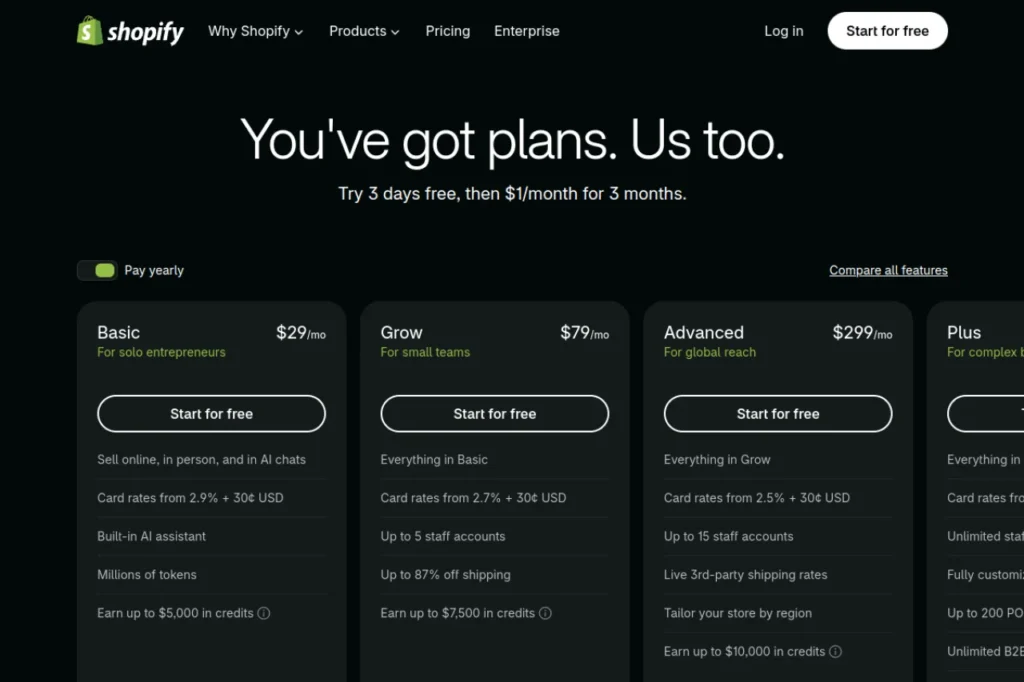
The plans are Basic at $25 a month ($19 billed annually), Grow at $65 ($49 annual), and Advanced at $399 ($299 annual). Every plan includes Sidekick, Shopify’s commerce AI, which builds pages, writes copy, and answers questions about your store.
The trial is three days free, then $1 a month for three months. The price that matters is the one most pet stores miss. Every Shopify plan includes POS Lite, the basic till. The real pet-store till is POS Pro, a $89-a-month add-on per location, which adds staff roles and permissions, in-store inventory management, exchanges, and flexible pickup and delivery. That makes the real price of Shopify as a pet-store till $114 a month on Basic monthly billing, or $108 a month on annual billing — not the $19 headline.
The processing rates are published by plan. On Basic, online payments cost 2.9% plus 30 cents, and in-person payments cost 2.6% plus 10 cents. Grow and Advanced lower the online rate first. Those rates assume Shopify Payments; third-party providers add their own fee on top.
The AI is broader than Square’s but just as blind to your shelves. Sidekick writes product descriptions, builds store pages, and handles everyday admin from a chat box. It does not know what is in your back room, and it will happily write a confident description of a product you stopped stocking in March. Check every description against the bag in your hand.
Shopify’s strength is the online store and the synced inventory: one stock count for the shop and the website, with Sidekick doing the writing. Its weakness is the add-on maths — $108 a month before you have taken a single payment — and the absence of any expiry or forecasting feature. Buy it if online sales are the plan. Do not buy it as a till alone.
Lightspeed Retail in detail
Lightspeed Retail is the deepest inventory system in this list, and the only one that forecasts. It is built for shops whose complexity lives in the catalogue: many SKUs, variants, suppliers, and purchase orders. For a pet store with 1,200 SKUs, food that expires, and a spring rush on flea and tick products, that depth is the whole pitch.
The plans are Basic at $89 a month billed annually ($109 month to month), Core at $149 ($179 monthly), and Plus at $289 ($339 monthly). Every plan includes one register, integrated payments, inventory management, Lightspeed Wholesale, the NuORDER supplier catalogue, purchase order sync, and a basic built-in online store. Core adds in-store and online loyalty, advanced sales, staff and inventory reports, accounting and marketing integrations, the mobile scanner app, and landed cost tracking. Plus adds forecasting with order recommendations and custom reporting, API access, workflows and automation, custom user roles, and single sign-on, with 24/7 phone support. A 14-day free trial runs on every plan.
Now the number you must read twice. The pricing page lists a Lightspeed Payments card-present rate of 1.5% on all three plans, with no per-transaction fee shown. Lightspeed’s own X-Series payments page lists 2.6% plus 10 cents in person. Both figures come from Lightspeed’s own site, and they cannot both be the complete rate on one account. At our volume the difference is $210 a month — $2,520 a year. Do not sign until Lightspeed puts the complete rate for your account in writing.
The AI lives in two places, and both cost extra. Insights — forecasting, order recommendations, and custom reporting — sits on Plus at $289 a month. AI Doc Import, which reads a supplier invoice and builds the purchase order for you, is an add-on on Basic and Core and included on Plus. The forecasting exists and it is real — and it costs $289 a month before you have sold a single bag of food.
Lightspeed’s strength is the deepest inventory in this list, with supplier ordering, landed costs, and the only real forecasting. Its weakness is the price of that forecasting, the unpriced extras — additional registers and locations are quoted, not published — and the two different processing rates on its own pages. It is the right buy for a store whose catalogue has outgrown a spreadsheet. It is the wrong buy for a store that only needs a till.

Canva in detail
Canva is the marketing department in this list, and for a pet store it is the tool you will open most often. Every sign, shelf talker, price tag, social post, and flyer comes out of it — and its AI is the one in this list that saves time every single week, because a pet store’s marketing is mostly images and short words.
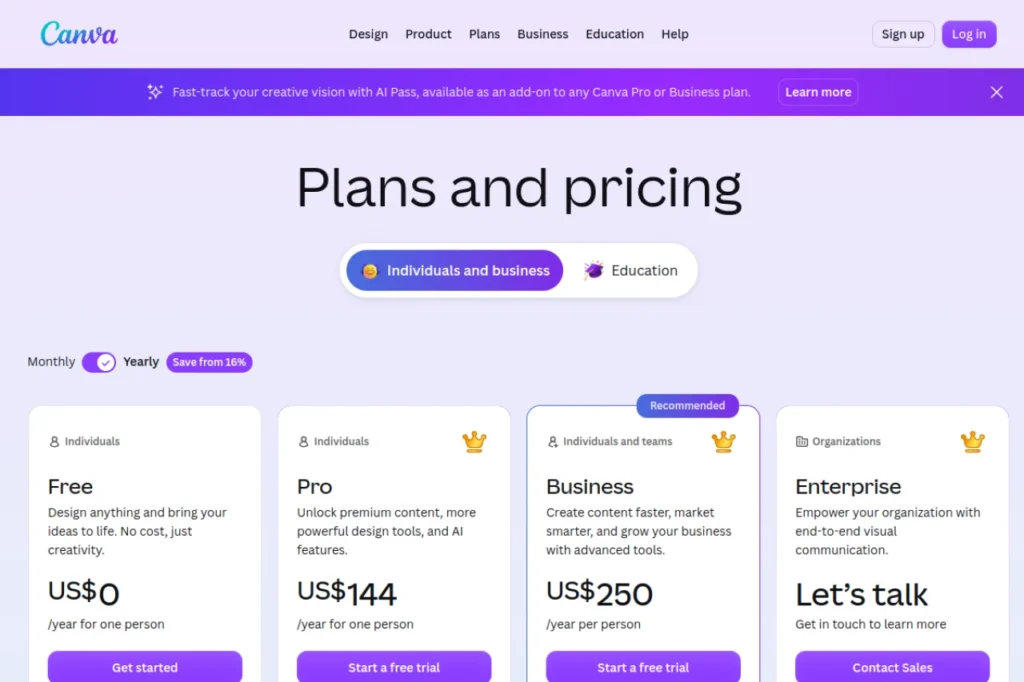
The plans are Free at $0, Pro at $15 a month per person or $144 a year, and Business at $250 a year per person. Enterprise is custom. The free plan has no time limit. Pro adds the full template library, Brand Kit, background remover, Magic Resize, 1TB of storage, and the full Magic Studio AI suite. Business adds a shared workspace, team Brand Kit management, template locking, shared folders, and approval workflows. A 30-day Pro trial needs no long commitment.
Magic Studio is the AI that does the work. Magic Write drafts the words for a post or a flyer. Magic Design turns a sentence into a layout. Background Remover cuts a product out of a phone photo in one click. Magic Resize turns one design into a poster, a shelf tag, and an Instagram post without rebuilding it three times. None of it forecasts — it makes things look good, and it knows nothing about your stock.
The pricing trap is the per-person seat. One owner pays $144 a year; three staff on Business pay $750 a year. That is still cheap against a designer’s day rate, but it means the bill grows with every hire — and Business costs more than three Pro seats at $432 a year. Buy Pro unless you need the shared workspace, template locking, and approval workflows that only Business adds.
Canva’s strength is that it replaces a designer for everything a pet store actually makes: signs, tags, posts, and flyers, with AI that does the fiddly work. Its weakness is that it is not a till and not an inventory system — it cannot tell you what to order, what is expiring, or what sold yesterday. Buy it for the marketing. Never mistake it for the business system.
ChatGPT Plus in detail
ChatGPT Plus is the writer in this list, and for a pet store it is the cheapest skilled help you will ever hire. It writes product descriptions, answers customer emails, drafts the monthly newsletter, plans the social calendar, and turns a supplier’s spec sheet into words a customer understands — in minutes, for $20 a month.
The plans are Free at $0, Go at $8 a month, Plus at $20 a month, and Pro from $100 a month, with Business at $20 per user a month billed annually ($25 monthly, two-user minimum). Free covers everyday text chats with limited tools. Go adds more messages with tools, more uploads, more image creation, and a longer memory — and may include ads. Plus adds the advanced reasoning models, expanded messages and uploads, deep research, Projects, scheduled tasks, custom GPTs, and Codex. Pro adds the heaviest reasoning and research limits in three tiers: $100, $200, or $500 a month.
What a pet store actually uses it for is narrower than the feature list. Product descriptions for 1,200 SKUs, written from the bag in your hand. Reorder emails to suppliers, drafted from your sales notes. Social posts for the spring flea and tick rush, written in your shop’s voice. Staff rota drafts and holiday cover plans. A custom GPT trained on your own price list that answers “do you stock this?” the way you would.
The weakness is the one that matters most in this guide: ChatGPT cannot see your till. It has no connection to your stock, your sales, or your expiry dates. It will write a beautiful description of a product you no longer carry, invent a price you never charged, and describe a food formula that does not exist — confidently, in perfect grammar. Check every word against the bag on the shelf.
The Go decision is simple. Go at $8 a month is the cheapest step up from Free, and it is enough if you only write a few posts a week and do not mind possible ads. Plus at $20 a month is the buy for a store that writes every day, because it removes the ads, adds the stronger models, and unlocks the scheduled tasks and custom GPTs that turn a chatbot into a repeatable workflow.
ChatGPT’s strength is the lowest price in this list for the most hours saved: writing, research, and planning for $20 a month. Its weakness is that it knows nothing about your business unless you tell it, and it will invent what you did not. Use it for words. Never let it near a price or a stock count without checking.

The maths: what a small pet store pays in year one
Same store for every tool: one owner, two part-time staff, one location, about 1,200 SKUs, roughly $15,000 a month in card payments across about 450 transactions. Subscriptions at list prices, monthly billing unless stated.
Square Free costs $0 a month in subscriptions. Processing at 2.6% plus 15 cents runs about $458 a month, or $5,490 a year, on $15,000 across 450 transactions. Square Plus costs $49 a month, or $588 a year, with processing at 2.5% — about $443 a month, or $5,310 a year — for a total of about $5,898 a year. Plus costs $408 a year more than Free at this volume: the 0.1% saving is worth $15 a month against a $49 fee. Square Premium costs $149 a month with processing at 2.4% — about $6,918 a year all-in.
Shopify Basic costs $25 a month ($228 a year on annual billing). Processing in person at 2.6% plus 10 cents runs about $435 a month, or $5,220 a year. With POS Pro at $89 a month, the real till costs $114 a month ($108 on annual billing) — about $6,588 a year all-in on monthly billing, or $6,516 a year on annual billing.
Lightspeed Basic costs $89 a month on annual billing, or $1,068 a year. Processing at the pricing page’s 1.5% runs $225 a month, or $2,700 a year — about $3,768 a year all-in. At the payments page’s 2.6% plus 10 cents, processing runs $435 a month — about $6,288 a year all-in. Core costs $149 a month, or $1,788 a year — about $4,488 a year all-in at 1.5%, or about $7,008 a year at 2.6% plus 10 cents. Plus costs $289 a month, or $3,468 a year — about $6,168 a year all-in at 1.5%.
Canva Pro costs $15 a month, or $144 a year. Business for three people costs $750 a year. ChatGPT Plus costs $20 a month, or $240 a year. Go costs $8 a month, or $96 a year.
Three stacks, priced honestly. The lean stack is Square Free at $0 plus Canva Free at $0 plus ChatGPT Go at $8 a month: $96 a year in subscriptions, plus about $5,490 a year in processing — roughly $5,586 all-in. The recommended stack is Square Free plus Canva Pro at $144 a year plus ChatGPT Plus at $240 a year: $384 a year in subscriptions, plus about $5,490 a year in processing — roughly $5,874 all-in.
The AI-heavy stack is Lightspeed Core at $1,788 a year plus Canva Business at $750 a year plus ChatGPT Plus at $240 a year: $2,778 a year in subscriptions, plus processing of $2,700 a year at the 1.5% rate — roughly $5,478 all-in, the cheapest stack here. At 2.6% plus 10 cents, processing becomes $5,220 a year and the same stack costs roughly $7,998 all-in — the most expensive stack here. One rate decides whether Lightspeed is the bargain or the trap.
Six traps to check before you pay
First, most pet-store software has almost no AI in it. Lightspeed’s forecasting is real AI and it costs $289 a month. Square’s AI removes a photo background. Canva’s AI makes a poster. ChatGPT’s AI writes words. None of the five knows what is on your shelves. Before you pay for “AI”, ask which of the four kinds you are buying.
Second, Lightspeed publishes two different processing rates. The pricing page says 1.5% card-present. The payments page says 2.6% plus 10 cents. Both are on Lightspeed’s own site, and the gap is $210 a month at our volume. Get the complete rate in writing before you sign, and re-run the maths on the rate they actually give you.
Third, the paid till can cost more than the free one. Square Plus saves 0.1% on processing and charges $49 a month for it. At $15,000 a month in card sales, that trade loses $34 a month. Plus only pays once card volume passes about $49,000 a month. Buy Plus for the inventory tools, never for the processing discount.
Fourth, the headline plan is not the till. Shopify Basic is $19 a month on annual billing, but the till a pet store actually needs — staff roles, in-store inventory management, exchanges — is POS Pro at $89 a month on top. The real price is $108 a month, and the $19 figure is the online store, not the counter.
Fifth, none of the five watches expiry dates. Pet food, treats, and medicines expire, and expired stock is money in the bin. None of these tools tracks a sell-by date or warns you before it passes. Pet-specific till systems exist that do, but they publish no prices, so they sit outside this comparison.
Sixth, the processing fee is the price. A store owner who compares $0 against $19 and stops there has compared the wrong numbers. On $15,000 a month in card payments, Square Free costs $5,490 a year in processing against $0 in subscriptions. Ask for the processing rate before you ask for the plan — the cheapest subscription here still takes $458 a month at the till.
Work out what your stack really costs
That is what our free AI Cost Calculator is for. Put in your monthly card payments, your transaction count, your staff number, and the plans you are comparing, and it totals the subscription plus the processing for year one — the same maths as this guide, but with your numbers. Run it once for the Square stack and once for the Lightspeed stack, and run the Lightspeed one twice: once at 1.5%, once at 2.6% plus 10 cents.
Pros and cons
Square for Retail Free at $0 a month is the proven free till: low-stock alerts, a free online store, and no monthly bill. Its cons are the processing rate — 2.6% plus 15 cents, about $5,490 a year at our volume — and the AI, which is a photo-background tool and nothing more.
Shopify Basic at $25 a month ($19 annual) is the online store with synced inventory: one stock count for the shop and the website, with Sidekick AI writing the copy. Its cons are the add-on maths — the real till costs $108 a month with POS Pro — and the absence of any expiry or forecasting feature.
Lightspeed Core at $149 a month is the deepest inventory here: supplier ordering, landed costs, and the only forecasting in this list on Plus. Its cons are the price of that forecasting — $289 a month on Plus — the unpriced extras for registers and locations, and the two different processing rates on its own pages.
Canva Pro at $15 a month ($144 a year) is the marketing department: Magic Studio AI, Brand Kit, and background removal for every sign, tag, and post. Its cons are the per-person seat — three staff on Business cost $750 a year — and the fact that it is not a till and knows nothing about your stock.
ChatGPT Plus at $20 a month is the cheapest skilled help in this list: product descriptions, supplier emails, and social posts in minutes. Its cons are the blindness — it cannot see your till, your stock, or your expiry dates — and the invention risk, because it will write a confident price you never charged.
No tool does the till, the forecasting, the expiry tracking, and the marketing in one published-price subscription.
Our verdict
Keep Square for Retail Free at $0 a month, add Canva Pro at $144 a year, and ChatGPT Plus at $20 a month. That stack costs $32 a month in subscriptions and about $458 a month in processing at our volume — roughly $5,874 all-in for year one — and it is the only combination here where the till, the marketing, and the writing all carry published prices and no quote.
Buy Lightspeed Core at $149 a month if your catalogue has outgrown a spreadsheet and you want the forecasting on Plus — but only after Lightspeed puts the complete processing rate in writing. At 1.5% it is the cheapest stack here; at 2.6% plus 10 cents, the most expensive. Do not buy it on the pricing page’s word alone.
Buy Shopify Basic with POS Pro at $108 a month on annual billing if online sales are the plan and you want one stock count for the shop and the website — but do not buy it as a till alone, because Square Free does the counter for $0.
Whatever you buy, do this first: run a trial on your real Saturday trade, count the expired stock in your back room before you sign, and ask for every processing rate and add-on price in writing.
Frequently asked questions
What is the best AI tool for pet stores?
Square for Retail Free at $0 a month with Canva Pro at $144 a year and ChatGPT Plus at $20 a month: a free till, AI marketing, and AI writing for $32 a month in subscriptions. Lightspeed Core at $149 a month is the best AI buy for forecasting — but only after the processing rate is confirmed in writing.
How much does AI software cost a small pet store?
A store with one owner and two part-time staff pays $0 a year in Square subscriptions, $228 on Shopify Basic annual, $1,068 on Lightspeed Basic annual, $144 on Canva Pro annual, and $240 on ChatGPT Plus — before card processing. Processing on $15,000 a month costs about $5,490 a year on Square Free, more than fourteen times the recommended stack’s subscriptions.
Can AI forecast what my pet store should order?
Yes, on one platform. Lightspeed’s Insights — forecasting, order recommendations, and custom reporting — sits on the Plus plan at $289 a month. No other tool in this list forecasts demand, and none of the five tracks expiry dates.
Do I need Shopify if I only sell in the shop?
No. Square for Retail Free runs the counter for $0 a month with low-stock alerts and a free online store if you ever want one. Buy Shopify only when online sales are part of the plan, and budget $108 a month with POS Pro, not the $19 headline.
Can ChatGPT write my product descriptions?
Yes, and it is the fastest way to cover 1,200 SKUs. Give it the bag in your hand — brand, formula, weight, price — and check every word it writes against that bag before you publish. It will invent a price or a formula you never stocked if you let it work from memory.
Price note
Price note — updated 23 November 2026: Prices in this post were checked on 23 November 2026 on the vendors’ official pricing pages. Square for Retail: squareup.com/us/en/point-of-sale/retail/pricing. Shopify: shopify.com/pricing. Lightspeed Retail: lightspeedhq.com/retail/pricing. Canva: canva.com/pricing. ChatGPT Plus: openai.com/chatgpt/pricing. When you are reading this, the price may be lower or higher, and a promo may have ended — always check the official pricing page before you buy. Annual-billing figures are marked as such; monthly billing costs more. Lightspeed’s card-present rate is listed as 1.5% on its pricing page and 2.6% plus 10 cents on its X-Series payments page — ask Lightspeed for the complete rate for your account before you buy.
Pros
- Square for Retail Free at $0 a month is the proven free till: low-stock alerts, a free online store, and no monthly bill.
- Shopify Basic at $25 a month ($19 annual) is the online store with synced inventory: one stock count for the shop and the website, with Sidekick AI writing the copy.
- Lightspeed Core at $149 a month is the deepest inventory here: supplier ordering, landed costs, and the only forecasting in this list on Plus.
- Canva Pro at $15 a month ($144 a year) is the marketing department: Magic Studio AI, Brand Kit, and background removal for every sign, tag, and post.
- ChatGPT Plus at $20 a month is the cheapest skilled help in this list: product descriptions, supplier emails, and social posts in minutes.
Cons
- Square for Retail: the processing rate — 2.6% plus 15 cents, about $5,490 a year at our volume — and the AI, which is a photo-background tool and nothing more.
- Shopify: the add-on maths — the real till costs $108 a month with POS Pro — and the absence of any expiry or forecasting feature.
- Lightspeed: the price of that forecasting — $289 a month on Plus — the unpriced extras for registers and locations, and the two different processing rates on its own pages.
- Canva: the per-person seat — three staff on Business cost $750 a year — and the fact that it is not a till and knows nothing about your stock.
- ChatGPT Plus: the blindness — it cannot see your till, your stock, or your expiry dates — and the invention risk, because it will write a confident price you never charged.
- No tool does the till, the forecasting, the expiry tracking, and the marketing in one published-price subscription.
Keep Square for Retail Free at $0 a month, add Canva Pro at $144 a year, and ChatGPT Plus at $20 a month. That stack costs $32 a month in subscriptions and about $458 a month in processing at our volume — roughly $5,874 all-in for year one — and it is the only combination here where the till, the marketing, and the writing all carry published prices and no quote.Buy Lightspeed Core at $149 a month if your catalogue has outgrown a spreadsheet and you want the forecasting on Plus — but only after Lightspeed puts the complete processing rate in writing. At 1.5% it is the cheapest stack here; at 2.6% plus 10 cents, the most expensive. Do not buy it on the pricing page's word alone.Buy Shopify Basic with POS Pro at $108 a month on annual billing if online sales are the plan and you want one stock count for the shop and the website — but do not buy it as a till alone, because Square Free does the counter for $0.Whatever you buy, do this first: run a trial on your real Saturday trade, count the expired stock in your back room before you sign, and ask for every processing rate and add-on price in writing.