

If you want one answer: buy Kickserv Start at $48 a month on annual billing and Rosie Scale at $149 a month, and run both all year. That stack costs $2,066 a year, about $172 a month, and it covers the two things that actually break a handyman business — the paperwork that eats your evenings and the phone calls nobody answers while you are on a ladder.If you want the full operating system instead of the lean stack, buy Jobber Grow for a five-user team at $229 a month on annual billing, and keep Rosie Scale beside it. It costs $4,238 a year — $2,172 more than the lean stack, the premium for quotes, scheduling, invoicing, and card payments in one place. The difference is what you are buying: Jobber does the quotes, the invoices, and the payments, while Kickserv does the same core job for a flat team price.
It is 9:15 on a Saturday morning and you are under a kitchen sink, one hand on a wrench, when your phone rings in the van. It rings again while you are driving to the next job. It rings a third time while you are on a ladder fixing a curtain rod. By lunchtime you have four missed calls and two voicemails, and one of those callers has already booked the other handyman in town — the one whose phone got answered.
That is the handyman version of the leak, and it is not a fixing-things problem. It is a phone-and-paperwork problem. A handyman’s day is ten small jobs in ten different houses, and every one of them starts with a call you take while your hands are busy and ends with an invoice you write after dark. A missed call on a Saturday is not a missed call. It is a $150 faucet job that hires the next name in the search results, and a repeat customer who quietly stops calling.
This guide compares the five AI tools a small handyman business actually buys — Jobber, Housecall Pro, Rosie, Dialzara, and Kickserv — at the real price for one owner, two helpers, one van, about 90 small jobs a month, and roughly 220 inbound calls a month. Every figure was checked on 23 November 2026.
Quick Answer
If you want one answer: buy Kickserv Start at $48 a month on annual billing and Rosie Scale at $149 a month, and run both all year. That stack costs $2,066 a year, about $172 a month, and it covers the two things that actually break a handyman business — the paperwork that eats your evenings and the phone calls nobody answers while you are on a ladder.
If you want the full operating system instead of the lean stack, buy Jobber Grow for a five-user team at $229 a month on annual billing, and keep Rosie Scale beside it. It costs $4,238 a year — $2,172 more than the lean stack, the premium for quotes, scheduling, invoicing, and card payments in one place. The difference is what you are buying: Jobber does the quotes, the invoices, and the payments, while Kickserv does the same core job for a flat team price.
In this article
- Best AI tools for handyman businesses at a glance
- How we compared them (and what we did not test)
- Jobber in detail
- Housecall Pro in detail
- Rosie in detail
- Dialzara in detail
- Kickserv in detail
- The maths: what a small handyman business pays in one year
- Six traps to check before you pay
- Work out what your stack really costs
- Pros and cons
- Our verdict
- Frequently asked questions
- Price note
Best AI tools for handyman businesses at a glance
| Tool | Entry price | What you get for it | Best for |
|---|---|---|---|
| Jobber | Core $49/mo ($29 annual); Grow $199/mo ($149 annual), 1 user | Quotes, scheduling, invoicing, card payments, voice AI | The full operating system |
| Housecall Pro | Basic $79/mo ($59 annual), 1 user; Essentials $189/mo ($149 annual), 5 users | Scheduling, dispatch, estimates, AI team members on every plan | The all-rounder with AI on every plan |
| Rosie | Professional $49/mo; Scale $149/mo; Growth $299/mo | AI answering 24/7, books appointments, 250–2,000 minutes | Never missing a Saturday call |
| Dialzara | Lite $29/mo; Pro $99/mo; Plus $199/mo; Elite $349/mo | AI receptionist, warm transfers, calendar booking, 60–1,000 minutes | The cheapest per-minute answering |
| Kickserv | Start $60/mo ($48 annual), 5 users; Run $119/mo; Scale $199/mo | Scheduling, invoicing, time tracking, flat team price | The lean stack for a 3-person crew |
The same business pays $2,748 a year for Jobber Grow, $1,788 for Housecall Pro Essentials, $1,490 for Rosie Scale, $3,156 for Dialzara Plus once the overage is counted, and $576 for Kickserv Start — all on annual billing.
How we compared them (and what we did not test)
Three things decide whether a handyman tool is worth your money, and only one of them is the price.
First, the pricing shape. A per-user subscription punishes every new helper. A per-minute answering service punishes every busy Saturday. A flat team price punishes nobody until you outgrow the user cap. We priced every tool for the same business — one owner, two helpers, one van, about 90 jobs a month at roughly $95 a job, about $8,550 a month in revenue, and roughly 220 inbound calls a month at about three minutes each, which is about 660 minutes of talk time — priced for a full year, because a handyman works twelve months, not five.
Second, the AI, and here you need to be blunt about what the word means. In this market it means four different things: a voice assistant that answers the phone while you are on a ladder, a quoting tool that writes the estimate from a photo or a description, a scheduling tool that orders your day, and a set of automations that send reminders. Only Rosie and Dialzara sell the first kind. Only Jobber and Housecall Pro sell the second and third in one place. Kickserv sells the fourth kind plus the flattest price in this list. Before you pay for “AI”, ask which of the four kinds you are buying.
Third, the costs that never appear in the headline: the per-minute overage, the extra user, the add-on that turns a $29 plan into a $199 plan, and the annual discount that is only a discount if you work all twelve months.
What we did not test: no live handyman season was run through any of these tools, no real customer calls were answered by either AI receptionist, and no faucet was fixed on any of these dispatch boards.
Two honest notes about the shortlist: Workiz was on it, but its pricing page now shows “Request pricing” on all three plans — Standard, Pro, and Ultimate — with no dollar figure anywhere, so no Workiz price in this guide could be verified. FieldPulse was on it too, but its pricing page is now quote-only and explicitly warns that third-party price figures are unverified, so no FieldPulse figure could be printed either. Kickserv and Dialzara take their places, and both publish every dollar.
Jobber in detail
Jobber is the full operating system in this list, and for a handyman business that wants one place for the quote, the schedule, the invoice, and the payment, it is the strongest candidate. It covers the whole job from the first phone call to the money in the bank: quotes with signature approval, scheduling and route optimization, time tracking, invoicing, and card payments in one dashboard, with a mobile app your helpers use from the van.
The plans are Core at $49 a month ($39 on a one-year commitment, $29 billed annually) for one user, Connect at $139 a month ($119 on a one-year commitment, $99 billed annually) for one user, Grow at $199 a month ($169, $149 annual) for one user, and Plus at $499 a month ($439, $399 annual) for five users. The price climbs with team size: Connect for five users is $199 a month ($169, $149 annual), and Grow for five users is $299 a month ($259, $229 annual).
That team-size jump is the first number to read twice. Core at $29 a month on annual billing is a solo-operator price. The moment you add your two helpers, you are on Grow at $229 a month on annual billing — nearly eight times the Core price for the same software. For our three-person business, Jobber Grow costs $229 a month on annual billing, which is $2,748 a year, or $299 a month on monthly billing, which is $3,588 a year. The annual option is cheaper for a year-round business, and that is the opposite of the seasonal maths in our snow-removal guide, where monthly billing won because the season was five months long.
The AI lives in three places. Jobber’s voice AI takes spoken instructions in the field — ask it to create a quote, update a schedule, or send a message while you are standing in a customer’s kitchen. Its scheduling recommends times from team availability and travel times, and its route tool optimizes daily or weekly routes in seconds. Jobber Receptionist, the 24/7 answering add-on, costs $99 a month.
The payments are published in full. Online card payments cost 2.9% plus 30 cents, in-person tap payments through the mobile app cost 2.7% plus 30 cents, and bank payments cost 1%.
On our $102,600 year, card payments through Jobber cost about $3,299 if every customer pays by card. Jobber’s strength is that it replaces four tools: the quote, the schedule, the invoice, and the payment link. Its weakness is the team-size pricing — a three-person crew pays the five-user rate — and the Receptionist add-on at $99 a month on top. Buy it if you want one system for the whole business. Do not buy Core expecting it to cover a crew.
Housecall Pro in detail
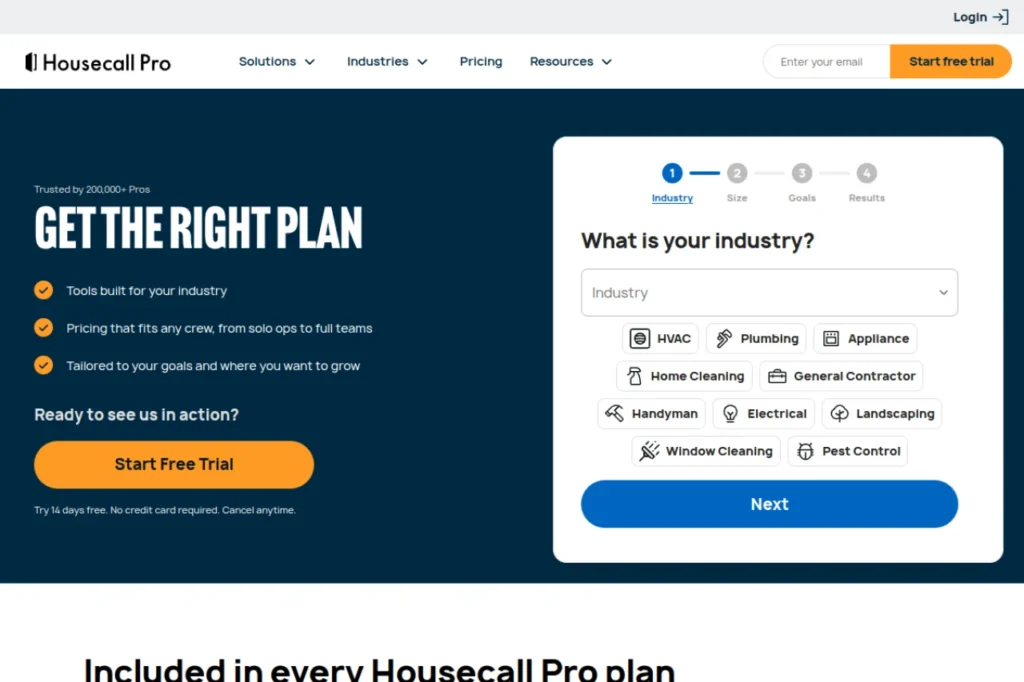
Housecall Pro is the all-rounder in this list, and it is the only tool here that puts an AI team member on every plan, including the cheapest one. It covers scheduling and dispatch, estimates and invoicing, payments, review management, and job costing in one place. Its pricing page even lists Handyman as one of the industries in its plan-finder quiz, which is the only time in this guide a vendor names handymen directly.
The plans are Basic at $79 a month ($59 billed annually) for one user, Essentials at $189 a month ($149 annual) for five users, and Max at $329 a month ($299 annual) for eight users, with extra users at $35 a month each on Max. Right now every plan is 50% off for three months — Basic $39.50, Essentials $94.50, Max $164.50 — and then the full price applies. A 14-day free trial runs on the Max plan with no credit card. For our three-person crew, Essentials is the fit: $149 a month on annual billing, $1,788 a year, or $189 a month on monthly billing, which is $2,268 a year.
The AI is the reason to look at Housecall Pro before Jobber. Its pricing page lists “AI team members to automate your work” as included in every plan, and its HCP Assist feature drafts estimates, writes customer messages, and answers job questions from your business data. Route optimization, the feature that orders a day of ten small jobs across town, sits on Max at $299 a month on annual billing — not on Essentials.
The processing rate is published as “card processing rates as low as 2.59%”, with a 1% fee on bank payments. On our $102,600 year, 2.59% is about $2,657 if every customer pays by card — but the pricing page states no per-transaction fee, so treat $2,657 as the floor, not the total, and ask for the full rate in writing before you switch payment processors.
Housecall Pro’s strength is the AI on every plan and the cheapest five-user annual price in this list at $149 a month — $960 a year less than Jobber Grow for the same five seats. Its weakness is that route optimization costs $299 a month on Max. Buy it if you want AI help on the cheapest plan. Do not buy Essentials expecting it to order your routes.
Rosie in detail
Rosie is the phone in this list, and for a handyman the phone is the business. It is an AI answering service that knows your business: it answers around the clock, takes messages with your own custom questions, and sends appointment links by text.
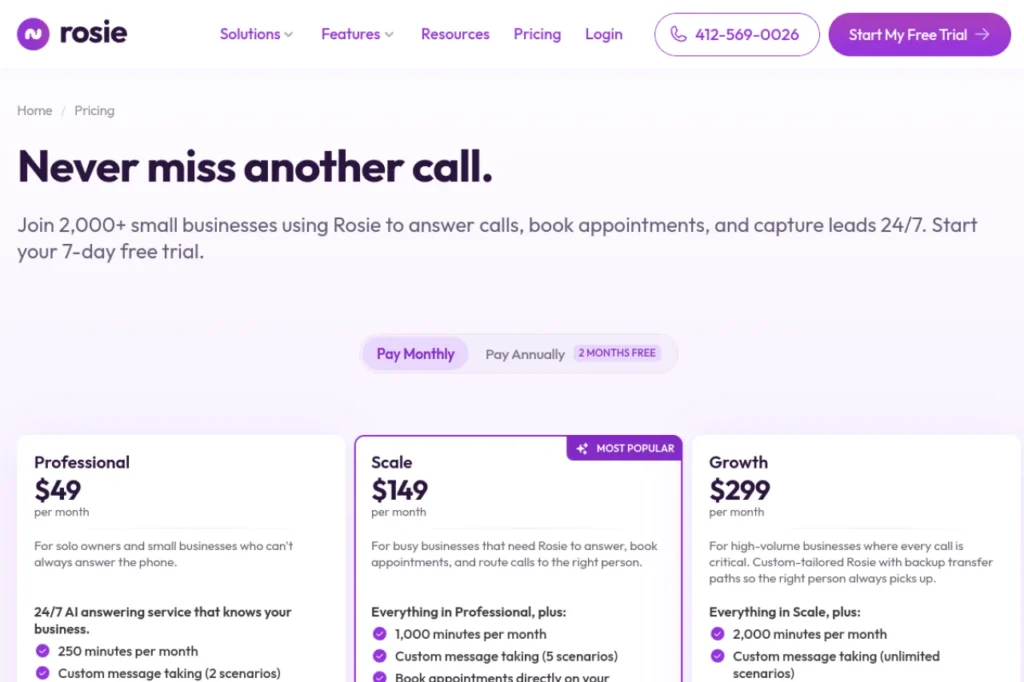
The plans are Professional at $49 a month with 250 minutes, Scale at $149 a month with 1,000 minutes, and Growth at $299 a month with 2,000 minutes. Annual billing gives two months free, so Scale costs $1,490 a year instead of $1,788 — a genuine saving for a year-round business.
The minute bucket is the whole decision. Our business takes about 220 calls a month at roughly three minutes each, which is about 660 minutes — but Saturdays do not spread evenly. A quiet week might take 120 minutes and a busy Saturday might take 200. Professional’s 250 minutes covers a quiet month and fails a busy one. Scale’s 1,000 minutes covers even the worst month this business will see. That is why the recommendation is Scale, not Professional, even though Professional looks $100 a month cheaper.
There is no per-minute overage charge. Rosie’s FAQ says going over your minutes automatically upgrades you to the next plan at its standard price — so a freak month can move you from Scale at $149 to Growth at $299 without a phone call. Watch your minutes in the Rosie app as the month goes on.
Rosie’s strength is the simplest promise in this list: every call answered, every time, with booking on the calendar and no busy signal. Its weakness is the automatic upgrade — a huge month can bump you from Scale to Growth at $299 — and the fact that it answers the phone but does nothing with the job afterwards. Buy it if missed calls are your biggest leak. Do not buy Professional for a business that takes 660 minutes of calls a month.
Dialzara in detail
Dialzara is the other phone in this list, and it is the one to buy when you want to see the overage maths before you sign. It is an AI receptionist with the same job as Rosie — answer every call, take the message with your custom questions, transfer to your team when a human is needed, and book onto your calendar — but every number is published down to the cent, including the overage.
The plans are Business Lite at $29 a month with 60 minutes and a $0.48 overage rate, Business Pro at $99 a month with 220 minutes and $0.45, Business Plus at $199 a month with 500 minutes and $0.40, and Business Elite at $349 a month with 1,000 minutes and $0.35. There is no contract, and you can cancel any time. The AI SMS agent costs $19 a month plus 5 cents a message, and the website chatbot is $39 a month standalone or free with any voice plan.
The minute maths is where Dialzara earns its place — and where it loses it for this business. Lite’s 60 minutes last about twenty three-minute calls — one busy Saturday. At our 660 minutes a month, Lite costs $29 plus 600 minutes of overage at $0.48, which is $317 a month. Pro costs $99 plus 440 minutes at $0.45, which is $297 a month. Plus costs $199 plus 160 minutes at $0.40, which is $263 a month, or $3,156 a year. Elite is $349 a month flat, or $4,188 a year. The cheapest headline in this list turns into the most expensive phone in this list the moment you count the minutes.
The warm transfer is the feature that matters most for handyman work. Lite only offers blind transfer — the caller is passed to your phone and you take it or you do not. Pro and above offer warm transfer, where the AI briefs your team member before connecting, and after-hours rules with escalation. On a ladder, warm transfer is the difference between a customer who gets helped and one who gets your voicemail a second time.
Dialzara’s strength is published pricing to the cent and the cheapest honest cover for a low-volume business. Its weakness is that at 660 minutes a month, even its best plan costs $263 a month — $1,666 a year more than Rosie Scale on annual billing. Buy it if you take fewer than 500 minutes of calls a month and want warm transfers. Do not buy Lite for a business that takes Saturday calls.

Kickserv in detail
Kickserv is the flat price in this list, and for a three-person handyman crew it is the most honest deal here. It charges per team, not per user: Start covers five users, Run covers ten, and Scale covers twenty. Our whole business — one owner, two helpers — fits inside the cheapest plan with two seats to spare.
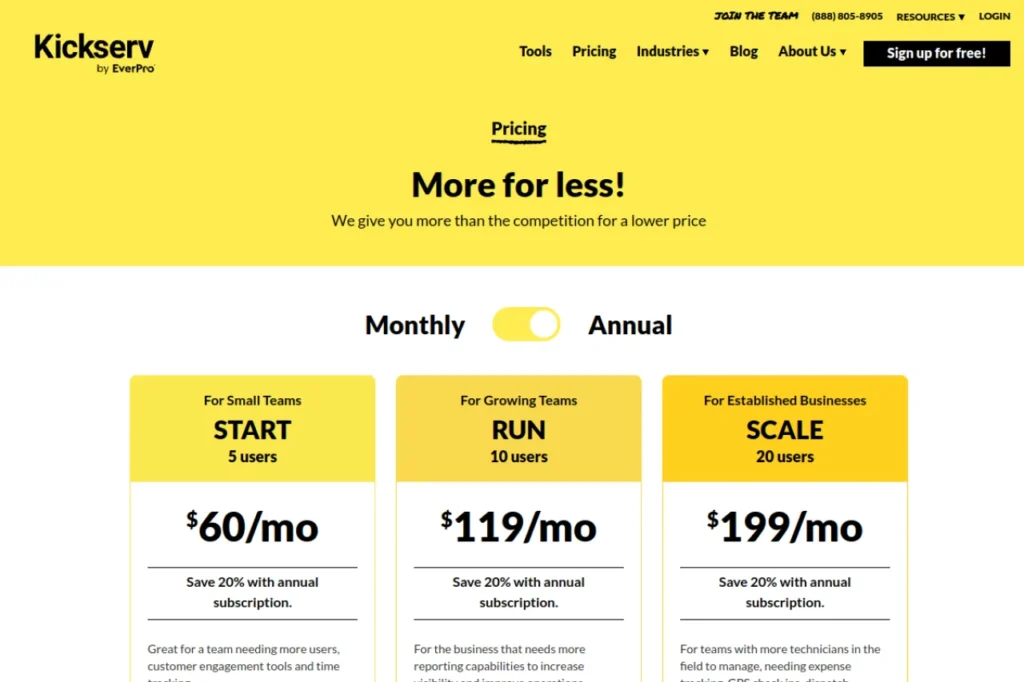
The plans are Start at $60 a month for five users, Run at $119 a month for ten users, and Scale at $199 a month for twenty users. Annual billing saves 20%, so Start costs $48 a month, or $576 a year; Run costs $95.20 a month, or $1,142.40 a year; and Scale costs $159.20 a month, or $1,910.40 a year. There is also Kickback: process at least $1,000 a month in online payments and Kickserv takes 5% off your subscription — on Start annual that is $547.20 a year instead of $576.
What you get for that flat price is the handyman core: scheduling and dispatch, estimates and invoices, customer records, time tracking, expense tracking, automated email and text reminders, and QuickBooks Online integration. Run adds dispatch mapping, GPS check-ins, and custom reports. Scale adds custom templates and review management. The pricing page does not publish a card processing rate, so ask for it in writing before you move your payments — this guide prints no rate it could not verify.
The AI story here is the thinnest in this list, and this guide says so plainly. Kickserv sells workflow automation — reminders that go out on their own, invoices that follow the job — not a named AI assistant, not a voice agent, and not an AI that writes your quotes. What it sells is a flat price for a small team and the unglamorous software a handyman actually uses every day, and for a three-person crew that is worth more than a chatbot.
Kickserv’s strength is the flat team price: $576 a year covers the whole crew, with no per-user jump when you hire your third helper. Its weakness is the thin AI story and the unpublished card rate. Buy it if your crew is three people and your evenings are eaten by paperwork. Do not buy it expecting it to answer the phone — pair it with Rosie instead.
The maths: what a small handyman business pays in one year
Same business, same year: one owner, two helpers, one van, 90 jobs a month at about $95 a job, $102,600 in revenue, 220 calls a month, 660 minutes of talk time.
Jobber Grow for five users costs $229 a month on annual billing, which is $2,748 a year. On monthly billing it is $299 a month, which is $3,588 a year — $840 more, so annual billing wins for a business that works all twelve months. Connect for five users costs $149 a month on annual billing, which is $1,788 a year, and Core for a solo operator costs $29 a month on annual billing, which is $348 a year — but Core does not cover your helpers, and that is the whole point of the jump.
Housecall Pro Essentials for five users costs $149 a month on annual billing, which is $1,788 a year, or $189 a month on monthly billing, which is $2,268 a year. Basic for a solo operator costs $59 a month on annual billing, which is $708 a year. Max costs $299 a month on annual billing, which is $3,588 a year.
Rosie Scale costs $149 a month, which is $1,788 a year on monthly billing — but annual billing gives two months free, so it costs $1,490 a year, a real $298 saving. Professional costs $49 a month, which is $588 a year, but its 250 minutes fail a 660-minute month. Growth costs $299 a month, which is $3,588 a year.
Dialzara Plus costs $199 a month plus the overage: 160 minutes over the 500 included, at $0.40, which is $64 a month. The real bill is $263 a month, or $3,156 a year. Pro’s real bill is $297 a month, Lite’s is $317 a month, and Elite is $349 a month flat. Every Dialzara plan except Elite costs more than Rosie Scale once the minutes are counted — the $29 headline is the most expensive phone in this list.
Kickserv Start costs $48 a month on annual billing, which is $576 a year for all five seats, or $547.20 a year if you process $1,000 a month online and claim the 5% Kickback. Run costs $95.20 a month on annual billing, which is $1,142.40 a year. Scale costs $159.20 a month on annual billing, which is $1,910.40 a year.
The stacks, all on annual billing: lean (Kickserv Start $576 + Rosie Scale $1,490) costs $2,066 a year, about $172 a month. The Housecall Pro stack (Essentials $1,788 + Rosie Scale $1,490) costs $3,278 a year. The Dialzara stack (Kickserv Start $576 + Dialzara Plus $3,156) costs $3,732 a year — $1,666 more than the lean stack, for warm transfers. The full system (Jobber Grow $2,748 + Rosie Scale $1,490) costs $4,238 a year — $2,172 more than the lean stack, for quotes, invoices, and payments in one place. Per job, the lean stack costs $1.91. One lost $150 faucet job pays for about 78 jobs’ worth of software.
Processing, if every customer pays by card: Jobber at 2.9% plus 30 cents costs about $3,299 a year. Housecall Pro at 2.59% costs about $2,657 a year as a floor — no per-transaction fee is stated, so the real number is higher. Kickserv publishes no card rate, so get it in writing before you switch. The same Jobber and Rosie stack cost $2,240 for a five-month snow season in our snow-removal guide, where monthly billing won — the handyman maths flips because the work never stops.
Six traps to check before you pay
First, the solo price is not your price. Jobber Core at $29 a month and Housecall Pro Basic at $59 a month are solo-operator prices. The moment your two helpers need seats, you are on a five-user plan, and the bill jumps to $229 or $149 a month. Price the plan your whole crew uses, not the one the homepage shows first.
Second, the minute bucket is the phone bill. Rosie Professional at $49 a month and Dialzara Lite at $29 a month both fail a 660-minute month — Professional by auto-upgrade to $299, Lite by $288 a month in overage. Count your minutes before you count the headline.
Third, the annual discount is only a discount if you work the year. It is a real saving here — Rosie Scale saves $298, Kickserv Start saves $144 — because a handyman works twelve months. The same discount was a trap in our snow-removal guide, where a five-month season made annual billing cost more than monthly. Know your calendar before you commit.
Fourth, the add-on is the real price. Jobber’s Receptionist costs $99 a month on top of the subscription, Dialzara’s SMS agent costs $19 a month plus 5 cents a message, and Rosie’s website texting costs $50 a month as an add-on. Add every add-on to the headline before you compare.
Fifth, the card rate is a second subscription. Jobber’s published 2.9% plus 30 cents costs about $3,299 a year on this business — more than the software itself. Housecall Pro’s 2.59% floor costs about $2,657. Kickserv publishes no rate at all. Get the full processing rate in writing before you move your payments, and count it in the stack.
Sixth, the trial is the only honest check. Every tool here offers a trial or a demo — Jobber and Housecall Pro run free trials, Rosie and Dialzara run 7-day trials, Workiz runs a 7-day trial, and FieldPulse offers a demo instead. Run the trial in your busiest week, with real calls and real jobs, and watch the minute counter and the invoice screen. A trial during a quiet week tells you nothing.
Work out what your stack really costs
The numbers above are for one specific business: 90 jobs a month, $95 a job, 660 minutes of calls. Your business is different, and the right stack changes with it. A solo handyman doing 40 jobs a month pays the solo price and needs the smallest minute bucket. A four-person crew doing 150 jobs a month outgrows Kickserv Start’s five seats and needs the next plan up.
Run your own numbers through our free AI Cost Calculator before you sign anything: it turns your job count, your average job value, and your call volume into the real monthly cost of each stack, including the overage and the card fees this guide warns about.
Pros and cons
Jobber Grow $229/mo annual ($299 monthly), quotes + scheduling + invoicing + payments, voice AI, free trial; Housecall Pro Essentials $149/mo annual ($189 monthly), AI team members on every plan, dispatch + estimates, 14-day Max trial; Rosie Scale $149/mo, 1,000 minutes covers any month, calendar booking, no busy signal; Dialzara Plus $199/mo, 500 minutes, published $0.40 overage, warm transfers, no contract; Kickserv Start $48/mo annual, flat 5-user price, scheduling + invoicing + time tracking, 20% annual saving.
Jobber 5-user minimum for a 3-person crew, Receptionist add-on $99/mo on top; Housecall Pro route optimization on Max $299/mo only; Rosie auto-upgrade on overage, Professional too small for 660 minutes; Dialzara real entry $263/mo with overage, Lite/Pro cost more than Scale at this volume; Kickserv thinnest AI story, no phone answering, no published card rate; no tool does phone + quotes + scheduling + payments in one published-price subscription.
Our verdict
Buy Kickserv Start at $48 a month on annual billing and Rosie Scale at $149 a month — $2,066 a year, $1.91 a job — and run both all year. It is the cheapest honest stack in this guide, and it covers the two leaks that cost a handyman real money: the evenings lost to paperwork and the Saturday calls nobody answers.
Buy Housecall Pro Essentials at $149 a month on annual billing instead of Jobber Grow if you want the full system and the AI help on the cheapest plan — $3,278 a year with Rosie Scale, $960 a year less than Jobber Grow for the same five seats.
Buy Jobber Grow at $229 a month on annual billing only if you want quotes, invoices, and card payments in one place and you are willing to pay $2,172 a year more than the lean stack for it. Buy Dialzara Plus only if you take fewer than 500 minutes of calls a month and warm transfers matter more to you than $1,666 a year. Do not buy Dialzara Lite, Rosie Professional, Jobber Core, or Housecall Pro Basic for a three-person crew — the solo price is not your price, and the small minute bucket is not your month.
Frequently asked questions
What is the best AI tool for a handyman business?
For a one-owner, two-helper business, Kickserv Start at $48 a month on annual billing plus Rosie Scale at $149 a month is the best stack: $2,066 a year, $1.91 a job. If you want one system for everything, Jobber Grow at $229 a month on annual billing plus Rosie Scale costs $4,238 a year.
How much does AI software cost a small handyman business?
Between $576 and $4,238 a year for the software in this guide, before card processing. The lean stack — Kickserv Start plus Rosie Scale — costs $2,066 a year. Card processing adds about $2,657 to $3,299 a year at the published rates, so count it before you compare.
Can AI answer my phone while I am on a job?
Yes. Rosie and Dialzara are AI receptionists that answer around the clock, take messages with your own questions, and book onto your calendar. Rosie Scale at $149 a month covers 1,000 minutes; Dialzara Plus at $199 a month covers 500 minutes, with $0.40 a minute over that. Neither Jobber, Housecall Pro, nor Kickserv answers the phone itself — Jobber sells a $99-a-month Receptionist add-on.
Do I need Jobber or Housecall Pro for handyman work?
Not necessarily. Both are strong all-rounders, but a three-person crew pays the five-user rate on both — $229 a month for Jobber Grow, $149 for Housecall Pro Essentials. Kickserv Start covers the same crew for $48 a month on annual billing, with the same scheduling, invoicing, and time tracking. Buy Jobber or Housecall Pro if you want the AI quoting and the all-in-one system; buy Kickserv if you want the flat team price.
Which plan should a solo handyman start on?
Start on the solo price and the smallest minute bucket that fits your real call volume: Jobber Core at $29 a month on annual billing or Housecall Pro Basic at $59 a month, with Rosie Professional at $49 a month if you take under 250 minutes of calls. The day you hire your first helper, re-price everything — the five-user jump is the most expensive surprise in this guide.
Price note
Price note — updated 23 November 2026: Prices in this post were checked on 23 November 2026 on the vendors’ official pricing pages — Jobber, Housecall Pro, Rosie, Dialzara, and Kickserv. When you are reading this, the price may be lower or higher, a promotion may have ended, or a plan may have changed. Workiz and FieldPulse publish no prices on their pricing pages as of this date, so no figure for either appears in this post. Check the official pricing page before you buy, and get any card processing rate in writing.
Pros
- Jobber Grow $229/mo annual ($299 monthly), quotes + scheduling + invoicing + payments, voice AI, free trial
- Housecall Pro Essentials $149/mo annual ($189 monthly), AI team members on every plan, dispatch + estimates, 14-day Max trial
- Rosie Scale $149/mo, 1,000 minutes covers any month, calendar booking, no busy signal
- Dialzara Plus $199/mo, 500 minutes, published $0.40 overage, warm transfers, no contract
- Kickserv Start $48/mo annual, flat 5-user price, scheduling + invoicing + time tracking, 20% annual saving
Cons
- Jobber 5-user minimum for a 3-person crew, Receptionist add-on $99/mo on top
- Housecall Pro route optimization on Max $299/mo only
- Rosie auto-upgrade on overage, Professional too small for 660 minutes
- Dialzara real entry $263/mo with overage, Lite/Pro cost more than Scale at this volume
- Kickserv thinnest AI story, no phone answering, no published card rate
- no tool does phone + quotes + scheduling + payments in one published-price subscription
Kickserv Start $48/mo annual + Rosie Scale $149/mo = $2,066/yr, $1.91/job; HCP Essentials $149/mo annual + Rosie Scale = $3,278/yr; Jobber Grow $229/mo annual + Rosie Scale = $4,238/yr; Dialzara Plus only under 500 min/mo; do not buy Lite/Professional/Core/Basic for a 3-person crew.
1 thought on “Best AI Tools for Handyman Businesses (2026): 5 Compared by Real Price”