

This guide to the best AI phone systems for small business compares five tools a small team can actually buy and use: Quo (formerly OpenPhone), Dialpad, Nextiva, RingCentral, and Grasshopper. Start with Quo Starter at $15 a user a month billed annually if you want an AI agent that answers calls included in the cheapest seat, with 10 free AI-handled calls a month. Pick Dialpad Standard at $15 a user a month billed annually if you want AI call transcripts and summaries on every plan, with no add-on to buy. Pick Nextiva Core at $15 a user a month billed annually if you want the phone, a basic CRM, and a ticketing system in one subscription, with 50 AI transcriptions and 50 AI summaries per user a month. Pick RingCentral Core at $20 a user a month billed annually if you want the broadest platform, with unlimited calling, video meetings for 300 people, and team chat from the entry plan. Pick Grasshopper True Solo at $14 a month billed annually if you are one person who just needs a professional business number, flat, with no per-user charge at all. Three of the five entry seats cost the same $15 a user a month on annual billing, so the seat price is not the decision. The AI answering is. Quo includes its Sona AI agent on every plan, Nextiva charges $99 a month for 100 XBert conversations on top of the seats, RingCentral charges $39 a month for 100 AI Receptionist minutes on top of the seats, Dialpad sells its AI Agents through sales with no published price, and Grasshopper sells no AI answering agent at any price.
In this article: Quick Answer Box / What an AI Phone System Actually Does / How We Picked These Five / The Five Tools at a Glance / Quo — The AI Agent Included in the Cheapest Seat / Dialpad — The Best AI Call Notes on the Cheapest Seat / Nextiva — The Phone Plus CRM and Ticketing Pick / RingCentral — The Broadest Platform, With the Priciest AI Add-On / Grasshopper — The Flat-Rate Line for One Person / Cost Maths / The Hidden Costs and Gotchas / Work Out What the Hour Is Worth / Pros and Cons / Our Verdict / Frequently Asked Questions / Price Note
Quick Answer Box
This guide to the best AI phone systems for small business compares five tools a small team can actually buy and use: Quo (formerly OpenPhone), Dialpad, Nextiva, RingCentral, and Grasshopper. Start with Quo Starter at $15 a user a month billed annually if you want an AI agent that answers calls included in the cheapest seat, with 10 free AI-handled calls a month. Pick Dialpad Standard at $15 a user a month billed annually if you want AI call transcripts and summaries on every plan, with no add-on to buy.
Pick Nextiva Core at $15 a user a month billed annually if you want the phone, a basic CRM, and a ticketing system in one subscription, with 50 AI transcriptions and 50 AI summaries per user a month. Pick RingCentral Core at $20 a user a month billed annually if you want the broadest platform, with unlimited calling, video meetings for 300 people, and team chat from the entry plan. Pick Grasshopper True Solo at $14 a month billed annually if you are one person who just needs a professional business number, flat, with no per-user charge at all.
Three of the five entry seats cost the same $15 a user a month on annual billing, so the seat price is not the decision. The AI answering is. Quo includes its Sona AI agent on every plan, Nextiva charges $99 a month for 100 XBert conversations on top of the seats, RingCentral charges $39 a month for 100 AI Receptionist minutes on top of the seats, Dialpad sells its AI Agents through sales with no published price, and Grasshopper sells no AI answering agent at any price.
What an AI Phone System Actually Does
A missed call is not a minor inconvenience for a small business. It is a customer who called once, got voicemail, and called your competitor next. One analysis of 347,609 real business calls found that home-services contractors miss 60 to 80 percent of inbound calls, and about 80 percent of callers hang up without leaving a message. The phone rings while you are on a job, in a meeting, or driving, and by the time you call back, the job is gone.
An AI phone system does three things. First, it answers the calls your team cannot, with a voice agent that takes the message, answers common questions, books the appointment, and hands the call to a human when it matters. Second, it writes down what happened: a transcript and a summary of every call, so nobody has to ask “who took that call?” or replay a voicemail twice. Third, it keeps the business number separate from your personal mobile, with shared numbers, business hours, and a record of every conversation the whole team can see.
The part to be careful with is the meter. AI answering is almost never unlimited. Quo counts AI calls in credits, Nextiva counts conversations, RingCentral counts minutes, and Dialpad does not publish a price at all. Ten free AI calls a month sounds generous until a busy week burns through them by Wednesday. This guide prices everything at one fixed volume, a five-person team, and then prices the AI answering separately at 100 AI-handled calls a month, so the meters are comparable.
The second thing to be careful with is the billing model. A $15-a-user price is only cheap if you can buy the seats you need. Some plans carry minimums, and Grasshopper charges a flat monthly rate for the whole account, which makes it the cheapest option in this guide for a team of any size. Check the billing model before the headline price.
How We Picked These Five
We picked the five tools in this guide to the best AI phone systems for small business by one rule: a small business owner with a team of one to five people must be able to buy the tool, see the price on the vendor’s own pricing page, and answer a call with AI on day one.
Every price in this guide was read on the vendor’s own pricing page on 20 November 2026, and the publishing run re-reads them on the day this post goes live. Two pages did not render their figures as plain text, so their numbers come from November 2026 reads of the same official pages, and the price note at the end of this post says exactly which ones. Where a price could not be read live, the guide says so instead of printing a stale figure as fact. The volume is fixed for the whole guide: five people, on annual billing, with the AI answering priced separately at 100 AI-handled calls a month.
The Five Tools at a Glance
| Tool | Entry price, 5 users, annual | How it charges | AI answering | Free trial | AI that matters |
|---|---|---|---|---|---|
| Quo | $75/mo | Per user | Sona included, 10 free calls/mo | 7 days | Sona AI agent, AI summaries on Business |
| Dialpad | $75/mo | Per user | AI Agents, quote only | 14 days | Transcripts + summaries on every plan |
| Nextiva | $75/mo | Per user | XBert, $99/mo for 100 conversations | Demo based | 50 AI transcriptions + summaries per user |
| RingCentral | $100/mo | Per user | AI Receptionist, $39/mo for 100 minutes | 14 days | AI Virtual Assistant on every plan |
| Grasshopper | $25/mo | Flat per account | None at any price | 7 days | AI call transcription, added October 2025 |
Quo — The AI Agent Included in the Cheapest Seat
Quo is the tool to buy when the AI answering matters more than the phone. Starter is $15 a user a month billed annually, or $19 billed monthly, read live on quo.com/pricing on 20 November 2026. Business is $23 a user a month billed annually, or $33 monthly. Scale is $35 a user a month billed annually, or $47 monthly. The trial is 7 days.

What the $15 buys is the only AI answering agent in this guide that comes with the cheapest seat. Sona, Quo’s AI agent, is included on every plan, including Starter. It answers calls, takes messages, and handles text conversations. Every plan also includes 1,000 free automation credits a month, which Quo counts as 10 AI-handled calls or 20 text conversations. The plan includes one new or ported number per user, unlimited calling and messaging to US and Canadian numbers, voicemail transcripts, and the Quo API.
The catch is the size of the free allowance, and it is the sharpest free-allowance trap in this guide. Ten AI-handled calls a month is about two a week. A business that misses three calls a day burns the free allowance before the first week ends, and then the meter starts: $25 a month for 40 calls, $49 for 100 calls, $99 for 250, and $199 for 600, with each extra call past the included credits costing between $1.00 and $0.45 depending on the tier.
The second catch is the summaries. AI call summaries and transcripts are a Business feature, not a Starter feature. On Starter, you get summaries only for the calls Sona handled, not for the calls your team answered themselves. If the whole point is never asking “what did they say on the call?”, Starter does not deliver it, and the real price of the feature is $23 a user a month, not $15. AI call tags sit higher still, on Scale at $35. Quo pricing: https://www.quo.com/pricing
Dialpad — The Best AI Call Notes on the Cheapest Seat
Dialpad is the tool to buy when the call notes matter more than the call answering. Standard is $15 a user a month billed annually, or $27 billed monthly, read on Dialpad’s official pricing page in November 2026. Pro is $25 a user a month billed annually, or $35 monthly, and Enterprise is quoted. The trial is 14 days.
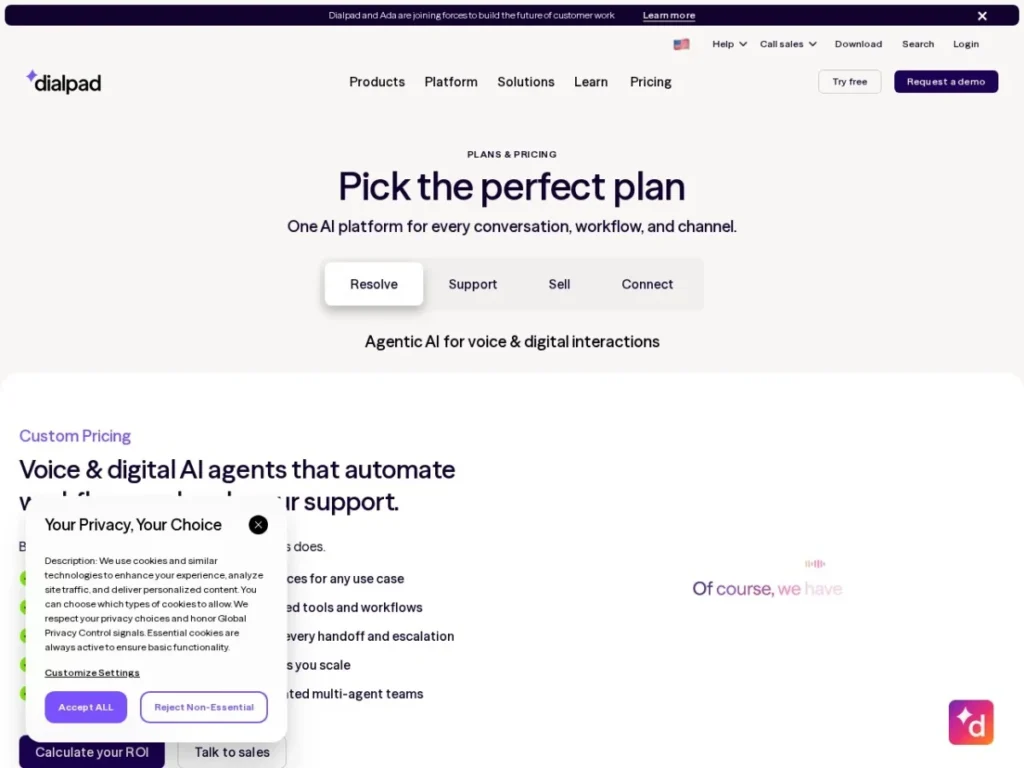
What the $15 buys is the best AI note-taking in this guide at the entry price. Real-time transcription and post-call summaries are included on every Dialpad Connect plan, including Standard, and so are voicemail transcriptions. That is the whole point of the tool: every call ends with a written record, without buying an add-on or stepping up a tier.
The catch is the monthly price, and it is the biggest monthly penalty in this guide. Pay monthly instead of annually and Standard costs $27 a user a month, not $15, which is an 80 percent jump. For a five-person team that is $720 a year extra. CRM integrations and 24/7 support sit on Pro, not Standard.
The second catch is the AI answering, and it is the least transparent in this guide. Dialpad’s pricing page now opens on its Agentic AI product, with custom pricing and a pool of AI Agent Credits that are “used only when AI delivers value.” There is no published per-call or per-minute price for an AI agent that answers your calls. You buy the credits through sales, and a conversation is billable only when the AI retrieves information or executes a real action. That may be fair, but it means the AI answering bill cannot be quoted in this guide, and a small business cannot budget it from the website. Dialpad pricing: https://www.dialpad.com/pricing/
Nextiva — The Phone Plus CRM and Ticketing Pick
Nextiva is the tool to buy when the phone is only half the job, and the other half is keeping track of the customers who call. NEXT Core is $15 a user a month billed annually, or $23 billed monthly, read live on nextiva.com/pricing.html on 20 November 2026. NEXT Engage is $25 a user a month billed annually, or $50 monthly. NEXT Scale is $75 a user a month. There is no free plan, and trials are demo based, so you talk to sales before you try it.

What the $15 buys is the most complete entry plan in this guide. Core includes unlimited voice and video, 100 business texts per user, team collaboration, skills-based routing, shared team and personal inboxes, and a basic CRM with a ticketing system, all in the one subscription. It also includes 50 AI transcriptions, 50 AI summarizations, and 50 AI Answer Assist conversations per user a month. Engage doubles the texts to 500 per user and the AI allowances to 200 each, adds live chat and a chatbot, and includes 2,000 toll-free inbound minutes. Scale makes the AI allowances unlimited.
The catch is the AI answering, and it is the most expensive add-on in this guide. XBert, Nextiva’s AI employee, starts at $99 a month for 100 conversations, and then costs $1.50 per conversation after that. For a five-person team on Core, the phone costs $75 a month and the AI answering costs $99, so the add-on costs more than the phone system it sits on. A 20-minute call and a 2-minute call both cost one conversation, which is good for long calls and bad if your calls are mostly short ones. Nextiva pricing: https://www.nextiva.com/pricing.html
RingCentral — The Broadest Platform, With the Priciest AI Add-On
RingCentral is the tool to buy when the business has more than one location, or when the phone has to do everything. RingEX Core is $20 a user a month billed annually, or $30 billed monthly, read live on RingCentral’s plans and pricing page on 20 November 2026. Advanced is $25 a user a month billed annually, or $35 monthly. Ultra is $35 billed annually, or $45 monthly. The trial is 14 days.
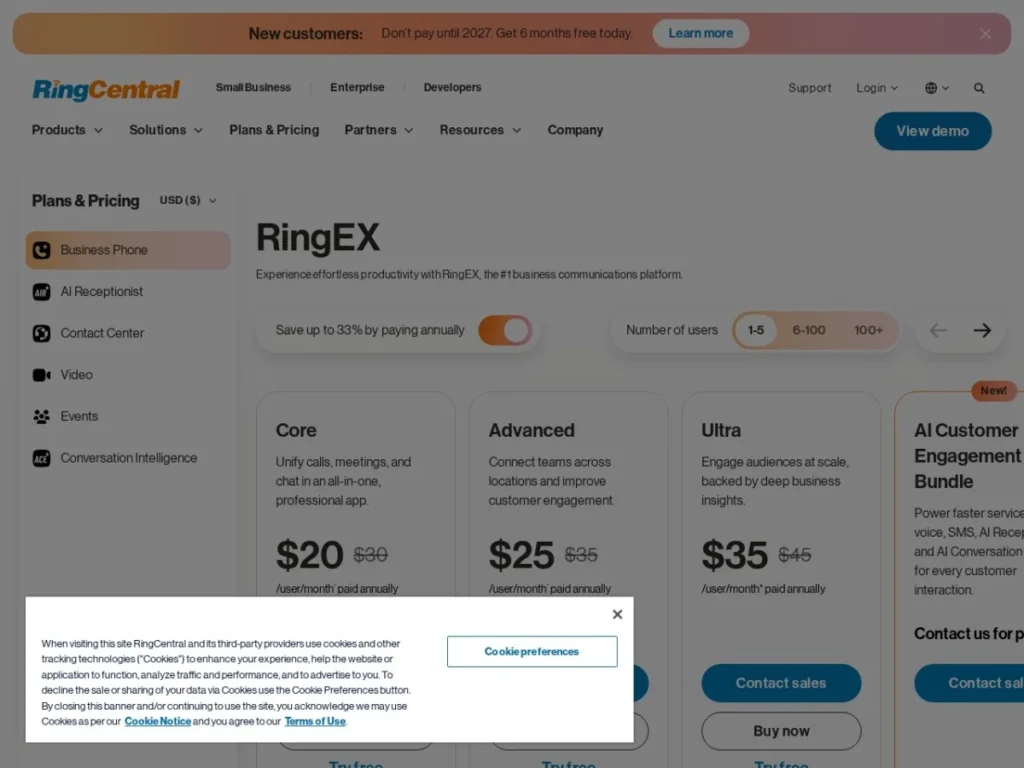
What the $20 buys is the broadest entry plan in this guide. Core includes unlimited domestic calling, business SMS, internet fax, HD video meetings for up to 300 participants, team messaging, and 24/7 support. It also includes the AI Virtual Assistant, which handles captions, transcriptions, notes, and summaries, so the call notes are included from the entry plan, like Dialpad. The page advertises savings of up to 33 percent on annual billing, and the per-user price does not change between 1 and 100 seats.
The catch is the caps, and they are the tightest in this guide. Core allows 25 SMS messages per user a month, which is less than one a day, and a single appointment-confirmation workflow can burn through it by Tuesday. Toll-free minutes are pooled at 100 a month for the whole account, not per user, and call recording is on-demand only. CRM integrations like Salesforce and HubSpot are not included on Core; they sit on Advanced at $25.
The second catch is the AI answering, and it is a meter with teeth. The AI Receptionist is a paid add-on on every RingEX tier, including Ultra. It costs $39 a month as a RingEX add-on, or $49 a month as a standalone plan that works with any phone system, and both include 100 minutes, with a 14-day trial. Past the 100 minutes, every minute costs $0.50, billed in 30-second increments. At 100 AI-handled calls a month averaging two minutes each, that is 200 minutes, so the add-on costs $39 plus $50 of overage, or $89 a month, on top of the seats. RingCentral pricing: https://www.ringcentral.com/office/plansandpricing.html
Grasshopper — The Flat-Rate Line for One Person
Grasshopper is the tool to buy when you are one person, or a tiny team, and you want a professional business number without learning a phone platform. True Solo is $14 a month billed annually, or $18 billed monthly, read live on grasshopper.com/pricing on 20 November 2026. Solo Plus is $25 a month billed annually, or $32 monthly. Small Business is $55 a month billed annually, or $70 monthly. The trial is 7 days, with a 7-day money-back guarantee.

What the $14 buys is the simplest pricing in this guide. Grasshopper charges per account, not per user, so one flat monthly rate covers the plan, and the difference between the plans is phone numbers, extensions, and user capacity, not features. True Solo covers one user, one number, and one extension. Solo Plus covers unlimited users, one number, and three extensions. Small Business covers unlimited users, four numbers, and unlimited extensions. Every plan includes the same core features, and AI-powered call transcription was added in October 2025.
The catch is what Grasshopper does not do, and it is the longest list in this guide. There is no AI answering agent at any price, so the calls you miss go to voicemail, and the voicemail gets transcribed. There is no CRM, no ticketing, and no meaningful integrations to speak of. The service works in the US and Canada only, international calls are not included and are billed per minute, and the top plan caps you at four phone numbers.
The second catch is the plan ladder itself. True Solo allows one user, so the moment a second person needs their own extension, you are on Solo Plus at $25. And Solo Plus allows one number, so the moment the business needs a second number, you are on Small Business at $55. The flat rate is honest, but the steps between plans are steep. Grasshopper pricing: https://grasshopper.com/pricing
Cost Maths
Here is what the five best AI phone systems for small business cost when five people share the phone for a year, all on annual billing where an annual price is published, with no add-ons.
| Tool | Plan at 5 users | Monthly | Yearly | Cost per user per month |
|---|---|---|---|---|
| Quo | Starter | $75.00 | $900.00 | $15.00 |
| Dialpad | Standard | $75.00 | $900.00 | $15.00 |
| Nextiva | Core | $75.00 | $900.00 | $15.00 |
| RingCentral | Core | $100.00 | $1,200.00 | $20.00 |
| Grasshopper | Solo Plus (flat) | $25.00 | $300.00 | $5.00 |
| All five together | $350.00 | $4,200.00 |
The realistic stack is one tool, not five: for a five-person team, Quo Starter, Dialpad Standard, or Nextiva Core at $75 a month, or $900 a year.
Now add the AI answering, at 100 AI-handled calls a month, each averaging two minutes, which is 200 minutes of AI talk time.
| Tool | Phone, 5 users | AI answering at 100 calls/mo | Total per month | Total per year |
|---|---|---|---|---|
| Quo | $75 | $49 (Sona Tier 3, 100 calls) | $124.00 | $1,488.00 |
| Dialpad | $75 | Quote only (AI Agents via sales) | $75 + unknown | Unknown |
| Nextiva | $75 | $99 (XBert, 100 conversations) | $174.00 | $2,088.00 |
| RingCentral | $100 | $89 (AIR $39 + 100 extra minutes at $0.50) | $189.00 | $2,268.00 |
| Grasshopper | $25 | Not sold at any price | $25.00 | $300.00 |
Two things jump out. First, the AI answering costs more than the phone on every tool that sells it except Quo, where it costs $49 against $75 of seats. Second, the meters punish different businesses: Nextiva charges per conversation, so a 20-minute call costs the same as a 2-minute one, while RingCentral charges per minute, so short calls are cheap and long ones are not. Count your average call length before you pick a meter, not after.
The monthly-billing penalty is the quietest cost in this guide. Pay monthly instead of annually and a five-person team pays $240 a year more on Quo, $720 more on Dialpad, $480 more on Nextiva, and $600 more on RingCentral. Grasshopper Solo Plus costs $84 a year more on monthly billing. Run the numbers in the AI Cost Calculator (https://aitbizhub.com/ai-cost-calculator/) before you buy, with your real headcount, not the round number in this guide.
The Hidden Costs and Gotchas
First, Quo’s 10 free AI calls a month run out fast. They are a demo allowance, not a plan. A business that misses three calls a day burns them before the first week ends, and then the meter starts at $25 a month for 40 calls.
Second, Dialpad’s monthly price is 80 percent higher than its annual price. Standard is $15 a user a month billed annually and $27 billed monthly, a $720-a-year penalty for a five-person team that pays monthly. That is the biggest percentage jump in this guide.
Third, Nextiva’s annual price is only for new customers with 1 to 100 employees on a 12-month or longer agreement, and the seat price is not the bill. Regulatory and E911 fees per line, federal USF, and state and local taxes all sit on top.
Fourth, RingCentral Core caps SMS at 25 messages per user a month and pools 100 toll-free minutes across the whole account. A single appointment-confirmation workflow can burn the SMS allowance by Tuesday, and call recording is on-demand only.
Fifth, Quo’s AI call summaries need Business at $23 a user a month, except for the calls Sona handled. On Starter, the calls your team answered themselves come with no summary, so the real price of the feature is $23, not $15.
Sixth, Grasshopper works in the US and Canada only, sells no AI answering agent, and caps the top plan at four phone numbers. International calls are billed per minute and are not included in any plan.
Seventh, Dialpad’s AI Agents have no published price. The pricing page now opens on its Agentic AI product with custom pricing, and the Connect plan prices sit under the Connect tab. A small business cannot budget the AI answering from the website; it is a sales conversation.
Eighth, Dialpad annual plans do not refund unused months. Refunds are only processed within three days of the transaction, and cancelling an annual plan early means owing the full remaining term.
Ninth, RingCentral’s AI Receptionist overage is $0.50 a minute in 30-second increments, past the 100 included minutes. At 100 AI-handled calls averaging two minutes, the overage alone is $50 a month, and a long call burns the included minutes fast.
Tenth, OpenPhone is now Quo. The rebrand happened in 2026, and the product, the pricing page, and the app all say Quo now. A roundup that still recommends OpenPhone has not been updated since the rebrand, and its prices are probably stale too.
Eleventh, Nextiva’s XBert charges per conversation, and the 101st conversation costs $1.50, more than the $0.99 average of the first 100 in the $99 package. The meter is cheap for long calls and expensive for short ones, so count your average call length before you buy.
Work Out What the Hour Is Worth
The price of the phone system is the smallest number in this decision. A missed call is not a lost conversation, it is a lost customer, and the research on missed calls is blunt: home-services contractors miss 60 to 80 percent of inbound calls, and about 80 percent of callers hang up without leaving a message. One missed emergency call for a plumber or an electrician can be worth thousands of dollars, more than a year of any phone system in this guide. Put your real number into the AI Time-Saving Calculator (https://aitbizhub.com/ai-time-saving-calculator/) before you buy anything.
Run it with honest numbers. Five people spending 15 minutes a day each on phone admin, replaying voicemails, chasing “who took that call?”, calling back numbers with no context, is 75 minutes a day, or about 25 hours a month. At $50 an hour, that is $1,250 a month of your team’s time spent on the phone instead of on the work. Quo Starter costs $75 a month. Even if the AI only cuts the phone admin in half, you have traded about $625 of your team’s time for $75 of software.
The break-even is almost embarrassingly low: at $50 an hour, Quo Starter pays for itself if it saves your team 90 minutes a month. Nextiva Core pays for itself at the same 90 minutes, and RingCentral Core at two hours a month. The question is not whether the tool is worth $15 a user, it is whether the calls it answers are calls you would otherwise lose.
Pros and Cons
Pros of Quo: the only AI answering agent included in the cheapest seat here, with Sona on every plan; the cheapest AI answering at low volume, with 10 free calls a month; shared numbers for small teams with up to 10 paid users on Starter.
Cons of Quo: the 10 free AI calls a month run out in days for a busy business; AI call summaries need Business at $23, except for Sona-handled calls; messaging costs extra, with a $19.50 one-time carrier fee.
Pros of Dialpad: AI transcripts and summaries on every plan, including the $15 Standard plan; the cheapest seat with the best call notes; video meetings and messaging included from Standard.
Cons of Dialpad: the monthly price is $27, an 80 percent jump from the $15 annual price; AI Agents have no published price and are sold through sales; annual plans do not refund unused months.
Pros of Nextiva: the phone, a basic CRM, and a ticketing system in one subscription; 50 AI transcriptions and summaries per user on Core; the most complete entry plan here.
Cons of Nextiva: XBert costs $99 a month for 100 conversations, more than the phone seats for a five-person team; the annual price is only for new customers on a 12-month or longer term; regulatory fees and taxes sit on top of the seat price.
Pros of RingCentral: the broadest platform here, with video for 300 people and team chat from Core; the AI Virtual Assistant is included on every plan; the per-user price does not change between 1 and 100 seats.
Cons of RingCentral: Core caps SMS at 25 per user a month and pools 100 toll-free minutes for the whole account; the AI Receptionist is a paid add-on on every tier, at $39 a month plus $0.50 a minute of overage; fees sit on top of the seat price.
Pros of Grasshopper: a flat monthly rate for the whole account, so five people cost $25 a month, not $75; the simplest pricing in this guide; AI call transcription included on every plan.
Cons of Grasshopper: no AI answering agent at any price, so missed calls go to voicemail; no CRM, no ticketing, and no meaningful integrations; US and Canada only, with the top plan capped at four numbers.
Our Verdict
The best AI phone systems for small business with a five-person team start with Quo Starter at $15 a user a month billed annually. It costs $75 a month, or $900 a year, and it is the only tool here that answers your calls with AI on the cheapest seat, with Sona included and 10 free AI-handled calls a month.
Buy Dialpad Standard at $15 a user a month billed annually if the call notes matter most, because transcripts and summaries are included on every plan. Just pay annually, because the monthly price is $27, and remember the AI answering has no published price, so budget it through sales before you commit.
Buy Nextiva Core at $15 a user a month billed annually if you want the phone, the CRM, and the ticketing in one subscription, and you are ready to pay $99 a month more for XBert when you want the AI to answer. Buy RingCentral Core at $20 a user a month billed annually if you run more than one location and want the broadest platform, and budget $39 a month plus overage for the AI Receptionist on top.
Buy Grasshopper Solo Plus at $25 a month flat if you are a tiny team that wants one professional number and no per-user bill, and you are honest that nobody will answer the calls you miss. And whichever tool you buy, count your average call length before you pick an AI meter, check the monthly-billing penalty before you pay monthly, and never trust a roundup that still calls Quo by its old name, OpenPhone.
Frequently Asked Questions
What is the best AI phone system for a small business? Quo Starter is the best overall pick at $15 a user a month billed annually, because its Sona AI agent is included on every plan. Dialpad Standard is the best for AI call notes at the same $15, Nextiva Core is the best phone-plus-CRM pick at $15, RingCentral Core is the broadest platform at $20, and Grasshopper True Solo is the best flat-rate line for one person at $14 a month.
How much does an AI phone system cost? For a five-person team on annual billing, the phone costs $75 a month on Quo, Dialpad, or Nextiva, $100 on RingCentral, and $25 flat on Grasshopper Solo Plus. AI answering at 100 calls a month adds $49 on Quo, $99 on Nextiva, and $89 on RingCentral, while Dialpad sells its AI Agents through sales with no published price and Grasshopper sells no AI answering at any price.
Is OpenPhone still available? OpenPhone rebranded to Quo in 2026. It is the same product under a new name, and the pricing page, the app, and the plans all say Quo now. Roundups that still recommend OpenPhone have not been updated since the rebrand, and their prices are probably stale.
Can an AI receptionist really answer calls for a small business? Yes, for the routine calls. Quo’s Sona, Nextiva’s XBert, and RingCentral’s AI Receptionist answer calls around the clock, take messages, answer common questions, and book appointments, then hand the complex calls to a human with a summary attached. They are priced by the call, the conversation, or the minute, so the meter matters more than the headline price.
Do I need a desk phone? No. All five tools run as apps on your mobile and your computer, and Grasshopper forwards calls to the mobile phone you already own. A desk phone is optional hardware, not a requirement.
Price Note
Price note — updated 20 November 2026: Prices in this guide to the best AI phone systems for small business were checked on 20 November 2026. When you are reading this, the price may be lower, higher, or structured differently. Quo, Nextiva, and RingCentral prices were read live on the vendors’ own pricing pages on that date and re-checked live on the day of publishing. Grasshopper’s pricing page could not be re-read on the day of publishing because the page is only available in the USA and Canada, so its figures are from the live read on 20 November 2026.
Dialpad’s Standard $15 and Pro $25 figures come from November 2026 reads of Dialpad’s official pricing page, because the live page now opens on its Agentic AI product with custom pricing, and the Connect plan prices sit under the Connect tab. RingCentral’s AI Receptionist figures, $39 a month as a RingEX add-on or $49 standalone with 100 minutes included and $0.50 a minute of overage, come from October and November 2026 reads of RingCentral’s own AI Receptionist page.
Grasshopper’s Small Business plan is $55 a month on annual billing on the live page; some older guides still show $80, which is stale. Nextiva was showing a Black Friday offer of 3 months free on its pricing page on 20 November 2026. Always check the official pricing page before you buy.
Pros
- Every price checked on the vendor's own pricing page on 20 November 2026, or on a live screenshot of it
- Every figure that could not be read live is flagged rather than hidden
- The whole guide is priced at one volume, a five-person team, so the totals are numbers you can budget, not a list of starting prices
- The OpenPhone-to-Quo rebrand is verified, not repeated from a roundup
- Quo: the only AI answering agent included in the cheapest seat here, with Sona on every plan
- Quo: the cheapest AI answering at low volume, with 10 free calls a month
- Quo: shared numbers for small teams with up to 10 paid users on Starter
- Dialpad: AI transcripts and summaries on every plan, including the $15 Standard plan
- Dialpad: the cheapest seat with the best call notes
- Dialpad: video meetings and messaging included from Standard
- Nextiva: the phone, a basic CRM, and a ticketing system in one subscription
- Nextiva: 50 AI transcriptions and summaries per user on Core
- Nextiva: the most complete entry plan here
- RingCentral: the broadest platform here, with video for 300 people and team chat from Core
- RingCentral: the AI Virtual Assistant is included on every plan
- RingCentral: the per-user price does not change between 1 and 100 seats
- Grasshopper: a flat monthly rate for the whole account, so five people cost $25 a month, not $75
- Grasshopper: the simplest pricing in this guide
- Grasshopper: AI call transcription included on every plan
Cons
- Dialpad's Connect prices rested on November 2026 reads of the official page because the live page now opens on its Agentic AI product
- RingCentral's AI Receptionist prices come from October and November 2026 reads of RingCentral's own AI Receptionist page
- Nextiva's per-line fees are not in the seat price and vary by location
- Quo: the 10 free AI calls a month run out in days for a busy business
- Quo: AI call summaries need Business at $23, except for Sona-handled calls
- Quo: messaging costs extra, with a $19.50 one-time carrier fee
- Dialpad: the monthly price is $27, an 80 percent jump from the $15 annual price
- Dialpad: AI Agents have no published price and are sold through sales
- Dialpad: annual plans do not refund unused months
- Nextiva: XBert costs $99 a month for 100 conversations, more than the phone seats for a five-person team
- Nextiva: the annual price is only for new customers on a 12-month or longer term
- Nextiva: regulatory fees and taxes sit on top of the seat price
- RingCentral: Core caps SMS at 25 per user a month and pools 100 toll-free minutes for the whole account
- RingCentral: the AI Receptionist is a paid add-on on every tier, at $39 a month plus $0.50 a minute of overage
- RingCentral: fees sit on top of the seat price
- Grasshopper: no AI answering agent at any price, so missed calls go to voicemail
- Grasshopper: no CRM, no ticketing, and no meaningful integrations
- Grasshopper: US and Canada only, with the top plan capped at four numbers
The best AI phone systems for small business with a five-person team start with Quo Starter at $15 a user a month billed annually. It costs $75 a month, or $900 a year, and it is the only tool here that answers your calls with AI on the cheapest seat, with Sona included and 10 free AI-handled calls a month. Buy Dialpad Standard at $15 a user a month billed annually if the call notes matter most, because transcripts and summaries are included on every plan. Just pay annually, because the monthly price is $27, and remember the AI answering has no published price, so budget it through sales before you commit. Buy Nextiva Core at $15 a user a month billed annually if you want the phone, the CRM, and the ticketing in one subscription, and you are ready to pay $99 a month more for XBert when you want the AI to answer. Buy RingCentral Core at $20 a user a month billed annually if you run more than one location and want the broadest platform, and budget $39 a month plus overage for the AI Receptionist on top. Buy Grasshopper Solo Plus at $25 a month flat if you are a tiny team that wants one professional number and no per-user bill, and you are honest that nobody will answer the calls you miss. And whichever tool you buy, count your average call length before you pick an AI meter, check the monthly-billing penalty before you pay monthly, and never trust a roundup that still calls Quo by its old name, OpenPhone.
2 thoughts on “Best AI Phone Systems for Small Business (2026): 5 Compared by Real Price”