

For a business with about 800 SKUs, three staff, one location plus an online store, and roughly 300 orders a month, Zoho Inventory Standard is the cheapest complete match at $29 per organization per month billed annually, which is $348 a year. Sortly Ultra costs $1,788 a year, inFlow Inventory Lite with a third team member costs $1,536 a year, Cin7 Core Standard costs $4,188 a year, and Katana is free up to 30 SKUs before Advantage starts at $1,500 a month. Every price was checked on the vendor's official pricing page on 29 November 2026.
Quick Answer
The best ai inventory management software for small business depends on which limit you hit first: orders, items, users, or integrations. For a business with about 800 SKUs, three staff, one location plus an online store, and roughly 300 orders a month, Zoho Inventory Standard is the cheapest complete match at $29 per organization per month billed annually, which is $348 a year.
Sortly Ultra costs $149 a month on monthly billing ($1,788 a year) and is the easiest visual option. inFlow Inventory Lite costs $99 a month billed annually, and adding a third team member at $29 brings it to $128 a month ($1,536 a year). Cin7 Core Standard costs $349 a month ($4,188 a year) and suits heavier multichannel selling. Katana is free up to 30 SKUs, then its Advantage plan starts at $1,500 a month on a custom annual contract, so it sits outside the stack maths below.
Buying the four priced tools at those tiers costs $7,860 a year. Starting on Zoho Inventory Standard alone costs $348 a year, so one right tool saves $7,512 a year. Every best ai inventory management software price below was checked on the vendor’s official pricing page on 29 November 2026.
In this article
- How we compared the best ai inventory management software for small business
- The five tools at a glance
- Zoho Inventory: the cheapest complete system at small scale
- Sortly: visual tracking that a non-technical team will actually use
- inFlow Inventory: warehouse discipline without an ERP
- Cin7 Core: multichannel depth at a serious monthly price
- Katana: free for 30 SKUs, then a quote
- The maths: 800 SKUs, three staff, 300 orders a month
- Five traps that catch inventory buyers
- Strategic Pivot: count SKUs, orders and channels before you buy
- Pros and cons
- Our verdict
- Frequently asked questions
- Sources
How we compared the best ai inventory management software for small business
Inventory software usually enters a business through a bad afternoon. The spreadsheet says forty units, the shelf has nine, and a customer is waiting. That gap, not a feature list, is what owners are really shopping to close.
Our test business sells physical products. It holds about 800 SKUs in one location, sells through its own online store, and ships roughly 300 orders a month. Three people touch stock: the owner, one packer, and one person who receives deliveries and raises purchase orders.
We compared the same five things for every tool in this best ai inventory management software comparison. First, what that business pays each month and each year at published prices. Second, which limit bites first as it grows: orders, unique items, users, locations, or integrations. Third, whether barcode scanning and purchase orders sit on the entry plan or behind a higher tier. Fourth, what the free plan really covers. Fifth, where AI genuinely helps, such as demand forecasting or reorder suggestions, and where it is just a label.
One honesty note before the detail. No inventory tool fixes a process nobody follows. If receiving is not scanned in, every system in this post will confidently report the wrong number. The software question is which tool makes the right habit cheapest to keep.
The five tools at a glance
| Tool | Best for | Price checked 29 November 2026 | Free route |
|---|---|---|---|
| Zoho Inventory | Cheapest complete orders-and-stock system | Standard $29/org/month billed annually | Free: 50 orders/month, 1 user |
| Sortly | Visual, photo-led tracking for simple stock | Ultra $149/month monthly billing | Free: 100 unique items, 1 user |
| inFlow Inventory | Barcode receiving and warehouse discipline | Lite $99/month billed annually | 14-day free trial, no free plan |
| Cin7 Core | Multichannel selling with one stock record | Standard $349/month | 14-day free trial, no free plan |
| Katana | Makers with bills of materials | Free to 30 SKUs, then from $1,500/month | Free: 30 SKUs, unlimited users |
This best ai inventory management software table hides the real split, which is how each tool meters you. Zoho meters orders and users per organization. Sortly meters unique items and user licenses. inFlow meters team members and locations. Cin7 meters users, integrations, and yearly sale orders. Katana meters SKUs, then moves to a custom contract with a published starting price.
That split decides the winner. The same 800-SKU business is comfortably inside one tool’s entry plan and already forced into a higher tier on another. Pricing every tool at the same workload is the only fair way to compare them.
Zoho Inventory: the cheapest complete system at small scale
Zoho Inventory is the price leader here, and its pricing page is clear about the meters. The Free plan costs $0 with 50 orders a month, 1 user, and 1 location. Standard costs $29 per organization per month billed annually, with 500 orders a month, 3 users, and 2 locations. Premium costs $79 per organization per month billed annually, with 3,000 orders a month, 5 users, and 4 locations. Plus costs $129 and Enterprise $249 per organization per month billed annually. Prices exclude local taxes.
The free plan is a genuine starting point for a one-person seller. Fifty orders a month is roughly one or two orders a day, and composite items, dropshipment, and backordering are included. The limit that ends it is the single user: the moment a second person needs a login, Standard is the floor.
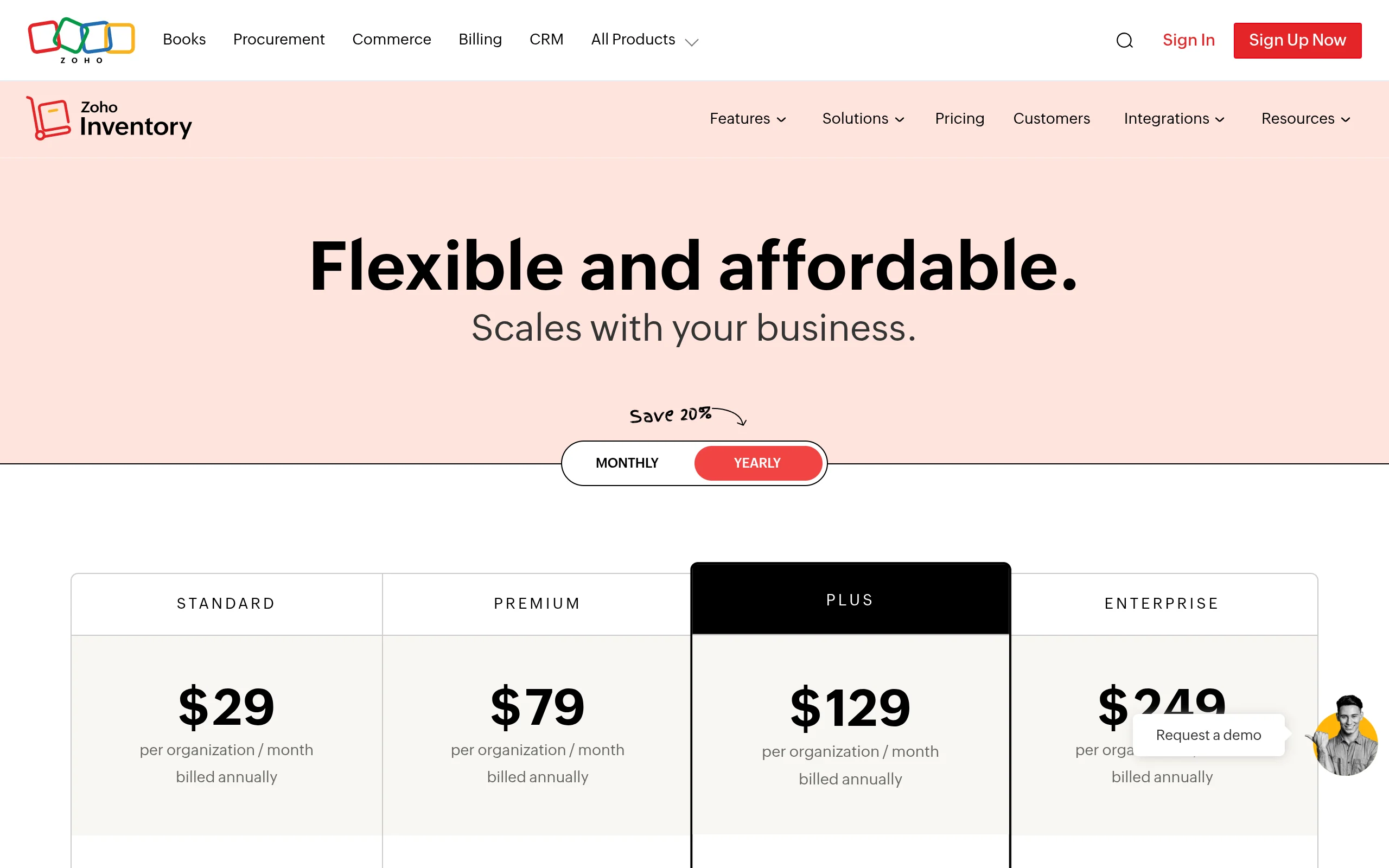
Standard is where our test business lands, and it lands exactly. Three hundred orders a month sits inside the 500-order cap, three staff match the 3 included users, and one location plus an online store fits the 2-location allowance. Composite items cover simple bundles, and the customer portal lets buyers check their own orders.
Premium is the tier to price before you need it. It adds serial number tracking, batch tracking, barcode generation, stock counting, profit margin reporting, and a vendor portal. A business selling dated, batched, or warrantied goods should budget for Premium, not Standard, because those tracking gates live there.
Add-ons soften the tier jumps. Extra users cost $7.50 per organization per month billed annually, extra blocks of 500 orders cost $7.50, and extra locations cost $10. That means a fourth user on Standard costs $7.50, not a forced move to Premium, which is unusually fair pricing for a growing team.
For our test business, Standard on annual billing costs $29 a month, which is $348 a year. The real cost drivers are monthly order volume and user count, both metered per organization rather than per seat. Passing 500 orders a month is the trigger to re-price.
Best for: small sellers under 500 orders a month who want orders, stock, and purchase workflows in one published-price system. Skip if: you need serial or batch tracking on day one, because that gate sits on Premium at $79 a month.
Sortly: visual tracking that a non-technical team will actually use
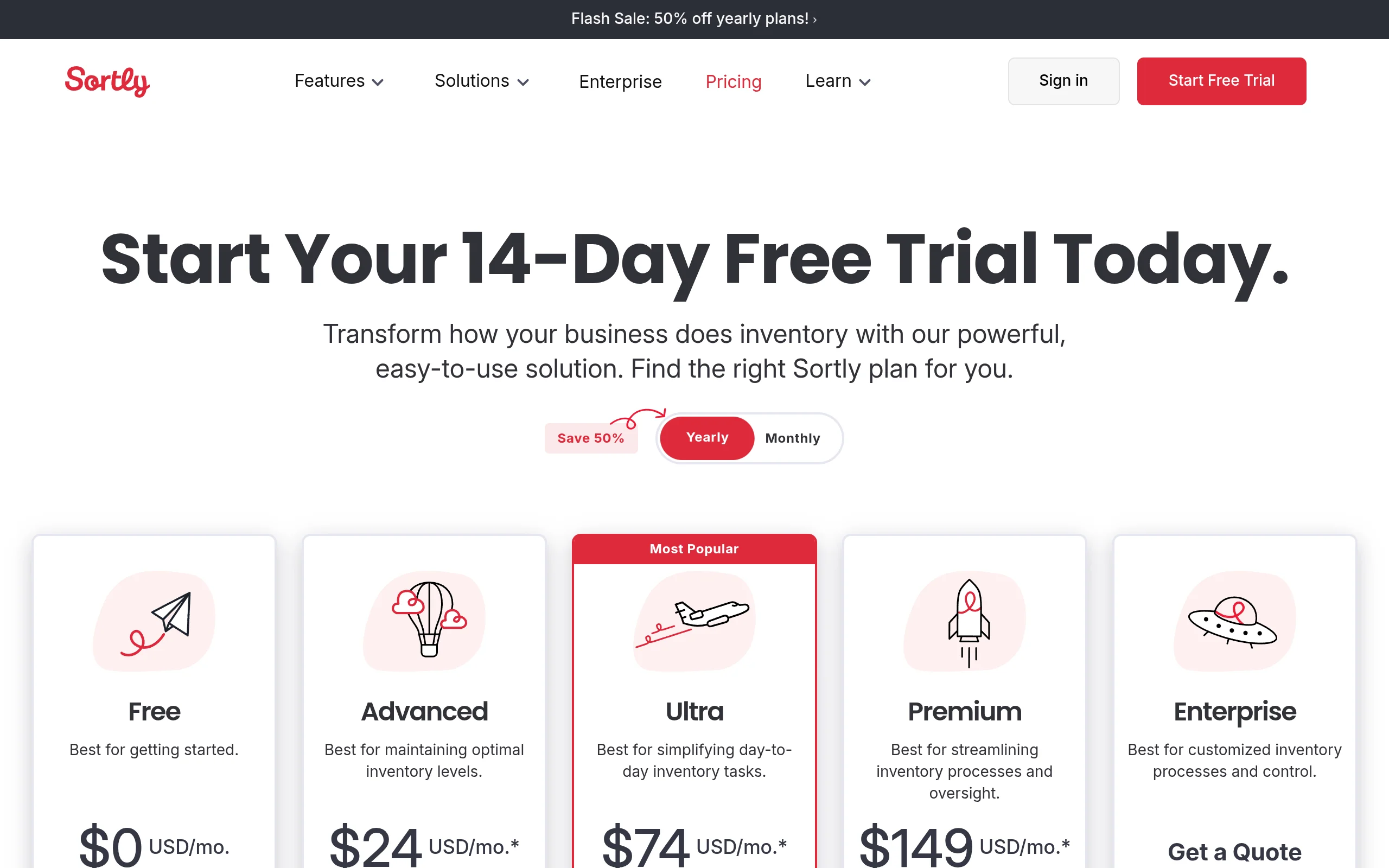
Sortly is the visual option, built around photos, QR labels, and a phone-first interface. The Free plan costs $0 with 100 unique items, 1 user license, and 2 active jobs. Advanced costs $49 a month, with 500 unique items and 2 user licenses. Ultra costs $149 a month, with 2,000 unique items and 5 user licenses. Premium costs $299 a month, with 5,000 unique items and 8 user licenses. Enterprise is quote-only. All prices are in USD.
One pricing detail needs care. The yearly toggle shows $24, $74, and $149 a month, but the page states the 50% discount applies only to the first year of new customer subscriptions. After the first year, a 20% discount applies to yearly plans. So Ultra on yearly billing is $888 in year one, then about $119.20 a month, or $1,430.40 a year, at today’s published terms.
The free plan suits a single person tracking tools, equipment, or a small product line. One hundred unique items means 100 different products, not 100 units, because quantities of an item do not count toward the limit. That makes the free tier more useful than it first looks, until a second person needs access.
Advanced adds unlimited QR code label creation and low-stock alerts, which is the moment Sortly becomes a stock system rather than a photo catalog. But Advanced caps at 500 unique items and 2 users, so our 800-SKU, three-person test business outgrows it on both meters at once.
Ultra is the realistic tier for that business. It raises the cap to 2,000 unique items and 5 user licenses, and it adds purchase orders and unlimited QR and barcode label creation. Premium adds customizable role permissions and a QuickBooks Online integration, so a business that needs accounting sync should price Premium, not Ultra.
For our test business, Ultra on monthly billing costs $149 a month, which is $1,788 a year. On the first-year yearly promo it costs $888, with the renewal step-up stated above. The real cost drivers are unique items and user licenses, and both jump together at each tier.
Best for: teams that will scan and photograph stock happily but will not learn a warehouse system. Skip if: you need deep order management or accounting sync on the entry tier, because purchase orders start on Ultra and QuickBooks Online sits on Premium.
inFlow Inventory: warehouse discipline without an ERP
inFlow Inventory is the warehouse-discipline option, aimed at product businesses that receive, stock, pick, and ship every day. Lite costs $99 a month billed annually, or $129 billed monthly, with 2 team members and 1 location. Core costs $299 billed annually, or $379 monthly, with 5 team members and 5 locations. Pro costs $499 billed annually, or $629 monthly, with 10 team members and unlimited locations. Max costs $699 billed annually, or $879 monthly, with 20 team members. There is a 14-day free trial and no free plan.
The plan structure is built on members and locations, not orders or items. Products, orders, and integrations are not the meters here, which suits a business whose catalog grows faster than its headcount. Extra team members cost $29 a month each, so a small team can stretch Lite instead of jumping straight to Core.

Onboarding is the cost line to read twice. Most inFlow plans require a one-time onboarding package, listed at $499, and it is required from Core upward while optional on Lite. A business comparing first-year costs should add that $499 to any Core, Pro, or Max quote before comparing it with rivals.
Add-ons are the other place the bill grows. Lot numbers, serial numbers, API access, and the B2B portal sit as add-ons on lower plans, and manufacturing is a separate product line. None of that makes inFlow expensive by itself, but the honest comparison prices the add-ons your workflow needs, not the bare plan.
For our test business, Lite plus one extra team member costs $99 plus $29, which is $128 a month billed annually, or $1,536 a year. That covers three staff at one location with barcode receiving and purchase orders. The real cost drivers are team members, locations, and the one-time onboarding package if you choose Core or above.
Best for: one-location product businesses that want barcode receiving, picking discipline, and unlimited products without per-order meters. Skip if: you are a one-person seller under 50 orders a month, because Zoho’s free plan covers that stage for $0.
Cin7 Core: multichannel depth at a serious monthly price
Cin7 Core is the multichannel option, built for brands selling through a store, marketplaces, and wholesale at the same time. Standard costs $349 a month with 5 users, 2 e-commerce and app integrations, 6,000 sale orders a year, and unlimited inventory locations. Pro costs $599 a month with 10 users, 4 integrations, and 24,000 sale orders a year. Advanced costs $1,199 a month with 15 users, 6 integrations, and 120,000 sale orders a year. Prices are in USD, exclude taxes, and apply to new customers. There is no free plan.
Standard already includes the connected workflows smaller tools charge extra for. Purchase order management, barcode scanning, a standard warehouse app, assembly manufacturing with bills of materials, batch and expiration tracking, and Xero or QuickBooks Online accounting integration are all in the entry tier. For a business overselling the same SKU on two channels, that single stock record is the whole point.
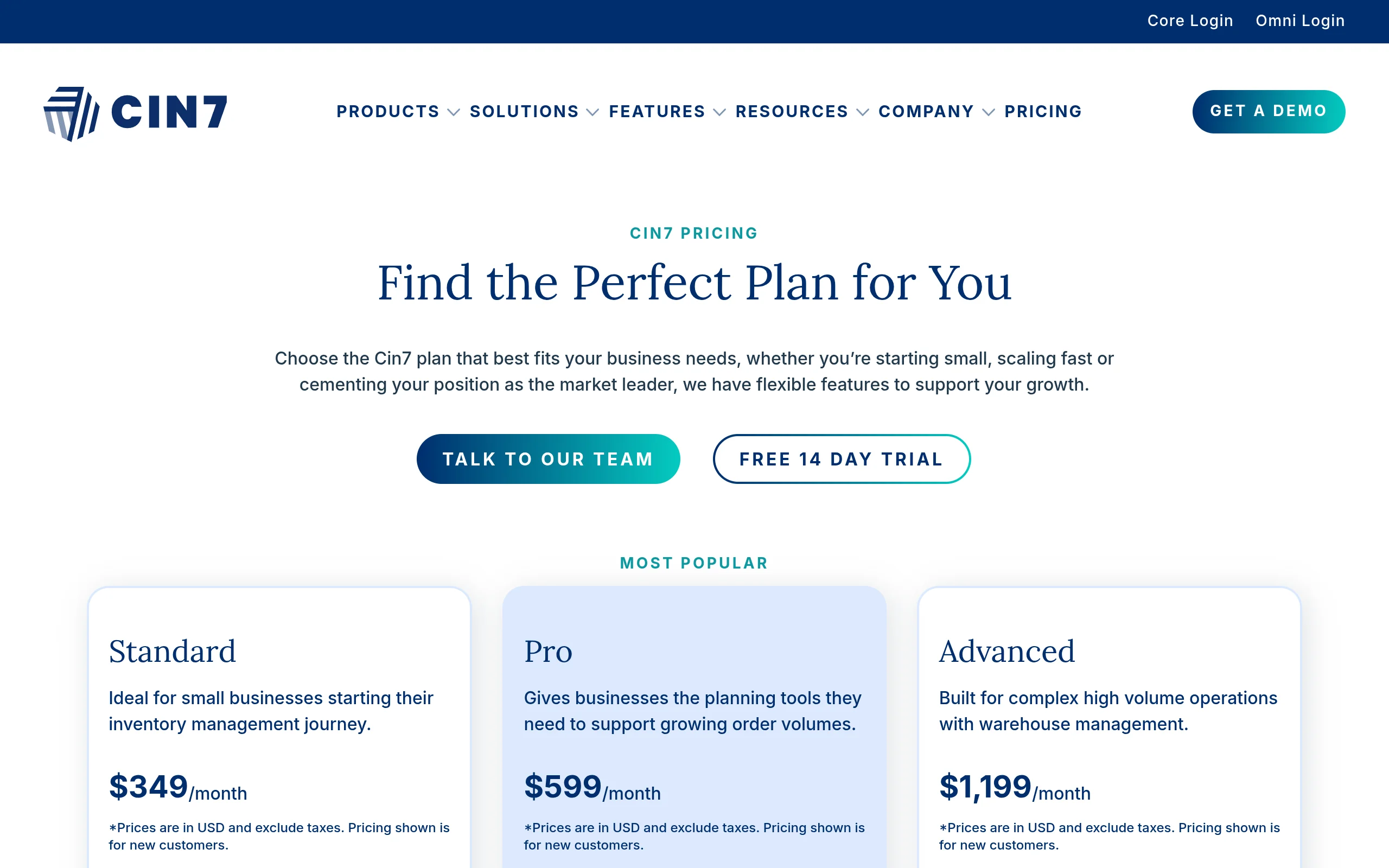
The meters are users, integrations, and yearly sale orders, and more of each is available for purchase at prices the page does not list. That is the honest caveat: the $349 headline is exact, but the cost of a third integration or a seventh user comes from a written quote, not the pricing page.
Pro adds material requirements planning, which turns demand and stock into supply suggestions. Advanced adds advanced warehouse management with FIFO and FEFO pick enforcement. Cin7’s ForesightAI forecasting, its AI demand-forecasting and reordering tool, is an add-on on every Core plan, so a buyer choosing Cin7 for AI forecasting should ask for that add-on price in writing before signing.
For our test business, Standard costs $349 a month, which is $4,188 a year. Three staff fit inside 5 users, and 3,600 orders a year fit inside the 6,000 cap, with one store integration to spare. The real cost drivers are integrations and order volume, and the renewal price deserves a written confirmation because published prices are stated for new customers.
Best for: brands selling the same stock through several channels that need one honest count everywhere. Skip if: you sell through one store only, because you would pay multichannel money for a single-channel problem.
Katana: free for 30 SKUs, then a quote
Katana is the maker option, built for businesses that assemble or manufacture from bills of materials. Its pricing page now lists two plans. Free costs $0 with no credit card, covering up to 30 SKUs with unlimited users, integrations, and inventory locations, plus API access. Advantage is a custom annual contract with unlimited SKUs, starting at $1,500 a month and priced per business after a scoping call.
The free plan is unusually complete inside its cap. All Katana features are included within the 30-SKU limit, including manufacturing orders, bills of materials, traceability, and barcode scanning. For the first 15 days the SKU limit lifts to unlimited, so a maker can load a real catalog and test with real data before the cap applies.

Two limits decide whether free is a home or a trial. The first is the 30-SKU ceiling: a candle maker with ten scents in three sizes is already at the limit. The second is that only Shopify integrates with the Free plan for e-commerce, so a maker selling elsewhere gets less from it.
Advantage is less a bigger tier than a service contract. It bundles unlimited SKUs, users, and integrations with implementation, a dedicated customer success manager, an implementation manager, and 24/7 live support, under one annual price for the agreed scope. That can suit a manufacturer with complex workflows, but the $1,500 monthly starting price puts it in a different budget class from the other four tools, and the final figure depends on the scoped quote.
For our test business, Katana starts at $1,500 a month, which is $18,000 a year before any scope above the floor. Eight hundred SKUs is far beyond the free cap, so the real cost driver is the scoped contract itself. Because that final price is scope-dependent rather than a like-for-like plan price, Katana sits outside the stack maths below.
Best for: makers with 30 SKUs or fewer who want full manufacturing features free, or larger makers willing to scope a contract. Skip if: your budget is small-business plan money, because paid Katana starts at $1,500 a month.
The maths: 800 SKUs, three staff, 300 orders a month
Now price the best ai inventory management software contenders at the same workload: about 800 SKUs, three staff, one location plus an online store, roughly 300 orders a month, with barcode scanning, purchase orders, and low-stock alerts required. That workload is where spreadsheets usually break, because three people editing one file stops matching the shelf.
Zoho Inventory Standard costs $29 a month billed annually, which is $348 a year. The workload fits inside its 500 orders a month, 3 users, and 2 locations, so no add-on is needed. A fourth user later adds $7.50 a month, not a tier jump.
Sortly Ultra costs $149 a month on monthly billing, which is $1,788 a year. The workload needs Ultra because 800 unique items and three users exceed Advanced’s 500 items and 2 licenses, and purchase orders start on Ultra. The first-year yearly promo brings year one to $888, with renewal at about $1,430.40 a year on today’s terms.
inFlow Inventory Lite plus one extra team member costs $128 a month billed annually, which is $1,536 a year. Lite’s 2 included members plus one $29 member cover the three staff at one location, and onboarding is optional on Lite. Choosing Core instead would cost $299 a month plus the required $499 onboarding package.
Cin7 Core Standard costs $349 a month, which is $4,188 a year. Five users, 6,000 sale orders a year, and 2 integrations cover the workload with room to grow. Katana cannot join this table like-for-like, because 800 SKUs needs the Advantage contract, starting at $1,500 a month ($18,000 a year) with the final price set by scope.
Add the four priced tools together and the full stack costs $7,860 a year. Start on Zoho Inventory Standard alone and the same workload costs $348 a year. The difference is $7,512 a year, which is the price of buying four answers to one stock problem.
The lean choice is not automatically Zoho for every business. A team that will only scan stock if the app is visual may get more value from Sortly, and a multichannel brand may need Cin7’s single stock record. For the best ai inventory management software decision, the maths sets the budget; the workflow picks the tool inside it.
Five traps that catch inventory buyers
The first trap in buying the best ai inventory management software is choosing by SKU count alone. Every tool here meters something different, so the limit that ends your plan may be orders, users, integrations, or unique items. Write down your SKU count, monthly orders, staff logins, locations, and sales channels before you open a pricing page, then check which meter you hit first.
The second trap is the free plan that ends at the second login. Zoho’s free plan allows 1 user, Sortly’s allows 1 user license, and Katana’s free plan stops at 30 SKUs. A free plan is a fine start, but price the first paid step before your team depends on the tool.
The third trap is the feature gate hiding in the tier above. Serial and batch tracking sit on Zoho Premium. Purchase orders start on Sortly Ultra. Cin7’s ForesightAI forecasting is an add-on on every Core plan. The entry price only counts if the entry plan includes the workflow you actually run.
The fourth trap is first-year pricing that steps up at renewal. Sortly’s yearly prices carry a 50% first-year discount for new customers, then 20% off yearly plans after that. Cin7’s published prices are stated for new customers. Budget the renewal figure, not the launch figure, and get it in writing where the page allows doubt.
The fifth trap is ignoring one-time and add-on costs. inFlow requires a $499 onboarding package from Core upward. Cin7 sells extra users, integrations, and order volume at unlisted prices. The subscription is the visible cost; onboarding, add-ons, and capacity purchases are where first-year totals drift.
Strategic Pivot: count SKUs, orders and channels before you buy
Here is the pivot that saves the money. Before choosing the best ai inventory management software in this post, count five numbers: SKUs, orders a month, staff who need logins, locations, and sales channels. Those five numbers, not a feature checklist, decide which plan you land on and what you pay.
If your count is under 50 orders a month with one login, start on Zoho’s free plan and spend nothing. If you pass 500 orders a month, re-price Zoho Premium against inFlow Lite. If a second channel starts overselling the first, that is the moment Cin7 earns its price. If you manufacture from bills of materials, test Katana free inside its 30-SKU cap before scoping a contract.
Then run the yearly totals through our free AI Cost Calculator before you sign anything. It turns monthly plan prices, add-ons, and one-time fees into one honest yearly figure, which is the number your budget actually feels.
If stock is only one of several costs you are untangling, our guide to the best ai expense management software covers the receipt-and-approval side of the same back office. And if the online store itself is the next decision, our Shopify alternatives comparison prices the storefront side of the stack.
Pros and cons
Zoho Inventory pros: the cheapest complete system here at $348 a year for our workload; per-organization pricing with cheap user and order add-ons; a real free plan for one-person sellers. Zoho Inventory cons: serial and batch tracking wait for Premium; the free plan ends at the second login.
Sortly pros: the most approachable visual interface for non-technical teams; photo-led tracking and QR labels staff will actually use; a free plan covering 100 unique items. Sortly cons: purchase orders start on Ultra; yearly promo pricing steps up at renewal; QuickBooks Online sits on Premium.
inFlow Inventory pros: barcode receiving and warehouse discipline without per-order meters; unlimited products suit growing catalogs; extra members stretch Lite cheaply. inFlow Inventory cons: no free plan; a required $499 onboarding package from Core upward; lot and serial tracking are add-ons on lower plans.
Cin7 Core pros: one stock record across channels, warehouses, and accounting; batch tracking and assemblies included from Standard; published tier prices. Cin7 Core cons: $349 a month is serious money for a single-channel seller; extra capacity prices are unlisted; AI forecasting is a paid add-on.
Katana pros: full manufacturing features free up to 30 SKUs; unlimited users on both plans; implementation bundled into Advantage. Katana cons: paid plans start at $1,500 a month on a custom contract; only Shopify integrates with the free plan.
Our verdict
For most small product businesses choosing the best ai inventory management software at our test workload, Zoho Inventory Standard is the buy. At $348 a year it covers 500 orders a month, three users, and two locations, and its add-ons grow the bill gently instead of forcing tier jumps. It is the cheapest tool here that still runs the whole orders-and-stock workflow.
Choose Sortly Ultra instead if your team’s real risk is adoption, not features. A visual system your packer scans every day beats a deeper system nobody updates, even at $1,788 a year on monthly billing. Choose inFlow Lite if receiving discipline and barcode workflows matter most at one location, and price the $499 onboarding before stepping up to Core.
Choose Cin7 Core Standard when the same stock sells through several channels and overselling is already costing refunds. At $4,188 a year it is the priciest of the four plan-priced tools here, and it earns that only when multichannel accuracy is the problem. Choose Katana free if you make products from bills of materials and your catalog fits 30 SKUs; above that, Advantage starts at $1,500 a month, so get the scoped quote in writing and compare it against Cin7 Pro before signing.
Frequently asked questions
What is the best ai inventory management software for small business?
For a small product business with about 800 SKUs, three staff, and 300 orders a month, Zoho Inventory Standard is the best ai inventory management software at $29 per organization per month billed annually ($348 a year). Sortly Ultra suits teams that need a visual interface, inFlow Lite suits barcode-led warehouses, and Cin7 Core suits multichannel sellers. The right pick depends on which limit you hit first: orders, items, users, or integrations.
Is there a free inventory management software for small business?
Yes. Zoho Inventory’s free plan covers 50 orders a month, 1 user, and 1 location. Sortly’s free plan covers 100 unique items and 1 user license. Katana’s free plan covers up to 30 SKUs with unlimited users. Each free plan ends at a clear limit, so price the first paid tier before your team depends on the tool.
When should a small business stop using a spreadsheet for inventory?
Stop when the spreadsheet stops matching the shelf. The usual triggers are several people editing the same file, more than a couple of hundred SKUs, purchase orders tracked in email threads, or the same product overselling on two channels. Below that point, a spreadsheet owned by one person is honestly fine.
How much does inventory management software cost for a small business?
At a workload of 800 SKUs, three staff, and 300 orders a month, published best ai inventory management software prices checked on 29 November 2026 run from $348 a year for Zoho Inventory Standard to $4,188 a year for Cin7 Core Standard. Sortly Ultra costs $1,788 a year on monthly billing, and inFlow Lite with a third team member costs $1,536 a year billed annually. Katana’s paid Advantage plan starts at $1,500 a month ($18,000 a year) on a custom annual contract.
Does inventory software need AI to be useful?
No. Barcode receiving, purchase orders, and low-stock alerts solve most small-business stock problems without AI. AI earns its place in demand forecasting and reorder suggestions, such as Cin7’s ForesightAI add-on, once your sales history is long enough to forecast from. Buy the workflow first and treat AI forecasting as a later upgrade.
Sources
Prices and plan limits were checked on the vendors’ official pricing pages on 29 November 2026: Zoho Inventory pricing, Sortly pricing, inFlow Inventory pricing, Cin7 pricing, and Katana pricing. Where a vendor’s final price depends on a scoped quote, this post states the published starting price instead of estimating the final figure.
Price note — updated 29 November 2026: Prices in this post were checked on 29 November 2026. When you are reading this, the price may be lower or higher, and plan limits may have changed. Check the vendor’s official pricing page before you buy, and get renewal and add-on prices in writing where the page does not list them.
Pros
- Zoho Inventory: the cheapest complete system here at $348 a year for our workload; per-organization pricing with cheap user and order add-ons; a real free plan for one-person sellers
- Sortly: the most approachable visual interface for non-technical teams; photo-led tracking and QR labels staff will actually use; a free plan covering 100 unique items
- inFlow Inventory: barcode receiving and warehouse discipline without per-order meters; unlimited products suit growing catalogs; extra members stretch Lite cheaply
- Cin7 Core: one stock record across channels, warehouses, and accounting; batch tracking and assemblies included from Standard; published tier prices
- Katana: full manufacturing features free up to 30 SKUs; unlimited users on both plans; implementation bundled into Advantage
Cons
- Zoho Inventory: serial and batch tracking wait for Premium; the free plan ends at the second login
- Sortly: purchase orders start on Ultra; yearly promo pricing steps up at renewal; QuickBooks Online sits on Premium
- inFlow Inventory: no free plan; a required $499 onboarding package from Core upward; lot and serial tracking are add-ons on lower plans
- Cin7 Core: $349 a month is serious money for a single-channel seller; extra capacity prices are unlisted; AI forecasting is a paid add-on
- Katana: paid plans start at $1,500 a month on a custom contract; only Shopify integrates with the free plan
For most small product businesses choosing the best ai inventory management software at our test workload, Zoho Inventory Standard is the buy. At $348 a year it covers 500 orders a month, three users, and two locations, and its add-ons grow the bill gently instead of forcing tier jumps. It is the cheapest tool here that still runs the whole orders-and-stock workflow.Choose Sortly Ultra instead if your team's real risk is adoption, not features. A visual system your packer scans every day beats a deeper system nobody updates, even at $1,788 a year on monthly billing. Choose inFlow Lite if receiving discipline and barcode workflows matter most at one location, and price the $499 onboarding before stepping up to Core.Choose Cin7 Core Standard when the same stock sells through several channels and overselling is already costing refunds. At $4,188 a year it is the priciest of the four plan-priced tools here, and it earns that only when multichannel accuracy is the problem. Choose Katana free if you make products from bills of materials and your catalog fits 30 SKUs; above that, Advantage starts at $1,500 a month, so get the scoped quote in writing and compare it against Cin7 Pro before signing.