

The best AI tools for DJs split into two jobs: playing the gig and running the business. For performance, Serato DJ Pro costs $11.99 a month or $299 to buy once, and VirtualDJ Pro costs $19 a month with AI features reserved for paying professionals. DJ.Studio Pro + Stems is a one-time $149 for building mixes before the night. On the business side, EMP DJ costs $799 a year billed yearly, and HoneyBook Essentials costs $588 a year at list price. Buying all five costs $1,907.88 in year one. A lean stack of VirtualDJ Pro plus HoneyBook Essentials costs $816 a year, saving $1,091.88.
Quick Answer
The best AI tools for DJs split into two jobs: playing the gig and running the business. For performance, Serato DJ Pro costs $11.99 a month or $299 to buy once, and VirtualDJ Pro costs $19 a month with AI features reserved for paying professionals. DJ.Studio Pro + Stems is a one-time $149 for building mixes before the night. On the business side, EMP DJ costs $799 a year billed yearly, and HoneyBook Essentials costs $588 a year at list price. Buying all five costs $1,907.88 in year one. A lean stack of VirtualDJ Pro plus HoneyBook Essentials costs $816 a year, saving $1,091.88.
In this article
- How we compared the best ai tools for djs
- The five tools at a glance
- Serato DJ Pro: real-time stems, subscription or buy once
- VirtualDJ: free to learn, Pro to earn
- DJ.Studio: build the mix before the gig
- EMP DJ: the DJ-specific CRM with AI follow-up
- HoneyBook: proposals, contracts, and payments
- The maths: what five tools really cost a working DJ
- Five traps that catch DJs
- What to buy first
- Pros and cons
- Our verdict
- Frequently asked questions
- Sources
How we compared the best ai tools for djs
Most DJ software lists rank mixers and controllers, then mention AI in a footnote. A working mobile or wedding DJ has a different problem. The music has to work live, the couple’s must-play list has to arrive before the day, and the deposit has to land before anyone dances.
So we compared five tools across both halves of the job. Two are performance software you play from. One prepares mixes in advance. Two handle bookings, planning, and payments. Every price below was checked on the vendor’s official pricing page on 27 November 2026, and the dated price note at the end says when to re-check.
Our test DJ is a solo mobile and wedding DJ playing four gigs a month. That is 48 gigs a year at an average of $1,200 a gig, or $57,600 a year before expenses. Clients pay a deposit and a balance, so 96 payments of $600 move through the year. Every total in this post uses that DJ, so you can scale the maths to your own diary.
The five tools at a glance
| Tool | Job | Price checked 27 November 2026 | Free route |
|---|---|---|---|
| Serato DJ Pro | Live performance, real-time stems | $11.99/mo or $299 once; Suite $14.99/mo or $499 | Serato DJ Lite free; 14-day trial |
| VirtualDJ | Live performance, video and karaoke | Pro $19/mo; Home $4/mo; Business $99/mo | Free for non-professional use |
| DJ.Studio | Mix preparation and stem edits | Pro + Stems $149 once; Studio $99; Pro $129; Ultimate $179 | 7-day trial, no card |
| EMP DJ | DJ CRM, music planner, client app | Single User $67/mo billed yearly ($799/yr) | 7-day trial, no card |
| HoneyBook | Proposals, contracts, payments | Starter $29/mo; Essentials $49/mo; Premium $109/mo, billed yearly | 30-day trial |
One honesty note before the detail. Serato DJ Pro and VirtualDJ are rivals for the same job, not partners. Nobody needs both on the same laptop. We price both because the right choice depends on your controller, your venue, and whether you play video. The maths section shows the cost of buying everything anyway, so the duplication is priced in plain sight.
Serato DJ Pro: real-time stems, subscription or buy once
Serato DJ Pro is the performance standard for open-format and scratch DJs, and its AI headline is Stems. Serato’s own product page describes separating vocals, melody, bass, or drums in real time, with each stem landing on its own pad. In practice that means pulling an acapella over another track’s instrumental without preparing the edit at home.
The pricing page offers two ways to pay. Serato DJ Pro costs $11.99 a month as a subscription, or $299 USD to buy once. Serato DJ Suite costs $14.99 a month or $499 USD once, and adds all DJ Pro Expansions, the Club Kit, Serato DJ for iOS, and Serato Studio. Serato DJ Lite stays free for beginners on supported controllers.
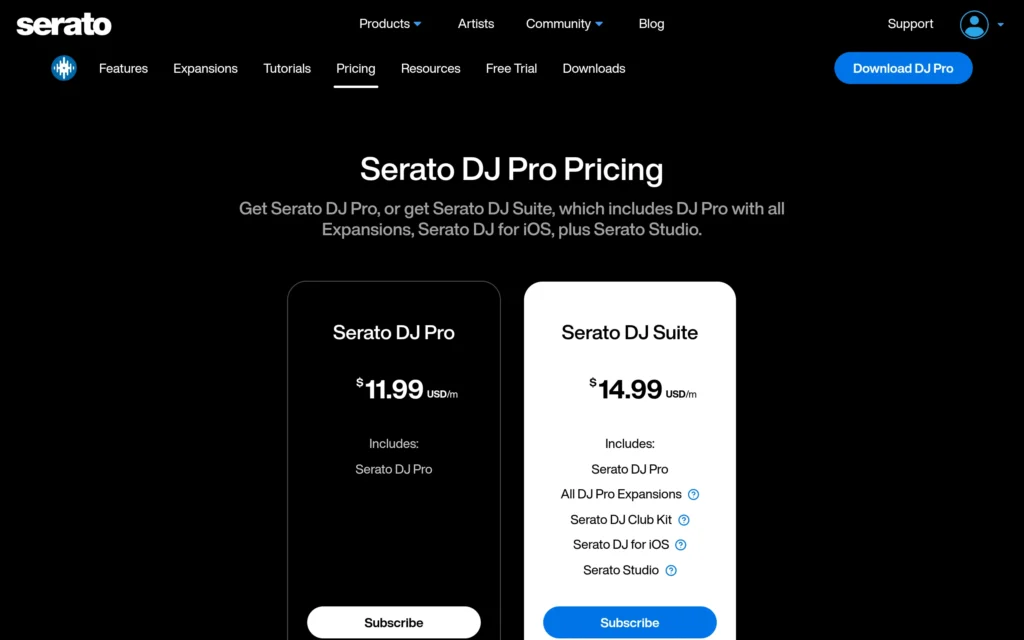
The buy-once maths is simple. At $11.99 a month, the $299 licence pays for itself in about 25 months. The Suite licence takes about 33 months to beat its $14.99 subscription. If you expect to DJ for three more years, buying once is the cheaper road. If you are testing whether weddings suit you, the subscription keeps the exit cheap.
Two limits matter. First, DVS and club-mixer work need the Suite, because Serato’s FAQ puts DVS mode and club-standard mixer use behind a Suite licence or subscription. Second, hardware changes the bill. If your controller unlocks Serato DJ Pro when connected, Serato says you need no licence or subscription at all. Check your exact controller before paying for software it may already include.
Recording has a catch too. Serato’s FAQ says set recording is not available when you play music from a streaming service or in Practice Mode. A DJ who wants a recording of every wedding set should plan around owned files, not streamed ones.
VirtualDJ: free to learn, Pro to earn
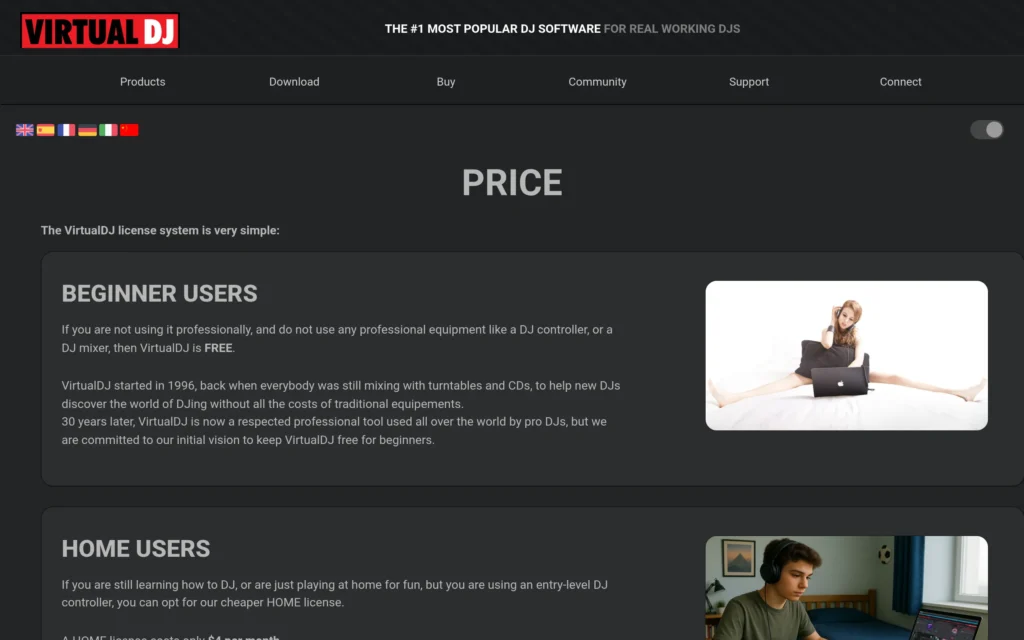
VirtualDJ takes the opposite route. The software is free if you are not using it professionally and do not use professional equipment such as a DJ controller or mixer. The moment you earn money with it, the licence changes. VirtualDJ’s price page states plainly that professional use, defined as earning money using VirtualDJ, requires a Pro licence.
The ladder is short. The Home licence costs $4 per month and works only with entry-level controllers. It also keeps the VirtualDJ branding, including the video logo and audio drops. The Pro licence costs $19 per month, works with any DJ controller, removes the audio drop, and unlocks advanced AI features reserved for Pro users. The Business licence costs $99 per month, with 15% off if billed annually, and adds multi-user licences and concierge support.
The AI features sit where a working DJ feels them. VirtualDJ’s comparison table lists access to advanced AI features including AIPrompt and full lyrics, with AI-generated lyrics limited to popular songs on the free and Home tiers. Video and karaoke are built in rather than sold as expansions, which suits wedding DJs who run a screen, a slideshow, or a karaoke hour.
Licences are personal. VirtualDJ states that licences are not transferable, are tied to your email, and can only be bought on virtualdj.com or inside the software. Any other seller is described as a scam. A cheap second-hand VirtualDJ licence is therefore not a bargain. It is a warning sign.
For our test DJ, VirtualDJ Pro costs $228 a year. That is $84.12 more than a year of Serato DJ Pro by subscription, but there is no buy-once option to compare. The choice is really about workflow. Serato sells permanence. VirtualDJ sells a clean monthly licence with video included.
DJ.Studio: build the mix before the gig
DJ.Studio is not performance software, and it does not pretend to be. It is a timeline editor for preparing mixes, mashups, and radio shows before the night. You arrange tracks on a timeline, edit each transition, and export the finished mix. For a wedding DJ, that is the first-dance edit, the dinner playlist, and the clean intro you cannot build live.
The pricing page sells one-time licences. Studio costs $99, Pro costs $129, Pro + Stems costs $149, and Ultimate costs $179. On the day we checked, the page showed Pro + Stems against a $277 bundle price and Ultimate against $524, under a Black Friday banner. Treat those struck-through figures as marketing anchors. The prices you pay today are $149 and $179, and they may change when the sale ends.
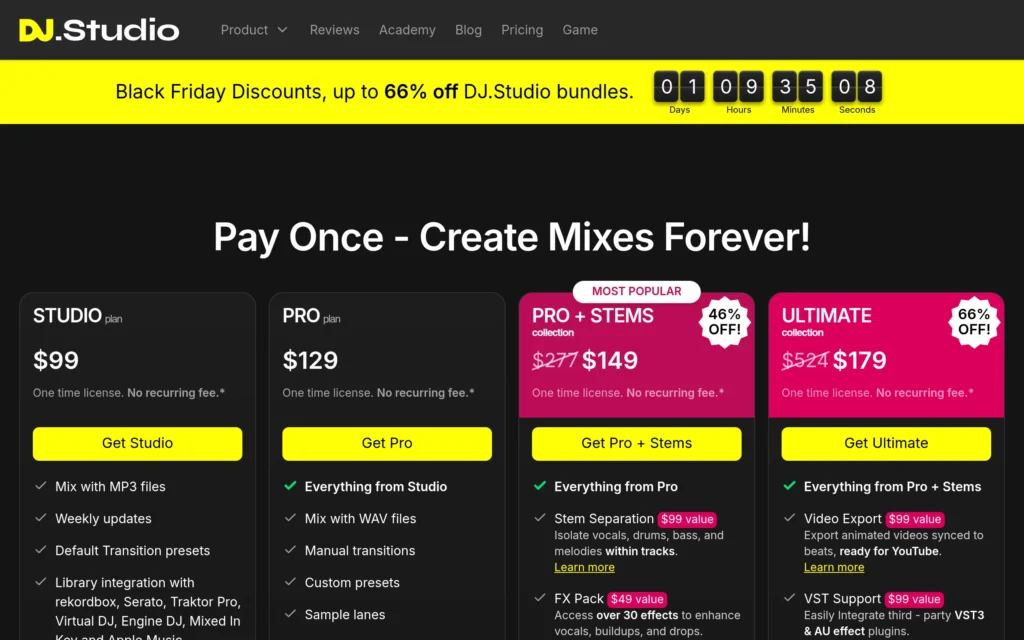
Every licence is perpetual for one user on two machines, with 12 months of updates and pro-level support included. After those 12 months the software keeps working, but new features stop unless you buy the Update Package for $49. Stem separation, which isolates vocals, drums, bass, and melodies within tracks, starts at the Pro + Stems tier. The $99 Studio tier mixes MP3 files with default transition presets, while Pro adds WAV files, manual transitions, and Ableton Live export.
The trial terms are unusually honest. The free trial runs 7 days, needs no payment details, and never converts into a subscription by itself. One-time licences carry a 14-day money-back guarantee, while monthly subscription payments cannot be refunded. Prices in US dollars exclude tax, which is added at checkout.
For our test DJ, DJ.Studio Pro + Stems is a $149 year-one cost and $0 in year two unless the $49 update package is wanted. That shape is rare in this list. Everything else bills monthly or yearly, so a one-time tool quietly becomes the cheapest line in the stack by year three.
EMP DJ: the DJ-specific CRM with AI follow-up
EMP DJ is a CRM, music planner, and booking system built only for DJs. Its homepage describes an AI chat widget that answers questions on your website and captures leads around the clock. A Revise with AI tool improves emails and messages, an AI Assistant follows up leads inside workflows, and an AI connector lets you run the business from Claude or ChatGPT.
The planning side is the part couples touch. Clients paste playlist links from Spotify, YouTube, Apple Music, Deezer, or Tidal, tag songs as Must Play, First Dance, or Don’t Play, and build their event timeline. That replaces the spreadsheet of song requests that arrives three days before the wedding, if it arrives at all.
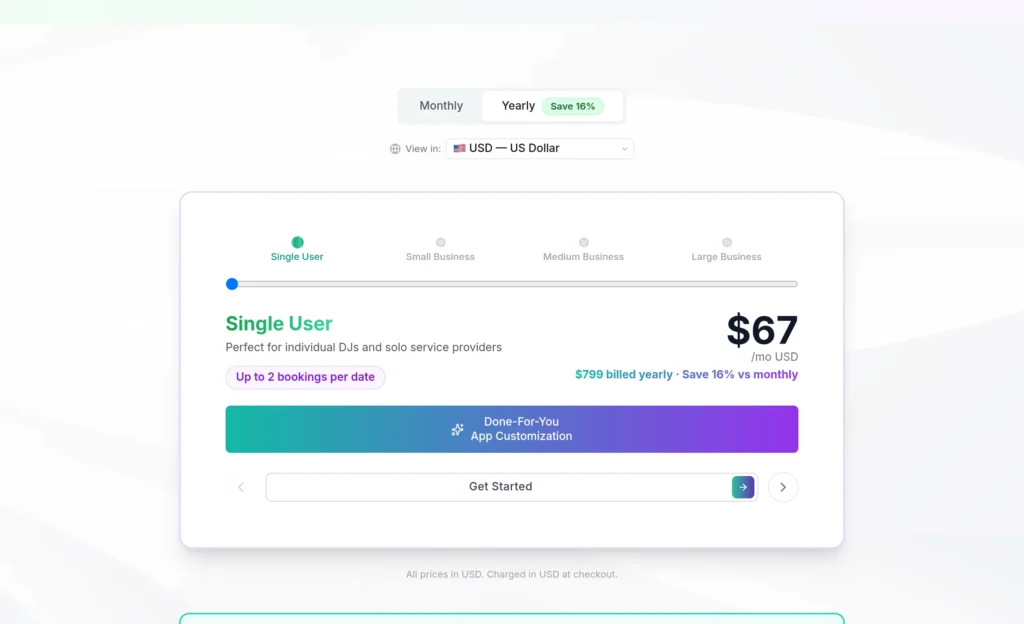
Pricing scales by capacity, not features. The pricing page states that every feature is included on every plan, and plans scale in intervals of 2 events per date. The Single User plan, for individual DJs with up to 2 bookings per date, showed $67 a month billed yearly, which is $799 a year, with a 16% saving against monthly billing. A solo DJ playing one wedding a day stays inside that tier. A multi-op running three events on one Saturday moves up a step.
Three terms deserve attention. The 7-day free trial gives full access with up to 2 bookings and needs no credit card. Existing customers keep their rate for life under grandfathered pricing. Yearly plans are non-refundable once purchased, while monthly plans can be cancelled anytime. Subscriptions are processed through PayPal, and client payments can run through Stripe, Square, PayPal, and other gateways.
EMP DJ is the most expensive tool in this post at $799 a year. It earns that place only if enquiries, follow-ups, and music planning are your bottleneck. If your diary fills by word of mouth and your couples happily use a form, the same money buys several years of performance software.
HoneyBook: proposals, contracts, and payments
HoneyBook is the generalist in this list. It handles enquiries, proposals, contracts, invoices, and payments for service businesses, and DJs use it for the booking half of the job. It has no music planner and no idea what a first dance is. What it does well is turning a quote into a signed contract and a paid deposit without a chain of emails.
The pricing page lists three plans billed yearly. Starter costs $29 a month, Essentials costs $49 a month, and Premium costs $109 a month. On 27 November 2026 the page showed a Black Friday offer with Essentials at $36.75 and Premium at $81.75, each marked 25% off. Our maths uses the list prices, because a sale price is not a budget. All plans start with a 30-day free trial.
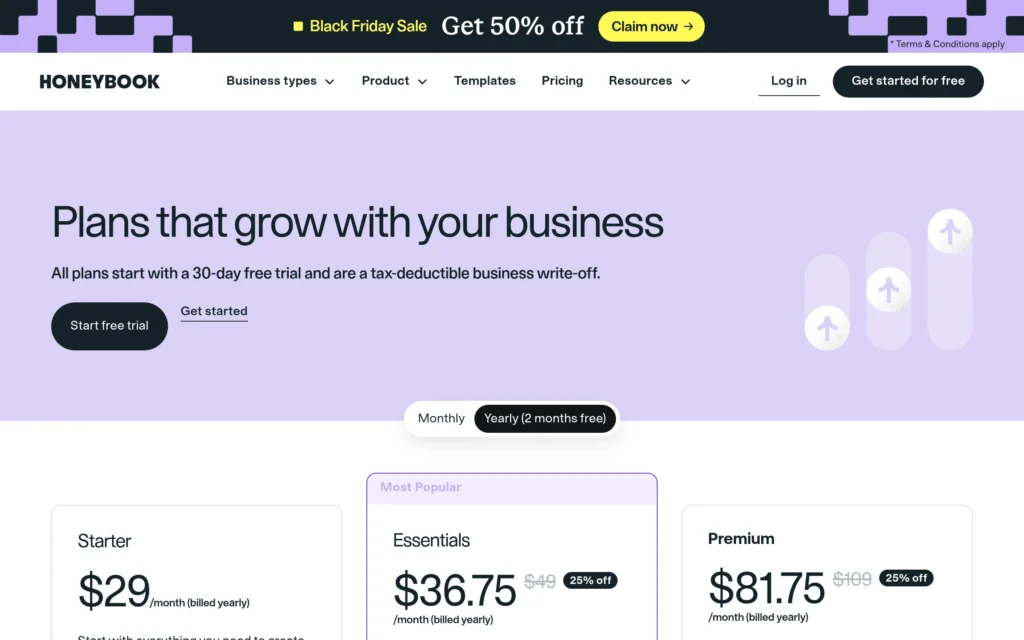
Automations are the dividing line. Workflow automations sit on Essentials and above, so the $29 Starter plan is a manual system with nicer paperwork. For a DJ sending deposit reminders and final-balance nudges every week, Essentials at $588 a year is the realistic tier. Starter at $348 a year suits a DJ who books a handful of gigs and sends every email by hand.
Payment fees decide the rest. Card payments start at 2.9% plus 25 cents, while ACH bank transfers cost 1.5%. On our test DJ’s 96 payments of $600, card fees total $1,694.40 a year. The same money by ACH costs $864. Steering couples to bank transfer saves $830.40 a year, which is more than the Essentials subscription itself.
HoneyBook and EMP DJ overlap on enquiries and follow-up. Running both means paying twice for lead handling. The honest split is this: HoneyBook is stronger on proposals, contracts, and getting paid. EMP DJ is stronger on the music planning couples actually see. Choose by which half of your week hurts more.
The maths: what five tools really cost a working DJ
Here is the full stack for our solo DJ, at list prices checked on 27 November 2026. Serato DJ Pro by subscription costs $143.88 a year. VirtualDJ Pro costs $228 a year. DJ.Studio Pro + Stems costs $149 once. EMP DJ Single User costs $799 a year. HoneyBook Essentials costs $588 a year. The year-one total is $1,907.88.
Spread across 48 gigs, that stack costs $39.75 per gig. Against a $1,200 average fee, software takes about 3.3% of gross income before payment fees. Add card fees of $1,694.40 and the true cost of running the business stack passes $3,600. Payment method, not software choice, is the biggest line in that bill.
The lean stack drops the duplication. VirtualDJ Pro at $228 plus HoneyBook Essentials at $588 costs $816 a year, or $17 per gig. That saves $1,091.88 against the full stack, roughly $1,092. The DJ gives up Serato’s stems workflow, DJ.Studio’s prepared edits, and EMP DJ’s music planner. Whether that trade is wise depends on how the gigs are won.
A middle stack suits a Serato DJ. Buying Serato DJ Pro once for $299, adding DJ.Studio Pro + Stems for $149, and running HoneyBook Essentials for $588 costs $1,036 in year one. In year two the same stack costs $588, because both performance tools are paid off. By year three, the buy-once stack is the cheapest serious setup in this post.
Run your own numbers before copying ours. Our free AI Cost Calculator lets you enter your gig count, your average fee, and your payment mix, then see the stack cost per gig. Ten minutes there beats a year of paying for a tool your diary never needed.
Five traps that catch DJs
First, the free licence trap. VirtualDJ is free only for non-professional use without professional equipment. Playing a paid wedding on the free or Home licence breaks the terms and leaves audio drops in your output. Budget $19 a month from the first paid gig.
Second, the hardware trap. Many controllers unlock Serato DJ Pro when connected, so a licence purchase can duplicate what the hardware already includes. The reverse also bites. A Lite controller needs a paid licence to run Pro, and DVS needs the Suite. Match the software bill to the exact controller on your desk.
Third, the anchor-price trap. DJ.Studio showed $149 against a $277 bundle and $179 against $524 during a Black Friday sale. The discount framing is not the price. The price is what leaves your account, plus tax, plus the $49 update package in year two if you want new features.
Fourth, the capacity trap. EMP DJ prices by bookings per date, in steps of two. A solo DJ is fine at $799 a year. Add a second rig on the same Saturday and the plan steps up. Read the capacity rule before the wedding season, not during it.
Fifth, the payment-fee trap. HoneyBook card fees on 96 payments of $600 reach $1,694.40 a year, while ACH costs $864. DJs who compare subscriptions to the dollar and ignore processing fees are watching the small number. Offer bank transfer first and keep cards as the backup.
What to buy first
Start with the performance licence your hardware needs. That is Serato DJ Pro if your controller and venues point that way, or VirtualDJ Pro if you play video, karaoke, or mixed controllers. One performance tool is enough. The second one is a hobby, not a business expense.
Next, fix the money path. HoneyBook Essentials pays for itself when it replaces deposit chasing and contract emails across 48 gigs. If couples keep asking where to put their song lists, EMP DJ answers that question better, and its AI follow-up works while you are on stage. Our guide to the best ai tools for event planners covers the wider booking stack if you also plan the events you play.
Add DJ.Studio last, when prepared edits start winning compliments or repeat bookings. At $149 once, it is the easiest purchase in this post to justify and the easiest to delay. The order matters more than the list. Performance first, payments second, polish third.
Pros and cons
Serato DJ Pro. Pros: real-time stems on pads, a buy-once licence at $299, free Lite edition, and hardware unlocks that can remove the bill entirely. Cons: DVS and club-mixer work need the $499 Suite, expansions cost extra on Pro, and streaming playback cannot be recorded.
VirtualDJ. Pros: one $19 monthly licence covers any controller, video, and karaoke, with advanced AI features for Pro users. Cons: no buy-once option, the free and Home tiers ban paid gigs and keep audio drops, and licences cannot be transferred or resold.
DJ.Studio. Pros: one-time pricing from $99, stem separation at $149, a 7-day trial with no card and no auto-conversion, and a 14-day refund on licences. Cons: it prepares mixes rather than playing them live, updates stop after 12 months without the $49 package, and sale anchors make the real price easy to misread.
EMP DJ. Pros: every feature on every plan, a client music planner with Must Play and Don’t Play tags, AI lead follow-up, and grandfathered pricing. Cons: $799 a year is the highest bill here, capacity steps raise the price as bookings per date grow, and yearly plans are non-refundable.
HoneyBook. Pros: proposals, contracts, and payments in one flow, a 30-day trial, and ACH fees of 1.5% that undercut cards. Cons: automations need the $49 Essentials tier, card fees reach $1,694.40 a year at our test volume, and there is no music planning for couples.
Our verdict
For most solo mobile and wedding DJs, the best ai tools for djs start with one performance licence and one money tool. VirtualDJ Pro at $228 a year plus HoneyBook Essentials at $588 costs $816 and covers the gig and the booking. Serato DJs should buy the $299 licence once instead of subscribing, then add DJ.Studio Pro + Stems when prepared edits matter.
EMP DJ is the upgrade, not the starting point. At $799 a year it makes sense when enquiry volume and music planning eat your week, and its AI follow-up answers leads while you are mid-set. Buy it for the planner and the follow-up, not for features a cheaper CRM already covers.
The full five-tool stack at $1,907.88 is a showroom, not a shopping list. Two of the tools do the same job, and two more overlap on lead handling. Pick one from each pair, pay once where you can, and let the saved $1,091.88 fund the next controller instead.
Frequently asked questions
What is the cheapest AI tool for a working DJ?
Serato DJ Pro by subscription is the cheapest performance licence at $11.99 a month, or $143.88 a year. VirtualDJ Pro costs $19 a month and includes video and karaoke. Both beat every business tool here on price, because performance software is priced for individuals while CRMs are priced for businesses.
Is VirtualDJ free for paid gigs?
No. VirtualDJ is free only if you are not using it professionally and do not use professional equipment. Earning money with VirtualDJ requires the Pro licence at $19 per month. The $4 Home licence also excludes paid gigs and keeps the video logo and audio drops in your output.
Should I buy Serato DJ Pro or subscribe?
Buy once if you will DJ for more than about 25 months. The $299 licence divided by the $11.99 monthly subscription breaks even at roughly 25 months. The Suite licence at $499 breaks even against $14.99 a month at about 33 months. Shorter horizons favour subscribing.
Does DJ.Studio replace Serato or VirtualDJ?
No. DJ.Studio prepares mixes on a timeline before the event. It does not play a live set to a dance floor. Use it for first-dance edits, dinner playlists, and stem mashups, then perform with Serato DJ Pro or VirtualDJ. The tools sit side by side rather than replacing each other.
EMP DJ or HoneyBook for a wedding DJ?
Choose EMP DJ when music planning and lead follow-up are the pain, because couples build timelines and tag Must Play songs inside it. Choose HoneyBook when contracts and payments are the pain, because proposals, e-signatures, and ACH payments at 1.5% are its strength. Running both duplicates lead handling.
Sources
Prices and terms were checked on the official pages on 27 November 2026: Serato DJ Pro pricing and product pages (serato.com), VirtualDJ price and licences page (virtualdj.com), DJ.Studio pricing page (dj.studio), EMP DJ pricing and homepage (empdj.com), and HoneyBook pricing page (honeybook.com). Vibo was considered for the planning slot, but its official site and help centre publish only the $20 monthly or $200 yearly team-member price, with the main subscription price shown through its demo flow, so EMP DJ takes the slot with published pricing.
Price note — updated 27 November 2026: Prices in this post were checked on 27 November 2026. When you are reading this, the price may be lower or higher, and sale prices such as Black Friday offers may have ended. Check the official pricing page before you buy.
Pros
- Serato DJ Pro: real-time stems on pads, a buy-once licence at $299, free Lite edition, and hardware unlocks that can remove the bill entirely
- VirtualDJ: one $19 monthly licence covers any controller, video, and karaoke, with advanced AI features for Pro users
- DJ.Studio: one-time pricing from $99, stem separation at $149, a 7-day trial with no card and no auto-conversion, and a 14-day refund on licences
- EMP DJ: every feature on every plan, a client music planner with Must Play and Don't Play tags, AI lead follow-up, and grandfathered pricing
- HoneyBook: proposals, contracts, and payments in one flow, a 30-day trial, and ACH fees of 1.5% that undercut cards
Cons
- Serato DJ Pro: DVS and club-mixer work need the $499 Suite, expansions cost extra on Pro, and streaming playback cannot be recorded
- VirtualDJ: no buy-once option, the free and Home tiers ban paid gigs and keep audio drops, and licences cannot be transferred or resold
- DJ.Studio: it prepares mixes rather than playing them live, updates stop after 12 months without the $49 package, and sale anchors make the real price easy to misread
- EMP DJ: $799 a year is the highest bill here, capacity steps raise the price as bookings per date grow, and yearly plans are non-refundable
- HoneyBook: automations need the $49 Essentials tier, card fees reach $1,694.40 a year at our test volume, and there is no music planning for couples
For most solo mobile and wedding DJs, the best ai tools for djs start with one performance licence and one money tool. VirtualDJ Pro at $228 a year plus HoneyBook Essentials at $588 costs $816 and covers the gig and the booking. Serato DJs should buy the $299 licence once instead of subscribing, then add DJ.Studio Pro + Stems when prepared edits matter.EMP DJ is the upgrade, not the starting point. At $799 a year it makes sense when enquiry volume and music planning eat your week, and its AI follow-up answers leads while you are mid-set. Buy it for the planner and the follow-up, not for features a cheaper CRM already covers.The full five-tool stack at $1,907.88 is a showroom, not a shopping list. Two of the tools do the same job, and two more overlap on lead handling. Pick one from each pair, pay once where you can, and let the saved $1,091.88 fund the next controller instead.