
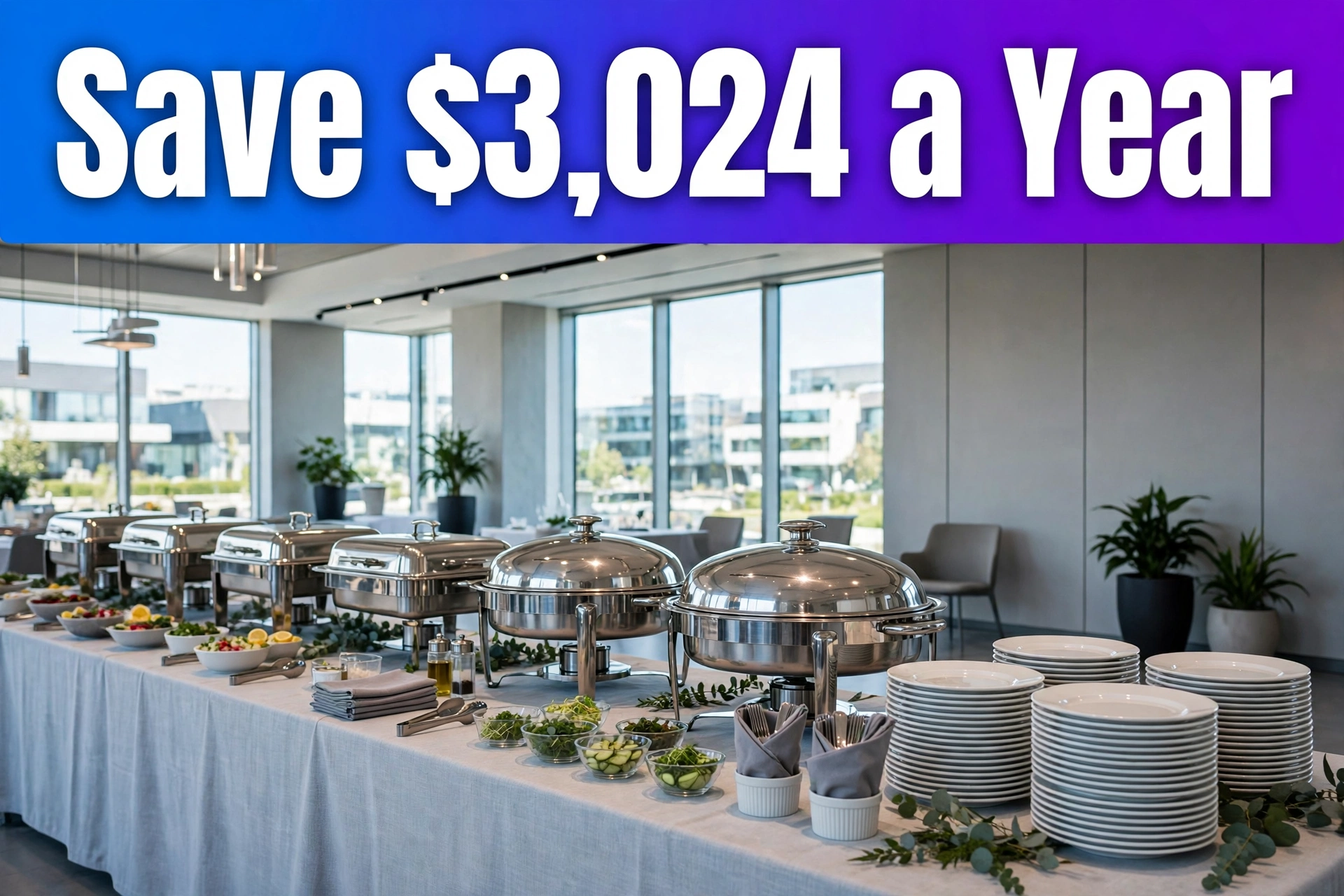
For a small caterer running 6 events a month at an average of $1,800 an event, with two people in the software, start with HoneyBook Essentials at $588 a year billed annually for proposals, contracts, automations, and client follow-up, and add ChatGPT Plus at $240 a year for menu drafts, replies, and costing checks. That lean stack costs $828 a year in subscriptions. When recipe costing, staff shifts, and packing lists become weekly work, Caterease Standard for two users costs $2,524 in year one including launch fees, and Total Party Planner Feast costs $3,528.20 in year one including setup. Whichever platform you choose, take deposits and balances by bank transfer where you can: on Square's free plan, card fees on this workload cost $4,320 a year, while ACH costs $1,296 — a saving of $3,024.
A caterer rarely loses money on the food. The leak starts around it: the proposal rebuilt from an old email thread at midnight, the menu costed on a spreadsheet nobody has updated since spring, the packing list written from memory in the van.
That is the work the best ai tools for caterers are meant to absorb. The honest version is narrower than the badges suggest. One platform runs events, recipes, staff shifts, and packing lists, with an AI hub for reading your data. One is built by caterers and prices by included users, with its own payment system required. One handles proposals, contracts, and follow-up automations, with AI drafting built in. One takes the money and charges nothing until a card does. One writes the menus, replies, and costing checks that fill the gaps.
We compared five tools for the same small catering business and checked every price on the vendor’s own page on 27 November 2026. No roundup prices, and no tool here pays us anything. Where a vendor requires its own payment system, charges per user, or prints no rate at all, we say so instead of filling the gap with a guess.
Quick Answer
For a small caterer running 6 events a month at an average of $1,800 an event, with two people in the software, start with HoneyBook Essentials at $588 a year billed annually for proposals, contracts, automations, and client follow-up, and add ChatGPT Plus at $240 a year for menu drafts, replies, and costing checks. That lean stack costs $828 a year in subscriptions.
When recipe costing, staff shifts, and packing lists become weekly work, Caterease Standard for two users costs $2,524 in year one including launch fees, and Total Party Planner Feast costs $3,528.20 in year one including setup. Whichever platform you choose, take deposits and balances by bank transfer where you can: on Square’s free plan, card fees on this workload cost $4,320 a year, while ACH costs $1,296 — a saving of $3,024.
In this article
- How we compared the best ai tools for caterers
- The five tools at a glance
- Caterease: the full catering operation, modules extra
- Total Party Planner: built by caterers, its own payments required
- HoneyBook: proposals and follow-up, with AI drafting
- Square: free to start, priced by how clients pay
- ChatGPT Plus: menus, replies, and costing checks
- The maths: what five tools really cost a small caterer
- Five traps that catch caterers
- What to buy first
- Pros and cons
- Our verdict
- Frequently asked questions
How we compared the best ai tools for caterers
Every price in this guide is for the same imaginary business: one small caterer, 6 events a month, an average event value of $1,800, and two people using the software — the owner and one assistant. That is 72 events a year and $129,600 in annual event revenue. Clients pay a deposit and a balance, so the year holds 144 payments averaging $900 each.
We judged each tool on five things: year-one cost for this business; whether the AI is real and which plan or add-on unlocks it; whether proposals, event sheets, costing, and payments live in one system; how price moves when the team or the event count grows; and which fees or rates stay unprinted.
One honesty note before the numbers. Three of these five tools do the same core job. Caterease, Total Party Planner, and HoneyBook are all client-and-event platforms: inquiries, proposals, contracts, and payments in one login. You would run exactly one of them as your system of record. Square sits beside the platform as the payment layer, and ChatGPT Plus sits beside both as the writing and checking layer. Buying all five means paying for three platforms to hold the same client list.
The AI labels also vary in honesty. Caterease includes its Horizon Hub, described as live, AI-driven access to your Caterease data, on every plan. HoneyBook includes HoneyBook AI features such as email drafts and meeting notes. Total Party Planner’s pricing page names no AI assistant. Square’s pricing page names no AI assistant either. ChatGPT Plus is the AI itself. We price each tool for the job it actually does, not the badge on the homepage.
One more question runs under every price here: how the client pays. Across 72 events, that choice is worth more than most subscriptions in this guide. We price it openly below.
The five tools at a glance
| Tool | Best for | Starting price | Free plan or trial | Year-one cost for this business |
|---|---|---|---|---|
| Caterease | Events, recipes, staff shifts, and packing lists in one system | Express $99 a month billed annually | No free plan printed; free demo | Standard for 2 users $2,524 including launch fees |
| Total Party Planner | Catering operations with proposals, BEOs, and costing | Nibble $119 a month | Free live demo; 30-day money-back guarantee | Feast for 2 users $3,528.20 including setup |
| HoneyBook | Proposals, contracts, automations, and client follow-up | Starter $29 a month billed annually | 30-day trial | Essentials $588 a year |
| Square | Invoices and card payments with no monthly fee to start | Free plan $0 a month | Free plan; 30-day trials on paid plans | Free plan $0 subscription; fees $1,296–$4,320 by payment method |
| ChatGPT Plus | Menu drafts, client replies, and costing checks | Free plan; Plus $20 a month | Free plan | Plus $240 a year |
The table hides the two numbers that decide most real bills. The first is the gate: Caterease’s plans include no modules, Total Party Planner requires its own payment system, and HoneyBook’s automations start on Essentials. The second is overlap: three of these tools hold the same client records, so the saving comes from choosing one platform well, not from stacking all three. The sections below price both.
Caterease: the full catering operation, modules extra
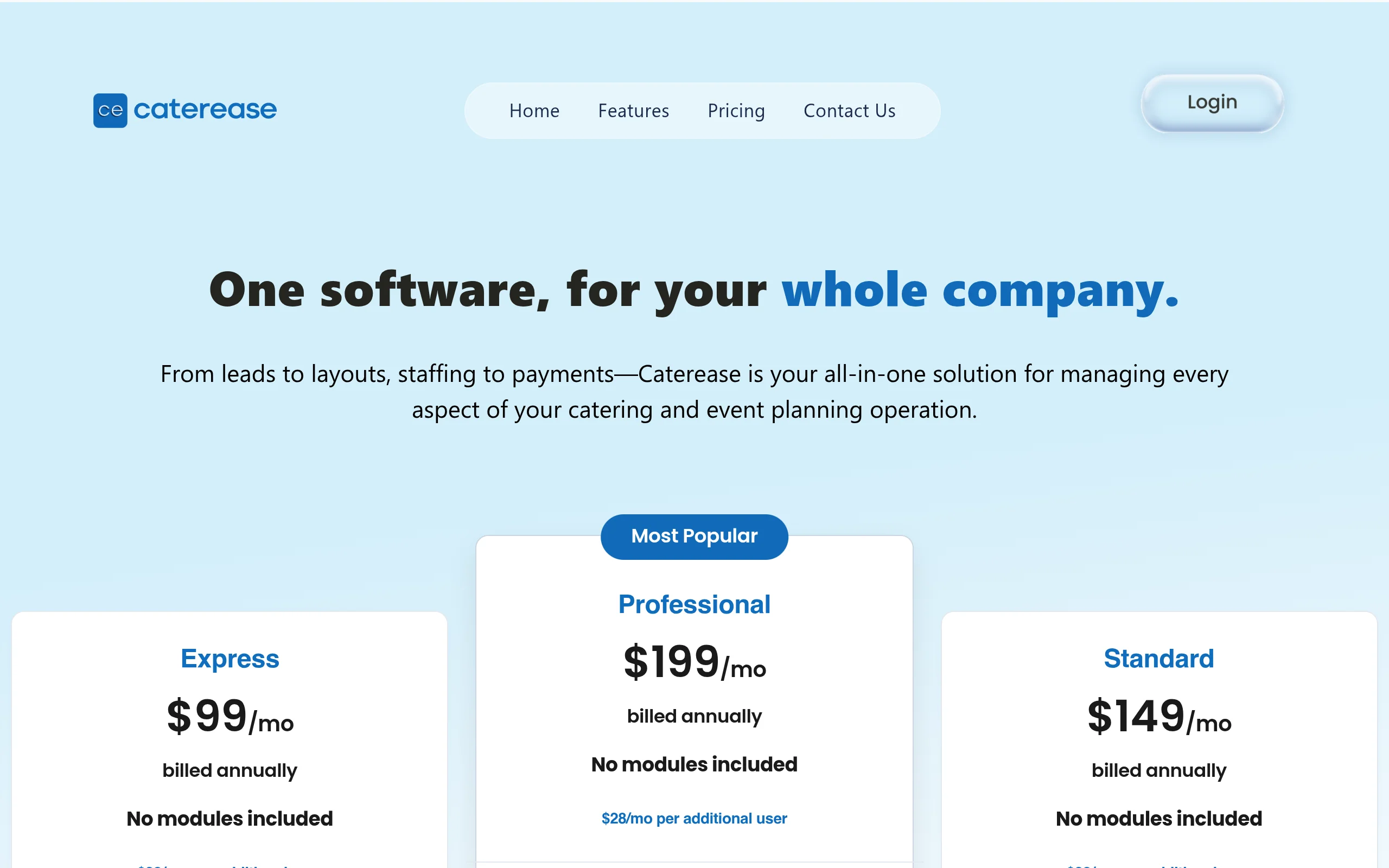
Caterease is the deepest catering system in this comparison. Its pricing page describes one software for the whole company: leads to layouts, staffing to payments. Every plan includes wizard-driven event and client management, a custom library of event prints, available program add-ins and interfaces, and payment processing through its Mosaic system, with processing fees applying.
The plan ladder is printed plainly. Express costs $99 a month billed annually and suits businesses entering automation. Standard costs $149 a month billed annually and adds shift and event staff management, detailed menu item recipe tracking, and automatic equipment packing lists. Professional costs $199 a month billed annually and adds batch merge emails, enhanced user security, and copying of default menus and prints.
Three charges sit on top of every plan. Additional users cost $28 a month each. Optional Enhance and Integrate modules cost $25 a month each billed annually. And every plan carries a one-time launch fee of $200 per user. The plans themselves include no modules, so the headline price is the floor, not the finished system.
The AI claim is specific. All plans include the Horizon Hub, described as live, AI-driven access to your Caterease data from any device. That is a data-access assistant, not a menu writer or a costing engine. The recipe tracking that protects your margins lives in Standard, and it is structured software, not AI. Price the AI for what it does: reading your event data back to you quickly.
For our two-user caterer, Standard is the honest tier, because recipe tracking and packing lists are the weekly work. Standard at $149 a month plus one additional user at $28 a month is $177 a month billed annually, or $2,124 a year. Add launch fees of $200 for each of two users, and year one costs $2,524 before any modules.
Each module you add costs $300 a year. A caterer who adds two modules — say a web inquiry tool and a document builder — pays $3,124 in year one and $2,724 a year after. None of that is hidden; the pricing page prints every figure. But a buyer comparing the $149 headline against a rival’s all-in price will underbudget by design.
Caterease fits a caterer whose pain is operational: recipes drifting from costed prices, staff shifts managed by text message, packing lists rebuilt per event. It is the only tool here that builds automatic equipment packing lists from the event itself. If your pain is inquiries going unanswered, Caterease solves a problem you do not yet have.
Total Party Planner: built by caterers, its own payments required
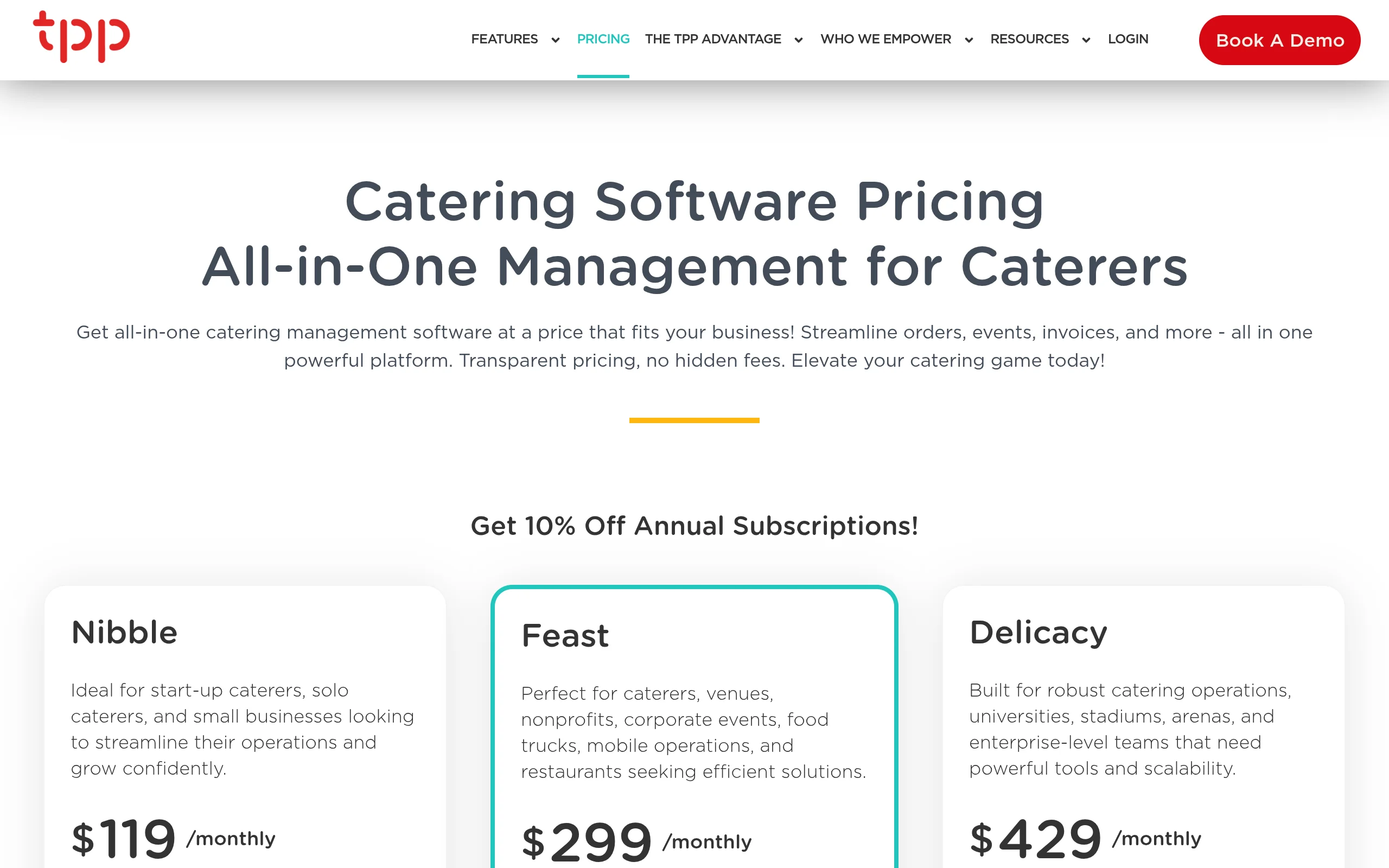
Total Party Planner is catering software built around the event sheet. Its pricing page lists event management with custom events, a calendar of events, beverage and equipment tracking, order tracking, banquet room management, and packing lists. Reporting includes basic and detailed profit analysis, menu quick costing, and menu recipe costing. Proposals carry electronic signatures for proposals and contracts.
The plans are priced by included users. Nibble costs $119 a month with 1 user. Feast costs $299 a month with 2 users. Delicacy costs $429 a month with 3 users. Additional users cost $25 a month each on every plan, and paying annually takes 10% off.
Two further charges decide the real bill. Every tier carries a one-time $299 setup fee, which includes a guided account preference setup. And online ordering through TPPorder is an add-on: $149 a month on Nibble, $129 on Feast, and $119 on Delicacy. An optional data setup service costs $500 for up to 2,000 items.
The payment term needs reading twice. The pricing page states that TPP Pay is a required function within the platform, and that a $200 monthly fee applies to clients who do not adopt TPP Pay. The page does not print TPP Pay’s processing rates. For a business moving $129,600 a year, an unprinted processing rate is the largest unknown in this entire comparison. Ask for the rate in writing before you sign, and compare it against the printed rates below.
There is no free trial. In its place, the vendor offers a free live demo and a 30-day money-back guarantee. That is a fair substitute for a system this deep, but it means your first month is a paid month, setup fee included.
For our two-user caterer, Feast is the matching tier: $299 a month with 10% off for annual payment is $269.10 a month, or $3,229.20 a year. Add the $299 setup fee and year one costs $3,528.20, before TPPorder and before any processing fees. Nibble with one added user costs $144 a month before the annual discount, which undercuts Feast — but the pricing page does not say whether the 10% annual discount covers added users, so confirm that before relying on it.
Total Party Planner fits a caterer who wants the event sheet, costing, and client portal in one catering-native system and is comfortable adopting its payment rail. Its recipe costing and profit analysis speak the caterer’s language directly. The unprinted processing rate is the one figure you must pin down first.
HoneyBook: proposals and follow-up, with AI drafting
HoneyBook is the client-facing platform in this comparison. It is not catering software, and it does not pretend to be. What it runs is everything before the event: inquiries, proposals that combine contract and payment in one flow, e-signed contracts, invoices, a client portal, and the follow-up that stops a warm lead going cold.
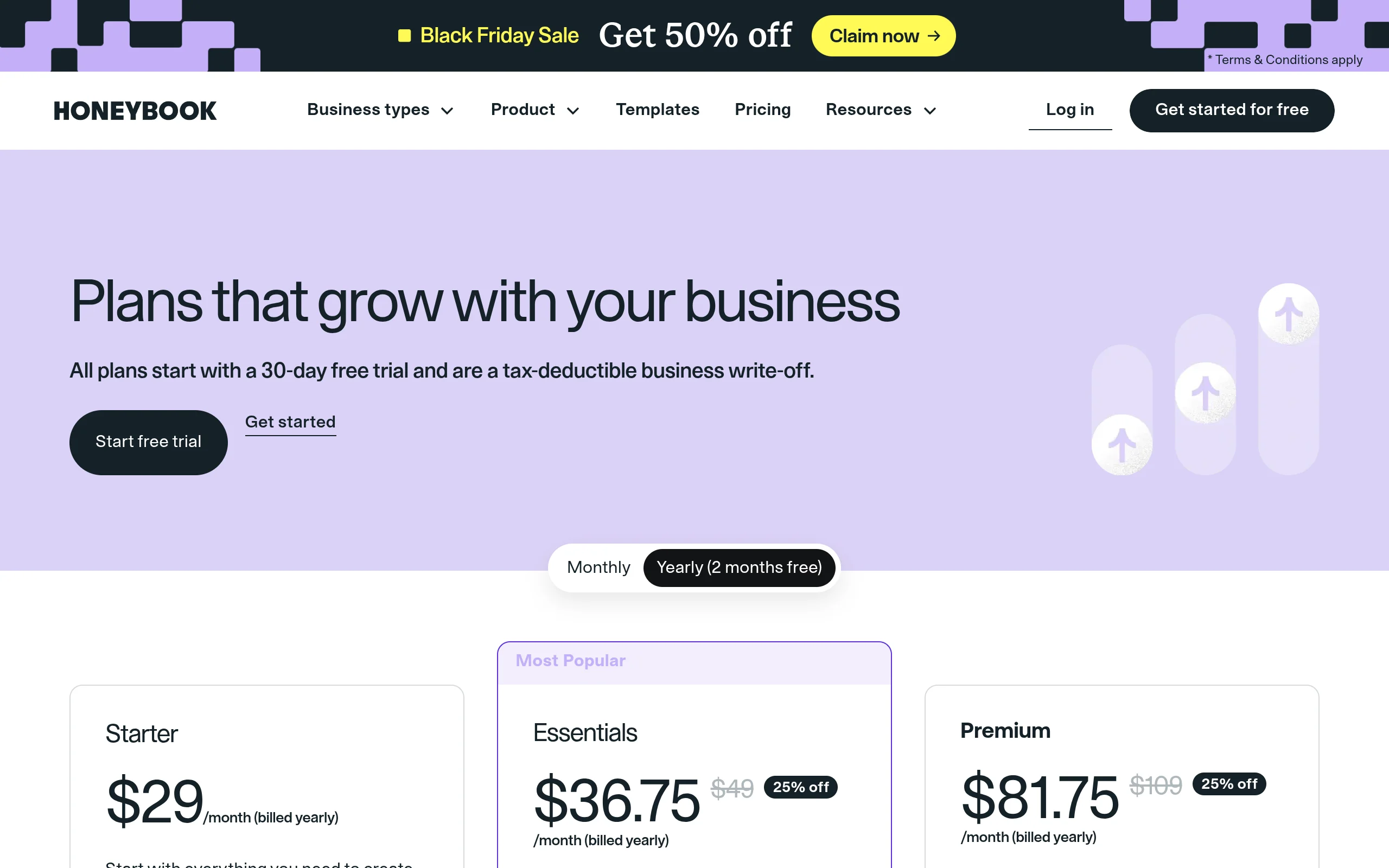
The plans are printed with annual billing as the default view. Starter costs $29 a month billed annually, for the owner only, with unlimited clients and projects, proposals, contracts, invoices, a client portal, and up to 2 live lead forms. Essentials costs $49 a month billed annually and adds the scheduler, automations, QuickBooks Online integration, SMS reminders, and up to two team members. Premium costs $109 a month billed annually and adds unlimited team members, multiple companies, and advanced reports.
The gate that matters is automations. Starter has none. The automatic follow-up emails, files, and tasks that chase an unsigned proposal live on Essentials and above. For a caterer answering inquiries between events, that automation is the product. Starter is a filing cabinet; Essentials is the assistant.
The AI is included, not sold separately. HoneyBook AI covers priority lead notifications, email drafts, a meeting notetaker that joins video calls to produce notes and action items, project recaps, and lead enrichment. It drafts and summarises; it does not cost a menu or build a packing list. Priced honestly, it is a writing aid inside the platform you already pay for.
Payments carry their own price list. Card payments start at 2.9% plus 25 cents. ACH bank transfers cost 1.50%. Instant deposits add 1% for eligible accounts. On our workload — 144 payments averaging $900 — card fees at the starting rate come to $3,794.40 a year, while ACH comes to $1,944. The difference, $1,850.40, is more than three years of Essentials subscriptions.
For our two-person caterer, Essentials at $588 a year is the matching tier: it covers the owner plus up to two team members, which fits the assistant. The 30-day trial needs no credit card, so the proposal flow can be tested on a real inquiry before any money moves.
HoneyBook fits a caterer whose leak is at the front door: inquiries answered late, proposals sent as attachments, deposits chased by hand. It will not cost your recipes or pack your van. Pair it with disciplined costing elsewhere, and it is the cheapest platform here by a wide margin.
Square: free to start, priced by how clients pay
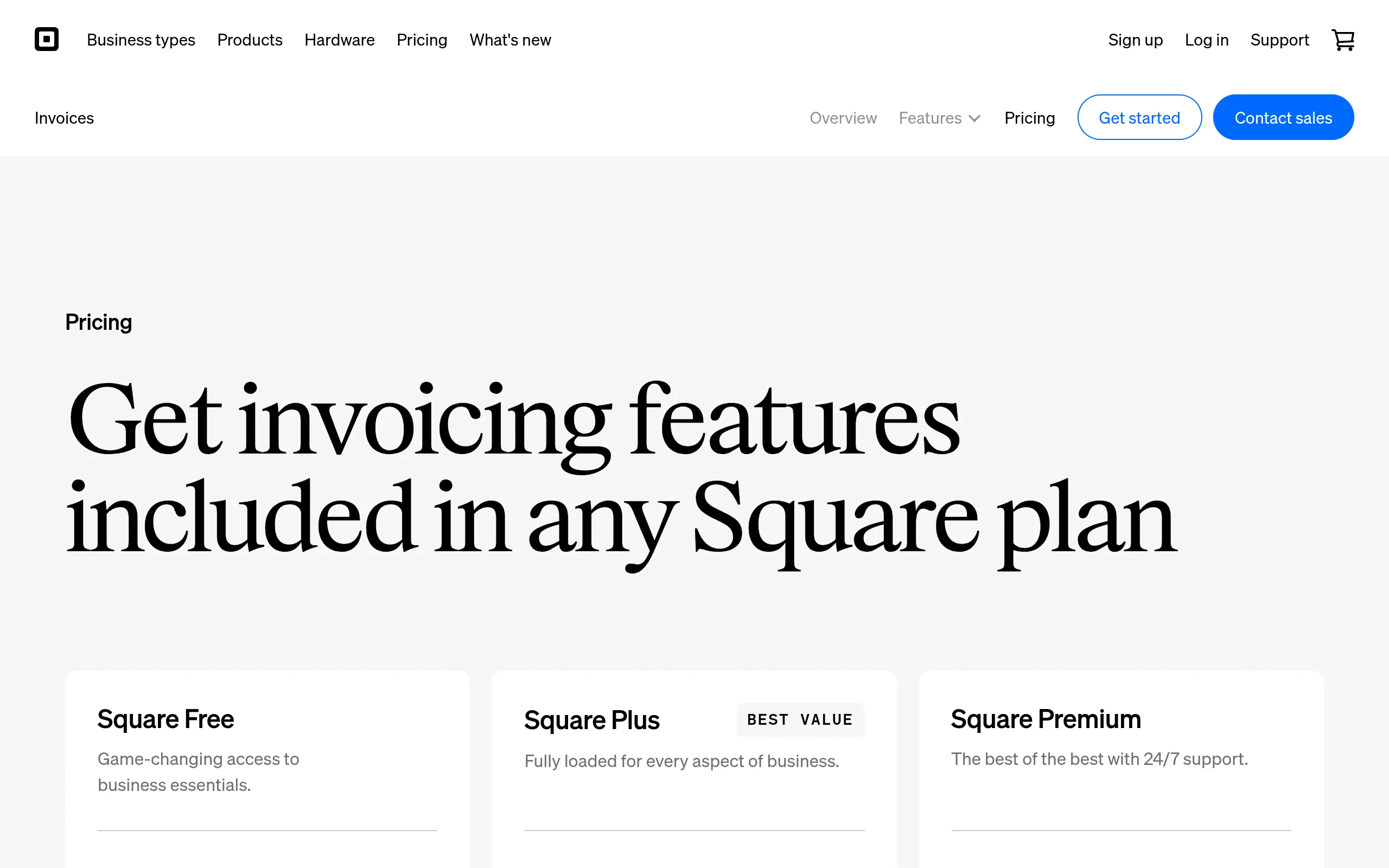
Square is the payment layer in this comparison. Its free plan costs $0 a month per location and includes unlimited invoices, estimates, and contracts. Plus costs $49 a month per location, and Premium costs $149 a month per location. Paid plans carry a 30-day trial, and you can cancel or switch plans anytime.
Square’s real price is the processing rate, and the rate depends on how the client pays. On the free plan, a tapped, dipped, or swiped card costs 2.6% plus 15 cents. An online or invoice card payment costs 3.3% plus 30 cents. An ACH bank transfer through an invoice costs 1%, with a $1 minimum.
Plus and Premium lower the card rates. Online and invoice payments drop to 2.9% plus 30 cents on both paid plans. In-person rates drop to 2.5% plus 15 cents on Plus and 2.4% plus 15 cents on Premium. ACH stays at 1% but gains a $10 fee cap per payment on the paid plans.
Run our workload through those rates. The year holds 144 invoice payments averaging $900, totalling $129,600. On the free plan by card, fees are 3.3% of $129,600 plus 144 times 30 cents: $4,320 a year. On the free plan by ACH, fees are 1% of $129,600: $1,296 a year. The same invoices, the same clients, a $3,024 difference decided purely by payment method.
The paid plans do not rescue the card maths at this volume. Plus by card costs $3,801.60 in fees plus $588 in subscription: $4,389.60 a year, slightly more than the free plan by card. Plus by ACH costs $1,296 in fees — each $900 payment’s 1% is $9, under the $10 cap — plus $588: $1,884 a year. At 72 events a year, the free plan with ACH beats every paid combination.
The cap starts to matter when payments grow. A single $2,500 balance payment costs $25 by ACH on the free plan and $10 on Plus. A caterer whose average payment passes $1,000 should rerun this maths, because the cap then saves real money on every invoice.
Square fits any caterer who wants invoices, estimates, and contracts without a monthly fee, and it pairs with whichever platform runs the events. Its pricing page names no AI assistant. The tool earns its place on arithmetic, not intelligence: it is where the $3,024 saving lives.
ChatGPT Plus: menus, replies, and costing checks
ChatGPT Plus is the writing layer in this comparison. It holds no client records, sends no invoices, and knows nothing about your calendar. What it does is draft: the menu description that makes a $28-per-person package sound like one, the reply to the inquiry that arrived during service, the polite chase for a final guest count.
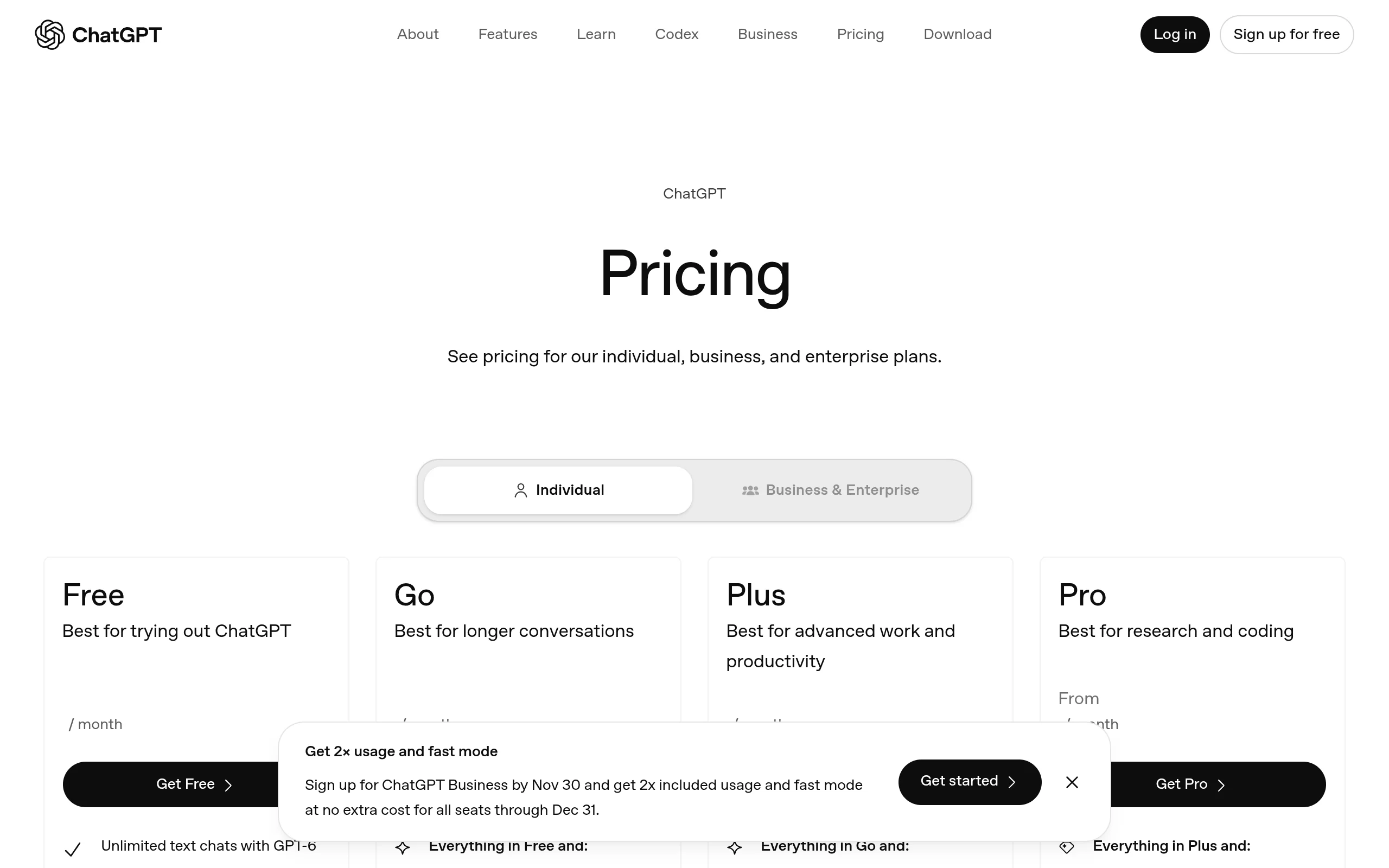
The price is simple. The free plan costs $0 a month. Plus costs $20 a month billed monthly, with no annual billing option. That is $240 a year, per user. Pro starts from $100 a month and is aimed at research and coding workloads a caterer will not reach.
The catering value is in repetition. A caterer writes the same dozen documents all year: inquiry replies, menu packages at three price points, tasting invitations, final-count reminders, thank-you notes that ask for the review. Drafted once and refined, those become templates. The AI’s job is the first draft and the variations — the same package rewritten for a wedding, a corporate lunch, and a memorial service, in three different registers.
The second job is checking. Paste a costed menu and ask for the arithmetic to be re-run line by line. Paste a proposal and ask what a client would find unclear. Paste a supplier invoice and ask which lines moved since the last one. The answers still need a human eye — an AI can misread a quantity as confidently as it reads one — but a second pass costs seconds instead of an evening.
The limits are real. ChatGPT does not know your food costs or supplier prices unless you give them. Treat its costing as a draft to verify, never as the spreadsheet. Client payment details do not belong in prompts.
For our caterer, one Plus seat at $240 a year covers the owner’s drafting and checking. The assistant works from the templates the owner produces. A second seat doubles the line to $480 and is rarely the first upgrade worth buying.
ChatGPT Plus fits every caterer in this guide, whichever platform runs the events. It is the only tool here that is AI all the way down, and at $240 a year it is the cheapest line in the comparison. Its output is only as good as the checking behind it.
The maths: what five tools really cost a small caterer
Start with subscriptions, before processing fees. Caterease Standard for two users costs $2,524 in year one, including $400 of launch fees, and $2,124 a year after. Total Party Planner Feast costs $3,528.20 in year one, including the $299 setup fee, and $3,229.20 a year after. HoneyBook Essentials costs $588 a year. Square’s free plan costs $0. ChatGPT Plus costs $240 a year.
Buying all five subscriptions costs $7,468 in year one. That figure buys three platforms holding the same client list, which no caterer needs. The lean stack — HoneyBook Essentials plus ChatGPT Plus, with Square’s free plan taking payments — costs $828 a year in subscriptions and leaves no job duplicated at the front of the business.
The operational stack costs more and does more. Caterease Standard plus ChatGPT Plus costs $2,764 in year one and covers recipes, staff shifts, and packing lists that the lean stack leaves to spreadsheets. Total Party Planner Feast plus ChatGPT Plus costs $3,768.20 in year one. The gap between the lean stack and the operational stack is the price of catering-native operations: roughly $1,936 to $2,940 in year one.
Processing fees sit on top of every stack, and they rival the subscriptions. On $129,600 of annual payments, Square’s free plan charges $4,320 by card and $1,296 by ACH. HoneyBook charges $3,794.40 by card at its starting rate and $1,944 by ACH. Caterease’s Mosaic processing fees apply but its pricing page prints no rate. Total Party Planner requires TPP Pay and prints no rate either. For the two catering platforms, the processing line is unpriced until you ask.
Per event, the picture sharpens. The lean stack’s $828 spread over 72 events is $11.50 an event. Caterease Standard’s year-one $2,524 is $35.06 an event. The card-versus-ACH choice on Square is worth $42 an event — more than any subscription decision in this guide. A caterer who negotiates software for a week and never asks clients to pay by bank transfer has optimised the smaller number.
Growth changes the answer in predictable places. A third user adds $336 a year on Caterease and $300 on Total Party Planner. Doubling events to 144 a year doubles the processing fees, making the ACH conversation worth $6,048 a year instead of $3,024.
Five traps that catch caterers
The first trap is the headline plan with no modules. Caterease prints “No modules included” on every plan, and each module costs $25 a month billed annually. Budget the modules you actually need before comparing its headline against an all-in rival.
The second trap is the required payment rail with an unprinted rate. Total Party Planner requires TPP Pay, charges $200 a month to clients who do not adopt it, and prints no processing rate. On six figures of annual payments, half a percentage point is $648 a year. Get the rate in writing.
The third trap is the automation gate. HoneyBook Starter has no automations, so the follow-up that justifies the platform starts at Essentials. Buying Starter for the $29 headline and chasing proposals by hand is paying for a filing cabinet.
The fourth trap is paying card rates on bank-transfer-sized invoices. A $900 balance payment costs $30 by card on Square’s free plan and $9 by ACH. Clients rarely object to a bank transfer link when the invoice offers both; the caterer who never offers it pays the difference 144 times a year.
The fifth trap is treating AI drafts as finished documents. A menu description can promise a dish your kitchen does not serve. A costing check can repeat your own arithmetic error back to you. The draft is the starting point; the send button still needs your eyes.
What to buy first
Buy in the order your leaks appear. If inquiries sit unanswered and proposals go out late, HoneyBook Essentials at $588 a year is the first purchase, with its 30-day trial running on real inquiries. Add ChatGPT Plus at $240 a year when drafting starts eating evenings. Readers comparing wider event software can also see our guide to the best ai tools for event planners.
If the leak is operational — recipes drifting, packing lists rebuilt from memory, staff shifts in a group chat — Caterease Standard is the first purchase, and its $2,524 year one should be compared against the cost of one under-costed wedding, not against HoneyBook’s headline. Total Party Planner earns its higher price when its event-sheet workflow fits your team better in the demo, and only after its processing rate is in writing.
Whichever platform wins, set up bank-transfer payment options in the same week. That single setting is worth up to $3,024 a year on this workload, which pays for the lean stack three times over.
Before you commit to any of them, run your own event count and average payment through the numbers. Our free AI Cost Calculator does that arithmetic for your figures in a minute, and the result will tell you whether your next dollar belongs in software or in payment settings.
Pros and cons
Caterease. Pros: the deepest catering operations here, with recipe tracking, staff shifts, and automatic packing lists on Standard; every price printed, including modules and launch fees; the Horizon Hub gives AI-driven access to your event data on all plans. Cons: plans include no modules, and each module adds $300 a year; a $200 launch fee per user; annual billing only on the printed plans; Mosaic processing fees apply with no rate printed.
Total Party Planner. Pros: catering-native event sheets with menu recipe costing and profit analysis; proposals with electronic signatures included; a free live demo and a 30-day money-back guarantee instead of a trial. Cons: the highest year-one cost here at $3,528.20 for two users; TPP Pay is required and its processing rate is unprinted; a $299 setup fee on every tier; online ordering costs $119–$149 a month extra.
HoneyBook. Pros: the cheapest platform here at $588 a year for Essentials; automations, scheduler, and QuickBooks integration on the middle plan; HoneyBook AI drafting included; a 30-day trial with no credit card. Cons: not catering software — no recipe costing, BEOs, or packing lists; automations require Essentials, not Starter; card fees start at 2.9% plus 25 cents, so payment method matters.
Square. Pros: a free plan with unlimited invoices, estimates, and contracts; every processing rate printed; ACH at 1% makes bank-transfer payments cheap; paid plans add a $10 ACH cap. Cons: card rates on the free plan are the highest here at 3.3% plus 30 cents online; paid plans do not pay for themselves at 72 events a year; no AI assistant named on its pricing page.
ChatGPT Plus. Pros: $240 a year for drafting, rewriting, and checking across every document a caterer repeats; a free plan to test the habit first; works beside any platform. Cons: no client records, invoices, or calendar; costing output must be verified against your own numbers; no annual billing discount; client payment details do not belong in prompts.
Our verdict
HoneyBook Essentials is the best first buy for a small caterer whose week is inquiries, proposals, and follow-up: $588 a year for automations, contracts, and a client portal, with AI drafting included. Add ChatGPT Plus at $240 a year for menus and replies, and take payments by bank transfer through Square’s free plan. That stack costs $828 a year in subscriptions, and the payment setting alone can save $3,024 a year against card fees.
Caterease Standard earns its $2,524 year one when recipes, staff shifts, and packing lists are the weekly pain — it is the only tool here that builds the packing list from the event. Total Party Planner earns consideration when its event-sheet workflow fits your team best in the demo, provided its processing rate arrives in writing first. Whichever platform wins your trial, buy one, price the modules and the payment rail before the headline, and offer bank transfer on every invoice.
Frequently asked questions
What is the cheapest AI tool for a small caterer?
ChatGPT Plus costs $20 a month, or $240 a year, and its free plan costs $0. Among platforms, HoneyBook Starter costs $29 a month billed annually, but its automations start on Essentials at $49 a month billed annually. Square’s free plan costs $0 a month and charges only processing fees. Caterease starts at $99 a month billed annually, and Total Party Planner at $119 a month.
Does Caterease include modules in its plans?
No. Every Caterease plan prints “No modules included.” Express costs $99 a month billed annually, Standard $149, and Professional $199. Optional Enhance and Integrate modules cost $25 a month each billed annually, additional users cost $28 a month each, and every plan carries a one-time launch fee of $200 per user. The Horizon Hub for AI-driven data access is included on all plans.
Is TPP Pay required with Total Party Planner?
Yes. Total Party Planner’s pricing page states that TPP Pay is a required function within the platform, and that a $200 monthly fee applies to clients who do not adopt it. The page does not print TPP Pay’s processing rates, so ask for them in writing before signing. Plans run from Nibble at $119 a month for 1 user to Delicacy at $429 a month for 3 users, each with a $299 one-time setup fee.
How much does Square charge on a $900 invoice payment?
On Square’s free plan, a $900 invoice paid by card costs 3.3% plus 30 cents, which is $30. The same payment by ACH bank transfer costs 1%, which is $9. Across 144 such payments a year, card fees total $4,320 and ACH fees total $1,296, a difference of $3,024. Square Plus lowers the card rate to 2.9% plus 30 cents and caps ACH fees at $10 per payment.
Can HoneyBook handle catering proposals and contracts?
Yes, for the client-facing side. HoneyBook combines proposal, contract, and payment in one flow, with e-signatures, a client portal, and payment schedules. Essentials at $49 a month billed annually adds automations and up to two team members. It does not include recipe costing, banquet event orders, or packing lists, so catering operations still need a system like Caterease or Total Party Planner, or disciplined spreadsheets.
Price note — updated 27 November 2026: Prices in this post were checked on 27 November 2026. When you are reading this, the price may be lower or higher, plans may have changed, and trial terms may differ. Check the official pricing page before you buy, and confirm any add-on price or unprinted fee with the vendor in writing.
Sources
- Caterease pricing: https://caterease.com/pricing
- Total Party Planner pricing: https://totalpartyplanner.com/catering-software-pricing/
- HoneyBook pricing: https://www.honeybook.com/lp/pricing
- Square Invoices pricing: https://squareup.com/us/en/invoices/pricing
- ChatGPT pricing: https://chatgpt.com/pricing/
Pros
- Caterease: the deepest catering operations here, with recipe tracking, staff shifts, and automatic packing lists on Standard; every price printed, including modules and launch fees; the Horizon Hub gives AI-driven access to your event data on all plans
- Total Party Planner: catering-native event sheets with menu recipe costing and profit analysis; proposals with electronic signatures included; a free live demo and a 30-day money-back guarantee instead of a trial
- HoneyBook: the cheapest platform here at $588 a year for Essentials; automations, scheduler, and QuickBooks integration on the middle plan; HoneyBook AI drafting included; a 30-day trial with no credit card
- Square: a free plan with unlimited invoices, estimates, and contracts; every processing rate printed; ACH at 1% makes bank-transfer payments cheap; paid plans add a $10 ACH cap
- ChatGPT Plus: $240 a year for drafting, rewriting, and checking across every document a caterer repeats; a free plan to test the habit first; works beside any platform
Cons
- Caterease: plans include no modules, and each module adds $300 a year; a $200 launch fee per user; annual billing only on the printed plans; Mosaic processing fees apply with no rate printed
- Total Party Planner: the highest year-one cost here at $3,528.20 for two users; TPP Pay is required and its processing rate is unprinted; a $299 setup fee on every tier; online ordering costs $119–$149 a month extra
- HoneyBook: not catering software — no recipe costing, BEOs, or packing lists; automations require Essentials, not Starter; card fees start at 2.9% plus 25 cents, so payment method matters
- Square: card rates on the free plan are the highest here at 3.3% plus 30 cents online; paid plans do not pay for themselves at 72 events a year; no AI assistant named on its pricing page
- ChatGPT Plus: no client records, invoices, or calendar; costing output must be verified against your own numbers; no annual billing discount; client payment details do not belong in prompts
HoneyBook Essentials is the best first buy for a small caterer whose week is inquiries, proposals, and follow-up: $588 a year for automations, contracts, and a client portal, with AI drafting included. Add ChatGPT Plus at $240 a year for menus and replies, and take payments by bank transfer through Square's free plan. That stack costs $828 a year in subscriptions, and the payment setting alone can save $3,024 a year against card fees.Caterease Standard earns its $2,524 year one when recipes, staff shifts, and packing lists are the weekly pain — it is the only tool here that builds the packing list from the event. Total Party Planner earns consideration when its event-sheet workflow fits your team best in the demo, provided its processing rate arrives in writing first. Whichever platform wins your trial, buy one, price the modules and the payment rail before the headline, and offer bank transfer on every invoice.
1 thought on “Best AI Tools for Caterers (2026): 5 Compared by Real Price”