

Short on time? Here's the whole guide to the best ai tools for translators in 30 seconds. For a freelance translator, memoQ translator pro at $54 a month, or $436 a year, is the best single buy: a full desktop CAT tool with translation memory, termbases, and LiveDocs, that opens the Trados packages agencies actually send you.DeepL Pro Individual at $8.74 a month billed annually is the machine-translation pick — the best raw draft quality for European languages, with glossaries that keep your client's terms consistent and a Pro promise that your text is never used to train its models. Trados Studio Freelance at $47 a month billed annually ($564 a year) is the agency-standard pick: the tool most agencies assume you own, now with a cheaper browser-only Trados Go at £24 a month billed annually on the pound store.Smartcat Adapt at $1,200 a year is a team platform, not a solo tool - powerful, but priced for companies. Phrase's Freelancer plan at $27 a month billed annually looks solo-friendly, but its 1 TMS seat and 1,000,000-MTU allowance are built for a localization workflow, not a freelancer's desk.
The agency email lands at 4:47pm on a Friday: 12,000 words, legal, due Monday, and the file is a Trados package you have never opened. Your translation memory is on your old laptop, your glossary lives in a spreadsheet with three spellings of the client’s product name, and the rate is the same one they offered in 2019.
That is the freelance translator’s week in 2026. The work itself has not changed – one careful sentence at a time – but everything around it has. Machine translation drafts the first pass in seconds. Agencies expect you to own a CAT tool. Clients paste your work into AI checkers and ask why two versions differ. The question is no longer whether to use AI tools. It is which ones earn their subscription, and which ones quietly eat your rate.
The best ai tools for translators don’t translate for you. They decide how fast the first draft appears, how consistent your terminology stays across a 12,000-word job, and how much of your fee survives the software bill. This guide compares five tools by their real, published prices: DeepL Pro, Smartcat, Trados Studio, memoQ, and Phrase. Every price was checked on the vendor’s own pricing page on 25 November 2026 – nothing here comes from a roundup. At the end, the maths: a full stack costs a solo translator $2,868.88 a year, the lean version $540.88, and the gap is $2,328 a year.
Quick Answer
Short on time? Here’s the whole guide to the best ai tools for translators in 30 seconds. For a freelance translator, memoQ translator pro at $54 a month, or $436 a year, is the best single buy: a full desktop CAT tool with translation memory, termbases, and LiveDocs, that opens the Trados packages agencies actually send you.
DeepL Pro Individual at $8.74 a month billed annually is the machine-translation pick — the best raw draft quality for European languages, with glossaries that keep your client’s terms consistent and a Pro promise that your text is never used to train its models. Trados Studio Freelance at $47 a month billed annually ($564 a year) is the agency-standard pick: the tool most agencies assume you own, now with a cheaper browser-only Trados Go at £24 a month billed annually on the pound store.
Smartcat Adapt at $1,200 a year is a team platform, not a solo tool – powerful, but priced for companies. Phrase’s Freelancer plan at $27 a month billed annually looks solo-friendly, but its 1 TMS seat and 1,000,000-MTU allowance are built for a localization workflow, not a freelancer’s desk.
In this article
- Quick Answer
- How we compared them
- DeepL Pro — the machine-translation pick
- Smartcat — the team platform pick
- Trados Studio — the agency-standard pick
- memoQ — the freelancer CAT pick
- Phrase — the localization platform pick
- The maths: what the stack really costs
- 5 traps that cost translators real money
- What to buy first
- Pros and Cons
- Our verdict
- Frequently asked questions
How we compared them
Every tool in this guide was judged the same way: on the work a real freelance translator does every week – and that is the test the best ai tools for translators have to pass. Taking a 10,000-word job from an agency in a CAT package. Drafting with machine translation, then editing every sentence yourself. Keeping the client’s terms identical on page 1 and page 40. Delivering a file the agency can open without emailing you back. And knowing, before you accept the job, exactly what the software costs you per word.
The maths section prices a solo translator — one person, no employees, agency and direct clients — translating about 10,000 words a month, or 120,000 words a year, on annual billing where published, at list prices. Subscription prices are the stack. Per-word machine-translation charges are shown separately, because for a translator the per-word charge is the bill that grows with your volume.
| Tool | Starts at | The plan a solo translator actually needs | Best for | Key limit |
|---|---|---|---|---|
| DeepL Pro | $10.49/mo | Individual, $8.74/mo annual ($104.88/yr) | Best MT draft quality, glossaries | 3 document translations a month |
| Smartcat | $1,200/yr | Adapt, $1,200/yr | Team translation workflows + marketplace | $1,200 minimum, built for teams |
| Trados Studio | $63/mo | Freelance, $47/mo annual ($564/yr) | Agency-standard CAT, .sdlppx packages | No perpetual licence for new buyers |
| memoQ | $54/mo | translator pro, $54/mo or $436/yr | Full desktop CAT for one freelancer | Windows only; TMS is a different product |
| Phrase | $27/mo annual | Freelancer, $27/mo billed annually ($324/yr) | App and software string translation | Team plan is $1,245/mo — not for solo use |
DeepL Pro — the machine-translation pick
DeepL is the tool translators actually argue about, because its drafts are the ones that read like a person wrote them — at least in European languages. It is not a CAT tool. It will not manage your translation memory, your termbase, or your project files. What it does is produce the best first draft in the business, and then get out of your way while you fix the sentences that matter.
DeepL has just restructured its plans, and the old Starter, Advanced, and Ultimate names are gone from the pricing page. The new tiers are Individual, Team, and Business, plus custom Enterprise. On the US store, Individual is $10.49 a month, or $8.74 a month billed annually; Team is $34.49 a user a month, or $28.74 billed annually; and Business is $68.99 a user a month, or $57.49 billed annually — annual billing saves 16% against monthly. (The euro store shows Individual €7.49, Team €24.99, and Business €49.99 a month billed annually.)
What you are paying for is draft quality plus control. Individual gives you unlimited text translation, a monthly document allowance, glossaries so the client’s product name comes out the same way every time, and DeepL Write. Team adds more documents, bigger files, team glossaries, and CAT tool integration – the connection that pulls a DeepL draft straight into memoQ or Trados instead of you copying and pasting between windows. Every paid plan carries a 30-day free trial, and you can cancel any time.
The part that matters most is the data promise: on Pro, DeepL deletes your texts after translation and never trains on them. The free plan carries no such promise, and its terms prohibit confidential or personal data. Contracts, medical records, anything with a name in it – the free plan is not a bargain for those. It is a liability.
For a solo translator, Individual at $8.74 a month billed annually is the honest pick. It covers 300,000 characters and 3 document translations a month – enough for the daily draft-and-edit loop and the occasional client file. Team only makes sense when you need the CAT integration, the 1,000,000-character allowance, or 20 documents a month every week – and at $28.74 a month, it costs more than three times Individual for features a solo translator uses twice a month.
The catch is the document cap. DeepL counts files, not words. A month with four client PDFs hits the wall on Individual’s 3-a-month allowance, and the overage answer is to upgrade, not to pay per file. Count your files before you count your words: if you regularly translate more than three documents a month, price the Team tier, not Individual. And remember DeepL is a draft engine, not a CAT tool – it does not remember what you translated last Tuesday. That memory lives in memoQ or Trados.
Who is DeepL Pro actually best for? A translator working in European languages who wants the cleanest machine draft to post-edit, and who handles confidential text that must never train a model. If your language pair is Asian or low-resource, test the draft quality on your own texts before you pay – DeepL’s edge is narrowest where its training data is thinnest.

Smartcat — the team platform pick
Smartcat is the most ambitious tool in this guide, and the least suited to a solo freelancer. It is not a CAT tool you buy for yourself. It is an AI workforce platform for companies that publish content in many languages — and its pricing page now reads like a hiring page, with “AI coworkers” instead of seats and a $1,200-a-year starting price.
The Adapt plan starts at $1,200 a year, billed annually, and includes 100,000 Smartwords, unlimited users, linear workflows, and a standard SLA. The higher tiers — Accelerate, Anticipate, and Autonomous — are all custom-priced, and add reviewer coworkers, marketplace experts, branching workflows, API access, and enterprise governance. Every plan includes a 15-day free trial.
What you are paying for is the workflow around the translation, not the translation itself. Smartcat’s AI coworkers translate, review, and update content in 280+ languages, using your glossary, style guide, and translation memory so terms stay consistent. Translation memory matches and repetitions are free on every plan – once a sentence is approved, reusing it costs no Smartwords.
For a solo translator, Adapt at $1,200 a year is the honest price – and the honest verdict is that it is too much. One hundred thousand Smartwords sounds generous, but at 10,000 words a month the annual allowance lasts ten months, and then you top up. But the deeper problem is the shape of the product: unlimited users, workspaces, and approval workflows are features for a team, and a freelancer is a team of one. You would be paying enterprise money for a collaboration layer with nobody to collaborate with.
The catch is the Smartwords meter. Smartcat charges by the word the AI processes, not by the word you deliver – and “processed” includes the words you later rewrite. A job you heavily post-edit still burns the full allowance. Translation memory matches are free, which softens the bill over time, but in your first year, with a thin memory, the meter runs at full speed. And the $1,200 is a floor, not a ceiling: the plans above Adapt are custom-priced, which means a sales call for a price you cannot publish in a comparison.
Who is Smartcat actually best for? A company or agency translating content at volume across many languages, with reviewers and approvers in the loop. If you are a solo translator, the marketplace is the only part built for you – and you can reach its linguists without buying the platform.

Trados Studio — the agency-standard pick
Trados Studio is the tool agencies assume you own. When an agency sends a .sdlppx package, it was built in Trados, and the smoothest way to open it, translate it, and send it back is Trados. That network effect is the whole reason to buy it — not because it is the nicest editor, but because it is the one your clients already use.
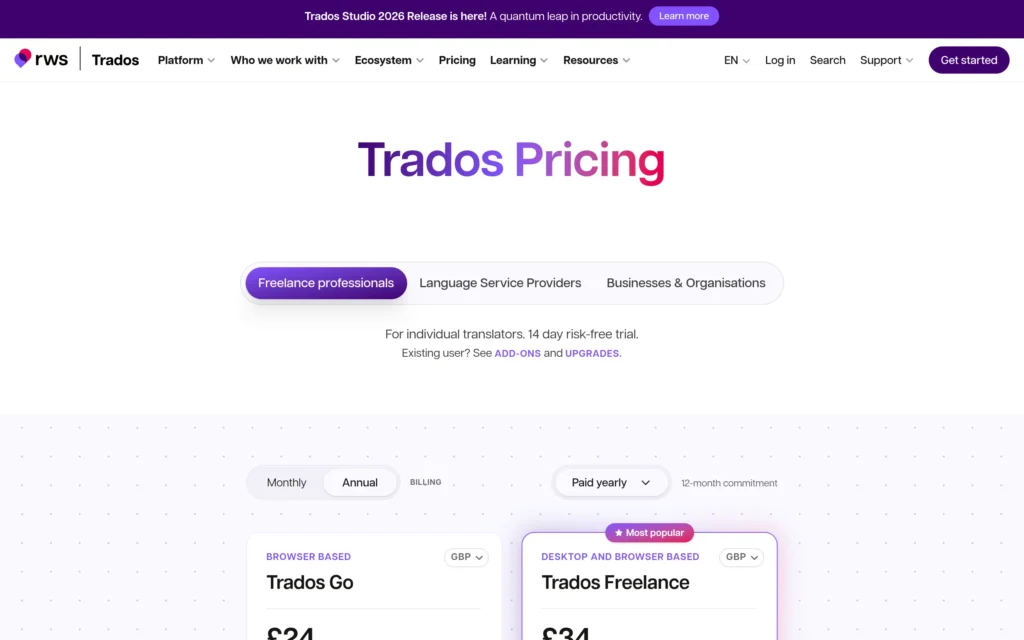
Trados has just shipped Studio 2026, and the freelance pricing has two tiers now. Trados Go is the browser-based edition at £24 a month billed annually (£288 a year) on the pound store, and Trados Freelance is the desktop-and-browser edition at $47 a month billed annually ($564 a year) on the US store — $63 a month if you pay month to month. Both carry a 14-day free trial. The pricing page shows a currency selector, so check your own currency at checkout before you buy; the pound-store Freelance price is £34 a month billed annually (£408 a year).
What you are paying for is compatibility plus the desktop editor. Freelance gives you the full Studio desktop application with translation memory, termbases, and the package handling agencies expect, plus browser access. Go gives you the browser edition only – real Trados, but without the desktop application. On one machine at one desk, the desktop edition is the point.
For a solo translator, Freelance at $47 a month billed annually is the honest pick – if your agencies send Trados packages. If your clients send Word files and PDFs, you do not need Trados at all, and memoQ at $436 a year opens Trados packages anyway when one does arrive. If half your income comes from two agencies that live in Trados, $564 a year is the cost of staying on their vendor list, and it pays for itself the first time a project manager picks you because your file came back clean.
The catch is the licence. Trados no longer sells perpetual licences to new buyers – it is subscription only, every year, forever. The old deal where you bought Studio once and used it for five years is gone. Miss a renewal and the software stops. Freelance allows unlimited target words on the desktop, but only 1 million target words a year in the cloud – a cap to know about if you work in the browser.
And the two-tier split is a trap of its own: Go looks like the smart saving at £24 a month, but if an agency’s package needs a desktop feature Go does not have, you will discover that on a Friday deadline, not on the pricing page. Check with your biggest agency client which edition their packages require before you pick.
Who is Trados Studio actually best for? A freelance translator whose agency clients work in Trados and send .sdlppx packages every week. If your clients send Word and PDF, buy memoQ and pocket the difference – it opens Trados packages when you need it to.
memoQ — the freelancer CAT pick
memoQ translator pro is the CAT tool built for exactly one person: you, at your desk, with an agency package to translate and a memory to build. It is the loyal alternative to Trados, with a fanbase that argues about its editor the way photographers argue about lenses — and for a solo translator, it is the best single purchase in this guide.
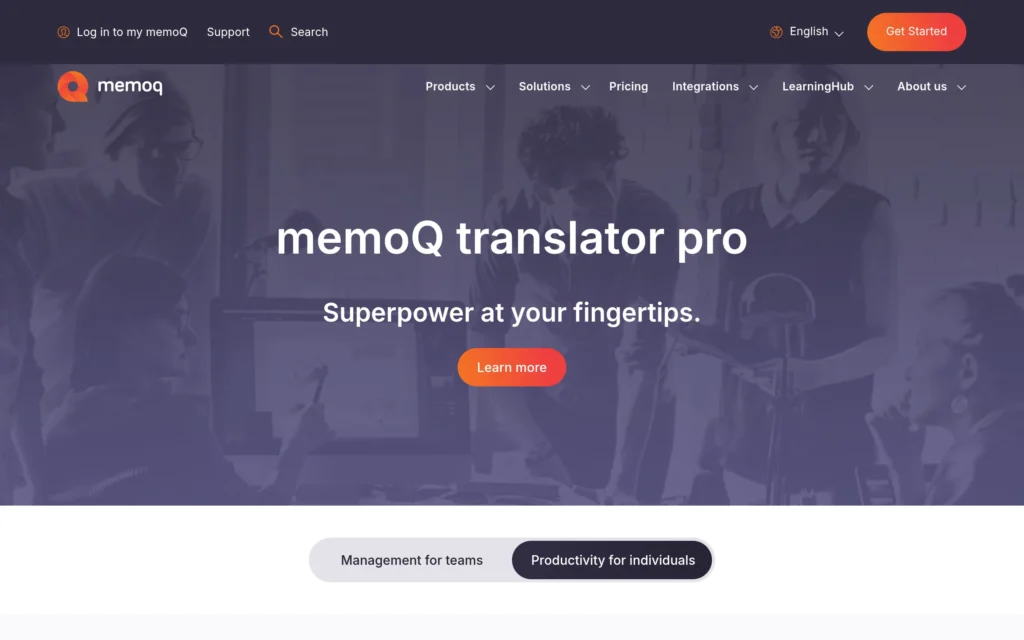
The price is $54 a month, or $436 a year, per licence. Annual billing works out to about $36 a month, and the trial lasts 14 days. That is the desktop product, translator pro — the one freelancers buy. Do not confuse it with memoQ TMS, the team server product, which starts at $3,025 a year for one project-manager licence and five linguists. TMS is for agencies. Translator pro is for you. The two products share a name and almost nothing else, and the pricing page leads with TMS — which is how translators end up pricing the wrong product.
What you are paying for is a complete desktop CAT tool: translation memory, termbases, LiveDocs, and Muse predictive typing. It imports packages from the major other CAT tools, including Trados .sdlppx, which matters every time an agency sends you a file prepared elsewhere. It runs on Windows, and works with memoQ servers when your agencies run them.
For a solo translator, $436 a year is the honest pick, and it is the cheapest full CAT tool here that agencies accept. The maths that matters is the memory: every sentence you approve goes into it, and every repeat or fuzzy match after that is work you do not redo. Two years of memory makes a translator measurably faster – and the memory is yours, portable, and not rented by the word.
The catch is Windows. MemoQ translator pro runs on Windows, full stop. A translator on a Mac needs Windows running alongside it – a virtual machine or a second machine – and that is a real cost in money and patience that the $436 price tag does not show.
The second catch is the perpetual-licence question. MemoQ’s own pricing page now sells subscriptions only – no perpetual price is published. Its FAQ still mentions a perpetual licence and a support agreement at $164 a year, but the webshop link that should sell it returns a page-not-found error, so no perpetual price could be verified. If a seller offers you a one-time licence, confirm the price on memoQ’s own site first – the subscription is the price this guide verified.
Who is memoQ actually best for? A freelance translator who wants a full CAT tool they own the workflow of, works on Windows, and takes agency packages in several formats. If you are on a Mac and will not run Windows, Trados Go in the browser is the honest alternative.
Phrase — the localization platform pick
Phrase is the tool in this guide that a freelance translator is least likely to need and most likely to be sold. It is a localization platform for companies shipping software and apps in many languages — and its Freelancer plan, at $27 a month billed annually, is the cheapest way into a system built for teams.
The Freelancer plan is $27 a month billed annually, or $324 a year. There is no pay-monthly price — Phrase offers annual and quarterly billing only, and the prices on the page apply to annual billing. What you get is 1 TMS seat, no Strings seats, 6 Phrase products with basic capacities, 650,000 TMS processed words a year (300,000 paid plus 350,000 complimentary quoting capacity), and 1,000,000 machine translation units (MTUs) a year. Every plan includes a 14-day free trial and 24/7 customer support.
What you are paying for is string management at scale: the memory, machine translation, AI, and workflows that keep an app’s interface text consistent across forty languages and fifty releases. For a company localizing software, that is the whole business. For a freelancer translating documents, almost none of it applies – your work does not live in string files, and you do not ship forty languages at once. The MTU allowance is the one genuinely useful piece: a million units a year is far more than a solo translator will burn through.
For a solo translator, $324 a year is the honest price – and the honest verdict is to skip it unless a client requires it. The Team plan, at $1,245 a month billed annually, shows what this product really costs: $14,940 a year. Freelancer is the on-ramp to that world, not a tool for your desk. If an agency client runs Phrase and invites you in, they pay the platform bill – you just translate in it.
The catch is the capacity language. MTUs, processed words, AI units, Strings seats – Phrase prices in units that take a spreadsheet to compare with anyone else’s per-word rate. A million MTUs sounds enormous until you learn what an MTU is in your workflow, and the 650,000 processed-words figure splits into paid capacity and complimentary quoting capacity. And professional translations ordered through Phrase start at $0.06 a word – cheap for a vendor, but a reminder that the platform also sells the human work you do.
Who is Phrase actually best for? A company or agency localizing software, apps, and websites across many languages. If you are a freelance translator, the only reason to hold a Freelancer plan is a specific client who works in Phrase – and even then, ask whether they will cover it.

The maths: what the stack really costs
Here is the part most guides skip: what all of this costs together, for one realistic translator. The scenario is a solo freelance translator – one person, no employees – translating about 10,000 words a month, or 120,000 words a year, on annual billing where published, at list prices. Subscription prices are the stack; metered charges are shown separately, because for a translator the meter is the bill that grows with your volume.
| Tool | Full stack | Lean stack | Saving |
|---|---|---|---|
| DeepL Pro | Team $344.88/yr | Individual $104.88/yr | $240 |
| Smartcat | Adapt $1,200/yr | — | $1,200 |
| Trados Studio | Freelance $564/yr | — | $564 |
| memoQ | translator pro $436/yr | translator pro $436/yr | $0 |
| Phrase | Freelancer $324/yr | — | $324 |
| Total | $2,868.88/yr | $540.88/yr | $2,328 |
The full stack costs $2,868.88 a year. The lean stack costs $540.88 a year. The gap is $2,328 a year. The entire saving comes from dropping the team platforms and the second CAT tool, and from running DeepL on Individual instead of Team.
The honest middle stack is $1,104.88 a year: the lean stack plus Trados Freelance at $564 a year, for a translator whose agencies live in Trados. It costs $564 more than lean, and it is the only upgrade here that buys you work instead of features.
Now the number that actually decides this purchase: the cost per word. At 120,000 words a year, the full stack costs about 2.4 cents a word in subscriptions. The lean stack costs about 0.45 cents a word. At a $0.10-a-word rate, the lean stack pays for itself after 5,409 words – about half a month’s work. The full stack needs 28,689 words, or nearly three months, before it breaks even. The meters sit on top: Smartcat’s 100,000 Smartwords are an annual allowance, not unlimited – a busy year burns through it in ten months at 10,000 words a month, and then you top up.
5 traps that cost translators real money
1. Buying the team platform when you are a team of one. Smartcat Adapt starts at $1,200 a year, and Phrase Team is $1,245 a month – $14,940 a year. Both are built for companies with reviewers, approvers, and workspaces. A freelancer buying either one pays to collaborate with nobody.
2. Pricing the wrong memoQ. MemoQ’s pricing page leads with TMS, the team server product starting at $3,025 a year. The product a freelancer buys is translator pro at $436 a year. Price the wrong one and you will either walk away thinking memoQ costs seven times what it does, or buy a server product you cannot use.
3. Paying for machine translation twice. DeepL Individual, Smartcat’s Smartwords, and Phrase’s MTUs all charge you for the same job: turning source words into a draft. Buy two and you pay two meters for one draft. Pick one MT engine – DeepL for most translators – and let the CAT tool’s memory do the rest for free.
4. Running client work through free machine translation. Free DeepL caps you at 1,500 characters per entry and its terms prohibit confidential or personal data. A contract or medical record does not belong in a free translator. Pro deletes your text after translation and never trains on it. The free plan is for testing quality, not for client work.
5. Buying Trados Go when your agency needs Freelance – and forgetting the subscription never ends. Go is browser-only at £24 a month billed annually; Freelance is desktop and browser at $47. If an agency’s package needs a desktop feature, Go leaves you stuck on a Friday deadline. And Trados no longer sells perpetual licences – miss a renewal and the software stops. Budget it as a yearly cost, every year, forever.
What to buy first
Don’t buy all five. Buy two, run them on real jobs for two weeks, and see what breaks. For most freelance translators, that is memoQ translator pro at $436 a year and DeepL Pro Individual at $8.74 a month billed annually – $540.88 a year together. The CAT tool holds your memory and your terms. DeepL drafts the first pass. Everything else in this guide is an upgrade you buy when a client requires it, not before.
If your agencies send Trados packages every week, add Trados Freelance at $47 a month billed annually – the middle stack at $1,104.88 a year. And if you are tempted by Smartcat, ask yourself who the second user is. If there isn’t one, there is your answer.
Before you commit to a stack, run the numbers for your own practice. Our free AI Cost Calculator adds up the real starting prices of the tools you pick, so you can see the yearly total before you hand over a card.
Pros and Cons
Pros
- Every tool here publishes real prices on its core plans — no quote-only walls except Smartcat’s upper tiers and Phrase Business and Enterprise.
- Two genuinely cheap starting points (DeepL Individual at $8.74 a month billed annually and memoQ translator pro at $436 a year) cover the whole freelance workflow: draft plus CAT.
- The lean stack saves $2,328 a year against the full stack without losing the CAT tool or the MT engine.
Cons
- No single tool does everything: the best MT engine (DeepL) has no translation memory, and the best CAT tools charge you every year forever.
- The team platforms are priced for companies — Smartcat’s $1,200 floor and Phrase Team’s $1,245 a month buy features a solo translator will never use.
- Per-word meters (Smartwords, MTUs) grow with your volume, so your busiest month is also your most expensive.
Our verdict
For most freelance translators, memoQ translator pro at $54 a month, or $436 a year, plus DeepL Pro Individual at $8.74 a month billed annually, is the buy. Together they cost $540.88 a year, they cover the whole job, and the stack pays for itself after about 5,400 words at a $0.10-a-word rate.
If your agencies live in Trados, add Trados Studio Freelance at $47 a month billed annually ($564 a year) – the middle stack at $1,104.88 a year, and the only upgrade here that buys you work. And if you are weighing Smartcat, count your second user first – if there isn’t one, skip it.
First step: start the 14-day memoQ trial and the 30-day DeepL trial this week, on a real job, not a test file. The CAT tool your memory actually grows in, and the draft engine whose output you edit least, are the ones to keep – that is how the best ai tools for translators earn their keep. If you translate for clients who need their apps and websites in many languages, see our separate comparison of the tools localization teams use.
Frequently asked questions
What are the best ai tools for translators for a freelancer?
MemoQ translator pro, plus DeepL Pro Individual. MemoQ at $54 a month or $436 a year is a full desktop CAT tool with translation memory and termbases that opens Trados packages. DeepL Individual at $8.74 a month billed annually gives you the best machine draft for European languages, with glossaries and a promise your text is never used for training.
Is DeepL Pro worth it for translators?
Yes, for European language pairs and confidential text. Individual at $8.74 a month billed annually covers 300,000 characters and 3 document translations a month. Its edge is narrowest in Asian or low-resource pairs, so test the draft quality on your own texts before you pay.
Do I need Trados Studio as a freelance translator?
Only if your agencies send Trados packages every week. Trados Freelance is $47 a month billed annually ($564 a year) with a 14-day trial. If your clients send Word files and PDFs, memoQ at $436 a year opens Trados packages when one arrives, and you can skip Trados entirely.
What is the cheapest CAT tool for translators?
MemoQ translator pro at $436 a year is the cheapest full desktop CAT tool agencies accept. Trados Go is cheaper at £24 a month billed annually, but it is browser-only – no desktop application. DeepL’s free plan costs $0, but it is not a CAT tool and its terms prohibit confidential data.
Can I use free machine translation for client work?
Not for anything confidential. Free DeepL limits you to 1,500 characters per entry and prohibits confidential or personal data. Pro deletes your text after translation and never trains on it. Test quality on the free plan, and pay for Pro before a client’s contract goes through it.
Price note — updated 25 November 2026: Prices in this post were checked on 25 November 2026. When you are reading this, the price may be lower or higher — always check the official pricing page before you buy.
Also note: DeepL has restructured its plans: Starter, Advanced, and Ultimate are gone, replaced by Individual, Team, and Business — Individual is $10.49 a month, or $8.74 billed annually. Trados Freelance is $63 a month, or $47 a month billed annually ($564 a year); Trados Go is £24 a month billed annually on the pound store. MemoQ’s pricing page sells subscriptions only; its FAQ mentions a perpetual licence, but the webshop link returns a page-not-found error, so no perpetual price could be verified. Phrase’s Freelancer plan is annual billing only — no pay-monthly price is published. Prices exclude VAT where the vendor states it.
Sources: DeepL Pro pricing — https://www.deepl.com/en/pro · Smartcat pricing — https://www.smartcat.com/pricing/ · Trados pricing — https://www.trados.com/pricing/ · memoQ translator pro pricing — https://www.memoq.com/pricing/individual-use/ · Phrase pricing — https://phrase.com/pricing/
Pros
- Every tool here publishes real prices on its core plans — no quote-only walls except Smartcat's upper tiers and Phrase Business and Enterprise.
- Two genuinely cheap starting points (DeepL Individual at $8.74 a month billed annually and memoQ translator pro at $436 a year) cover the whole freelance workflow: draft plus CAT.
- The lean stack saves $2,328 a year against the full stack without losing the CAT tool or the MT engine.
Cons
- No single tool does everything: the best MT engine (DeepL) has no translation memory, and the best CAT tools charge you every year forever.
- The team platforms are priced for companies — Smartcat's $1,200 floor and Phrase Team's $1,245 a month buy features a solo translator will never use.
- Per-word meters (Smartwords, MTUs) grow with your volume, so your busiest month is also your most expensive.
For most freelance translators, memoQ translator pro at $54 a month, or $436 a year, plus DeepL Pro Individual at $8.74 a month billed annually, is the buy. Together they cost $540.88 a year, they cover the whole job, and the stack pays for itself after about 5,400 words at a $0.10-a-word rate.If your agencies live in Trados, add Trados Studio Freelance at $47 a month billed annually ($564 a year) - the middle stack at $1,104.88 a year, and the only upgrade here that buys you work. And if you are weighing Smartcat, count your second user first - if there isn't one, skip it.First step: start the 14-day memoQ trial and the 30-day DeepL trial this week, on a real job, not a test file. The CAT tool your memory actually grows in, and the draft engine whose output you edit least, are the ones to keep - that is how the best ai tools for translators earn their keep. If you translate for clients who need their apps and websites in many languages, see our separate comparison of the tools localization teams use.