
For a small independent funeral home doing about 20 cases a month, the cheapest honest AI setup is Goodcall Starter at $79 a month for after-hours answering plus Afterword Essential from $79 a month for case management — $158 a month combined. If you would rather have one system that does both jobs, FuneralHQ Platform at $250 a month is the pick. FuneralWiseAI ($195 a month plus a $995 one-time setup) is the only answering service here built only for funeral homes. Smith.ai's AI Receptionist Pro costs $270 a month for the same 150 calls Goodcall covers for $79 — $2,292 a year more, and the extra money buys one thing: a live human agent on standby when the AI hits its limit.
The phone rings at 2:47 a.m. You are the on-call director and the person who writes the obituary before the family arrives. Nobody pays you extra for the 2:47 a.m. part. That is the job AI can actually help with in a funeral home — not sitting with a grieving family, never that, but the ringing phone, the blank obituary page, and the checklist that rebuilds itself after every case.
This guide compares five tools by what they really cost a small independent funeral home handling about 20 cases a month. Every price below was read on the vendor’s own pricing page on 24 November 2026 — no roundups, no figures copied from a review site, and no tool that hides its price behind a sales call. That is why the biggest names in funeral software are not here, and we say so plainly.
Quick Answer
For a small independent funeral home doing about 20 cases a month, the cheapest honest AI setup is Goodcall Starter at $79 a month for after-hours answering plus Afterword Essential from $79 a month for case management — $158 a month combined.
If you would rather have one system that does both jobs, FuneralHQ Platform at $250 a month is the pick. FuneralWiseAI ($195 a month plus a $995 one-time setup) is the only answering service here built only for funeral homes. Smith.ai’s AI Receptionist Pro costs $270 a month for the same 150 calls Goodcall covers for $79 — $2,292 a year more, and the extra money buys one thing: a live human agent on standby when the AI hits its limit.
In this article
- Best AI tools for funeral homes at a glance
- How we compared them (and what we did not test)
- Goodcall in detail
- FuneralWiseAI in detail
- Smith.ai in detail
- FuneralHQ in detail
- Afterword in detail
- The maths: what a 20-case-a-month home pays in one year
- Four traps to check before you pay
- Work out what your stack really costs
- Pros and cons
- Our verdict
- Frequently asked questions
Best AI tools for funeral homes at a glance
| Tool | What the AI actually does | Price at 20 cases / ~150 calls a month | First-year cost | Free option |
|---|---|---|---|---|
| Goodcall | AI phone answering, books and transfers, trained by you | $79/mo (Starter, about 150 calls) | $948 | Free demo agent |
| FuneralWiseAI | AI answering trained only for funeral homes, pages the on-call director | $195/mo + $995 setup | $3,335 | Demo line |
| Smith.ai AI Receptionist | AI answering, transfers to live US agents | $270/mo (Pro, 150 calls) | $3,240 | Free plan, 25 calls/mo |
| FuneralHQ Platform | Case management plus AI phone answering, one system | $250/mo per location | $3,000 | None stated (book a demo) |
| Afterword Essential | Case management; AI assistant builds task lists | From $79/mo (based on 200 cases/yr) | From $948 | None stated (book a demo) |
How we compared them (and what we did not test)
Every tool here publishes its price on its own website. That rule alone cut the field in half. Passare, Gather, FrontRunner, and Osiris all make real funeral software — Passare and Gather both have AI obituary writers, and Passare adds an AI notetaker — but none of them publishes a price. You have to book a demo and wait for a quote. A guide that compares by “real price” cannot include a tool whose price it has never seen, so they are out of the table. If obituary drafting is your main reason for buying, ask Passare and Gather for a quote directly.
We priced everything at one fixed volume: a home handling about 20 cases a month (240 a year) and taking about 150 inbound calls a month. That call figure is our working assumption, stated openly — your real number depends on how many families call before they visit. Count your calls for one month before you buy a per-call plan.
Goodcall in detail
Goodcall is not a funeral tool. It is a general AI answering service, and that is both its strength and its weakness. Its AI agent answers your phone around the clock, takes messages, books appointments, answers questions from a knowledge base you train, and transfers urgent calls to a person. You build it yourself, test it with a free demo agent, and only pay when you connect a number. There is no per-minute charge: a nine-minute call from a distraught family member costs exactly the same as a thirty-second wrong number.
The price is the simplest in this guide. Starter is $79 a month and covers 100 unique customers a month — Goodcall says that works out to about 150 calls — with extra customers at 79 cents each. Growth is $129 a month for 500 unique customers (about 750 calls), then 26 cents each. Scale is $299 a month for 2,000 unique customers (about 3,000 calls), then 15 cents each. Every plan includes a local number, and you can keep your existing number by forwarding it. A “unique customer” is one phone number in a month, so a family that calls five times counts once. Spam and wrong numbers do not count.
For our 20-case home at roughly 150 calls a month, Starter fits: $79 a month, $948 a year, nothing else to pay. Watch the meter, though. A busy month pushes extra customers to 79 cents each, and Goodcall itself will tell you when a bigger plan is cheaper. And Goodcall knows nothing about funerals until you teach it — you write the greeting, load your service list and prices, and set the escalation rules. That setup afternoon is the price of the lowest bill in this guide.
Who is Goodcall actually best for? A small home that misses calls after hours, already has case software it likes, and wants the cheapest reliable phone cover without a setup fee or a sales call. If your budget is tight and you will spend an afternoon training the agent, this is the one.
Pros:
- Cheapest answering in this guide at $79 a month, with no setup fee and no per-minute billing
- Free demo agent — hear it answer before you pay anything
- Repeat callers from one family count once
- Spam and wrong numbers do not count
Cons:
- Not built for funerals — you train it yourself
- The Starter meter (100 unique customers) can bite in a busy month
- Answers the phone and nothing else — no case management, no obituaries

FuneralWiseAI in detail
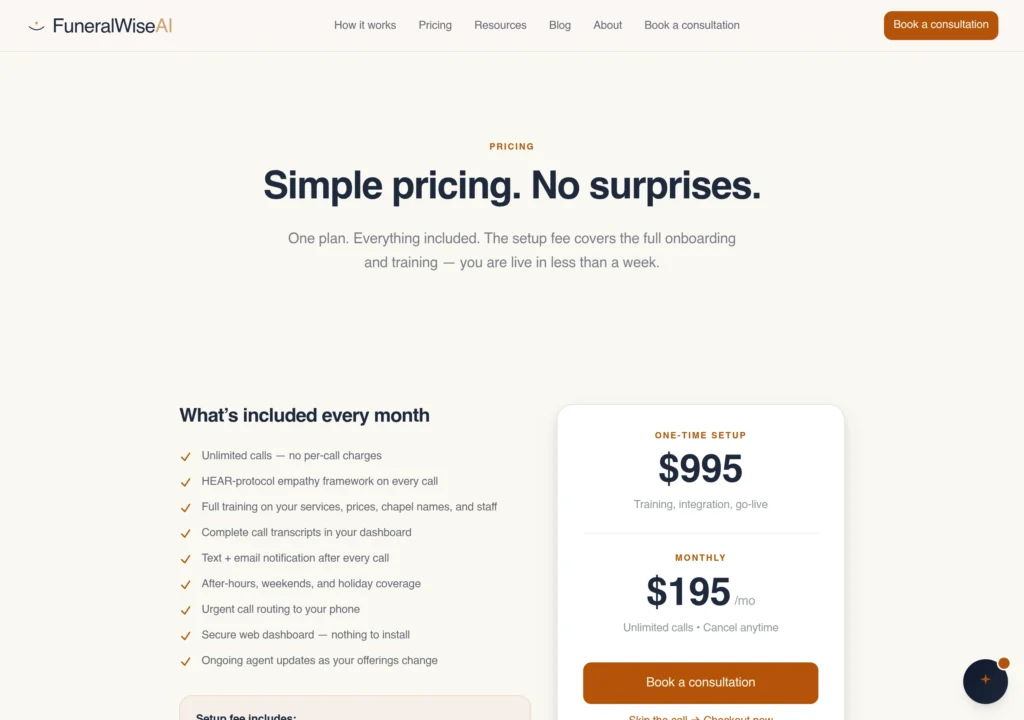
FuneralWiseAI is the only tool in this guide that does one thing, for one industry, and nothing else. It is an AI answering service trained for funeral homes. It picks up every call, captures the details a director needs from a first call, and pages you only when it matters. Routine questions get answered from your own services and price list. A first call at 2 a.m. gets routed straight to your phone. Everything else is summarized by text and email, with a full transcript in the dashboard.
The price is one plan, no tiers: a one-time setup fee of $995, then $195 a month, with unlimited calls. No per-call or per-minute charges, no matter how busy the month gets. The setup fee covers the onboarding interview, training the agent on your website, price list, chapel names and staff, integrating your existing number, and a test-call review before go-live. Most homes are live within five business days. Billing is monthly and you can cancel anytime, with a 30-day satisfaction guarantee — but read the fine print: if you cancel within 30 days of going live, your first month’s subscription is refunded in full. The $995 setup fee is non-refundable once the agent has been built and deployed.
The vendor’s own FAQ answers the question every director asks first: will families know they are talking to an AI? The agent answers as your funeral home and does not present itself as a human, and the company says families generally recognize it as an automated system — and that it is “substantially better than voicemail or a generic answering service.” Nobody expects a person at 3 a.m. They expect to be heard.
Two things to weigh before you pay. First, the setup fee makes year one cost $3,335, not $2,340 — the monthly price only tells the truth from year two onward. Second, this is a young, single-founder product with no independent reviews we could find. A $995 non-refundable setup fee deserves a hard look at the demo line before you commit. Call it, listen to how it handles a first call, and decide with your ears.
Who is FuneralWiseAI actually best for? A home that wants the phone handled by something that already speaks funeral, and will pay a setup fee for unlimited calls and no meter to watch.
Pros:
- Built only for funeral homes, trained on your services, prices, and chapel names
- Unlimited calls — a busy month costs the same as a quiet one
- Urgent calls route to the on-call director; routine calls get summarized, not dumped on you
- Live in about five business days, cancel anytime
Cons:
- $995 setup fee, non-refundable after go-live, makes year one the most expensive answering option here
- Young product, no independent reviews we could find
- No case management or obituary tools — the phone, full stop
Smith.ai in detail
Smith.ai is the biggest name in this guide, and it sells two different things that are easy to confuse — so let’s be precise. The AI Receptionist is the AI product: an AI front desk that answers, qualifies, and routes calls around the clock. The Virtual Receptionist plans are live human receptionists in North America, starting at $300 a month for 30 calls. This section prices the AI product. The human plans matter only as the backup the AI can hand off to.
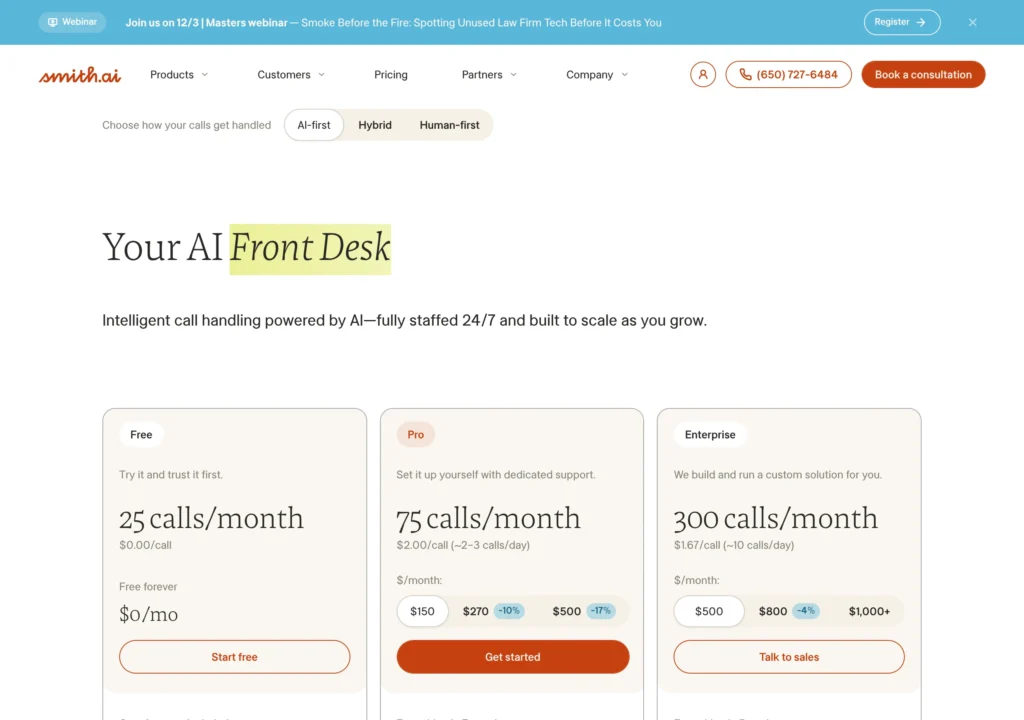
The AI Receptionist has three tiers. Free is $0 a month for 25 calls, with extra calls at $3.00 each, and it includes recording, transcription, summaries, lead qualification, and call routing. Pro starts at $150 a month for 75 calls ($2.00 a call), with a 150-call tier at $270 a month ($1.80 a call) and a 300-call tier at $500 a month ($1.67 a call). Extra calls run $2.50, $2.30, and $2.17 respectively.
Enterprise starts at $500 a month for 300 calls, rising to $800 for 500 calls, with 1,000-plus calls priced on request. Every plan is month-to-month with no setup fee, and every plan includes test calls equal to its real-call count so you can rehearse changes without paying for them.
For our 20-case home at about 150 calls a month, the honest price is the Pro 150-call tier: $270 a month, $3,240 a year. The $150 tier would leave you paying $2.50 for each of the 75 calls over your allowance — $337.50 a month, more than the bigger tier. Do not buy the small tier and hope your calls stay small.
What the $270 buys that Goodcall’s $79 does not is a human safety net. When a call gets complicated — a family in crisis, a question the AI cannot answer — Smith.ai’s AI can transfer to a live North America-based receptionist, day or night. Smith.ai says it has answered over 20 million calls in ten years, and its spam filtering blocks known spam numbers before the AI picks up. Whether that is worth $2,292 a year more than Goodcall is the question the verdict answers. Note the live Virtual Receptionist plans ($300 for 30 calls, $810 for 90, $2,100 for 300) are a different, human-answered product with per-call add-ons — appointment booking $1.50 a call, recording and transcription $0.25 a call.
Who is Smith.ai actually best for? A home that wants AI answering but is not comfortable letting a machine be the last voice a family hears — the live-agent handoff is the product, and you pay for it. It is also the only tool here with a free tier.
Pros:
- Only AI answering here with live human agents on standby, 24/7
- Free plan with 25 calls a month — try the real thing before paying
- No setup fee, month-to-month, strong spam filtering
- Test calls included, so you can rehearse the agent before it meets a family
Cons:
- $270 a month at 150 calls — $2,292 a year more than Goodcall
- Per-call billing punishes long conversations and busy months alike
- Not funeral-specific; you train it yourself, like Goodcall
- Two product lines (AI vs live receptionists) that are easy to confuse; live plans cost far more
FuneralHQ in detail
FuneralHQ is the only tool here that tries to be the whole office. Its Platform plan is case management, first-call intake, documents and e-signatures, payments, preneed, and AI phone answering in one system, priced per location. One login, one bill, one place where the case lives from the first call to the paid invoice.
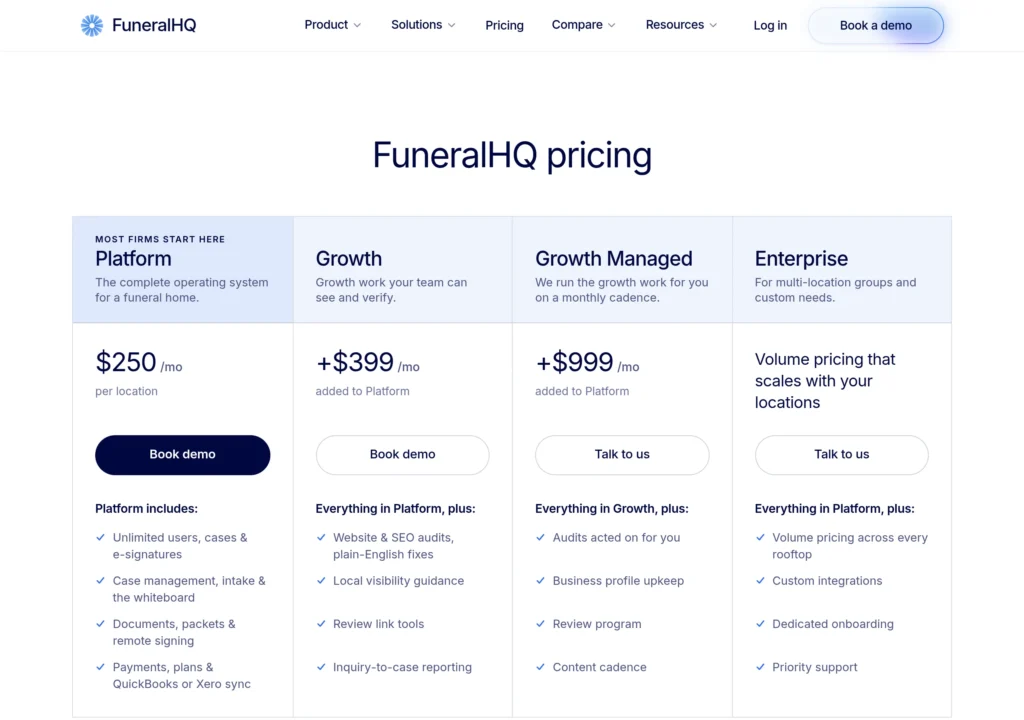
FuneralHQ’s price is refreshingly plain: Platform is $250 a month per location, with unlimited users, unlimited cases, and unlimited e-signatures. Adding staff does not change the price; adding a location does. That includes case management and intake, the whiteboard, documents, packets and remote signing, payments and plans, and QuickBooks or Xero sync. Card and ACH payment processing is billed separately. Two add-ons sit on top: Growth at $399 a month extra (website and SEO audits, local visibility, review tools, inquiry-to-case reporting) and Growth Managed at $999 a month extra (their team runs the growth work for you). Enterprise is volume pricing for multi-location groups, quoted on request.
One honesty check on the AI claim: FuneralHQ’s own product description lists “AI phone answering” as part of the platform, alongside case management and e-signatures. The pricing page does not break out the answering features in the same detail as the funeral-only answering tools — no published script for how it handles a first call, no demo line to ring.
That does not mean the feature is thin; it means you should make the demo call and listen before you assume it matches FuneralWiseAI’s funeral-trained agent. What is certain is the value of the bundle: a home that buys FuneralHQ for case management gets phone answering inside the same $250, instead of paying $79 to $270 a month to a second vendor.
The trade-off is the usual one with all-in-one systems. You get one vendor to call when something breaks, and intake notes flow straight into the case file without retyping. You also get one vendor to leave if it stops fitting, and moving years of cases out of any platform is a weekend nobody enjoys. FuneralHQ says it helps with migration during onboarding, mapping your old cases in from your current system or a spreadsheet. Ask for that in writing before you sign.
Who is FuneralHQ actually best for? A single-location independent home that wants one system for the whole case — intake, documents, signatures, payments, and the phone — and would rather pay $250 a month to one vendor than juggle subscriptions.
Pros:
- One system for case management and AI answering — $250 a month replaces a case tool plus a phone tool
- Unlimited users, cases, and e-signatures; staff growth never raises the bill
- Published, per-location pricing with no per-user charges and no setup fee stated
- QuickBooks and Xero sync included; migration help during onboarding
Cons:
- AI answering is listed, not demonstrated — no published call flow or demo line
- $250 a month beats the cheapest case tool ($79) only if you also need answering
- Growth add-ons ($399/$999) are marketing services, not AI
- Payment processing is billed separately, on top of the subscription
Afterword in detail
Afterword is case management software with an AI assistant, and it is worth saying that the right way round. The case management is the product; the AI is the helper inside it. Its Task Lists module builds your task list automatically from your cases and documents “with our AI assistant,” and the company also offers a Grace AI Assistant for tasks, reminders, and documents. There is an Online Planner that lets families select preferences and plan online, and automatic FTC-compliant price lists. It is a serious, full-featured system — and its AI footprint is narrower than the answering tools above. It does not answer your phone. It does not write your obituaries.
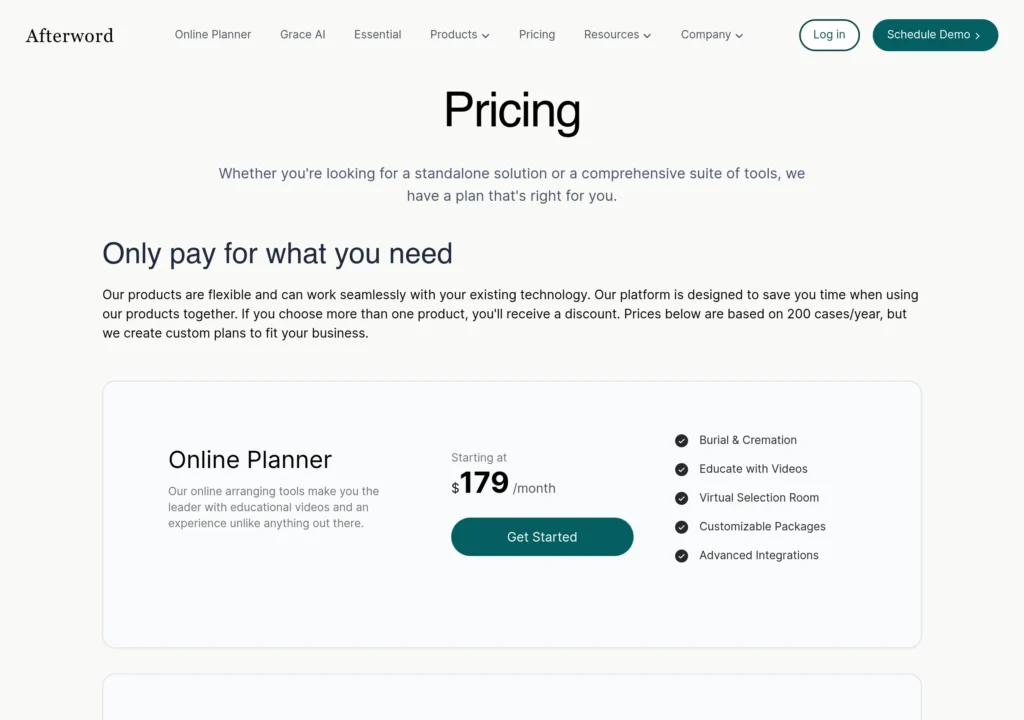
The pricing is modular, which is both the appeal and the trap. Prices are published per product, based on 200 cases a year, with a discount if you take more than one product. Essential Case Management starts at $79 a month: vitals collected once and flowing into every document, statement of goods and services, document library and custom forms, basic reporting, and Tukios and ASD integrations.
Personalized Case Management starts at $325 a month, adding custom vitals collection, unlimited e-signatures, payment processing, and reporting with backups. Online Planner starts at $179 a month, Chain of Custody starts at $149 a month, and Task Lists — the module with the AI assistant — starts at $99 a month. No setup fees are stated, you can cancel anytime, and implementation typically takes three to eight weeks including price-book digitizing and data migration.
Read the “based on 200 cases a year” line twice. Our comparison home does 240 cases a year, and Afterword says it creates custom plans to fit your business — so $79 is the floor, not necessarily your price. Get the quote for your actual volume before you budget on $79. The multi-product discount exists, but its size is not published.
For a home that already has phone cover and needs the case file handled properly, Essential at $79 a month is the cheapest real case management in this guide — $948 a year against FuneralHQ’s $3,000. The gap buys you FuneralHQ’s included phone answering and unlimited e-signatures, so compare the whole stack, not the headline. And if the AI task assistant is the feature you actually want, remember it lives in the $99-a-month Task Lists module, not in the $79 Essential plan. Add them together — $178 a month — before you call Afterword cheap.
Who is Afterword actually best for? A home that needs proper case management and FTC-compliant paperwork first, already has the phone covered, and wants to buy only the modules it uses.
Pros:
- Cheapest case management here, from $79 a month, with modular pricing — pay for what you use
- Real AI assistant in Task Lists, plus FTC Funeral Rule compliance built in
- Online Planner lets families start arranging from home, with educational videos
- No setup fees stated, cancel anytime, full data export if you leave
Cons:
- Published prices assume 200 cases a year — a 240-case home should expect a custom quote
- The AI assistant lives in the $99 Task Lists module, not the $79 plan
- No phone answering, no obituary writer — you still need a second tool for the 3 a.m. calls
- Three-to-eight-week implementation is the longest onboarding here
The maths: what a 20-case-a-month home pays in one year
One year of bills, at 20 cases and about 150 calls a month. Setup fees are counted in year one only.
| Setup | Monthly cost | Year one | Every year after |
|---|---|---|---|
| Goodcall Starter (answering only) | $79 | $948 | $948 |
| FuneralWiseAI (answering only) | $195 + $995 setup | $3,335 | $2,340 |
| Smith.ai AI Receptionist Pro 150 calls (answering only) | $270 | $3,240 | $3,240 |
| FuneralHQ Platform (cases + answering) | $250 | $3,000 | $3,000 |
| Afterword Essential (cases only) | From $79 | From $948 | From $948 |
The single most useful number in this guide is the gap between the two general answering tools: Smith.ai Pro at $270 a month costs $2,292 a year more than Goodcall Starter at $79 a month for the same 150 calls (($270 − $79) × 12 = $2,292). That is the price of the live-human safety net. If one escalated call a month is worth $191 to you — the monthly gap — Smith.ai earns its premium. If your calls are mostly routine and your on-call director is reachable, it does not.
The second useful number is the FuneralWiseAI curve. Year one costs $3,335, the most expensive answering option here. Year two costs $2,340 — cheaper than Smith.ai by $900 a year, and unlimited, so a busy month never moves the bill. If you stay two years, the setup fee fades into the background. If you cancel in month three, you have paid $995 for a product you no longer use.
Now the stacks, because nobody buys one tool in isolation. The lean stack is Afterword Essential (from $79) for the case file plus Goodcall Starter ($79) for the phone: $158 a month, $1,896 a year. The single-vendor stack is FuneralHQ Platform at $250 a month, $3,000 a year — more money, one bill, one login, no juggling.
The funeral-only stack is FuneralWiseAI ($195) plus Afterword Essential (from $79): from $274 a month, $3,288 a year plus the $995 setup in year one. And the stack to avoid is FuneralHQ plus any answering service: FuneralHQ already includes AI answering, so adding Goodcall or FuneralWiseAI on top means paying twice for the same ringing phone. For scale, even Goodcall’s $948 a year is a rounding error next to a part-time hire’s salary — these tools compete with a missed call, and a missed first call is a family that rings the next funeral home on the list.
Four traps to check before you pay
1. “From” prices that assume a smaller home than yours. Afterword’s published prices are based on 200 cases a year. A home doing 240 cases is buying a custom plan, and that price is not on the page. Get your volume’s number in writing before you budget.
2. Setup fees that never come back. FuneralWiseAI’s $995 setup is non-refundable after go-live. That is fair — the build work is done — but it means the real trial is the demo line. Ring it, ask the hardest first-call question you can think of, and only then pay the setup fee.
3. Meters that punish your busiest month. Goodcall bills per unique customer, Smith.ai bills per call. Both sting exactly when you are busiest — a well-known family, a bad week. Know your real monthly call count before you pick a meter, and what the next tier costs before you need it.
4. The obituary trap. No tool in this guide writes publish-ready obituaries on its own, and none should. Passare and Gather both sell an AI obituary writer, but neither publishes a price, so they are not in this comparison. Whatever tool drafts the first version, a person — a director or a family member — must read every line before it goes anywhere. AI is good at structure and tone. It is also good at inventing a middle name, a military honor, or a surviving relative who does not exist. In this business, that is not a typo. It is a wound.
Work out what your stack really costs
The prices above are honest, but your stack is yours. A $79 tool plus a $195 tool plus a $99 module is $373 a month before you have noticed. Use AIT Biz Hub’s free AI Cost Calculator at aitbizhub.com/ai-cost-calculator/ to total the monthly and yearly cost of the stack you are considering, and see the number before the first invoice arrives. It takes two minutes — the difference between a $158-a-month plan and a $373-a-month surprise.
Pros and cons
Pros of using AI in a funeral home:
- The phone gets answered at 3 a.m., every time, without waking the on-call director for a routine question
- First drafts of obituaries and arrangement notes take minutes, not hours, leaving the director free for the family in front of them
- Task lists build themselves from the case file, so nothing gets forgotten in a busy week
- One $250-a-month system can replace two or three subscriptions
Cons of using AI in a funeral home:
- AI cannot sit with a grieving family, and any tool that pretends otherwise is selling something dangerous
- Setup fees, per-call meters, and “from” pricing mean the advertised price is rarely what you pay
- Funeral-specific tools are young and small, with thinner track records and fewer independent reviews
- A wrong word in an AI-drafted obituary is not a typo — every draft needs a human read
Our verdict
Buy the lean stack first: Goodcall Starter ($79 a month) for the phone and Afterword Essential (from $79 a month) for the case file — $158 a month combined. It is the cheapest way to cover both jobs with real AI help, it has no setup fee, and you can hear Goodcall answer before you pay a cent. If phone volume grows past 100 unique customers a month, move Goodcall to Growth at $129 before the overage charges do it for you.
Runner-up: FuneralHQ Platform at $250 a month, for the home that would rather have one system than two subscriptions. It costs $1,104 a year more than the lean stack, and that buys one login, one vendor, and phone answering built into the case file.
FuneralWiseAI is the right pick if the phone is your whole problem and you want it handled by something that already speaks funeral. Unlimited calls and funeral-trained intake are genuinely different from a general answering service. Just go in knowing year one costs $3,335, and ring the demo line before paying the $995 setup fee.
Smith.ai is the right pick only if the live-human handoff matters more than $2,292 a year. The AI is good, the free tier is genuinely useful, and the transfer to a live agent is the best safety net in this guide. But $270 a month for 150 calls is a premium price, and most small homes will not use the handoff often enough to earn it back.
Start with the free options: Smith.ai’s free 25 calls for a month, Goodcall’s free demo agent after hours for a week. Then buy the one your families never noticed — that is the whole test. The best AI tool in a funeral home is the one nobody has to think about.
Frequently asked questions
Can AI write an obituary for a funeral home?
AI can write a strong first draft in minutes — structure, tone, and flow from the facts you give it. Passare and Gather both sell an AI obituary writer built into their case software. But no AI should publish an obituary unchecked. A director or a family member must read every line first, because AI can invent details that sound right and are wrong — a middle name, a service record, a surviving relative.
Will families know they are talking to an AI when they call at 3 a.m.?
Usually, yes — and the honest vendors say so. FuneralWiseAI states its agent answers as your funeral home and does not present itself as a human, and families generally recognize it as an automated system. The company says families find it substantially better than voicemail or a generic answering service. Nobody expects a person at 3 a.m. They expect to be heard, and called back by a person in the morning.
How much does AI software cost a small funeral home?
At about 20 cases a month, the honest range is $79 to $270 a month for phone answering alone, and $79 to $250 a month for case management. The cheapest complete setup is $158 a month: Goodcall Starter ($79) plus Afterword Essential (from $79). A single all-in-one system, FuneralHQ Platform, is $250 a month. Add a $995 one-time setup fee if you choose FuneralWiseAI, and treat “from” prices as the floor, not the final number.
Can AI answer the phone and page the on-call director?
Yes, and this is the most useful thing AI does in a funeral home. FuneralWiseAI routes urgent calls — a first call at 2 a.m., a family in crisis — straight to the director’s phone, and summarizes routine calls by text and email. Goodcall and Smith.ai both transfer calls to a person you name, and Smith.ai can hand a difficult call to a live agent. You set the escalation rules; the AI follows them.
Do I still need case management software if I buy an AI answering service?
Yes. An answering service handles the phone. Case management handles the case — vitals, documents, FTC-compliant price lists, e-signatures, payments, and the checklist that gets a family from first call to service. Goodcall, FuneralWiseAI, and Smith.ai do not do any of that. The only tool here that does both jobs is FuneralHQ Platform, at $250 a month per location. Otherwise, pair an answering service with a case tool like Afterword.
Price note
Price note — updated 24 November 2026: Prices in this post were checked on 24 November 2026. When you are reading this, the price may be lower or higher — always check the official pricing page before you buy.
Pros
- The phone gets answered at 3 a.m., every time, without waking the on-call director for a routine question
- First drafts of obituaries and arrangement notes take minutes, not hours, leaving the director free for the family in front of them
- Task lists build themselves from the case file, so nothing gets forgotten in a busy week
- One $250-a-month system can replace two or three subscriptions
Cons
- AI cannot sit with a grieving family, and any tool that pretends otherwise is selling something dangerous
- Setup fees, per-call meters, and "from" pricing mean the advertised price is rarely what you pay
- Funeral-specific tools are young and small, with thinner track records and fewer independent reviews
- A wrong word in an AI-drafted obituary is not a typo — every draft needs a human read
Buy the lean stack first: Goodcall Starter ($79 a month) for the phone and Afterword Essential (from $79 a month) for the case file — $158 a month combined. It is the cheapest way to cover both jobs with real AI help, it has no setup fee, and you can hear Goodcall answer before you pay a cent. If phone volume grows past 100 unique customers a month, move Goodcall to Growth at $129 before the overage charges do it for you.Runner-up: FuneralHQ Platform at $250 a month, for the home that would rather have one system than two subscriptions. It costs $1,104 a year more than the lean stack, and that buys one login, one vendor, and phone answering built into the case file.FuneralWiseAI is the right pick if the phone is your whole problem and you want it handled by something that already speaks funeral. Unlimited calls and funeral-trained intake are genuinely different from a general answering service. Just go in knowing year one costs $3,335, and ring the demo line before paying the $995 setup fee.Smith.ai is the right pick only if the live-human handoff matters more than $2,292 a year. The AI is good, the free tier is genuinely useful, and the transfer to a live agent is the best safety net in this guide. But $270 a month for 150 calls is a premium price, and most small homes will not use the handoff often enough to earn it back.Start with the free options: Smith.ai's free 25 calls for a month, Goodcall's free demo agent after hours for a week. Then buy the one your families never noticed — that is the whole test. The best AI tool in a funeral home is the one nobody has to think about.