

For a small business taking $5,000 a month online, Stripe costs $175 a month in processing fees (2.9% + 30¢ per transaction), or $2,100 a year. Braintree is the only alternative that beats it on price, at $173.50 a month ($2,082 a year) — a saving of $18 a year, which is a rounding error, not a reason to switch.Square's free plan costs $195 a month online but only $145 a month in person, and it charges no dispute fee at all. PayPal costs $198.50 a month on card payments, or $223.50 through PayPal Checkout. Paddle costs $300 a month (5% + 50¢) — $1,500 a year more than Stripe — but handles sales tax, VAT, and chargebacks as the merchant of record, which Stripe charges extra for. Lemon Squeezy charged the same 5% + 50¢, but it stopped taking new sign-ups on 16 November 2026 and stops processing payments on 31 March 2027 — do not sign up for it.
You take card payments online, and Stripe works. Then the bill arrives — or the payout takes two days, or a customer disputes a charge and you lose $15, or your accountant asks why the tax on a sale to a customer in Germany is your problem. Stripe is the default for a reason: it is powerful, well documented, and every developer knows it. But “default” and “cheapest for your business” are not the same thing.
This guide prices five Stripe alternatives the way a small business actually buys them: $5,000 a month in card payments, mostly online, with invoicing included and no developer on staff. Square is the counter-first rival with no dispute fee. PayPal is the name your customers already trust. Paddle takes the tax problem off your desk entirely — and Lemon Squeezy did too, until it announced on 16 November 2026 that it is shutting down: no new sign-ups, and all payments stop on 31 March 2027.
Braintree quietly undercuts Stripe by a hair. One costs $360 a year less than Stripe at this volume; Paddle costs $1,500 a year more — and for the right seller, that extra money buys something Stripe charges for separately.
Quick Answer Box
For a small business taking $5,000 a month online, Stripe costs $175 a month in processing fees (2.9% + 30¢ per transaction), or $2,100 a year. Braintree is the only alternative that beats it on price, at $173.50 a month ($2,082 a year) — a saving of $18 a year, which is a rounding error, not a reason to switch.
Square’s free plan costs $195 a month online but only $145 a month in person, and it charges no dispute fee at all. PayPal costs $198.50 a month on card payments, or $223.50 through PayPal Checkout. Paddle costs $300 a month (5% + 50¢) — $1,500 a year more than Stripe — but handles sales tax, VAT, and chargebacks as the merchant of record, which Stripe charges extra for. Lemon Squeezy charged the same 5% + 50¢, but it stopped taking new sign-ups on 16 November 2026 and stops processing payments on 31 March 2027 — do not sign up for it.
The honest short version: if you sell online and want the lowest fee, stay on Stripe or move to Braintree only if your developer prefers it — the saving is $1.50 a month. If you sell in person, Square is the better buy: cheaper in-person fees, money in your bank the next business day, and no $15 charge when a customer disputes. If you sell software or digital products worldwide, Paddle costs more per sale but removes the tax and dispute work Stripe leaves with you. If your customers already have PayPal accounts, PayPal’s higher fee buys you checkout conversion you can measure.
In this article
- Why Small Businesses Look for a Stripe Alternative
- The Tools at a Glance
- Square in Detail: The Counter-First Alternative
- PayPal in Detail: The Name Your Customers Already Trust
- Paddle in Detail: The Merchant of Record for Software
- Lemon Squeezy in Detail: Shutting Down on 31 March 2027
- Braintree in Detail: The Developer’s Alternative
- Cost Maths: What $5,000 a Month Actually Costs
- The Invoicing Test: Getting Paid Without Chasing
- The Hidden Costs and Gotchas
- Strategic Pivot: Work Out What Your Payment Stack Costs
- Pros and Cons
- Our Verdict: Stripe Alternatives
- Frequently Asked Questions
- Price Note
Why Small Businesses Look for a Stripe Alternative
Stripe earned its place as the default: its checkout converts well, its API is the one every developer has used, and its pricing is simple — 2.9% plus 30 cents, no monthly fee. For a business that sells online and has a developer, there is little to complain about — until the bill is measured against what the business actually does.
The complaints are specific. The first is the payout wait: Stripe pays out on a two-business-day schedule in the US, so Monday’s sales reach your bank on Wednesday.
The second is the dispute fee: $15 when a dispute arrives, plus $15 more to contest it by hand. A business selling custom goods or event tickets can eat several a month.
The third is the setup: Stripe is built for developers, so a business with no developer either uses a platform that plugs into Stripe or pays for its add-ons. And the fourth is tax — Stripe processes the payment, but collecting and remitting sales tax and VAT is Stripe Tax, from $90 a month.
This guide prices them all at the same volume — $5,000 a month, 100 transactions averaging $50 — and flags where each one stops being the cheapest.

The Tools at a Glance
| Stripe | Square | PayPal | Paddle | Lemon Squeezy | Braintree | |
|---|---|---|---|---|---|---|
| Online card rate | 2.9% + 30¢ | 3.3% + 30¢ (Free) | 2.99% + 49¢ (cards) | 5% + 50¢ | 5% + 50¢ (ends 31 Mar 2027) | 2.89% + 29¢ |
| In-person rate | 2.7% + 5¢ | 2.6% + 15¢ (Free) | 2.29% + 9¢ | No in-person | No in-person | 2.89% + 29¢ (online only) |
| Monthly fee | $0 | $0 (Free); $49 (Plus); $149 (Premium) | $0 standard | $0 | $0 | $0 standard |
| Dispute / chargeback fee | $15 (+$15 if contested by hand) | $0 | $20 chargeback; $15 dispute | Handled by Paddle | Handled by Lemon Squeezy | $15 |
| Payout speed | 2 business days | Next business day | Balance instantly; free bank transfer | Monthly, by the 15th | Twice a month | Typically 2 business days |
| Invoicing | 0.4% per invoice, $2 cap | Included free | Free to send; card 2.99% + 49¢ | Included | Included | Via API |
| Sales tax / VAT | Stripe Tax from $90/mo | Not handled | Not handled | Included (merchant of record) | Included — service ends 31 Mar 2027 | Not handled |
Prices are in US dollars, as shown on the official pricing pages on 22 November 2026. All five alternatives publish their prices; the figures above are the standard US rates for a small business, before any volume discount or custom deal.
Square in Detail: The Counter-First Alternative
Square is the Stripe alternative for a business that sells in person first — a shop counter, a salon chair, a food truck, a market stall, a home-services van. Its free plan costs nothing a month and includes the point-of-sale app, an online site, an item library, invoicing, booking, and checking and savings accounts. You only pay when you take a payment: 2.6% plus 15 cents in person, and 3.3% plus 30 cents online.
That split is the whole story. Square is roughly tied with Stripe in person — but Square’s free POS software is the real saving — and more expensive online (3.3% plus 30 cents against 2.9% plus 30 cents). A business that takes most of its money at a counter wins on Square; one that takes it through a website loses.
Square’s paid plans close the online gap but charge for the privilege. Square Plus costs $49 a month per location and drops the rates to 2.5% plus 15 cents in person and 2.9% plus 30 cents online — matching Stripe — while adding loyalty rewards, email and text marketing, and staff management. Square Premium costs $149 a month per location, drops in-person to 2.4% plus 15 cents, and adds 24/7 priority support and advanced reporting.
Square’s two quiet advantages never appear in a rate comparison. First, it charges no dispute fee: win or lose, a chargeback costs you the disputed amount and nothing else — against Stripe’s $15, PayPal’s $20, and Braintree’s $15. Second, Square pays out the next business day, free — the fastest default payout in this guide.
Square sells its own hardware — a contactless-and-chip reader for $59 and a countertop Terminal for $299 — and charges no statement fee or PCI compliance fee. Its weakness is online depth: its checkout and billing tools are simpler than Stripe’s, and a business that needs subscriptions or a custom checkout will outgrow it. But for a business that meets its customers face to face, Square is the most complete free toolkit in this guide.

PayPal in Detail: The Name Your Customers Already Trust
PayPal is the oldest name in this guide, and its advantage is not a rate — it is recognition. Hundreds of millions of people already have a PayPal account, and a checkout button that says PayPal converts shoppers who would abandon a card form.
PayPal’s standard rates are 2.99% plus 49 cents for card payments, and 3.49% plus 49 cents for payments through PayPal Checkout, guest checkout, or Venmo. In-person and QR code payments cost 2.29% plus 9 cents — the cheapest in-person rate in this guide. Pay Later costs 4.99% plus 49 cents, and international transactions add 1.5%. There is no monthly fee for a standard business account.
Invoicing is where PayPal is genuinely useful for a service business. Sending an invoice is free, and the customer pays by card at 2.99% plus 49 cents, by PayPal or Venmo at 3.49% plus 49 cents, or by bank (ACH) at 1% of the invoice, capped at $10. That ACH option is the cheapest way in this guide to take a large invoice payment: a $1,000 invoice paid by bank costs $10, against $29.30 on Stripe.
PayPal’s costs hide in the corners. A card chargeback costs $20, and a dispute on a PayPal payment costs $15 — $30 for high-volume sellers. If you refund a customer, PayPal charges nothing for the refund itself, but the fee you paid to receive the payment is not returned. Moving money to your bank is free on the standard transfer, or costs 1.5% (minimum 50 cents) for an instant transfer. Currency conversion carries a spread of 3% to 4%.
PayPal’s weakness is the fee stack: the headline card rate is higher than Stripe’s, the PayPal-button rate is higher still, and a refunded sale costs you the fee twice over — once to take it, once to give it back. Its strength is that your customers already have it, and for a business whose buyers are consumers rather than companies, that is worth real money.

Paddle in Detail: The Merchant of Record for Software
Paddle is not a payment processor in the Stripe sense. It is a merchant of record: Paddle sells your product to the customer, so the sale, the sales tax, the VAT, the chargeback, and the buyer’s billing questions are legally Paddle’s problem. That distinction explains both the price and the payout schedule.
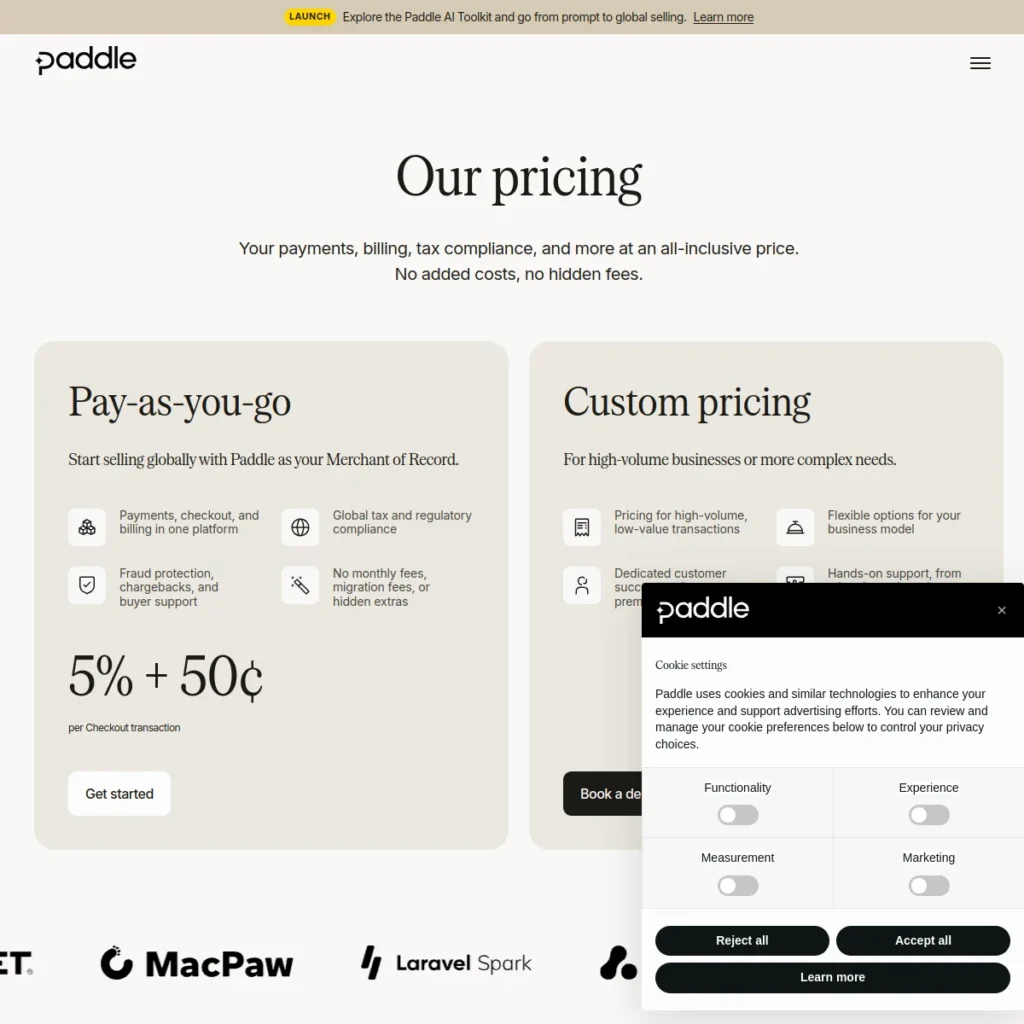
Paddle charges 5% plus 50 cents per checkout transaction, with no monthly fee, no migration fee, and no hidden extras. That single rate covers payments, checkout, billing, global tax compliance, fraud protection, chargebacks, and buyer support. There is a custom pricing tier for high-volume businesses. At $5,000 a month, Paddle costs $300 a month — $125 a month more than Stripe, or $1,500 a year.
Whether that is expensive depends on what you would otherwise pay for. A software business selling worldwide also needs Stripe Tax (from $90 a month), plus someone to answer buyer billing questions and file in every jurisdiction. Paddle’s 5% buys all of that in one line, and a SaaS business with customers in twenty countries can easily spend more than the $125 monthly gap on tax compliance alone.
The price of that convenience is the payout schedule, and it catches people out. Paddle does not pay daily. On the 1st of each month, your balance converts to a payout if it is above the threshold you set — minimum $100, adjustable up to $100,000. Paddle sends the money by the 15th, and it can take up to three working days to arrive, by wire transfer or Payoneer.
There is no on-demand withdrawal. A sale made on the 2nd of a month waits until the 1st of the next month to convert, then until the 15th to be sent — roughly six weeks from sale to bank. A small software business that lives month to month on subscription revenue needs to plan around that, or keep a cash buffer.
Paddle is built for software and SaaS. Its checkout, subscription management, invoicing, and failed-payment recovery are designed around recurring billing, and its customer stories are software companies. A creator selling one-off digital products can use it, but the monthly payout cycle and the SaaS-shaped tooling are a poor fit for a stream of small one-off sales. Choose Paddle if you sell software or subscriptions to customers in many countries, and you can live with monthly payouts. Do not choose it if you need the money next week.
Lemon Squeezy in Detail: Shutting Down on 31 March 2027
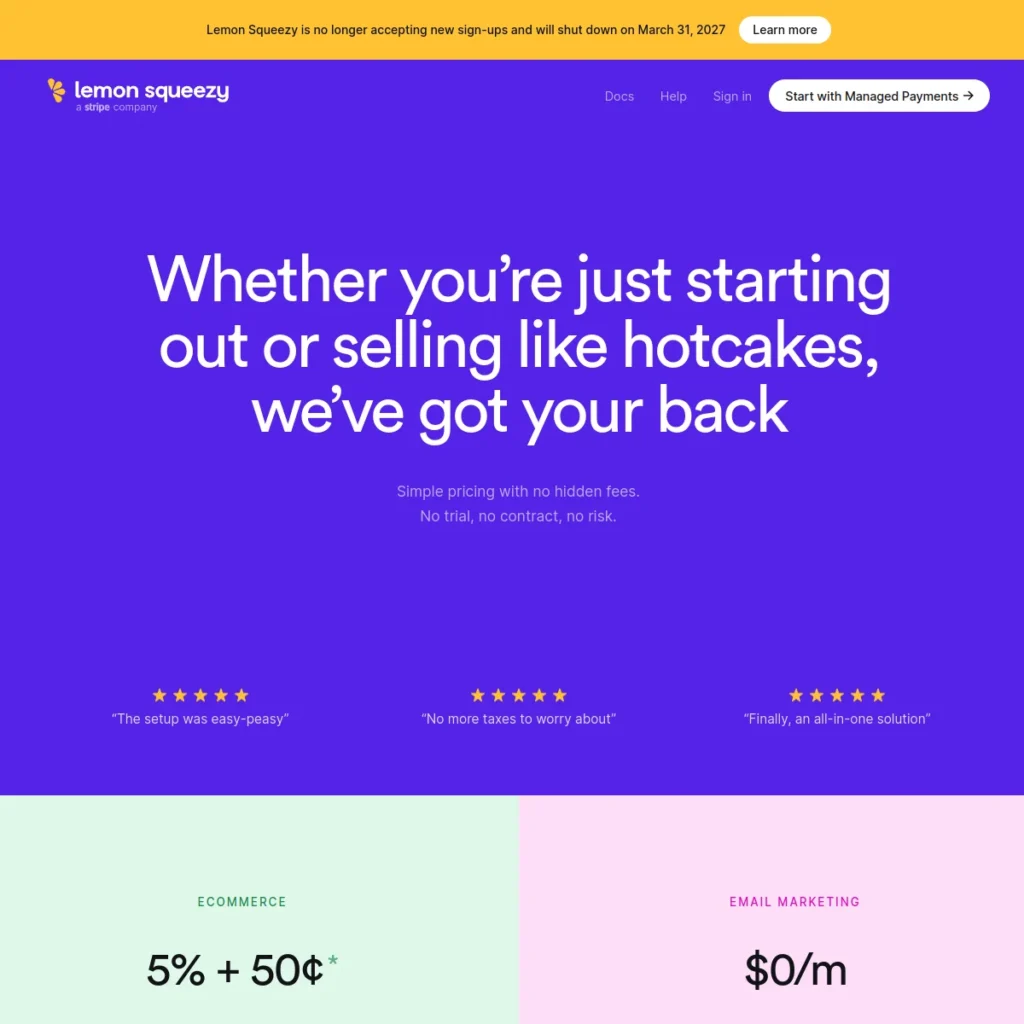
Lemon Squeezy is the one entry in this guide you should not sign up for — and the reason is printed at the top of its own pricing page. On 16 November 2026, Lemon Squeezy announced it is winding down. New sign-ups closed that day, and it stops processing all transactions, including subscription renewals, on 31 March 2027. Stripe bought Lemon Squeezy in 2024 and is folding it into Stripe Managed Payments rather than running two merchant-of-record products. If you are reading this guide to choose a Stripe alternative, Lemon Squeezy is not one.
For existing sellers, the price is still 5% plus 50 cents per transaction with no monthly fee, and the service is still a merchant of record: checkout in 95 currencies, automated sales tax and VAT collection and filing, fraud protection, cart recovery, and billing support, all included. Payouts still go out twice a month, to a bank or PayPal. The screenshot below shows both facts at once: the 5% plus 50 cents rate, and the yellow banner announcing the shutdown. At $5,000 of sales, that is $300 a month — the same $1,500 a year more than Stripe that Paddle costs.
What existing sellers must do is move, and the dates are fixed. Lemon Squeezy’s migration tool opens on 2 December 2026: it creates your products in Stripe, moves your customers, and moves eligible subscriptions. It recommends starting by mid-January 2027, because the move can take up to eight weeks, and the 31 March 2027 deadline will not be extended. The recommended destination, Stripe Managed Payments, does not deliver files, licence keys, or download links, and it does not run affiliates or storefronts. PayPal subscriptions cannot migrate at all; those customers have to start a new subscription.
So the recommendation flips. Creators who would have chosen Lemon Squeezy should look at Paddle instead: the same 5% plus 50 cents, the same merchant-of-record tax handling, and it is still signing up sellers. The payouts are monthly rather than twice a month, but it is a live service. Lemon Squeezy stays in this guide because its shutdown is the warning this whole guide is built on: a payment platform can close, and the cheaper rate means nothing if the platform is gone.
Braintree in Detail: The Developer’s Alternative
Braintree is PayPal’s developer-facing processor, and it is the quietest entry in this guide — the one that beats Stripe on price by almost nothing, and beats it on breadth by a lot. Its standard rate for cards and third-party digital wallets is 2.89% plus 29 cents, against Stripe’s 2.9% plus 30 cents: a saving of $1.50 a month at $5,000 of volume, or $18 a year. Nobody should switch to Braintree for the rate alone.
What Braintree sells is the bundle. One integration takes cards, PayPal, Venmo, Apple Pay, Google Pay, and ACH direct debit. Venmo costs 3.49% plus 49 cents. ACH costs 0.75% per transaction, capped at $5 — so a $1,000 bank payment costs $5, against $29.30 on Stripe’s card rate. There is no monthly fee on the standard plan, and volume discounts are available for established businesses. A chargeback costs $15, the same as Stripe.
Braintree’s catch is the same as Stripe’s: it is built for developers. There is no no-code checkout and no free point-of-sale app like Square’s. A small business that wants Braintree will get it through a developer or an agency — and that setup cost dwarfs the $18 a year the rate saves. Braintree is also owned by PayPal, so PayPal transactions through it are billed at PayPal’s own rates (3.49% plus 49 cents).
Choose Braintree if you are building a checkout and want PayPal and Venmo in it without a second integration, or if your developer prefers its SDKs. Do not choose it as a cheaper Stripe: the saving is $1.50 a month, and the switching cost is a developer’s day.
Cost Maths: What $5,000 a Month Actually Costs
The headline rates look close until you multiply them. The table below prices every tool at $5,000 a month — 100 transactions averaging $50 — and shows the monthly cost, the yearly total, and the gap against Stripe.
| Monthly fee cost | Yearly total | Gap vs Stripe ($2,100/yr) | |
|---|---|---|---|
| Stripe (online) | $175.00 | $2,100 | — |
| Braintree | $173.50 | $2,082 | −$18 |
| Square Free (online) | $195.00 | $2,340 | +$240 |
| Square Free (in person) | $145.00 | $1,740 | −$360 |
| Square Plus (online) | $224.00 | $2,688 | +$588 |
| Square Plus (in person) | $189.00 | $2,268 | +$168 |
| PayPal (standard cards) | $198.50 | $2,382 | +$282 |
| PayPal Checkout | $223.50 | $2,682 | +$582 |
| Paddle | $300.00 | $3,600 | +$1,500 |
| Lemon Squeezy | $300.00 | $3,600 | +$1,500 |
Three things deserve a second look. First, Square Plus costs more than Square Free at this volume — the $49 monthly fee is bigger than the rate saving until online volume passes about $12,250 a month.
Second, the cheapest way to take $5,000 a month in this guide is Square Free in person, at $1,740 a year — $360 less than Stripe — but only if your customers are standing in front of you. Third, Paddle costs $1,500 a year more than Stripe, and that gap is the price of tax handling: a business that would otherwise pay for Stripe Tax and a bookkeeper may still come out ahead. Lemon Squeezy cost the same — but it is shutting down, so that comparison is academic for anyone new.
One more calculation matters: the dispute. A single chargeback costs $15 on Stripe or Braintree, $20 on PayPal, and $0 on Square. A business that gets four disputes a month pays $720 to $960 a year in dispute fees on Stripe or PayPal. If you sell event tickets or custom work, the dispute fee can matter more than the card rate.
The Invoicing Test: Getting Paid Without Chasing
A payment processor that cannot invoice is a checkout, not a business tool. The test here is simple: can a freelancer or small service business send an invoice, get paid, and chase the late ones, without buying another app?
Square includes invoicing free on every plan: send estimates, contracts, and invoices from the same app as the till, and the customer pays online at 3.3% plus 30 cents, or in person at the counter rate. PayPal also lets you send invoices free, and its Pay by Bank option — 1% capped at $10 — is the cheapest way in this guide to collect a large invoice.
Stripe’s invoicing costs 0.4% of the invoice total, capped at $2 per invoice, and its subscription billing costs 0.7% of billing volume on pay-as-you-go. Paddle and Lemon Squeezy both include invoicing in their flat rate — their whole pitch is that billing is handled.
If invoicing is your main job, Square and PayPal are the strongest here, and PayPal’s bank-payment option is the cheapest way to collect a four-figure invoice. If invoicing is a side job, Stripe’s 0.4% is small enough to ignore. Either way, check the invoice fee before you choose: it is the line most comparisons skip.
The Hidden Costs and Gotchas
First, the monthly plan that costs more than it saves. Square Plus is $49 a month, and at $5,000 a month online it saves $20 in fees. Buy Plus for the loyalty programme and staff management — not for the rate.
Second, the dispute fee is a second bill. Stripe charges $15 when a dispute arrives, plus $15 more to contest it by hand. PayPal charges $20 on a card chargeback and $15 on a PayPal dispute. Braintree charges $15. Square charges nothing. Four disputes a month is $720 to $960 a year on Stripe or PayPal — zero on Square.
Third, refunds do not refund the fee. PayPal charges nothing to make a refund, but the fee you paid to receive the payment is not returned. Stripe’s policy is the same: the processing fee stays with Stripe when you refund. A business with a generous refund policy pays the fee on every sale it gives back.
Fourth, the tax bill arrives separately on Stripe. Its 2.9% covers processing; collecting and filing sales tax and VAT is Stripe Tax, from $90 a month. Comparing Stripe’s 2.9% with Paddle’s 5% without adding the tax cost compares the wrong numbers.
Fifth, the payout wait is a cost. Paddle pays monthly, Stripe and Braintree in two business days, Square the next business day. A business that needs the money this week should not choose a processor that pays next month, whatever the rate.
Sixth, PayPal’s cheapest rate is not the one most customers use. Standard card payments cost 2.99% plus 49 cents, but a customer who pays with their PayPal account or Venmo costs 3.49% plus 49 cents — and that is the button most PayPal customers click. Price your products on the 3.49% rate, not the 2.99% one, or the margin surprise arrives with the first statement.
Strategic Pivot: Work Out What Your Payment Stack Costs
The rate is only one line on the bill. The real cost is the card rate, plus the dispute fees, plus the invoicing cost, plus the tax tool, plus the days your money sits with the processor.
That is what the site’s free AI Cost Calculator is for. Tick the tools you use or want — Stripe, Square, PayPal, or the others in this guide — and it adds the real starting price of each one, with no hidden add-ons in the total until you tick them. Run it with your actual monthly volume, not the $5,000 in this guide, and compare the total against the table above.
Use the calculator before you switch, not after. Switching processors means new checkout code, new payout details, new dispute rules, and a week of explaining to customers why the payment page looks different. The calculator tells you whether the saving is $18 a year or $1,500 a year — before you commit to the work.
Pros and Cons
Stripe
Pros: Cheapest online card rate alongside Braintree; no monthly fee; Checkout, payment links, and customer portal included; widest range of payment methods; most integrations.
Cons: Payouts take two business days; $15 dispute fee plus $15 more to contest by hand; built for developers; tax, billing, and fraud screening priced separately; no free point-of-sale app.
Square
Pros: No monthly fee on the free plan; free point-of-sale app, online site, invoicing, and booking included; no dispute fee; next-business-day payouts; hardware from $49.
Cons: Online rate of 3.3% plus 30 cents is the highest here; Plus costs more than it saves below about $12,250 a month online; simpler online checkout and billing than Stripe’s; no merchant-of-record tax handling.
PayPal
Pros: Customers already have accounts, which lifts checkout conversion; no monthly fee on standard; cheapest in-person rate at 2.29% plus 9 cents; invoicing free to send, and Pay by Bank costs 1% capped at $10.
Cons: PayPal Checkout rate of 3.49% plus 49 cents is the highest here; $20 card chargeback and $15 dispute fees; refunded sales keep the original fee; currency conversion spread of 3% to 4%.
Paddle
Pros: Merchant of record — sales tax, VAT, chargebacks, and buyer support are Paddle’s problem; one flat rate of 5% plus 50 cents, no monthly fee; built for SaaS and subscriptions.
Cons: Costs $1,500 a year more than Stripe at this volume; payouts monthly, by the 15th, with a $100 minimum threshold; no on-demand withdrawal; built for software, a poor fit for one-off product sales.
Lemon Squeezy
Pros: Merchant of record with tax and VAT handled; same 5% plus 50 cents rate, no monthly fee; payouts twice a month; email marketing free up to 500 subscribers. (All historical — see the shutdown note below.)
Cons: Shutting down: no new sign-ups since 16 November 2026, all payments stop 31 March 2027 — do not start here. The recommended move, Stripe Managed Payments, does not deliver files or licence keys and does not run affiliates. Some payments may carry small additional fees.
Braintree
Pros: Cheapest card rate in this guide at 2.89% plus 29 cents; one integration takes cards, PayPal, Venmo, Apple Pay, Google Pay, and ACH; ACH costs 0.75% capped at $5; no monthly fee.
Cons: Beats Stripe by $1.50 a month — not a reason to switch; built for developers, no no-code checkout or free POS app; PayPal transactions billed at PayPal’s higher rates; no merchant-of-record tax handling.
Our Verdict: Stripe Alternatives
There is no single best Stripe alternative: the five tools solve five different problems, and the right choice depends on where you sell and what you sell — not on the headline rate.
If you sell online, mostly to US customers, and you have no developer, stay on Stripe: its 2.9% plus 30 cents is the cheapest online rate that matters. If you have a developer and want PayPal and Venmo in one checkout, Braintree is the same price with a wider net — but do not switch for the $18 a year.
If you sell in person, switch to Square. Its free plan is the most complete toolkit in this guide, its in-person rate beats Stripe’s at this volume, it pays out the next business day, and it charges no dispute fee.
If your customers are consumers who already have PayPal, use PayPal — but price on the 3.49% Checkout rate and steer large invoices to Pay by Bank. If you sell software or digital products to customers in many countries, pay the 5% to Paddle and let it carry the tax and chargeback risk. Paddle costs $1,500 a year more than Stripe at $5,000 a month — and can still be cheaper than Stripe plus a tax tool and a bookkeeper. Lemon Squeezy was the creator-friendly version of the same deal, but it is shutting down on 31 March 2027, so it is not an option for anyone new.
The mistake to avoid is switching for the rate alone. A $1.50-a-month saving does not pay for a week of re-integration. Run your real volume through the cost calculator, count your disputes, and switch once — for the feature that actually changes your business.
Frequently Asked Questions
What is the cheapest Stripe alternative for a small business?
At $5,000 a month online, Braintree is the cheapest at $173.50 a month (2.89% + 29¢), against Stripe’s $175 — a saving of $1.50 a month. Square Free is the cheapest in person at $145 a month (2.6% + 15¢). No alternative beats Stripe by enough online to justify switching on price alone.
Is Square cheaper than Stripe?
In person, yes: Square Free charges 2.6% plus 15 cents against Stripe’s 2.7% plus 5 cents, and Square pays out the next business day with no dispute fee. Online, no: Square Free charges 3.3% plus 30 cents against Stripe’s 2.9% plus 30 cents, which costs $240 a year more at $5,000 a month. Square’s Plus plan matches Stripe online, but the $49 monthly fee costs more than the saving below about $12,250 a month.
Does PayPal cost more than Stripe?
Yes, on the rates most customers use. PayPal Checkout costs 3.49% plus 49 cents, against Stripe’s 2.9% plus 30 cents — $223.50 a month against $175 at $5,000 of volume. Standard card payments cost 2.99% plus 49 cents, or $198.50 a month. PayPal’s in-person rate of 2.29% plus 9 cents is cheaper than Stripe’s, and Pay by Bank (1% capped at $10) is the cheapest way to collect a large invoice.
Is Paddle better than Stripe for selling software?
For a software business selling worldwide, often yes — but not on price. Paddle costs 5% plus 50 cents, or $300 a month at $5,000 of volume, against Stripe’s $175. The extra $125 a month buys merchant-of-record status: Paddle collects and remits sales tax and VAT, handles chargebacks, and answers buyer billing questions. Paddle pays out monthly, by the 15th — slower than Stripe’s two business days.
Is Lemon Squeezy shutting down?
Yes. Lemon Squeezy announced on 16 November 2026 that it is winding down: new sign-ups closed that day, and it stops processing all transactions, including subscription renewals, on 31 March 2027. Stripe bought Lemon Squeezy in 2024 and is folding it into Stripe Managed Payments. Existing sellers should start moving by mid-January 2027, because the move can take up to eight weeks. Stripe Managed Payments does not deliver files, licence keys, or download links, and does not run affiliates. Paddle is the closest live alternative at the same 5% plus 50 cents rate.
Price Note
Price note — updated 22 November 2026: Prices in this post were checked on 22 November 2026 on the official pricing pages: stripe.com/pricing, squareup.com/us/en/pricing, paypal.com/us/webapps/mpp/merchant-fees, paddle.com/pricing, lemonsqueezy.com/pricing, and braintreepayments.com/pricing. When you are reading this, the price may be lower or higher, and a promotion may have started or ended — check the official pricing page before you buy. All prices are in US dollars, before tax, for a small business on the standard plan, unless the text says otherwise. Lemon Squeezy’s pricing page carries a banner saying it is no longer accepting new sign-ups and will shut down on 31 March 2027 — see the Lemon Squeezy section.
Pros
- Stripe: Cheapest online card rate alongside Braintree; no monthly fee; Checkout, payment links, and customer portal included; widest range of payment methods; most integrations.
- Square: No monthly fee on the free plan; free point-of-sale app, online site, invoicing, and booking included; no dispute fee; next-business-day payouts; hardware from $59.
- PayPal: Customers already have accounts, which lifts checkout conversion; no monthly fee on standard; cheapest in-person rate at 2.29% plus 9 cents; invoicing free to send, and Pay by Bank costs 1% capped at $10.
- Paddle: Merchant of record — sales tax, VAT, chargebacks, and buyer support are Paddle's problem; one flat rate of 5% plus 50 cents, no monthly fee; built for SaaS and subscriptions.
- Lemon Squeezy: Merchant of record with tax and VAT handled; same 5% plus 50 cents rate, no monthly fee; payouts twice a month; email marketing free up to 500 subscribers. (All historical — see the shutdown note below.)
- Braintree: Cheapest card rate in this guide at 2.89% plus 29 cents; one integration takes cards, PayPal, Venmo, Apple Pay, Google Pay, and ACH; ACH costs 0.75% capped at $5; no monthly fee.
Cons
- Stripe: Payouts take two business days; $15 dispute fee plus $15 more to contest by hand; built for developers; tax, billing, and fraud screening priced separately; no free point-of-sale app.
- Square: Online rate of 3.3% plus 30 cents is the highest here; Plus costs more than it saves below about $12,250 a month online; simpler online checkout and billing than Stripe's; no merchant-of-record tax handling.
- PayPal: PayPal Checkout rate of 3.49% plus 49 cents is the highest here; $20 card chargeback and $15 dispute fees; refunded sales keep the original fee; currency conversion spread of 3% to 4%.
- Paddle: Costs $1,500 a year more than Stripe at this volume; payouts monthly, by the 15th, with a $100 minimum threshold; no on-demand withdrawal; built for software, a poor fit for one-off product sales.
- Lemon Squeezy: Shutting down: no new sign-ups since 16 November 2026, all payments stop 31 March 2027 — do not start here. The recommended move, Stripe Managed Payments, does not deliver files or licence keys and does not run affiliates. Some payments may carry small additional fees.
- Braintree: Beats Stripe by $1.50 a month — not a reason to switch; built for developers, no no-code checkout or free POS app; PayPal transactions billed at PayPal's higher rates; no merchant-of-record tax handling.
There is no single best Stripe alternative: the five tools solve five different problems, and the right choice depends on where you sell and what you sell — not on the headline rate.If you sell online, mostly to US customers, and you have no developer, stay on Stripe: its 2.9% plus 30 cents is the cheapest online rate that matters. If you have a developer and want PayPal and Venmo in one checkout, Braintree is the same price with a wider net — but do not switch for the $18 a year.If you sell in person, switch to Square. Its free plan is the most complete toolkit in this guide, its in-person rate beats Stripe's at this volume, it pays out the next business day, and it charges no dispute fee.If your customers are consumers who already have PayPal, use PayPal — but price on the 3.49% Checkout rate and steer large invoices to Pay by Bank. If you sell software or digital products to customers in many countries, pay the 5% to Paddle and let it carry the tax and chargeback risk. Paddle costs $1,500 a year more than Stripe at $5,000 a month — and can still be cheaper than Stripe plus a tax tool and a bookkeeper. Lemon Squeezy was the creator-friendly version of the same deal, but it is shutting down on 31 March 2027, so it is not an option for anyone new.The mistake to avoid is switching for the rate alone. A $1.50-a-month saving does not pay for a week of re-integration. Run your real volume through the cost calculator, count your disputes, and switch once — for the feature that actually changes your business.