

The best squarespace alternatives depend on what your site must do. Wix Core costs $29 a month billed yearly and adds payments and basic ecommerce. WordPress.com Premium renews at $9 a month billed every 12 months and lets you install plugins, including a store. Webflow Premium costs $25 a month billed yearly for a content site, while its Ecommerce Standard plan costs $29 a month billed yearly plus a 2% transaction fee. Framer Basic costs $10 a month billed yearly for a marketing site with a custom domain. Shopify Basic costs $29 a month billed yearly for a full online store. Squarespace Core, the plan most small businesses compare against, costs $29 a month billed annually with no online store transaction fee. For our test business, Squarespace Core costs $348 a year. WordPress.com Premium at its $9 renewal rate costs $108 a year. The saving is $240 a year, before card processing fees that every route charges in some form.
Quick Answer
The best squarespace alternatives depend on what your site must do. Wix Core costs $29 a month billed yearly and adds payments and basic ecommerce. WordPress.com Premium renews at $9 a month billed every 12 months and lets you install plugins, including a store. Webflow Premium costs $25 a month billed yearly for a content site, while its Ecommerce Standard plan costs $29 a month billed yearly plus a 2% transaction fee.
Framer Basic costs $10 a month billed yearly for a marketing site with a custom domain. Shopify Basic costs $29 a month billed yearly for a full online store. Squarespace Core, the plan most small businesses compare against, costs $29 a month billed annually with no online store transaction fee.
For our test business, Squarespace Core costs $348 a year. WordPress.com Premium at its $9 renewal rate costs $108 a year. The saving is $240 a year, before card processing fees that every route charges in some form.
In this article
- How we compared squarespace alternatives
- The five tools at a glance
- Wix: the closest like-for-like swap
- WordPress.com: the cheapest route with plugins
- Webflow: design control with a CMS bill
- Framer: the low-cost marketing site
- Shopify: the store-first alternative
- The maths: what a small site and store really cost
- Five traps that catch Squarespace switchers
- What to buy first
- Pros and cons
- Our verdict
- Frequently asked questions
- Sources
How we compared squarespace alternatives
Squarespace makes a beautiful site feel easy. Then the bill arrives, the store needs a feature the plan gates, or search traffic needs control the editor does not give. That is the moment owners start pricing squarespace alternatives.
So we compared five routes a small business would actually buy. Wix is the all-in-one builder swap. WordPress.com is the hosted WordPress route with plugins. Webflow is the design-led CMS route. Framer is the fast marketing-site route. Shopify is the store-first route. Every price below was checked on the vendor’s official pricing page on 27 November 2026.
Our test business is small and specific. It runs one website on a custom domain, publishes service or product pages and a blog, and sells online at about $2,000 a month. One owner edits the site. Prices use yearly billing where the vendor offers it, and WordPress.com maths uses renewal rates rather than one-time discounts.
One honesty note before the detail. These five tools do not replace Squarespace in the same way. Two are website builders, one is a hosted CMS, one is a design tool that publishes sites, and one is a commerce platform. The right pick depends on whether your bottleneck is price, SEO control, design freedom, or selling.
The five tools at a glance
| Tool | Best for | Price checked 27 November 2026 | Free route |
|---|---|---|---|
| Wix | Like-for-like builder swap with bookings | Core $29/mo billed yearly | Free plan with Wix domain |
| WordPress.com | Lowest cost with plugins and SEO tools | Premium renews at $9/mo, billed every 12 months | Free plan with ads, 1 GB storage |
| Webflow | Design control plus a real CMS | Premium $25/mo billed yearly | Starter free on webflow.io domain |
| Framer | Fast, cheap marketing site | Basic $10/mo billed yearly | Free on a Framer domain |
| Shopify | Store-first selling | Basic $29/mo billed yearly | 3-day trial, then $1/mo for 3 months |
Squarespace is the baseline. Basic costs $19 a month billed annually, or $25 billed monthly, with a 2% online store transaction fee. Core costs $29 billed annually, or $39 billed monthly, with no online store transaction fee. Plus costs $49 billed annually and Advanced costs $99 billed annually. Every Squarespace site starts with a 14-day free trial and no credit card required.
The table hides the real story, which is what each price unlocks. Some plans include checkout. Some include a CMS. Some charge a percentage of every sale. A cheap headline price can still lose once fees and add-ons join the bill.
Wix: the closest like-for-like swap
Wix is the alternative that feels most familiar to a Squarespace owner. You get templates, a drag-and-drop editor, hosting, and business tools in one dashboard. Its pricing turns on storage, collaborators, and whether the plan can accept payments.
Free costs $0 a month and never expires, with a Wix-branded domain and core editor features. Light costs $17 a month billed yearly. It connects a custom domain, removes Wix ads, includes 2 GB of storage and a light marketing suite, and allows 2 site collaborators. Light does not add payments, so a selling business should not stop there.
Core costs $29 a month billed yearly. It adds 50 GB of storage, basic ecommerce, the ability to accept payments, scheduling and services, a basic marketing suite, and 5 collaborators. Business costs $39 a month billed yearly, with 100 GB of storage, standard ecommerce and marketing, and 10 collaborators. Business Elite costs $159 a month billed yearly, with unlimited storage and advanced ecommerce.

Monthly billing costs more. Wix lists Light at $24 a month, Core at $36, Business at $46, and Business Elite at $172 on monthly billing. Yearly prices are paid in full at purchase and exclude taxes. Paid annual plans include a custom domain free for the first year, and Wix offers a 14-day money-back guarantee.
For our test business, Core at $29 a month billed yearly costs $348 a year. That matches Squarespace Core dollar for dollar. The reason to switch is not savings. It is the app market, bookings, and editor freedom, balanced against a busier dashboard.
WordPress.com: the cheapest route with plugins
WordPress.com is the hosted version of WordPress run by Automattic. Hosting, updates, security, and backups sit inside the plan. It is not the same as installing the free WordPress software on your own host, and that distinction matters for cost and control.
Free costs $0 with a WordPress.com subdomain, 1 GB of storage, unlimited pages and posts, basic stats for the last 7 days, and ads shown to visitors. The free plan cannot install plugins or connect a custom domain. Every paid plan can install plugins, which changes the maths for a small store.
Personal renews at $5 a month billed every 12 months, with 6 GB of storage, a free domain for one year, no visitor ads, premium themes, and plugin access. Premium renews at $9 a month billed every 12 months. It adds 13 GB of storage, premium stats and analytics, payment buttons, advanced SEO tools, and ad-free video hosting. Business renews at $28 a month billed every 12 months, with 50 GB of storage, real-time backups, a staging site, and priority support. Commerce renews at $50 a month billed every 12 months, with premium store themes and managed store tools.
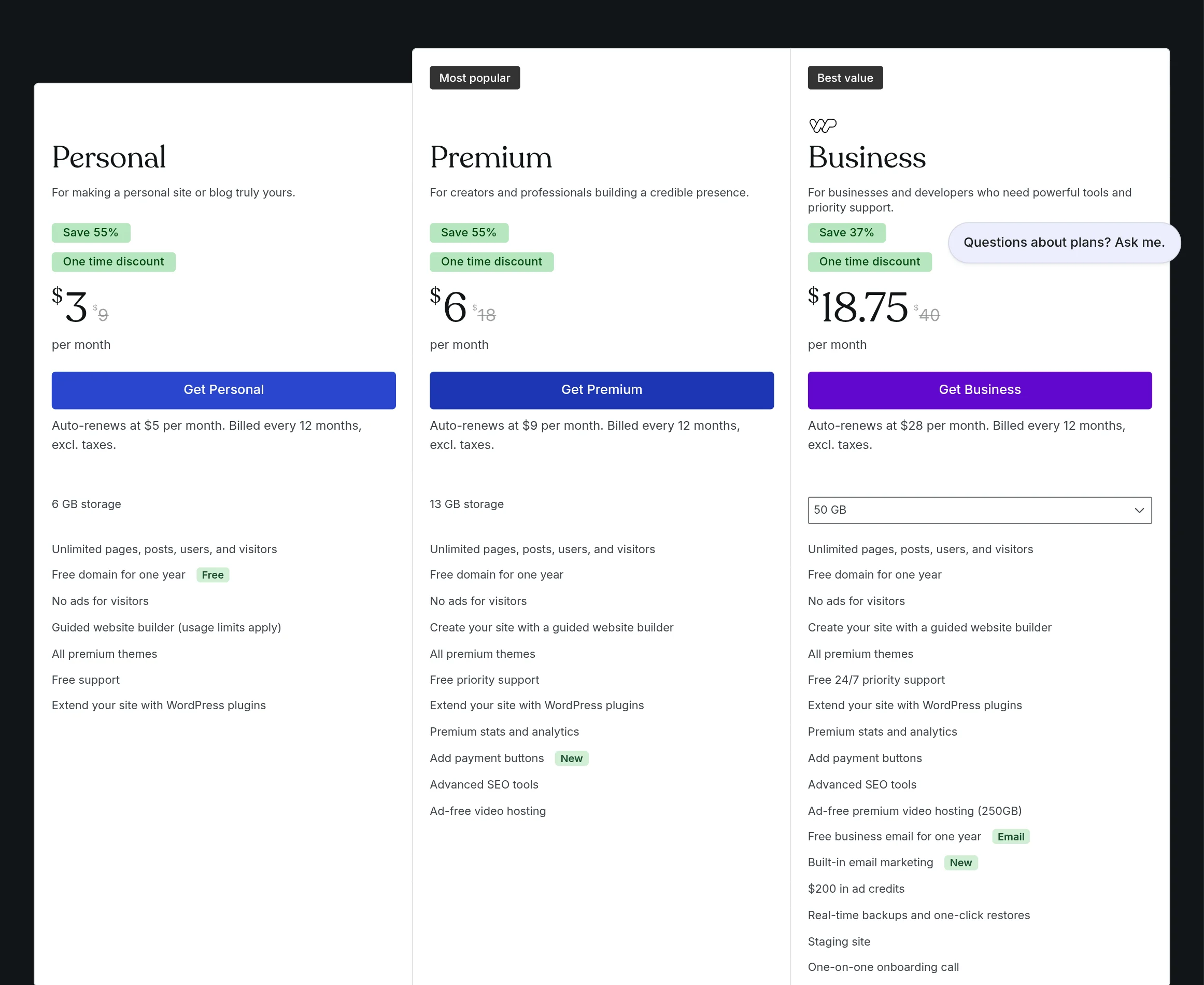
A Black Friday promotion was running on the pricing page on 27 November 2026. First-term prices showed Personal at $3 a month, Premium at $6, Business at $18.75, and Commerce at $33.75, each billed every 12 months before tax. Our maths uses the renewal rates printed on the same cards, because a website bill repeats every year.
For our test business, Premium at the $9 renewal rate costs $108 a year. A store can run through WooCommerce as a plugin, with card fees charged by the payment gateway. Commerce at $600 a year buys the managed store route instead. Either way, WordPress.com is the price leader in this comparison.
Webflow: design control with a CMS bill
Webflow is the design-led alternative. It gives precise layout control and a structured CMS, closer to a visual development tool than a template builder. Its pricing has two layers: a Site plan for each published site, and a Workspace plan for the people who build.
Starter is free on a webflow.io domain, with 2 static pages, 50 CMS items, and 1 GB of bandwidth. Basic costs $15 a month billed yearly, or $25 billed monthly. It adds a custom domain, 300 static pages, and 10 GB of bandwidth, but no CMS. Premium costs $25 a month billed yearly, or $39 billed monthly. It adds the Webflow CMS, site search, code components, and form file uploads. Team costs $2,500 a month on an annual contract, and Enterprise is custom pricing.

Selling costs extra. Ecommerce Standard costs $29 a month billed yearly, or $42 billed monthly, with 500 ecommerce items and a 2% transaction fee. Plus costs $74 billed yearly, or $84 billed monthly, with 5,000 items and no transaction fee. Advanced costs $212 billed yearly, or $235 billed monthly, with 15,000 items. Workspace upgrades and extra seats sit on top, with a full seat at $39 a month billed yearly.
For our test business, Premium at $300 a year covers the marketing site and blog. A store on Ecommerce Standard costs $348 a year plus 2% of $24,000 in annual sales, another $480. The store route totals $828 a year before card processing. Webflow earns that only when design control is the proven bottleneck.
Framer: the low-cost marketing site
Framer is the speed alternative. It publishes fast, polished marketing sites from a design canvas, with a CMS for blogs and landing pages. Its pricing is per site, with editor seats billed separately.
Free costs $0 on a Framer domain. It includes 500 AI credits to try, 10 CMS collections, 1,000 pages, and 5 GB of bandwidth. A custom domain needs a paid plan. Basic costs $10 a month billed yearly. It adds a free custom domain on yearly billing, 2 CMS collections, 50 GB of bandwidth, built-in SEO, and 1,000 AI credits a month. Pro costs $30 a month billed yearly. It adds 10 CMS collections, 100 GB of bandwidth, site redirects, a staging environment, and 3,000 credits a month. Enterprise is custom pricing.

People cost extra. Additional editors cost $20 a month each, and viewers are free. A Black Friday banner on the pricing page offered 50% off the first year of Pro on 27 November 2026. Our maths uses the standard yearly rates, because the second year arrives quickly.
For our test business, Basic at $120 a year covers the website and blog at the lowest builder price in this list. The catch is checkout. Framer does not sell a built-in store checkout in these plans, so product sales need an external checkout or a different platform. Pro at $360 a year suits a growing content site, not a store replacement.
Shopify: the store-first alternative
Shopify is the commerce alternative. It starts from the store and adds website pages around it, rather than starting from a website and adding a shop. Its pricing turns on card rates, staff accounts, and third-party transaction fees.
Basic costs $29 a month billed yearly. It covers selling online, in person, and in AI chats, with card rates from 2.9% plus 30 cents in US dollars online. Grow costs $89 a month billed yearly, with up to 5 staff accounts and card rates from 2.7% plus 30 cents. Advanced costs $359 a month billed yearly, with up to 15 staff accounts and card rates from 2.5% plus 30 cents. Plus serves complex businesses with unlimited staff accounts and a fully customizable checkout.

The entry offer is short. Shopify offers 3 days free, then $1 a month for 3 months, before standard pricing applies. There are no setup fees. Third-party transaction fees may apply when you use a payment provider other than Shopify Payments, and POS Pro costs $89 a month per location as an add-on.
For our test business, Basic at $348 a year matches Squarespace Core on subscription price. The reason to switch is store depth: inventory, shipping discounts, abandoned checkout recovery, and sales channels. The reason to stay is content. Shopify pages serve the store first, so a service business that rarely sells products gains little.
The maths: what a small site and store really cost
Price each route at the plan our test business would actually buy. Squarespace Core costs $348 a year billed annually, with no online store transaction fee. Wix Core also costs $348 a year billed yearly. Shopify Basic also costs $348 a year billed yearly. Three different platforms land on the same subscription line.
The gaps appear around that line. WordPress.com Premium at its $9 renewal rate costs $108 a year, saving $240 a year against Squarespace Core. Framer Basic costs $120 a year, saving $228, but without a built-in checkout. Webflow Premium costs $300 a year for the site and blog, saving $48 before any store plan.
Fees flip two routes. Squarespace Basic looks cheap at $228 a year, then its 2% store fee adds $480 on $24,000 of sales, for $708 in platform cost. Webflow Ecommerce Standard costs $348 a year plus the same $480 fee, for $828. At this sales level, a 0% fee plan beats a cheaper plan with a percentage attached.
Upgrades price out cleanly. Wix Business costs $468 a year, a $120 step over Core. WordPress.com Commerce costs $600 a year at renewal, a $492 step over Premium for the managed store route. Shopify Grow costs $1,068 a year, a $720 step over Basic. Card processing sits outside every total here, because gateways charge it on each platform.
If you want to run these numbers at your own sales level, our free AI Cost Calculator lets you model a software stack before you commit to it. Bring your monthly sales, your editor count, and whether checkout must live on the site. Those three inputs decide more than any template gallery.
Five traps that catch Squarespace switchers
First, the percentage-fee trap. Squarespace Basic charges 2% on online store sales, and Webflow Ecommerce Standard charges 2% as well. At $2,000 a month in sales, that fee costs $480 a year. A plan that looks $120 cheaper can cost $360 more once sales grow.
Second, the promotion trap. WordPress.com showed first-term prices of $3, $6, $18.75, and $33.75 a month during its Black Friday promotion. The renewal rates on the same cards are $5, $9, $28, and $50. Budget the renewal rate, and treat any first-term discount as a bonus.
Third, the checkout trap. Framer Basic at $120 a year is a website price, not a store price. Webflow Basic at $180 a year has no CMS, so a blog needs Premium. Read the plan gate before you compare the headline number.
Fourth, the seat trap. Webflow charges $39 a month billed yearly for each extra full seat. Framer charges $20 a month for each additional editor. A solo owner pays neither. A two-person team should add the seat line before calling either tool cheap.
Fifth, the migration trap. Squarespace content does not move itself. Pages, blog posts, product data, redirects, and SEO titles need a planned move on every route here. The cheapest subscription can still lose if the switch drops search rankings for a quarter.
What to buy first
Buy the route that matches your bottleneck. If price is the problem, start with WordPress.com Premium at the $9 renewal rate. Plugins cover SEO tools and a WooCommerce store, and the $240 yearly saving against Squarespace Core funds real marketing.
If ease is the problem, stay in builder territory. Wix Core at $348 a year matches Squarespace Core on price and adds bookings and a large app market. Choose it for workflow fit, not for savings.
If selling is the problem, price Shopify Basic at $348 a year against your current store limits. Choose Webflow Premium at $300 a year only when design control and CMS structure justify the learning curve. Choose Framer Basic at $120 a year when the site sells services, not products. Our guide to shopify alternatives compares the store-first routes in more depth if commerce is your main decision.
Pros and cons
Wix. Pros: Core costs $29 a month billed yearly with payments and basic ecommerce, the editor is familiar, and a free plan exists. Cons: monthly billing rises to $36 for Core, and the dashboard offers more apps than most small sites need.
WordPress.com. Pros: Premium renews at $9 a month billed every 12 months, every paid plan installs plugins, and advanced SEO tools are included. Cons: the free plan shows ads and blocks plugins, and first-term promotion prices rise at renewal.
Webflow. Pros: Premium costs $25 a month billed yearly with a full CMS, design control is precise, and Starter is free. Cons: Basic has no CMS, Ecommerce Standard adds a 2% transaction fee, and extra full seats cost $39 a month.
Framer. Pros: Basic costs $10 a month billed yearly with a custom domain, built-in SEO, and 50 GB of bandwidth. Cons: no built-in store checkout in these plans, additional editors cost $20 a month, and Pro limits grow through add-ons.
Shopify. Pros: Basic costs $29 a month billed yearly with a full store, no setup fees, and a 3-day trial before $1-a-month introductory pricing. Cons: content pages serve the store first, Grow jumps to $89 a month billed yearly, and POS Pro costs $89 a month per location.
Our verdict
For most small businesses leaving Squarespace on price, WordPress.com Premium is the strongest squarespace alternative. At its $9 renewal rate it costs $108 a year, includes plugins and advanced SEO tools, and saves $240 a year against Squarespace Core at $348. The trade is a steeper learning curve and renewal pricing you must budget honestly.
Wix Core and Shopify Basic both cost $348 a year, so neither saves money against Squarespace Core. Wix wins on builder familiarity and bookings. Shopify wins when the store is the business. Webflow Premium at $300 a year wins on design control, while Framer Basic at $120 a year wins for a service site that does not need checkout.
The cheapest headline is not always the cheapest year. Percentage fees, seat costs, and renewal jumps decide the real bill. Match the plan gate to your bottleneck first, then let the maths confirm the switch.
Frequently asked questions
What is the cheapest Squarespace alternative for a small business?
WordPress.com Premium renews at $9 a month billed every 12 months, which is $108 a year. Framer Basic costs $10 a month billed yearly, or $120 a year, for a marketing site. WordPress.com is cheaper and includes plugin access for a store.
How much does Squarespace Core cost compared with Wix Core?
Both cost $29 a month billed yearly, which is $348 a year. Squarespace Core charges no online store transaction fee. Wix Core adds payments, basic ecommerce, and scheduling, so the choice turns on workflow rather than subscription price.
Does WordPress.com let you install plugins on cheap plans?
Yes. Plugin installation is available on every paid WordPress.com plan, including Personal and Premium. The free plan cannot install plugins. Premium renews at $9 a month billed every 12 months and includes advanced SEO tools.
What does Webflow charge for an online store?
Webflow Ecommerce Standard costs $29 a month billed yearly with 500 ecommerce items and a 2% transaction fee. Plus costs $74 a month billed yearly with 5,000 items and no transaction fee. Card processing fees apply on top through the payment provider.
Is Shopify Basic cheaper than Squarespace for a small store?
Shopify Basic and Squarespace Core both cost $29 a month billed yearly. Shopify suits a store-first business with inventory and shipping needs. Squarespace Core suits a content-led site that also sells, with no online store transaction fee.
Sources
Prices and terms were checked on the official pages on 27 November 2026: Squarespace pricing page and pricing data (squarespace.com), Wix pricing pages (wix.com), WordPress.com pricing page (wordpress.com), Webflow pricing page (webflow.com), Framer pricing page (framer.com), and Shopify pricing page (shopify.com). WordPress.com maths uses renewal rates printed on its pricing cards, and Shopify yearly prices are the Pay yearly figures shown on its pricing page.
Price note — updated 27 November 2026: Prices in this post were checked on 27 November 2026. When you are reading this, the price may be lower or higher, and plan limits such as storage, fees, and editor seats may have changed. Check the official pricing page before you buy.
Pros
- Wix: Core costs $29 a month billed yearly with payments and basic ecommerce, the editor is familiar, and a free plan exists
- WordPress.com: Premium renews at $9 a month billed every 12 months, every paid plan installs plugins, and advanced SEO tools are included
- Webflow: Premium costs $25 a month billed yearly with a full CMS, design control is precise, and Starter is free
- Framer: Basic costs $10 a month billed yearly with a custom domain, built-in SEO, and 50 GB of bandwidth
- Shopify: Basic costs $29 a month billed yearly with a full store, no setup fees, and a 3-day trial before $1-a-month introductory pricing
Cons
- Wix: monthly billing rises to $36 for Core, and the dashboard offers more apps than most small sites need
- WordPress.com: the free plan shows ads and blocks plugins, and first-term promotion prices rise at renewal
- Webflow: Basic has no CMS, Ecommerce Standard adds a 2% transaction fee, and extra full seats cost $39 a month
- Framer: no built-in store checkout in these plans, additional editors cost $20 a month, and Pro limits grow through add-ons
- Shopify: content pages serve the store first, Grow jumps to $89 a month billed yearly, and POS Pro costs $89 a month per location
For most small businesses leaving Squarespace on price, WordPress.com Premium is the strongest squarespace alternative. At its $9 renewal rate it costs $108 a year, includes plugins and advanced SEO tools, and saves $240 a year against Squarespace Core at $348. The trade is a steeper learning curve and renewal pricing you must budget honestly. Wix Core and Shopify Basic both cost $348 a year, so neither saves money against Squarespace Core. Wix wins on builder familiarity and bookings. Shopify wins when the store is the business. Webflow Premium at $300 a year wins on design control, while Framer Basic at $120 a year wins for a service site that does not need checkout. The cheapest headline is not always the cheapest year. Percentage fees, seat costs, and renewal jumps decide the real bill. Match the plan gate to your bottleneck first, then let the maths confirm the switch.