
For a single-location studio with an owner-artist plus three artists, Tattoo Studio Pro at $489 a year on annual billing is the best-value pick among the best ai tools for tattoo studios: every feature on every plan, digital consent, and no charge for the owner. Square Plus costs $588 a year per location with unlimited calendars, and its Free plan costs $0. Vagaro costs $647.88 a year for four calendars and adds its Vera AI receptionist for $10 more a month. Apprentice costs $959.76 a year for four artist accounts and is the only tool here with an AI tattoo generator. Booksy costs $1,079.88 a year before tax for four team members, the most expensive subscription here.
A tattoo studio does not lose money at the chair. It loses money in the DMs at 11 p.m., when a client sends a blurry reference photo, asks for a price, goes quiet for two days, then books with the shop that answered first. Add a deposit chased by text, a consent form in a drawer, and a Saturday walk-in with no list to join, and the artist who should be tattooing is doing admin instead.
That is the job the best ai tools for tattoo studios are supposed to do: take the booking, collect the deposit, send the consent form, and remind the client. Honesty first: most tattoo software still has little AI in it. One tool here generates designs with AI, two answer messages with AI, and the rest earn their place on booking and consent.
We compared five tools at the same studio size, and we checked every price on the vendor’s own page on 25 November 2026. No roundup prices, and no tool here pays us anything. Where a vendor does not publish a price, we say so plainly.
Quick Answer
For a single-location studio with an owner-artist plus three artists, Tattoo Studio Pro at $489 a year on annual billing is the best-value pick among the best ai tools for tattoo studios: every feature on every plan, digital consent, and no charge for the owner.
Square Plus costs $588 a year per location with unlimited calendars, and its Free plan costs $0. Vagaro costs $647.88 a year for four calendars and adds its Vera AI receptionist for $10 more a month. Apprentice costs $959.76 a year for four artist accounts and is the only tool here with an AI tattoo generator. Booksy costs $1,079.88 a year before tax for four team members, the most expensive subscription here.
In this article
- How we compared the five tools
- The five tools at a glance
- Apprentice: the tattoo-first app with an AI generator
- Tattoo Studio Pro: every feature, priced by team size
- Vagaro: the budget start with an AI receptionist add-on
- Booksy: one plan, priced per team member
- Square Appointments: the free start with per-location pricing
- The maths: what five tools really cost a small studio
- Five traps that catch tattoo studio owners
- What to buy first
- Pros and cons
- Our verdict
- Frequently asked questions
How we compared the five tools
Every price in this guide is for the same imaginary studio, so the numbers can be compared fairly: one location, an owner-artist plus three artists, front-desk work handled from the owner login, and 160 tattoos a month at an average ticket of $250. That is about $40,000 a month in revenue before costs, which is big enough that card fees matter and small enough that a per-artist fee still stings.
We judged each tool on five things: online booking with deposits tied to real tattoo work, not 30-minute slots; digital consent forms stored with the client record; phone and message coverage when every chair is busy; walk-in, flash, and multi-session handling for a real studio; and year-one cost, including extra artists, add-ons, and needed upgrades.
The best ai tools for tattoo studios are not the ones with the longest feature list. They fit a studio of this size without charging it for logins it does not have or AI features it will never open. A tool that looks cheap for one artist can turn expensive once every chair counts.
The five tools at a glance
| Tool | Best for | Starting price | Free plan or trial | Year-one cost at our studio size |
|---|---|---|---|---|
| Apprentice | Tattoo-first booking, AI design generator | Free; Pro $24.99 a month | Free plan; 14-day trial | $959.76 |
| Tattoo Studio Pro | Every feature, team-size pricing | $29 a month (Solo) | 30-day free trial | $489 |
| Vagaro | Budget start, AI receptionist add-on | $23.99 a month for one calendar (limited-time rate) | Free trial offered on its site | $647.88 |
| Booksy | Marketplace listing, every feature included | $29.99 a month plus tax (one user) | 14-day free trial, no card required | $1,079.88 |
| Square Appointments | Free start, per-location pricing | Free; Plus $49 a month per location | Free plan; 30-day trial on paid plans | $588 |
Year one means the first twelve months at our studio size: an owner-artist plus three artists at one location. Tattoo Studio Pro’s figure is Solo on annual billing plus two extra staff spots, its cheapest honest combination for this team.
Apprentice’s figure is Studio Pro for three artists plus one extra artist, billed monthly. Vagaro’s figure is four calendars at $53.99 a month. Booksy’s figure is four team members at $29.99 plus three extra users at $20 each, before tax. Square’s figure is Plus at $49 a month for one location. Card fees sit on top of every figure, priced separately in the maths section.
Apprentice: the tattoo-first app with an AI generator
Apprentice is the only tool in this comparison built first for tattoo work, and it shows in how it thinks. A tattoo is treated like a project, not a calendar slot: references, drafts, messages, deposits, and session history sit together instead of scattered across DMs. Consent, deposit, and prep instructions travel in one link the client finishes before they arrive.
The published plans start with a real free tier. Free costs $0 forever for up to 50 clients, with 50 AI generations a month, a booking page, walk-in list, automatic reminders, flash gallery, and a unified inbox for Instagram, WhatsApp, and email. Pro costs $24.99 a month for one artist, with unlimited AI generations and unlimited clients. Studio Pro covers three artist accounts, and each additional artist costs $19.99 a month. A 14-day free trial needs no credit card.
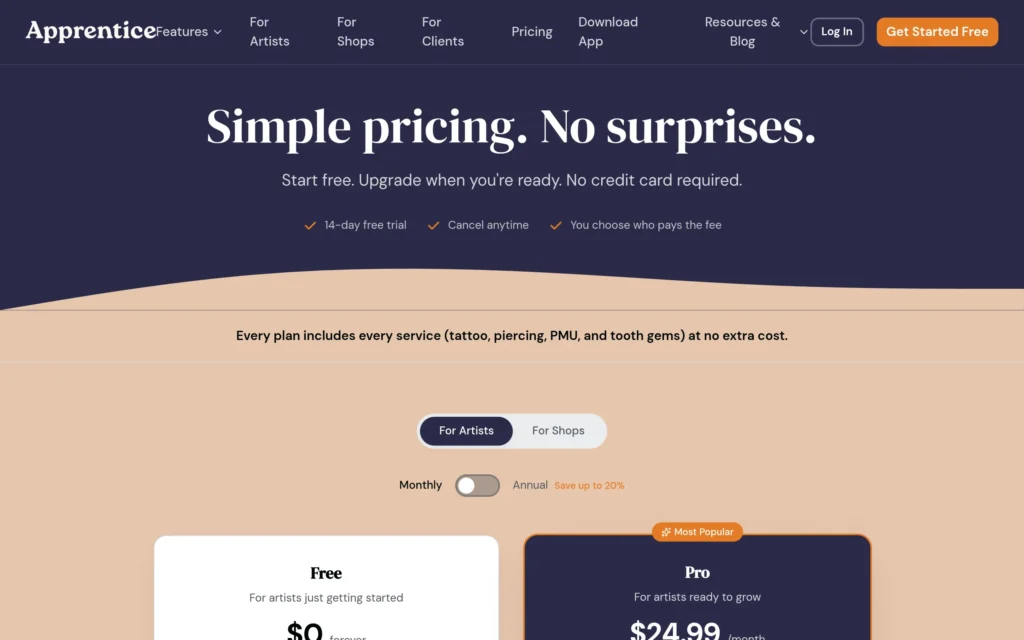
The AI layer is the headline. The stencil and AI tattoo generator is included on every plan, capped at 50 generations a month on Free and unlimited on Pro. That makes Apprentice the clearest answer here to the words AI tools: it helps an artist explore design directions and stencils inside the same app that holds the booking. No other tool in this guide publishes an AI design generator.
Payments carry the catch. Stripe charges 2.9% plus 30 cents and Apprentice adds a 2% platform fee. By default the client covers both, so a $200 tattoo costs the client $210.10 and you receive $200. Absorb the fee instead, and the combined rate is the most expensive processing here.
At our studio size, four artist accounts cost $59.99 plus $19.99, which is $79.98 a month, or $959.76 a year billed monthly. The pricing page advertises annual savings of up to 20% without printing an exact annual Studio Pro figure, so we budget the monthly figure and treat any annual discount as a bonus to confirm. Apprentice has no in-person point of sale today, so a studio that needs a counter card reader should price that gap honestly.
Who is Apprentice actually best for? A studio whose pain lives in DMs, references, and design back-and-forth, and that wants booking, deposits, consent, and AI design help in one tattoo-first app. If your clients happily cover the payment fee, the free start is hard to beat. If they will not, run the absorbed-fee maths before you fall in love with the generator.
Tattoo Studio Pro: every feature, priced by team size
Tattoo Studio Pro sells one simple promise: every plan includes every feature, and the price depends only on how many people need a login. Bookings, client profiles, digital consent forms, portfolios, reports, reminder texts, and a website with hosting are included for everyone. There are no feature tiers to decode and no consent-form upgrade waiting in year two.
The published plans are priced by team size. Solo costs $29 a month or $239 a year for you plus one more person. Crew costs $69 a month or $579 a year for you plus five. Larger bands run to Legion at $299 a month or $2,499 a year with no staff limit. Extra staff spots cost $15 a month or $125 a year each, and every plan starts with a 30-day free trial.
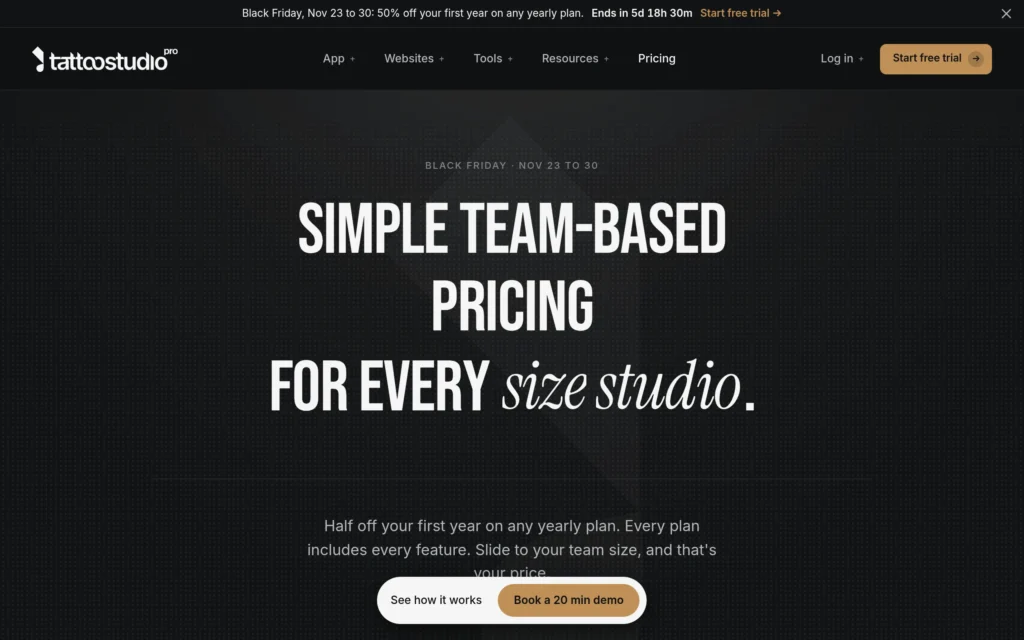
The counting rule is where this tool wins. The owner never counts toward the limit, and neither do managers or health officials. At our studio size, an owner plus three artists needs three staff spots: Solo on annual billing at $239 plus two extra spots at $125 each is $489 a year. Crew at $579 a year is the simpler buy if you expect to add artists soon. Monthly billing for the same team is $59 a month, or $708 a year.
Two dated details matter on 25 November 2026. A Black Friday offer runs from 23 to 30 November: yearly plans are half price for the first year, so this team would pay $246 for year one and renew at $489. Treat that as a genuine saving with an expiry date, not as the ongoing price. Card payments run through the studio’s Stripe account, and the pricing page does not print a processing percentage, so confirm your Stripe rate before budgeting card costs.
The honest gap is AI. Tattoo Studio Pro publishes no AI design generator and no AI receptionist. Its automation is confirmations, reminders, and records that stay with the client. If AI design help is the reason you are buying, this is the wrong first pick.
Who is Tattoo Studio Pro actually best for? A small studio that wants tattoo-specific booking and consent without feature gates, and a bill it can predict from a headcount. The owner-free counting rule suits exactly the owner-artist plus small-team shape most studios actually have.
Vagaro: the budget start with an AI receptionist add-on
Vagaro is the cheapest way into this comparison, and it is honest about what it is: a salon, spa, and fitness platform that tattoo studios also use. The booking side is strong. Clients book online, reminders go out automatically, memberships and packages sell through the same account, and the Vagaro Marketplace listing can send new clients your way. For a studio whose main pain is an empty chair, that is a real answer at a very low price.
The price is priced by bookable calendar, not by features. In the United States the base subscription is $23.99 a month for one calendar, marked on Vagaro’s own pricing article as a limited-time rate, and each additional calendar is $10 a month up to seven licenses, after which extra employees are free. Four artists therefore cost $53.99 a month before add-ons, and the front desk does not need a paid calendar because only bookable calendars are billed.
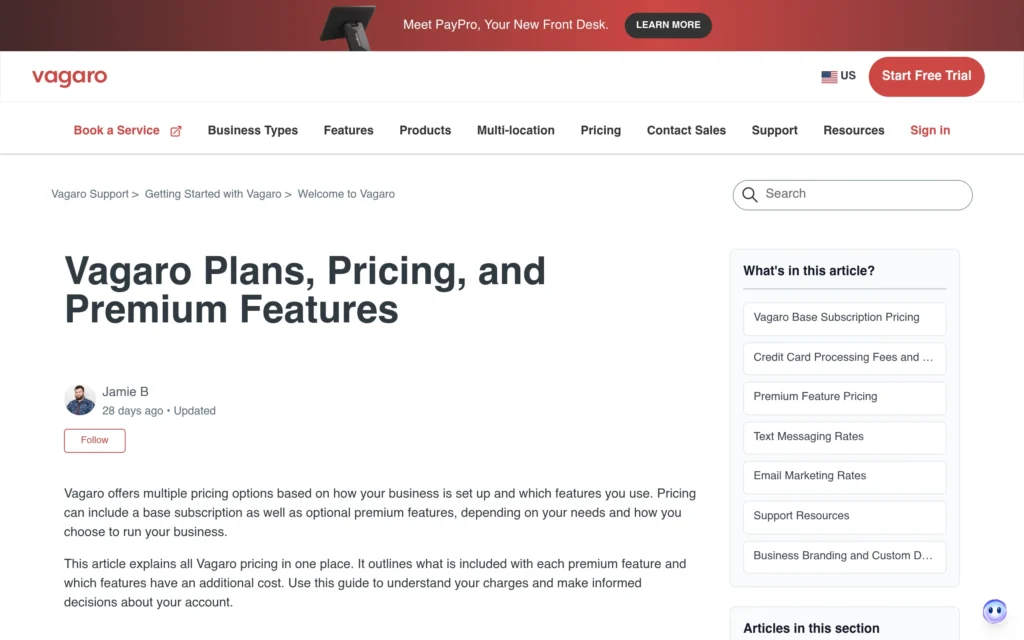
The tattoo extras are where the add-ons start. Vera Receptionist, Vagaro’s AI that answers client messages around the clock through Connect by Vagaro, costs $10 a month. Forms, which cover consent forms and liability waivers with electronic signatures, cost $10 a month. The Online Shopping Cart, which handles deposits and cancellation fees for online appointments, costs $10 a month. None of this is hidden, but a studio needing consent, deposits, and an AI receptionist is no longer paying the headline price.
Card processing at this volume falls on Vagaro’s Large Merchant rates, 2.29% plus 19 cents per in-person transaction, plus a $10 monthly subscription and card-network fees. On $40,000 a month across 160 tattoos, that processing alone runs to about $956.40 a month before network fees, the lowest published processing bill here. Small merchants under $4,000 a month pay 2.6% plus 10 cents instead.
At our studio size the honest core is four calendars: $53.99 a month, or $647.88 a year. Add Vera and it is $63.99 a month, or $767.88 a year, which makes Vagaro the cheapest way here to have an AI answering client messages. Add Forms and the Online Shopping Cart for consent and deposits, and the working figure is $83.99 a month, or $1,007.88 a year.
Who is Vagaro actually best for? A budget-led studio that books well online and wants an AI receptionist without a tier jump. If multi-session projects and flash handling run your day, the add-on list will grow.
Booksy: one plan, priced per team member
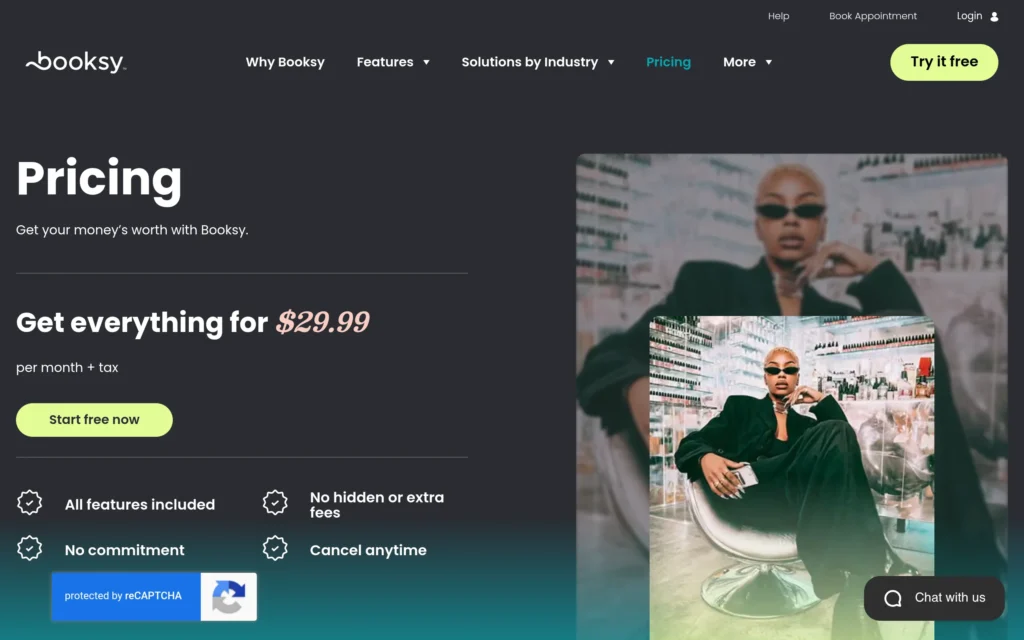
Booksy sells one promise: every feature in one subscription, with no higher tiers and no monthly feature add-ons. Unlimited bookings, waitlists, Reserve with Google, custom forms and liability waivers, no-show protection, gift cards, memberships, and marketing tools are all in the core price. For an owner who hates decoding plan tables, that single-plan honesty is the whole pitch, and the free marketplace listing can send new clients your way.
The price is per team member, not per studio. Booksy costs $29.99 a month plus tax for the first user, and each additional team member is $20 a month. The plan includes 2,000 free SMS marketing messages a month, and appointment confirmations and reminders are always free. A 14-day free trial needs no credit card, there is no commitment, and Booksy charges no booking fees to you or your clients.
The optional cost is Boost, Booksy’s marketplace visibility feature. Boost is free to switch on with no monthly fee, but when a client books with you for the first time while Boost is on, you pay a one-time commission of 30% of that first visit, up to a maximum of $100. On a $250 tattoo that is $75 for one new client. For a client who returns for a second session that can be fair money. For a one-and-done piece it is a real per-client cost the other tools here do not charge.
Card processing is published plainly. The Booksy Card Reader costs 2.49% plus 10 cents per transaction, Tap to Pay costs 2.49% plus 20 cents, and mobile or keyed-in payments cost 2.69% plus 30 cents. Next-business-day payouts are free, 30-minute fast payouts cost 1.5%, and the readers themselves cost $299 for the Stripe Reader S710 or $53.10 for the Reader M2, plus shipping. At our volume the reader rate works out to about $1,012 a month.
At our studio size, four team members cost $29.99 plus three extra users at $20, which is $89.99 a month before tax, or $1,079.88 a year. Booksy is the cheapest honest start for a solo artist and gets steadily less cheap with every chair, which is exactly the trade its pricing page describes. Its published AI story is thin: this is a booking and marketplace platform, not an AI design or AI receptionist product.
Who is Booksy actually best for? A solo artist or small team that values the marketplace listing and can live with a bill that grows by $20 with each hire. Price the team you are growing into, not the team you have today.
Square Appointments: the free start with per-location pricing
Square Appointments is a payments company first, and that order matters. Booking, deposits, reminders, and the card reader sit together, priced per location rather than per artist. For a studio that already takes cards with Square, or that wants one system from booking link to checkout, that togetherness is the product.
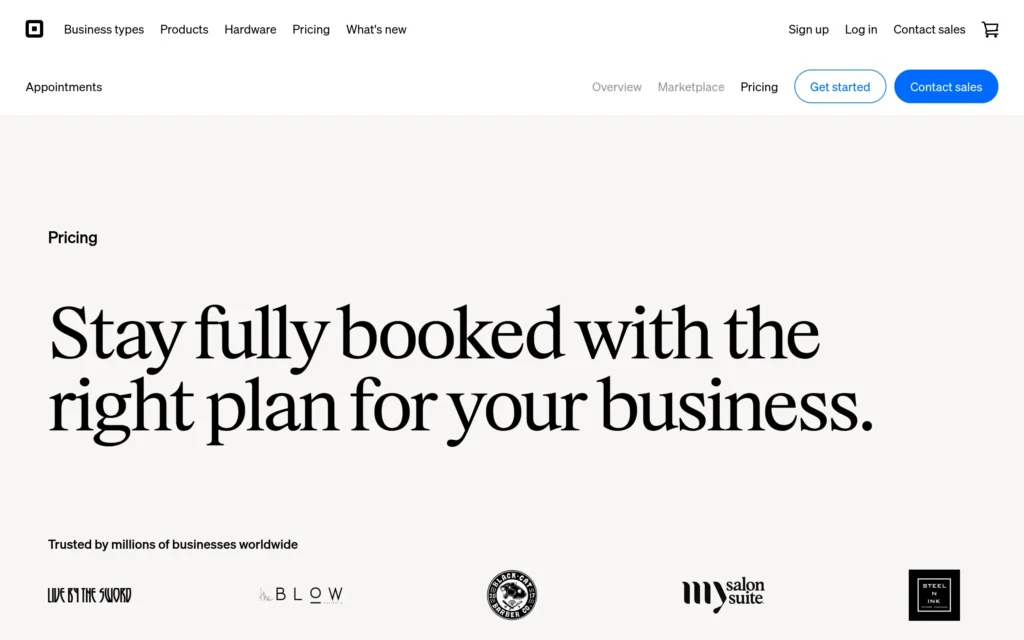
The published plans are three flat prices per location. Square Free costs $0 a month for one location, with an online booking site, appointment reminders, and unlimited staff calendars. Square Plus costs $49 a month per location and adds cancellation policies and no-show fees, multi-staff booking, and a waitlist. Square Premium costs $149 a month per location and adds resource management for rooms and chairs. Plus and Premium each offer a 30-day free trial.
The AI layer is modest and practical. Square Assistant lets customers reply to SMS reminders to confirm, cancel, or change an appointment, and the calendar updates automatically. It is the small automation that stops a reminder from turning into a phone call.
Card processing is where Square makes its money, and the rates are printed beside every plan. On Plus, in-person payments cost 2.5% plus 15 cents and online payments cost 2.9% plus 30 cents. Free costs 2.6% plus 15 cents in person and 3.3% plus 30 cents online. At our volume, Plus in-person processing works out to about $1,024 a month. Deposits and no-show charges run at the online rate, so price both rates, not just the tap rate.
At our studio size the maths is refreshingly flat: one location on Plus costs $49 a month, or $588 a year, however many artists share the calendars. Free costs $0 in subscription, with higher processing and no no-show fees or waitlist. The gaps are tattoo-specific: no flash gallery, no multi-session project record, and no consent workflow built for tattooing, so most studios pair Square booking with their own forms process.
Who is Square actually best for? A studio that wants the cheapest credible start, already lives on Square payments, and needs deposits, reminders, and a waitlist more than tattoo-specific project tools. Price the processing at your real volume before you celebrate the free plan, because at $40,000 a month the card bill dwarfs every subscription here.
The maths: what five tools really cost a small studio
Put the five year-one figures side by side and the spread is wide. Tattoo Studio Pro costs $489 on annual billing. Square Plus costs $588. Vagaro’s four calendars cost $647.88. Apprentice costs $959.76 for four artist accounts. Booksy costs $1,079.88 before tax for four team members. The gap between the cheapest tattoo-specific plan and the most expensive per-member plan is $590.88 a year, which at a $250 average ticket is a little over two tattoos of revenue.
Per tattoo, the software is almost embarrassingly cheap: Tattoo Studio Pro about 25 cents, Square Plus about 31 cents, Vagaro about 34 cents, Apprentice about 50 cents, and Booksy about 56 cents. Each tool pays for itself by saving or filling one appointment a month, so the decision should turn on fit — consent handling, deposit flow, message coverage — not on squeezing out the last $20.
Card fees are the quiet giant in this budget. At $40,000 a month across 160 in-person tattoos, Vagaro’s Large Merchant rate works out to about $956.40 a month including its $10 subscription, Booksy’s reader rate to about $1,012, and Square Plus to about $1,024. Apprentice is the swing figure: $0 to the studio when clients cover the fee, or about $2,008 a month when the studio absorbs Stripe plus the 2% platform fee. Tattoo Studio Pro prints no processing percentage, so its card bill is one to confirm, not to guess.
The honest middle is where most small studios should land. Tattoo Studio Pro at $489 buys tattoo-specific booking and consent with no feature gates. Square Plus at $588 buys deposits and no-show fees. Vagaro at $767.88 with Vera buys the cheapest AI message answering here.
Five traps that catch tattoo studio owners
The first trap is counting the wrong heads. Tattoo Studio Pro does not count the owner. Apprentice counts artist accounts. Vagaro counts bookable calendars. Booksy counts team members. Square counts locations. The same four-artist team is three billable spots on one platform and four on another, so price your actual roster on each vendor’s definition, not on the headline.
The second trap is the add-on list. Vagaro sells its AI receptionist, consent forms, and deposit cart as separate $10 lines. Square keeps no-show fees and the waitlist on its $49 Plus plan, not its free one. Apprentice puts unlimited AI generations on Pro, not Free. None of this is dishonest, but a budget built only on the plan price will be wrong by the second invoice.
The third trap is the marketplace fee. Booksy’s Boost is free to switch on, but a first visit booked through Boost costs 30% of that visit, up to $100. On a $250 tattoo that is $75. That can be fair money for a client who books a second session, and poor money for a one-time piece. Decide with your rebooking rate in front of you, not with the word free in front of you.
The fourth trap is the introductory rate. Vagaro’s $23.99 base is labelled a limited-time rate on its own pricing article. Tattoo Studio Pro’s half-price first year ends on 30 November 2026 and renews at the regular annual price. Apprentice advertises annual savings of up to 20% without printing the exact annual figure. Year two is the price you will actually live with, so ask what each plan costs when the offer ends.
The fifth trap is ignoring the exit. Ask how your client list, consent records, booking history, and reference files export if you leave, in what format, and whether export help costs extra. A studio’s client records and signed consent forms are its legal memory. The cheapest platform in year one can be the most expensive to leave in year three.
What to buy first
Start with the chair, because the chair is the one part of a studio that cannot be improvised. If your day runs on consent forms, deposits, and multi-session pieces, shortlist the tattoo-specific tools first: Tattoo Studio Pro for predictable all-features pricing, Apprentice for AI design help and a free start. If your day runs on online bookings and card checkout, Square Plus and Vagaro deserve the first look.
Then count heads twice: once for today and once for the team you plan to have in a year. Booksy is excellent value for a solo artist and a different decision at six chairs. Square stays at $49 per location however many calendars you add.
Finally, run one real Saturday through the trial before you sign. Book a tattoo, collect a deposit, send a consent form, and export the client list. The tool that survives your busiest morning is the right one.
If you want to run these numbers for your own chair count before booking demos, our free AI Cost Calculator takes the monthly prices in this guide and turns them into a year-one figure you can compare line by line. It will not choose for you, but it will stop a headline price from choosing for you.
Pros and cons
Apprentice
Pros: built for tattoo work, with projects, references, deposits, and consent in one flow; real free plan with booking and 50 AI generations a month; only AI tattoo generator here; unified inbox for Instagram, WhatsApp, and email.
Cons: four artists cost $959.76 a year billed monthly; payments add a 2% platform fee on top of Stripe unless clients cover it; no in-person point of sale today; exact annual Studio Pro price is not printed on its pricing page.
Tattoo Studio Pro
Pros: cheapest year-one figure here at $489 on annual billing; every feature on every plan, including digital consent; owner, managers, and health officials never count; 30-day free trial.
Cons: no AI design generator or AI receptionist; card processing percentage is not printed on its pricing page; half-price first year ends 30 November 2026; monthly billing costs more than annual.
Vagaro
Pros: cheapest AI message answering here, with Vera at $10 a month; priced by bookable calendar, so the front desk is free; marketplace listing can bring new clients; lowest published processing bill at this volume.
Cons: salon platform first, tattoo project handling second; base price is a limited-time rate; consent forms and deposits cost extra; card-network fees sit on top of processing.
Booksy
Pros: every feature in one subscription, with no tiers or feature add-ons; free marketplace listing can bring new clients; 2,000 free SMS marketing messages a month; no booking fees charged to clients.
Cons: $20 a month for every extra team member, so the bill grows with each chair; Boost charges $75 on a $250 first tattoo, up to $100; prices are before tax; no published AI design or AI receptionist product.
Square Appointments
Pros: free plan with unlimited calendars and reminders; Plus at $49 per location covers the whole team; deposits, no-show fees, and waitlist on Plus; booking and card reader in one system.
Cons: no flash gallery or multi-session project record; consent workflow is not built for tattooing; free plan has higher processing and no no-show fees; online payments cost more than in-person ones.
Our verdict
For most small tattoo studios, the answer is Tattoo Studio Pro. It pairs tattoo-specific booking and digital consent with a team-size price that does not count the owner, and every feature is included without an upgrade path. At $489 a year on annual billing, year one costs $99 less than Square Plus, $158.88 less than Vagaro’s core calendars, and $590.88 less than Booksy. If consent forms and predictable pricing are your daily pain, this is the best value here.
Apprentice is the pick if AI design help is the reason you are buying. The generator and stencil tools, tattoo-first project records, and free start make it the most genuinely AI tool in this guide. Price the payment fee with your eyes open: pass it to clients by default, or budget about $2,008 a month at this volume if you absorb it. Four artists at $959.76 a year is fair money only when the design workflow earns it.
Square Plus is the right first buy for a studio that lives on card checkout and wants deposits and no-show protection for $49 a location, and its free plan is the cheapest credible start here. Vagaro suits a budget-led studio that wants an AI answering messages for $10 a month. Booksy suits a solo artist or small team that values the marketplace listing and can live with per-member pricing plus the Boost fee.
The best ai tools for tattoo studios are the ones that fit the studio you actually run: your chairs, your consent process, your DM volume. Start with the tool that fixes your biggest leak, and let the saving pay for the next one.
Frequently asked questions
What is the best AI tool for tattoo studios?
For most small studios, Tattoo Studio Pro at $489 a year is the best all-round choice among the best ai tools for tattoo studios, because it pairs tattoo-specific booking and digital consent with every feature included. Apprentice is better if AI design generation and a free start matter more than the subscription price.
How much does tattoo studio software cost per month?
At a four-artist studio, the five tools here cost $49 to $89.99 a month before card fees: Square Plus $49 per location, Vagaro $53.99 for four calendars, Tattoo Studio Pro $59 billed monthly, Apprentice $79.98, and Booksy $89.99 before tax. Annual billing lowers Tattoo Studio Pro to $489 a year. Card fees add far more than any subscription at this volume, so read the processing rate first.
Which tool is best for consent forms and deposits?
Tattoo Studio Pro includes digital consent on every plan, and Apprentice bundles consent, deposit, and prep into one client link. Booksy includes custom forms and liability waivers in its subscription. Vagaro sells Forms and its deposit cart as $10 add-ons, and Square handles deposits and prepayments without a tattoo-specific consent workflow.
Which tool is best for an AI receptionist?
Vagaro’s Vera answers client messages around the clock for $10 a month, the cheapest published AI answering here. Square Assistant lets clients confirm or change appointments by replying to reminder texts. Apprentice’s AI strength is design generation rather than call answering, and Tattoo Studio Pro and Booksy publish no AI receptionist.
What should a solo tattoo artist buy first?
A solo artist should start with Apprentice Free, Square Free, or Tattoo Studio Pro Solo at $29 a month. Apprentice Free covers up to 50 clients with 50 AI generations a month, Square Free covers booking and reminders with processing fees only, and Solo includes every Tattoo Studio Pro feature. Choose Apprentice if design help matters, and Square if card checkout matters most.
Price note
Price note — updated 25 November 2026: Prices in this post were checked on 25 November 2026. When you are reading this, the price may be lower or higher, a plan may have been renamed, or a trial may have changed, so check the vendor’s own pricing page before you buy.
Tattoo Studio Pro’s half-price first year on yearly plans runs from 23 to 30 November 2026 and renews at the regular annual price; our year-one figures use the regular annual price. Vagaro’s United States base price of $23.99 a month is labelled a limited-time rate on its own pricing article. Booksy’s prices are before tax. Apprentice advertises annual savings of up to 20% without printing an exact annual Studio Pro figure, and Tattoo Studio Pro does not print a card processing percentage on its pricing page.
Sources
- Apprentice pricing: https://useapprentice.com/pricing
- Tattoo Studio Pro pricing: https://tattoostudiopro.com/pricing/
- Vagaro pricing: https://support.vagaro.com/hc/en-us/articles/22781768988187-Vagaro-Plans-Pricing-and-Premium-Features
- Booksy pricing: https://biz.booksy.com/en-us/pricing
- Square Appointments pricing: https://squareup.com/us/en/appointments/pricing
Try it with your own numbers
Every figure here is for one imaginary studio, and yours is not imaginary. Our free AI Cost Calculator takes the prices above, your artist count, and your tattoo volume, and works out what each tool costs you per year, per month, and per tattoo. Run your own numbers before you buy, and let the saving decide.
Pros
- Apprentice built for tattoo work, with projects, references, deposits, and consent in one flow; real free plan with booking and 50 AI generations a month; only AI tattoo generator here; unified inbox for Instagram, WhatsApp, and email
- Tattoo Studio Pro cheapest year-one figure here at $489 on annual billing; every feature on every plan, including digital consent; owner, managers, and health officials never count; 30-day free trial
- Vagaro cheapest AI message answering here, with Vera at $10 a month; priced by bookable calendar, so the front desk is free; marketplace listing can bring new clients; lowest published processing bill at this volume
- Booksy every feature in one subscription, with no tiers or feature add-ons; free marketplace listing can bring new clients; 2,000 free SMS marketing messages a month; no booking fees charged to clients
- Square Appointments free plan with unlimited calendars and reminders; Plus at $49 per location covers the whole team; deposits, no-show fees, and waitlist on Plus; booking and card reader in one system
Cons
- Apprentice four artists cost $959.76 a year billed monthly; payments add a 2% platform fee on top of Stripe unless clients cover it; no in-person point of sale today; exact annual Studio Pro price is not printed on its pricing page
- Tattoo Studio Pro no AI design generator or AI receptionist; card processing percentage is not printed on its pricing page; half-price first year ends 30 November 2026; monthly billing costs more than annual
- Vagaro salon platform first, tattoo project handling second; base price is a limited-time rate; consent forms and deposits cost extra; card-network fees sit on top of processing
- Booksy $20 a month for every extra team member, so the bill grows with each chair; Boost charges $75 on a $250 first tattoo, up to $100; prices are before tax; no published AI design or AI receptionist product
- Square Appointments no flash gallery or multi-session project record; consent workflow is not built for tattooing; free plan has higher processing and no no-show fees; online payments cost more than in-person ones
Tattoo Studio Pro at $489 a year on annual billing is the best value for most small tattoo studios, pairing tattoo-specific booking and digital consent with every feature included and no charge for the owner; Apprentice at $959.76 a year for four artists if AI design generation and a free start matter most; Square Plus at $49 a month per location for deposits, no-show protection, and card checkout in one system; Vagaro at $63.99 a month with Vera for the cheapest AI message answering here; Booksy at $89.99 a month before tax for a solo artist or small team that values the marketplace listing.