

This guide to the best AI tools for lawyers compares five tools a small firm can actually buy and use: Clio, MyCase, Gavel, Smith.ai, and Paxton AI. Start with MyCase Pro at $100 a month per user billed annually if you want one system that runs the cases, the billing, and the AI drafting together. Pick Clio if you already live in Clio and want its AI on the plan above Starter. Pick Gavel Exec at $160 a month per user if contracts are your firm's daily bread and you want redlining inside Word. Pick Smith.ai Pro from $150 a month — $270 a month at 150 calls — if the phone is where your cases leak. Pick Paxton AI at $499 a month per user, or $2,999 a year, if you want cited research and drafting and your firm pays for no research database — it is the most expensive seat in this guide. The two biggest names in legal AI, Harvey and Thomson Reuters CoCounsel, publish no small-firm price at all. That is not a detail. That is the story of this market.
Best AI Tools for Lawyers (2026): 5 Compared by Real Price
The client called at 4:47 on a Friday. The brief was due Monday, the discovery file was 400 pages deep, and the intake phone had been ringing unanswered since lunch because everyone was in court. A small firm does not lose to a bigger firm on legal skill. It loses on Friday afternoons.
This guide is about the one purchase that actually attacks that Friday. AI tools that draft, research, answer the phone, and file the billable hour while you are still doing the lawyering. Five of them, real prices, real limits, priced at the same firm size so the numbers mean something.
Every price in this post was checked on the vendor’s own pricing page on 19 November 2026.
Quick Answer Box
This guide to the best AI tools for lawyers compares five tools a small firm can actually buy and use: Clio, MyCase, Gavel, Smith.ai, and Paxton AI.
Start with MyCase Pro at $100 a month per user billed annually if you want one system that runs the cases, the billing, and the AI drafting together. Pick Clio if you already live in Clio and want its AI on the plan above Starter.
Pick Gavel Exec at $160 a month per user if contracts are your firm’s daily bread and you want redlining inside Word. Pick Smith.ai Pro from $150 a month — $270 a month at 150 calls — if the phone is where your cases leak. Pick Paxton AI at $499 a month per user, or $2,999 a year, if you want cited research and drafting and your firm pays for no research database — it is the most expensive seat in this guide.
The two biggest names in legal AI, Harvey and Thomson Reuters CoCounsel, publish no small-firm price at all. That is not a detail. That is the story of this market.
In This Article
- Quick Answer Box
- What AI Actually Does Inside a Law Firm
- How We Picked These Five
- The Five Tools at a Glance
- Clio — The Practice Manager With AI Built In
- MyCase — The All-in-One With AI From Pro
- Gavel — The Contract Redliner
- Smith.ai — The Phone, Answered
- Paxton AI — The Researcher With Receipts
- Cost Maths
- The Hidden Costs and Gotchas
- Work Out What the Hour Is Worth
- Pros and Cons
- Our Verdict
- Frequently Asked Questions
- Price Note
What AI Actually Does Inside a Law Firm
A law firm has five jobs that eat hours, and AI tools for lawyers are sold against all five. Intake: someone answers the phone, takes the facts, books the consult. Drafting: a first pass of a letter, a contract, a motion, built from your own templates. Research: a question answered with citations you can check, not a confident paragraph you cannot. Billing: time captured as it happens instead of reconstructed on Friday night.
And the general assistant: the document summary, the timeline, the “what did the other side actually say” read.
None of these tools is a lawyer. Every one of them needs a human to read the output before it goes to a client or a court. The American Bar Association said so plainly in Formal Opinion 512, issued 29 July 2024: a lawyer must assess the disclosure risk before client information goes into a self-learning tool, and must get the client’s informed consent. Boilerplate in an engagement letter is not enough. A tool that trains on your client files is a different purchase from one that does not, and the difference is worth more than the monthly price.
Clio’s 2026 Legal Trends Report found 85% of legal professionals report some level of AI adoption at their firms, up from 79% in 2025. But 57% of solos and 55% of small firms have no AI policy at all. Most small firms are using AI the way most people use a new appliance: plugged in, switched on, never read the manual.
How We Picked These Five
We picked tools a three-attorney firm can buy on a published price, this week, without a sales negotiation. Harvey publishes no price and its pricing page returned a 404 when checked in October 2026. Third-party reports of roughly $1,000 to $2,000 per seat per month are unverified, and we do not budget on them. Harvey’s own help centre says only several hundred dollars per user per month on average — a range so wide it is barely a price.
CoCounsel Legal, from Thomson Reuters, is the same shape: no firm price on its main page, and the figures floating around — $340.85 a user a month for Essentials on the in-house configurator, $1,694.90 for the full CoCounsel Legal tier, about $784 an attorney a month in one October review — disagree with each other by a factor of five. The one transparent firm tier is Westlaw Advantage plus CoCounsel Essentials at $639.20 a user a month for a solo on a one-year term, about $519 on a three-year term. A small firm should get its own written quote for both.
The five that survived all publish a dollar price a buyer can check before signing. Clio and MyCase are practice management with AI inside. Gavel is contract drafting and review inside Word. Smith.ai answers the phone. Paxton AI does cited research and drafting at a published price, which is rare in this category.
The Five Tools at a Glance
Here are the five AI tools for lawyers in this guide, priced at the same three-attorney firm, billed annually unless stated otherwise.
| Tool | What it does | Price (annual billing) | Best for | The catch |
|---|---|---|---|---|
| Clio | Practice management + AI (Duo/Manage AI) | From $49/user/mo (Starter); AI from Core | Firms already on Clio | AI tier price not on the pricing page |
| MyCase | Practice management + AI drafting | Basic $50, Pro $100, Advanced $130/user/mo | One system for cases, billing and AI | AI starts at Pro; Basic has none |
| Gavel | Contract drafting and redlining in Word | Exec $160/user/mo | Firms that live in contracts | Per-seat price adds up fast |
| Smith.ai | AI receptionist + intake | Pro from $150/mo (150 calls $270/mo) | Firms losing cases on the phone | Per-call charges scale with volume |
| Paxton AI | Cited research and drafting | $499/user/mo ($2,999/user/yr) | Firms that need cited research | Most expensive seat here; Enterprise quote-only |
Clio — The Practice Manager With AI Built In
What it is
Clio is the practice management system most small firms already know: matters, documents, time tracking, billing, and client intake in one place. In 2026 Clio spread its AI across the whole platform — Manage AI in practice management, Grow AI for intake, Draft AI for documents — and added Clio Work, a research add-on that searches more than a billion documents with citator-checked answers.
What the AI does
Clio’s built-in AI drafts documents, summarises matters, and captures time from your activity so the billable hour does not depend on your Friday memory. Grow AI handles intake conversations and books consults. Draft AI builds first-pass documents from your templates. Clio Work answers research questions with citations and, on the vendor’s own description, keeps zero retention of your data and never uses it to train models.
Pricing
Clio’s plans start at $49 a user a month, across Starter, Core, Signature, and Elite tiers. There is a 7-day free trial, and it needs no credit card. The AI is included on Core and above — Starter has no AI. The pricing page does not publish the Core price or the price of Clio Work, which is an unpriced add-on. A three-attorney firm should budget from $49 a user a month as a floor and get the Core and Clio Work figures in writing before deciding.

Best for
Firms already running on Clio. If your matters, documents, and billing already live there, the AI rides on data you already have, and the learning curve is nearly zero.
Watch out
Two things. First, the unpublished AI price. If a vendor will not print the price of the thing you are buying, your budget is a guess until the quote arrives. Second, Clio’s own pages have blocked automated checks more than once, and third-party reports of Manage AI at $39 to $59 a user a month conflict with each other. Do not budget on a third-party figure. Get the number from Clio.
MyCase — The All-in-One With AI From Pro
What it is
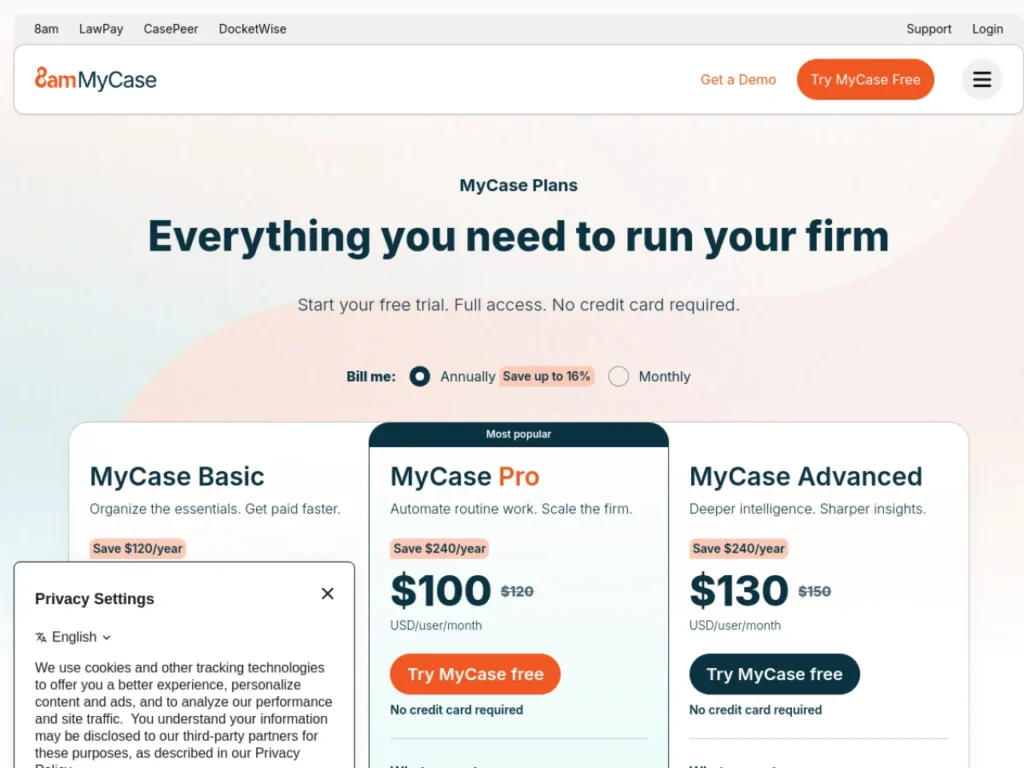
MyCase, from 8am, combines case and client management, billing, time tracking, and documents in one system, with AI drafting built in. It is the direct rival to Clio for the small firm that wants one login for the whole practice, and it is the only tool in this guide that prints every price, every tier, and every AI gate on one page.
What the AI does
The 8am IQ assistants are gated by tier, and the gate is the whole story. Pro adds the Writing Assistant and the Document Assistant: first-pass drafting, document summaries, and the kind of “read this 40-page file and tell me what matters” work that eats an associate’s afternoon. Advanced adds the Case Assistant, which builds case summaries and timelines, and the Discovery Assistant, which runs OCR and review across discovery files — 5,000 pages a user a month, shared, with extra blocks at $30 per 5,000 pages firm-wide. Basic has no AI at all.
Pricing
Basic costs $50 a user a month, Pro $100, and Advanced $130, all billed annually. Monthly billing is $60, $120, and $150. There is a 10-day free trial. An accounting add-on costs $39 a user a month on Pro and Advanced. For a three-attorney firm that wants AI, the real entry price is Pro: $300 a month billed annually, $360 billed monthly.
Best for
A firm that wants one system and wants to know the price before the sales call.
Watch out
The Basic tier is a trap for the careless buyer. At $50 a user a month it looks like the cheap way into MyCase, but it contains no AI whatsoever — you would be buying the practice manager and none of the reason you are reading this guide. And the Advanced tier’s discovery OCR is powerful, but only if your firm actually handles discovery volume. A family-law practice with three attorneys will pay $90 a month more for Advanced and use the Discovery Assistant twice a year.
Gavel — The Contract Redliner
What it is
Gavel is an AI contract review and document automation platform that works inside Microsoft Word, where lawyers actually live. It redlines contracts against a playbook, flags risky clauses, and turns intake forms into complete documents.
What the AI does
Five jobs, all inside Word: Review, which reads a contract and flags issues against your playbook; Draft, which builds first-pass language from a prompt; Ask, which answers questions about a document; Benchmarks, which compares a clause against market standards; and Playbooks, which store your firm’s positions so the AI redlines the way your senior partner would. Associate, its newer multi-document agent, works across a whole deal file instead of one document at a time.
Pricing
Gavel Exec, the AI contract-review product, costs $160 a user a month, or $1,740 a user a year, with 25 free queries per user in the trial. Gavel also sells Gavel Workflows, its document-automation product, from $83 a month for Lite to $290 for Pro, with Scale from $417 a month billed annually — those are the plan cards in the screenshot below, under the Document Automation tab. Workflows builds documents from intake forms; Exec reviews them. They are separate products and separate bills, so check which one you are buying.
Gavel publishes its prices, which puts it ahead of Harvey and CoCounsel on transparency, but $160 a seat is the highest per-seat price among the five tools here that publish one — and it is a per-seat price, so a three-attorney firm pays $480 a month billed annually before anyone has drafted a word.

Best for
Solo lawyers and small firms whose work is contracts: real estate closings, small-business formation, employment agreements, supplier deals. If your firm redlines three contracts a week, Gavel pays for itself in the first month. If your firm does one contract a month, it does not.
Watch out
The per-seat maths. Gavel charges per user, and a firm that gives every attorney and every paralegal a seat will watch the bill triple before the work does. Start with the attorneys who draft, not the whole office. And check the trial carefully: the free tier’s 25 queries are a genuine test, but they are also a countdown. Run your hardest contract through it, not your easiest.
Smith.ai — The Phone, Answered
What it is
Smith.ai is an AI receptionist and intake service for small firms: it answers the phone 24 hours a day, takes the caller’s facts, books the consult, and hands the firm a clean intake summary. It is the only tool in this guide that does not draft or research anything. It answers the phone, which is where small firms lose cases they never knew existed.
What the AI does
The AI receptionist answers in your firm’s name, screens for the practice areas you take, collects the caller’s details, books directly into your calendar, and escalates urgent matters — a new arrest, an accident, a deadline today — to a human. The firm gets a summary, not a voicemail to transcribe.
Pricing
The Free plan costs $0 a month and covers 25 calls a month, then $3.00 an extra call. Pro starts at $150 a month and covers 75 calls at $2.00 a call — on the pricing page’s own slider, 150 calls costs $270 a month and 300 calls costs $500. Enterprise starts at $500 a month and covers 300 calls at $1.67 a call. At 150 intake calls a month, Pro costs $270 a month.
That per-call charge is the whole maths of this tool: the monthly fee is small and the volume is everything. A firm that takes 40 calls a month pays $150 on Pro. A firm that takes 300 pays $500. Budget by your call log, not by the headline price. Smith.ai also sells human virtual receptionists on a separate price list, from $300 a month for 30 calls — a different product at a different price, so do not mix the two lists.

Best for
Firms whose intake leaks. Personal injury, family law, criminal defence, immigration — any practice where the client calls once, in distress, and never calls back if nobody answers. If your firm’s phone rings while everyone is in court, Smith.ai is the cheapest associate you will ever hire.
Watch out
Two things. First, the AI is only as good as the intake script you give it. A vague script produces vague intake, and a vague intake produces a wasted consult. Spend an hour writing the script before you switch it on. Second, the per-call charge means a spam wave or a wrong number costs real money. Check what counts as a billable call before you sign — a two-second hang-up should not cost $2.00.
Paxton AI — The Researcher With Receipts
What it is
Paxton AI is a legal research and drafting assistant built for solo and small firms: ask a question, get an answer with citations to real cases and statutes, then draft from the answer. It stands out in this category for one reason — it publicly lists its pricing and offers a 7-day trial, while its bigger rivals hide behind a sales call.
What the AI does
Cited research is the core job: answers grounded in case law across 30,000-plus legal sources, with links back to the source so a lawyer can verify before relying on anything. Drafting follows from the research — first-pass memos, letters, and clauses built on the cited material rather than on the model’s memory. A general chatbot will answer a legal question confidently and wrongly, and the lawyer who files that answer without checking is the one who answers to the judge.
Pricing
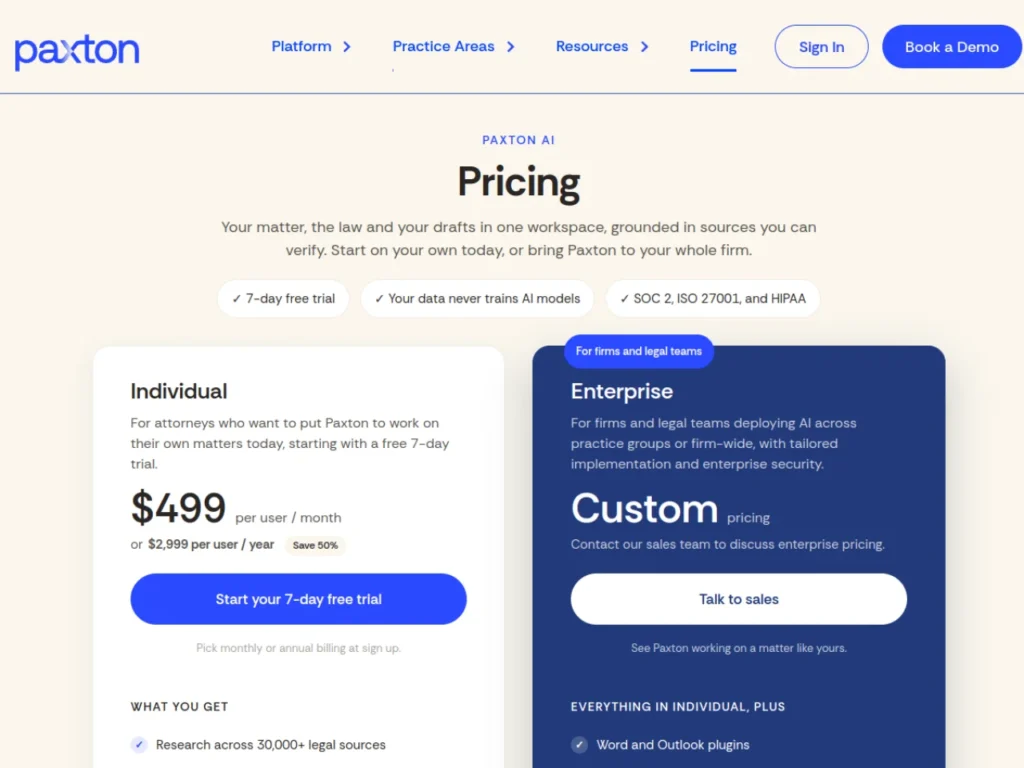
Paxton AI publishes one individual plan: $499 a user a month, or $2,999 a user a year — which works out to about $250 a month, a 50% saving against monthly billing. There is a 7-day free trial. Enterprise is custom pricing, by quote. For a three-attorney firm on annual billing, that is $8,997 a year, or about $750 a month — the largest single line in this guide’s maths. Pay monthly instead and the same three seats cost $1,497 a month, $17,964 a year: double. Confirm the annual figure on the pricing page on the day you buy, because a 50% discount is the kind of number that moves.
Best for
A firm that does enough cited research to justify $250 a user a month on annual billing. If your firm already pays for Westlaw or Lexis, CoCounsel or Lexis+ AI rides on data you already license, and Paxton is the wrong buy. If your firm pays for neither, Paxton is the only research tool here with a price you can check before the sales call — but at $499 a user a month on monthly billing, it is also the most expensive seat in this guide, so trial it on your hardest research question before you pay.
Watch out
The watch-out is the billing gap. Monthly billing costs $499 a user a month; annual billing costs $2,999 a user a year — about $250 a month. A firm that pays monthly pays double, and the discount is the largest in this guide. Get the annual figure in writing before you budget. The confidentiality question has a good answer on the pricing page itself: “Your data never trains AI models”, with SOC 2, ISO 27001, and HIPAA badges. That is the right answer for a lawyer — but read the full data policy before uploading a client file, because a badge is not a contract.
Cost Maths
The firm in this maths is three attorneys, 30 new matters a month, 150 intake calls a month, billed annually.
| Tool | Annual billing | Monthly cost | Yearly cost |
|---|---|---|---|
| Clio (Starter floor, no AI) | $49/user/mo | $147 | $1,764 |
| MyCase Pro | $100/user/mo | $300 | $3,600 |
| Gavel Exec | $160/user/mo | $480 | $5,760 |
| Smith.ai Pro (150 calls) | $150 base, 150 calls $270 | $270 | $3,240 |
| Paxton AI (annual) | $2,999/user/yr | $750 | $8,997 |
| All five | $1,947 | $23,361 |
Read the table with two corrections in mind. First, the Clio line is a floor, not a price: Starter at $49 has no AI, and the Core tier that includes it costs more — the pricing page does not print the figure. Second, the Paxton line is the annual price: $2,999 a user a year, about $250 a month. Pay monthly and the same three seats cost $1,497 a month. The total is therefore a planning figure, not a quote.
The realistic stack is smaller. A three-attorney firm does not need both Clio and MyCase — they do the same job. The stack that makes sense is MyCase Pro for the practice, Gavel for the contracts, Smith.ai for the phone, and Paxton for the research: $300 plus $480 plus $270 plus $750, or $1,800 a month, $21,597 a year. At 30 new matters a month, that is $60.00 per matter.
Now the break-even. Clio’s 2026 Legal Trends Report puts the average US lawyer rate at $362 an hour. The $1,800 stack pays for itself if it saves the firm just under five hours a month — under two hours per attorney.
The monthly-billing penalty is worth counting too. MyCase Pro billed monthly costs $360 a month instead of $300 — a $60-a-month penalty, $720 a year. Paxton’s is far bigger: $499 a user a month billed monthly against $2,999 a user a year — $2,989 a user a year, $8,967 across three seats. Pay annually if the cash flow allows it.
The Hidden Costs and Gotchas
First, the quote-only wall. Harvey and CoCounsel are the two names every lawyer asks about first, and neither publishes a small-firm price. A tool you cannot price is a tool you cannot budget, and a sales call is not a pricing page.
Second, the AI-gated tier. MyCase Basic at $50 and Clio Starter at $49 both look like cheap entries into AI. Neither contains any AI. The cheapest tier that actually includes the AI is MyCase Pro at $100 and Clio Core at an unpublished price.
Third, the monthly-billing penalty. MyCase charges $60 a month more across three seats for monthly billing — $720 a year.
Fourth, the per-seat trap. Gavel Exec at $160 a user a month sounds reasonable until the firm gives a seat to every attorney, every paralegal, and the office manager. Six seats is $960 a month.
Fifth, the per-call trap. Smith.ai Pro starts at $150 a month and covers 75 calls. At 150 calls it costs $270. At 300 calls it costs $500. The bill follows the phone, so a firm that grows its intake without watching the call count will blame the tool for a bill the volume created.
Sixth, the annual-discount trap. Paxton costs $499 a user a month billed monthly, or $2,999 a user a year — about $250 a month. Pay monthly and a single seat costs $5,988 a year; pay annually and it costs $2,999. The gap is $2,989 per user per year, and it is the largest billing penalty in this guide.
Seventh, the confidentiality trap. ABA Formal Opinion 512 says a lawyer must assess the disclosure risk before client information goes into a self-learning tool, and must get the client’s informed consent. A tool that trains on your uploads is a different purchase from one with zero retention.
Eighth, the hallucination trap. A general chatbot will answer a legal question with total confidence and a citation that does not exist. The lawyer who files that answer without checking is the one who answers to the judge — and judges have sanctioned lawyers for exactly this. Cited research tools exist so the check is part of the workflow. Use them that way, every time.
Ninth, the no-policy trap. Clio’s 2026 report found 57% of solos and 55% of small firms have no AI policy at all. That means the AI is being used on client matters with no rules about what goes in, what gets checked, and who is responsible. Write the policy before you buy the tool.
Tenth, the free-tier countdown. Gavel gives 25 free queries. Smith.ai gives 25 free calls. Both are genuine tests, and both are countdowns.
Eleventh, the double-payment trap. If your firm already pays for Westlaw, CoCounsel rides on data you already license. If you already pay for Lexis, Lexis+ AI does the same. Buying Paxton on top of a Westlaw subscription means paying twice for the same case law. Check what you already license before you buy anything new.
Work Out What the Hour Is Worth
The maths above says the realistic stack — MyCase Pro, Gavel, Smith.ai, Paxton — costs $1,800 a month and pays for itself in just under five saved hours. But “just under five hours” is a guess until you run your own numbers, with your own rate, your own matter count, and your own call volume.
That is what our free AI Cost Calculator is for. Put in what each tool costs, what your hour is worth, and how many hours it saves, and it shows you the monthly total, the yearly total, and the break-even in plain numbers.
Pros and Cons
The whole method — pros: every price in this guide was checked on the vendor’s own pricing page on 19 November 2026, and every tool that publishes no price is named as quote-only instead of guessed at. The five tools cover the five jobs a small firm actually has — practice, drafting, contracts, intake, research — and the maths is priced at one firm size so the numbers compare honestly.
The whole method — cons: one of the five prices is incomplete in a way we cannot fix from outside — Clio does not print its AI tier price, so the guide budgets from its $49 floor. The guide is priced for a three-attorney firm, so a solo or a ten-attorney firm must re-run the maths. And no guide can replace a trial: the only honest test of a legal AI tool is your own hardest matter, run through it, checked line by line.
Clio — pros: the practice manager most firms already know; AI across intake, drafting, and research; zero-retention research with citator-checked answers; vLex now inside the same company. Cons: the AI tier price is not published; Clio Work is an unpriced add-on; third-party price reports conflict.
MyCase — pros: every price printed on one page; AI from Pro at a clear $100 a user a month; one system for cases, billing, and drafting. Cons: Basic has no AI at all; Advanced discovery tools are wasted on firms without discovery volume; $720-a-year monthly-billing penalty.
Gavel — pros: works inside Word where lawyers live; published price; a free tier with 25 real queries; playbooks that redline the way your firm does. Cons: $160 a seat is the highest published per-seat price here; per-seat billing punishes a firm that seats everyone.
Smith.ai — pros: answers the phone 24 hours a day; books straight into your calendar; a genuinely free plan to test with. Cons: the bill follows call volume; a vague intake script produces vague intake; check what counts as a billable call.
Paxton AI — pros: cited research across 30,000-plus legal sources, with links you can check; a published price and a 7-day trial in a category where rivals hide behind sales calls; your data never trains its models. Cons: at $499 a user a month it is the most expensive seat in this guide, and the annual price is half the monthly one — pay monthly and you pay double; double-payment risk if the firm already licenses Westlaw or Lexis.
Our Verdict
Buy MyCase Pro first. It is the one purchase that changes the whole firm at once: cases, billing, and AI drafting in one system, at a price printed on the page, $300 a month for three attorneys billed annually.
Then add Smith.ai Pro if the phone is leaking cases, and Gavel Exec if contracts are your daily work. Add Paxton AI — at $499 a month per user, or $2,999 a year — only if your firm pays for no research database and does enough research to justify the most expensive seat in this guide. Skip it entirely if you already pay for Westlaw or Lexis, because you would be buying the same case law twice.
Skip Harvey and CoCounsel until they publish a small-firm price or give you a written quote.
Write the AI policy before you buy anything. Clio’s own research says more than half of small firms have no policy at all.
Frequently Asked Questions
1. What are the best AI tools for lawyers in a small firm?
The best AI tools for lawyers in a small firm are MyCase Pro for practice management and drafting at $100 a user a month billed annually, Gavel Exec for contracts at $160 a user a month, Smith.ai Pro for intake from $150 a month ($270 at 150 calls), and Paxton AI for cited research at $499 a month per user, or $2,999 a year. Start with MyCase Pro, then add the tool that matches your firm’s biggest leak — the phone, the contracts, or the research.
2. Is it ethical for a lawyer to use AI on client work?
Yes, with rules. ABA Formal Opinion 512, issued 29 July 2024, says a lawyer must assess the disclosure risk before client information goes into a self-learning tool and must obtain the client’s informed consent. The lawyer must also check every output before it goes to a client or a court. Use tools with zero retention where possible, and never paste confidential client facts into a general chatbot.
3. How much does AI cost a three-attorney firm?
The realistic stack in this guide — MyCase Pro, Gavel Exec, Smith.ai Pro at 150 calls a month, and Paxton AI on annual billing — costs $1,800 a month billed annually, or $21,597 a year. At the average US lawyer rate of $362 an hour, it pays for itself if it saves the firm just under five hours a month.
4. Why do Harvey and CoCounsel not publish prices?
Both are sold as enterprise platforms with negotiated contracts, seat minimums, and custom terms, so there is no single price to print. Harvey’s own help centre says several hundred dollars per user per month on average; third-party reports put it at roughly $1,000 to $2,000 a seat. CoCounsel’s own in-house figures run from $340.85 to $1,694.90 a user a month, with one transparent firm tier at $639.20 for a solo. Those figures disagree with each other and are unverified. A small firm should get a written quote for both — and budget nothing on a rumour.
5. Will AI replace lawyers?
No. AI drafts, summarises, answers phones, and finds cases. It does not exercise judgment, it does not owe a client a duty, and it cannot stand before a judge. The firms that win with AI are the ones that use it to clear the repetitive work so the lawyer’s hours go to the work only a lawyer can do. The firms that lose are the ones that file unchecked output and discover the error in court.
Price note — updated 19 November 2026: Prices in this post were checked on 19 November 2026. When you are reading this, the price may be lower or higher — always check the official pricing page before you buy.
Pros
- Every price checked on the vendor's own pricing page on 19 November 2026; every tool that publishes no price is named as quote-only instead of guessed at; the five tools cover the five jobs a small firm actually has.
- The practice manager most firms already know; AI across intake, drafting, and research; zero-retention research with citator-checked answers; vLex now inside the same company.
- Every price printed on one page; AI from Pro at a clear $100 a user a month; one system for cases, billing, and drafting.
- Works inside Word where lawyers live; published price; a free tier with 25 real queries; playbooks that redline the way your firm does.
- Answers the phone 24 hours a day; books straight into your calendar; a genuinely free plan to test with.
- Cited research across 30,000-plus legal sources, with links you can check; a published price and a 7-day trial in a category where rivals hide behind sales calls; your data never trains its models.
Cons
- One of the five prices is incomplete in a way we cannot fix from outside — Clio does not print its AI tier price, so the guide budgets from its $49 floor; the guide is priced for a three-attorney firm, so a solo or a ten-attorney firm must re-run the maths; no guide can replace a trial.
- The AI tier price is not published; Clio Work is an unpriced add-on; third-party price reports conflict.
- Basic has no AI at all; Advanced discovery tools are wasted on firms without discovery volume; $720-a-year monthly-billing penalty.
- $160 a seat is the highest published per-seat price here; per-seat billing punishes a firm that seats everyone.
- The bill follows call volume; a vague intake script produces vague intake; check what counts as a billable call.
- At $499 a user a month it is the most expensive seat in this guide, and the annual price is half the monthly one — pay monthly and you pay double; double-payment risk if the firm already licenses Westlaw or Lexis.
Buy MyCase Pro first. It is the one purchase that changes the whole firm at once: cases, billing, and AI drafting in one system, at a price printed on the page, $300 a month for three attorneys billed annually. Then add Smith.ai Pro if the phone is leaking cases, and Gavel Exec if contracts are your daily work. Add Paxton AI — at $499 a month per user, or $2,999 a year — only if your firm pays for no research database and does enough research to justify the most expensive seat in this guide. Skip it entirely if you already pay for Westlaw or Lexis, because you would be buying the same case law twice. Skip Harvey and CoCounsel until they publish a small-firm price or give you a written quote. Write the AI policy before you buy anything. Clio's own research says more than half of small firms have no policy at all.