

The best AI cold email tools for small business start with Smartlead Base at $39 a month — $32 a month billed yearly — for 6,000 sends and 2,000 stored contacts, with unlimited email accounts and unlimited warmup included. Woodpecker Email also starts at $39 a month for 5,000 emails, with unlimited contact storage and unlimited team members. Saleshandy Starter costs $41 a month ($34 billed yearly) for 6,000 emails and 2,000 active prospects, but only one user. Instantly Growth costs $47 a month for 5,000 emails and 1,000 uploaded contacts. lemlist Email costs $69 a month ($55 billed yearly) and looks expensive until you grow: it covers 50,000 emails a month with unlimited users, so at 20,000 sends it is the cheapest tool here. Buying all five entry plans costs $2,820 a year; running one lean plan costs $468 a year — a saving of $2,352 a year. Every price below was checked on the vendor's official pricing page on 29 November 2026.
Quick Answer
The best AI cold email tools for small business start with Smartlead Base at $39 a month — $32 a month billed yearly — for 6,000 sends and 2,000 stored contacts, with unlimited email accounts and unlimited warmup included. Woodpecker Email also starts at $39 a month for 5,000 emails, with unlimited contact storage and unlimited team members. Saleshandy Starter costs $41 a month ($34 billed yearly) for 6,000 emails and 2,000 active prospects, but only one user.
Instantly Growth costs $47 a month for 5,000 emails and 1,000 uploaded contacts. lemlist Email costs $69 a month ($55 billed yearly) and looks expensive until you grow: it covers 50,000 emails a month with unlimited users, so at 20,000 sends it is the cheapest tool here. Buying all five entry plans costs $2,820 a year; running one lean plan costs $468 a year — a saving of $2,352 a year. Every price below was checked on the vendor’s official pricing page on 29 November 2026.
In this article
- What an AI cold email tool actually does
- Best AI cold email tools for small business at a glance
- 1. Smartlead
- 2. Woodpecker
- 3. Saleshandy
- 4. Instantly
- 5. lemlist
- One small business, priced five ways
- The traps that change the bill
- Strategic Pivot
- Pros and cons
- Verdict
- FAQs
- Sources
What an AI cold email tool actually does
A cold email tool is not a newsletter tool. A newsletter tool sends one message to people who asked to hear from you. A cold email tool sends a short sequence — usually three to five emails with follow-ups — to people who have never heard of you, from several mailboxes at once, at a pace that does not get your domain flagged as spam. Our guide to the best AI email marketing tools for small business covers the newsletter side; this guide covers outbound prospecting, which is a different job with different pricing. This guide compares the best AI cold email tools for small business by real price.
The AI part is real but narrow. In 2026 the useful AI features are: drafting and personalizing the first line of each email, generating a full sequence from a short brief, sorting replies into interested, not now, and unsubscribe, and watching mailbox health so a domain problem is caught early. Instantly sells AI Agents, Smartlead builds its SmartAssistant into every plan, lemlist offers lemlist AI and its lemAgent assistant, Woodpecker builds an AI writer into its platform, and Saleshandy includes AI credits and an AI assistant. None of that fixes a bad list. If your prospects are wrong, every tool here will deliver the wrong email very efficiently.
Three numbers decide your bill, and only one of them is the headline price. The first is sends per month, including follow-ups — a list of 1,000 prospects with a four-email sequence is 4,000 sends, not 1,000. The second is how many contacts the plan lets you store or work at once. The third is seats: some tools charge per user, others charge one flat price for the whole team. The five tools below split across all three models, which is why the cheapest headline price is not always the cheapest bill.
Best AI cold email tools for small business at a glance
| Tool | Entry plan (monthly billing) | Sends included | Contact limit | Pricing model |
|---|---|---|---|---|
| Smartlead | Base $39/mo ($32 yearly) | 6,000/mo | 2,000 stored | Flat, by volume |
| Woodpecker | Email $39/mo at 5,000 emails | 5,000/mo at entry tier | Unlimited storage | Volume tiers |
| Saleshandy | Starter $41/mo ($34 yearly) | 6,000/mo | 2,000 active prospects | Flat, 1 user on Starter |
| Instantly | Growth $47/mo | 5,000/mo | 1,000 uploaded contacts | Flat, by volume |
| lemlist | Email $69/mo ($55 yearly) | 50,000/mo | Unlimited users and senders | Flat for Email; per user for Multichannel |
All five include email warmup, which matters more than any AI feature. Warmup keeps new mailboxes active so providers treat them as real. All five also let you connect more than one sending account, so you can spread volume across mailboxes instead of hammering one address. Where they differ is what happens when you grow past the entry tier — and that is where the money is.
1. Smartlead
Best for: a solo founder or small team that wants the lowest entry price with no seat or mailbox charges. Skip if: you need LinkedIn steps inside the same sequence on day one, or you want a built-in lead database included rather than as an add-on.
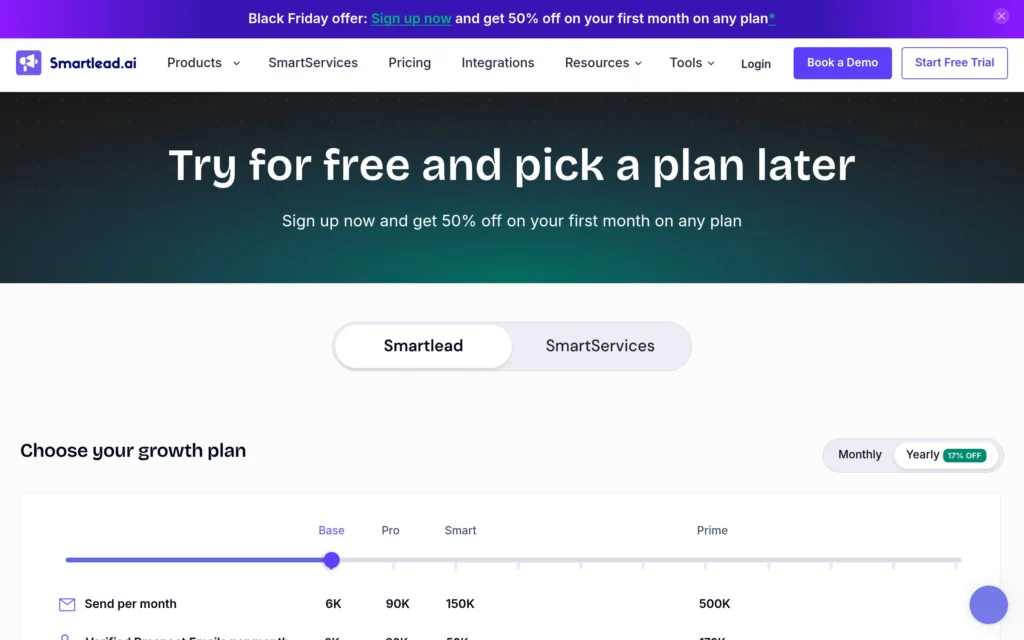
Smartlead Base costs $39 a month, or $32 a month billed yearly. It includes 6,000 email sends a month, storage for 2,000 contacts, unlimited email accounts, and unlimited warmup. The 14-day free trial needs no credit card. Smartlead’s own pricing page describes its model plainly: pricing is built around send volume, not per-seat or per-mailbox fees. For a small business, that is the right model — hiring a second person does not raise the bill.
The AI layer is SmartAssistant, which Smartlead says is included in all plans, including trials, at no extra cost. It builds prospect lists from a description of your ideal customer, drafts personalized sequences, monitors warmup and domain reputation, and sorts replies into interested, not now, and unsubscribe. Smartlead also sells SmartAgents, seven purpose-built AI agents for campaign creation, mailbox health, diagnostics, and reply triage.
The cost driver is the jump to Pro. Base stops at 6,000 sends and 2,000 contacts. Pro costs $94 a month ($78 billed yearly) and raises the ceiling to 90,000 sends and 30,000 contacts. That is a fair jump for the volume, but it means a business sending 10,000 emails a month pays Pro prices, not Base prices. Verified prospect emails through SmartProspect are a $59 a month add-on on Base and Pro, and inbox placement testing through SmartDelivery starts at $49 a month. Neither is required to send, but both are easy to add without noticing.
2. Woodpecker
Best for: a small team that wants unlimited contacts and unlimited teammates without a per-seat bill. Skip if: you want the deepest AI personalization, or your volume will pass 5,000 emails quickly and you do not want to price a higher tier.
Woodpecker’s Email plan starts at $39 a month on monthly billing at the 5,000-emails tier shown on its pricing page. The page offers a 14-day free trial with no credit card required, and annual billing saves 33%. The entry tier includes unlimited contact storage, unlimited email verification, three warm-ups, 100 Lead Finder credits, and unlimited team members. Unlimited verification is a quiet advantage: bouncing emails damage sender reputation, and most tools charge for verification separately or cap it.
Woodpecker positions itself as deliverability-first, and its own AI email writing guide describes it as a full platform with an AI writer built into the workflow. The AI here is a writing aid inside the sending platform, not an autonomous agent. For many small businesses that is enough: you write the angle, the tool helps with drafts and follow-ups, and the platform protects the domain.
The cost driver is the volume tier. The $39 price is tied to 5,000 emails sent; higher volumes are priced on the same page through its tier selector, and the Multichannel plan (email plus LinkedIn in one campaign) starts at $68 a month. LinkedIn on its own starts at $29 a month per account. Price your real volume on the page before you commit, because the entry tier will not cover a 20,000-send month.

3. Saleshandy
Best for: a solo operator who wants sending plus a built-in lead finder in one subscription. Skip if: more than one person needs to work in the tool on the entry plan, or you need CRM integrations from day one.
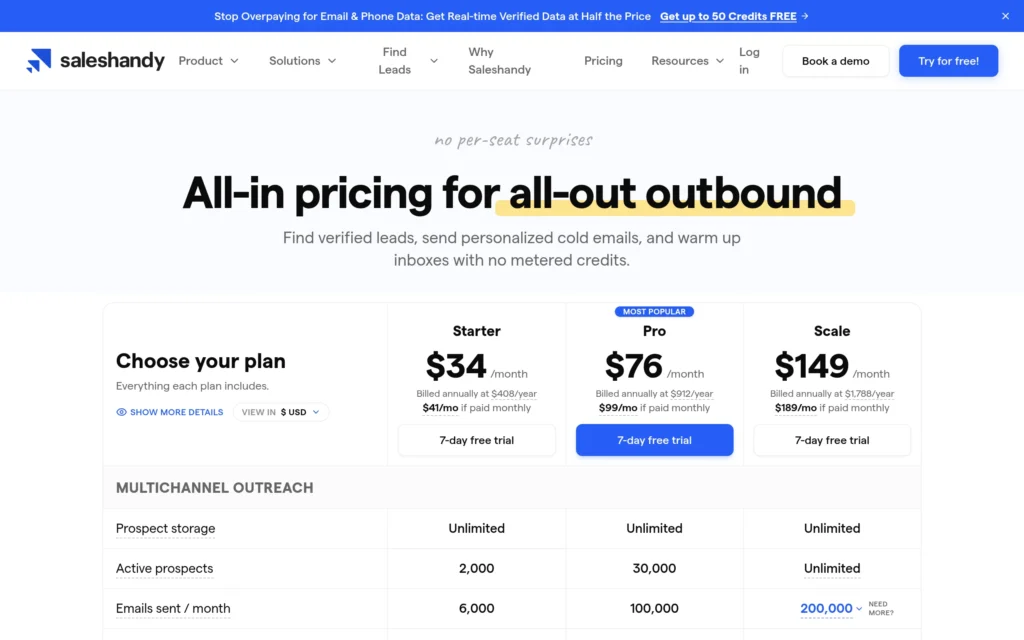
Saleshandy Starter costs $41 a month, or $34 a month billed yearly ($408 a year), with a 7-day free trial. It includes 6,000 emails a month, 2,000 active prospects, unlimited prospect storage, unlimited email accounts, and 1,500 Lead Finder credits a month. One credit reveals a verified work email, and the credits include waterfall enrichment and real-time verification. Starter also includes 100 one-time AI credits and 500 one-time email verification credits.
The bundled lead data is Saleshandy’s real difference. The other tools here either sell data separately or expect you to bring your own list. If you have no list and no data tool, Starter’s included credits can get a first campaign running without a second subscription. Saleshandy’s help center confirms every plan includes unlimited connected email accounts and warm-up at no extra cost.
The cost driver is the single seat. Starter is one user. Pro costs $99 a month ($76 billed yearly) and raises the limits to 100,000 emails, 30,000 active prospects, and up to 10 team members, plus subsequences and CRM integrations. Scale costs $189 a month ($149 billed yearly) for 200,000 emails and unlimited users. If a second person joins your outbound work, you are on Pro whether you need the volume or not.
4. Instantly
Best for: a high-volume sender who wants unlimited mailboxes and warmup with a simple flat price. Skip if: your list is large but your sending is modest — the uploaded-contact cap will force you onto the expensive tier.
Instantly Growth costs $47 a month on monthly billing. It includes 5,000 emails a month, 1,000 uploaded contacts, unlimited email accounts, unlimited email warmup, and chat support. Hypergrowth costs $107 a month and raises the limits to 125,000 emails and 25,000 uploaded contacts, with premium live support and a built-in CRM integrated with its Unibox. Light Speed costs $358 a month for 500,000 emails and 100,000 uploaded contacts. Instantly’s navigation leads with AI Agents, and its lead database and CRM are sold as separate products with their own pricing tabs.
Instantly is the volume sender’s tool. Unlimited accounts and unlimited warmup on every plan means the sending infrastructure is never the bottleneck. For an agency rotating dozens of mailboxes, that simplicity is worth money.
The cost driver is the uploaded-contact cap, and it bites earlier than the email cap. Growth holds only 1,000 uploaded contacts in total. A business with a 5,000-prospect list that sends a careful 4,000 emails a month still needs Hypergrowth at $107 a month, because the contacts do not fit. Price Instantly on your list size, not your send volume. Also note that lead data (Instantly Credits) and CRM are separate subscriptions, so the $47 headline is sending only.

5. lemlist
Best for: a team that will grow past 6,000 sends a month, or that wants email, LinkedIn, calls, and WhatsApp in one sequence. Skip if: you are a solo sender who will stay under 5,000 sends — you would pay for volume you never use.
lemlist Email costs $69 a month, or $55 a month billed yearly. It includes 50,000 emails a month, unlimited users, and unlimited email senders, plus an email and phone number finder. That is ten times the sending volume of the other entry plans here, for the whole team at one flat price. Multichannel costs $109 per user per month ($87 billed yearly) and adds LinkedIn, calls, and SMS steps, with five senders per user and unlimited emails and messages.
The AI layer is lemlist AI, which lemlist says is included in every paid plan. It generates personalized multichannel sequences, segments and cleans lead data, fine-tunes messages for tone and length, and detects interested prospects. Its lemAgent assistant builds campaigns from a prompt using your audience, value proposition, and trigger.
The cost driver is the plan split. Email is flat and generous. Multichannel is per user, so a five-person team pays five seats: $435 a month billed yearly. Buy Multichannel only if each rep genuinely runs LinkedIn or call steps. If your outreach is email-only, the Email plan is one of the best deals in this guide once volume grows.

One small business, priced five ways
Take a realistic small business: a two-person B2B service firm sending cold email to win clients. In month one it contacts 1,000 prospects with a four-email sequence — 4,000 sends — from three mailboxes, using its own list. Every entry plan here covers that month. On monthly billing the bill is Smartlead Base $39, Woodpecker Email $39, Saleshandy Starter $41, Instantly Growth $47, or lemlist Email $69. The lean choice, Smartlead Base, costs $468 a year on monthly billing or $384 a year billed yearly.
Now let the business grow. By month six it contacts 5,000 prospects a month with the same four-email sequence: 20,000 sends. The entry tiers fall away one by one. Smartlead Base stops at 6,000 sends, so the business moves to Pro at $94 a month. Instantly Growth stops at 5,000 emails and 1,000 contacts, so it moves to Hypergrowth at $107 a month.
Saleshandy Starter stops at 6,000 emails and one user, so it moves to Pro at $99 a month. lemlist Email does not move at all: 50,000 emails and unlimited users still cost $69 a month, or $55 billed yearly. Woodpecker’s price at 20,000 emails sits on its tier selector — check it on the pricing page before assuming the $39 entry price holds.
The lesson is simple. At low volume, Smartlead and Woodpecker are cheapest. At growing volume, lemlist’s flat 50,000-email tier undercuts everyone. And the full-stack mistake — paying for several of these tools at once, which happens when a team trials everything and cancels nothing — costs $235 a month for the five entry plans, $2,820 a year. One lean plan at $39 a month saves $2,352 a year against that stack. Pick one tool, run it for a month on real campaigns, and only switch when you hit a limit you can name.
The traps that change the bill
Follow-ups count as sends. A 1,000-prospect list with a four-step sequence is 4,000 sends. Entry plans capped at 5,000 or 6,000 sends cover roughly 1,250 to 1,500 prospects a month at that sequence length — far fewer than the headline suggests.
Contact caps bind before send caps. Instantly Growth holds 1,000 uploaded contacts total. Smartlead Base stores 2,000. Saleshandy Starter works 2,000 active prospects. A big list on a small plan forces an upgrade even if your sending is modest.
Per-seat pricing punishes teams. lemlist Multichannel at $87 per user billed yearly is fair for one rep and heavy for five. Saleshandy Starter is a single seat. Flat plans — Smartlead, Woodpecker, lemlist Email — do not raise the bill when a colleague joins.
Data is often a second subscription. Instantly Credits, Smartlead’s SmartProspect add-on at $59 a month, and lemlist’s enrichment credits all sit on top of the sending price. Saleshandy bundles lead credits into every plan; Woodpecker includes 100 Lead Finder credits at entry. If you have no list, price the data layer before you choose.
Deliverability add-ons stack quietly. Inbox placement testing, dedicated servers, done-for-you mailboxes, and white-label client workspaces are all sold separately across these tools. You do not need them to start. Add them only when a measured problem — rising bounces, spam placement — demands it.
Annual billing is the cheapest honest discount. Smartlead yearly billing saves 17%, lemlist yearly saves 20%, Woodpecker advertises 33% off annual, and Saleshandy annual saves 17% on Starter. Take the discount only after a monthly trial proves the tool fits; a year of the wrong tool is the most expensive plan of all.
Strategic Pivot
Before you buy any of these tools, run your real numbers through our free AI Cost Calculator. Enter your monthly sends including follow-ups, your list size, and your team size, and compare the lean plan against the full stack. Cold email tools look cheap one at a time; the calculator shows what the whole outbound stack costs over a year, which is the number that decides whether outreach pays. If your replies then need handling at scale, our guide on how to automate lead follow-up with AI shows the next step, and our best AI CRM for small business guide covers where those replies should land.
Pros and cons
Smartlead
Pros: Cheapest entry price at $39 a month ($32 yearly); unlimited email accounts and warmup on every plan; SmartAssistant AI included at no extra cost; no per-seat or per-mailbox fees; 14-day trial with no credit card.
Cons: Base caps at 6,000 sends and 2,000 contacts; verified prospect data is a $59 a month add-on on Base and Pro; inbox placement testing costs extra from $49 a month.
Woodpecker
Pros: $39 a month entry with unlimited contact storage; unlimited email verification included; unlimited team members; 14-day trial with no credit card; annual billing saves 33%.
Cons: Entry price is tied to 5,000 emails — higher volume needs a higher tier; LinkedIn and multichannel cost extra; AI is a writing aid, not an autonomous agent.
Saleshandy
Pros: Lead Finder credits bundled into every plan, so sending and data come in one subscription; unlimited email accounts and warmup; 7-day free trial; Pro is fairly priced for up to 10 users.
Cons: Starter is a single user; CRM and no-code integrations start at Pro; active-prospect cap of 2,000 on Starter binds quickly.
Instantly
Pros: Unlimited email accounts and warmup on every plan; simple flat pricing by volume; AI Agents and a large lead database available in the same platform; built for high-volume rotation.
Cons: Growth holds only 1,000 uploaded contacts, forcing early upgrades; lead data and CRM are separate subscriptions; Hypergrowth at $107 a month is a steep second step.
lemlist
Pros: Email plan covers 50,000 emails a month with unlimited users at one flat price; lemlist AI included in every paid plan; true multichannel sequences with LinkedIn, calls, and WhatsApp; cheapest option here at 20,000 sends.
Cons: $69 a month entry is wasted on low-volume solo senders; Multichannel is per user, so team cost scales fast; enrichment credits cost extra.
Verdict
Start with Smartlead Base if you are testing cold email for the first time: $39 a month, no seat fees, no mailbox fees, and a trial that needs no card. Choose Woodpecker if unlimited contacts, unlimited verification, and unlimited teammates matter more than AI depth. Choose Saleshandy if you have no prospect list and want lead data bundled into the same bill.
Choose Instantly if you already send at volume across many mailboxes and your list fits its contact caps. Choose lemlist the moment your sending passes roughly 6,000 emails a month — its flat 50,000-email Email plan becomes the cheapest serious option, and it is the only tool here that stays flat as your team grows. Whatever you pick, send from secondary domains, warm every mailbox, and verify every list. No AI feature in this guide can rescue a domain that providers have already flagged.
FAQs
What is the cheapest AI cold email tool for a small business?
Smartlead Base and Woodpecker Email tie at $39 a month on monthly billing. Smartlead Base includes 6,000 sends and 2,000 stored contacts with unlimited accounts and warmup. Woodpecker Email includes 5,000 emails with unlimited contact storage and unlimited team members. Billed yearly, Smartlead Base drops to $32 a month, and Woodpecker advertises 33% off annual billing.
Do I need a separate tool to find prospect email addresses?
Not always. Saleshandy bundles Lead Finder credits into every plan — 1,500 a month on Starter — and Woodpecker includes 100 Lead Finder credits at entry. Instantly and Smartlead sell lead data separately: Smartlead’s SmartProspect is a $59 a month add-on on Base and Pro. If you already have a verified list, skip the data layer and pay only for sending.
How many emails can I send from one mailbox?
Keep each mailbox modest and spread volume across several accounts — every tool here supports multiple sending accounts for exactly this reason. A common safe pattern is a few dozen cold emails per mailbox per day after warmup, scaled by adding mailboxes rather than pushing one address harder. All five tools include warmup; use it for at least two weeks before a real campaign.
Is per-seat or flat pricing better for a small team?
Flat pricing wins as soon as a second person joins. Smartlead, Woodpecker, and lemlist’s Email plan charge one price regardless of team size. Per-seat pricing — lemlist Multichannel at $87 per user billed yearly, or Saleshandy’s jump from one-user Starter to Pro — raises the bill with every hire. Price the team you will have in six months, not the team you have today.
Can AI write my cold emails for me?
AI can draft them, and every tool here offers some form of AI writing, from Smartlead’s SmartAssistant to lemlist AI’s sequence generator. Treat the output as a first draft. The emails that get replies name a specific reason for contacting that prospect, and that reason comes from your research, not from a model. Let AI handle structure and personalization tokens; keep the angle and the proof points human.
What should I check before paying annually?
Run one monthly cycle first and confirm three things: your sends including follow-ups fit the plan, your contact list fits the storage or active-prospect cap, and your bounce rate stays low with warmup on. Annual billing saves 17% to 33% across these tools, but only on a tool you have already proven fits your volume.
Sources
Prices and plan limits were checked on 29 November 2026 on the official pages below. We did not run paid campaigns in these tools for this guide; the comparison is based on published pricing, plan limits, and each vendor’s own feature descriptions.
- Instantly pricing — Growth $47/mo, Hypergrowth $107/mo, Light Speed $358/mo on monthly billing
- Smartlead pricing — Base $39/mo, Pro $94/mo, Unlimited Smart $174/mo, Unlimited Prime $379/mo; yearly $32/$78/$144/$315
- lemlist pricing — Email $69/mo ($55 yearly), Multichannel $109/user/mo ($87 yearly)
- Woodpecker pricing — Email $39/mo at 5,000 emails, Multichannel $68/mo, LinkedIn $29/mo on monthly billing
- Saleshandy pricing — Starter $41/mo ($34 yearly), Pro $99/mo ($76 yearly), Scale $189/mo ($149 yearly)
Price note — updated 29 November 2026: Prices in this post were checked on 29 November 2026 on each vendor’s official pricing page. When you are reading this, the price may be lower or higher, and promotional offers may have ended. Always check the official pricing page before you buy.
Pros
- Cheapest entry price at $39 a month ($32 yearly)
- unlimited email accounts and warmup on every plan
- SmartAssistant AI included at no extra cost
- no per-seat or per-mailbox fees
- 14-day trial with no credit card
Cons
- Base caps at 6,000 sends and 2,000 contacts
- verified prospect data is a $59 a month add-on on Base and Pro
- inbox placement testing costs extra from $49 a month
Start with Smartlead Base if you are testing cold email for the first time: $39 a month, no seat fees, no mailbox fees, and a trial that needs no card. Choose Woodpecker if unlimited contacts, unlimited verification, and unlimited teammates matter more than AI depth. Choose Saleshandy if you have no prospect list and want lead data bundled into the same bill. Choose Instantly if you already send at volume across many mailboxes and your list fits its contact caps. Choose lemlist the moment your sending passes roughly 6,000 emails a month — its flat 50,000-email Email plan becomes the cheapest serious option, and it is the only tool here that stays flat as your team grows. Whatever you pick, send from secondary domains, warm every mailbox, and verify every list. No AI feature in this guide can rescue a domain that providers have already flagged.