

The best ai point of sale systems for small business are decided by processing fees, not the software sticker. For one location taking $25,000 a month in card sales at a $25 average ticket, Square Free is the cheapest complete start at $9,600 a year in processing with $0 software. SpotOn POS essentials is the cheapest restaurant pick at $9,810 a year. Shopify only wins when the online store matters as much as the counter.Square Plus costs $9,888 a year at this volume, so its lower rate does not pay for itself until about $49,000 a month. Lightspeed Plus is the most expensive route at $12,468 a year, which is $2,868 more than Square Free for the same sales. Every price below was checked on the vendor's official page on 29 November 2026.
Quick Answer
The best ai point of sale systems for small business are decided by processing fees, not the software sticker. For one location taking $25,000 a month in card sales at a $25 average ticket, Square Free is the cheapest complete start at $9,600 a year in processing with $0 software. SpotOn POS essentials is the cheapest restaurant pick at $9,810 a year. Shopify only wins when the online store matters as much as the counter.
Square Plus costs $9,888 a year at this volume, so its lower rate does not pay for itself until about $49,000 a month. Lightspeed Plus is the most expensive route at $12,468 a year, which is $2,868 more than Square Free for the same sales. Every price below was checked on the vendor’s official page on 29 November 2026.
In this article
- What an AI POS actually does
- The five systems at a glance
- 1. Square
- 2. Shopify POS
- 3. Lightspeed Retail
- 4. Toast
- 5. SpotOn
- One shop, priced five ways
- The traps that change the bill
- Strategic Pivot
- Pros and cons
- Verdict
- FAQs
- Sources
What an AI POS actually does
A point of sale system rings up the sale, takes the card, updates stock, and records who sold what. That part is old. The AI layer is newer, and it is where the marketing gets slippery.
In this guide, “AI” means a named feature on the vendor’s official page. Square calls its assistant Squaremates. Shopify includes Sidekick on every plan. Lightspeed sells Lightspeed AI and AI Doc Import. Toast names Toast IQ. SpotOn includes an AI menu assistant and sells Profit Assist.
That definition matters because a reporting dashboard is not an AI assistant. Several well-known POS brands show charts and call the result insights. Charts help, but they do not draft a purchase order, answer a stock question, or rewrite forty menu prices from one prompt.
The second thing to understand is the meter. POS pricing runs on three meters at once: a monthly software fee, a percentage of every card sale, and a fixed fee per transaction. A system can win on one meter and lose on the other two.
Your average ticket decides how much the fixed fee hurts. At a $25 ticket, a 15¢ fixed fee adds 0.6% to every sale. At a $10 ticket, the same 15¢ adds 1.5%. Coffee and convenience sellers feel fixed fees far more than furniture stores do.
The five systems at a glance
| System | Named AI feature | Software price | In-person card rate | Scenario total per year |
|---|---|---|---|---|
| Square | Squaremates | $0 / $49 / $149 per location per month | 2.6% + 15¢ / 2.5% + 15¢ / 2.4% + 15¢ | $9,600 (Free) |
| Shopify POS | Sidekick, included on every plan | Basic $29/mo billed yearly + POS Pro $89/mo per location | 2.6% + 10¢ on Basic | $10,416 (Basic + POS Pro) |
| Lightspeed Retail | Lightspeed AI; AI Doc Import included on Plus | $89 / $149 / $289 per month billed annually | 2.6% + 10¢ | $12,468 (Plus) |
| Toast | Toast IQ AI Assistant | Starter Kit $0/mo; Point of Sale from $69/mo | 2.49% + 15¢ on the paid plan | $10,098 (Point of Sale) |
| SpotOn | AI menu assistant included; Profit Assist add-on | $0/station All-In; $55/station POS essentials | 2.45% + 15¢ on essentials | $9,810 (essentials) |
The scenario total uses one location, $25,000 a month in in-person card sales, a $25 average ticket, and one register or station. That is $300,000 a year across 12,000 transactions. Hardware is excluded because every vendor prices it differently, and the traps section covers it separately.
1. Square
Square is the default counter system for a reason. The free plan is genuinely free software, the paid plans are per location rather than per register, and the pricing page states there are no locked-in contracts. For a single shop that mostly needs to take cards and track stock, that combination is hard to beat.

Square Free costs $0 a month per location. In-person payments cost 2.6% + 15¢, and online payments cost 3.3% + 30¢. Square Plus costs $49 a month per location and drops the in-person rate to 2.5% + 15¢. Square Premium costs $149 a month per location at 2.4% + 15¢. Plus and Premium each include a free 30-day trial.
The AI feature is Squaremates, described on the pricing page as the AI business partner built into Square. It sits inside the same dashboard as sales, inventory, and staff tools, so a small team does not need a separate analytics login.
Best for: a one-location shop, café, or service business that wants the lowest total bill and no contract.
Skip if: you need deep retail inventory workflows, matrix variants, or multi-location stock transfers as your main job. That is Lightspeed territory, and Square will feel thin there.
The cost driver is volume. Plus saves 0.1 percentage point on processing, which covers its $49 fee only at about $49,000 a month in card sales. Below that, Plus is a features purchase, not a savings purchase. Premium needs about $100,000 a month to beat Plus on rate alone.
Square also offers custom pricing for businesses processing over $250,000 a year. Our scenario shop processes $300,000, so a real owner at this size should ask for the custom quote before assuming the published rate is the final rate.
2. Shopify POS
Shopify POS is not really a POS with a store attached. It is an online store with a counter attached. That order decides who should buy it. If online sales are half your business, Shopify’s single inventory pool is the strongest offer here. If you never sell online, you are paying for a store you do not use.

With yearly billing, Basic is $29 a month, Grow is $89 a month, and Advanced is $359 a month. Monthly billing is higher: Shopify’s own POS cost guide lists $39, $105, and $399. POS Pro adds $89 a month per retail location on top of the base plan.
In-person processing is 2.6% + 10¢ on Basic, 2.5% + 10¢ on Grow, and 2.4% + 10¢ on Advanced. The 10¢ fixed fee is the quiet advantage: it is 5¢ less per transaction than Square, Toast, and SpotOn charge.
Every plan includes Sidekick, Shopify’s commerce AI, and the pricing page lists a built-in AI assistant even on Basic. The trial is 3 days free, then $1 a month for 3 months on most plans, which is a promotion rather than the steady price.
Best for: a retailer whose online store and physical counter must share one stock count, one customer list, and one checkout brain.
Skip if: you sell only in person. POS Pro is built for permanent retail operations, and at $89 a month it never pays for itself through processing savings on Basic, because the Basic rate stays 2.6% + 10¢ with or without it.
Grow is the subtle trap. Grow plus POS Pro costs $60 a month more than Basic plus POS Pro, while its rate saving is 0.1 percentage point. That saving covers the extra fee only at about $60,000 a month in card sales. Below that, Grow must justify itself with staff accounts and features, not fees.
If the online store is the real decision, our Shopify alternatives guide prices the switch away from Shopify in full.
3. Lightspeed Retail
Lightspeed is the serious retail system in this list. It is built for shops with real inventory pain: purchase orders, stock transfers, landed costs, and multi-location reporting. The price reflects that focus, and the AI story is split across two features with different plan gates.
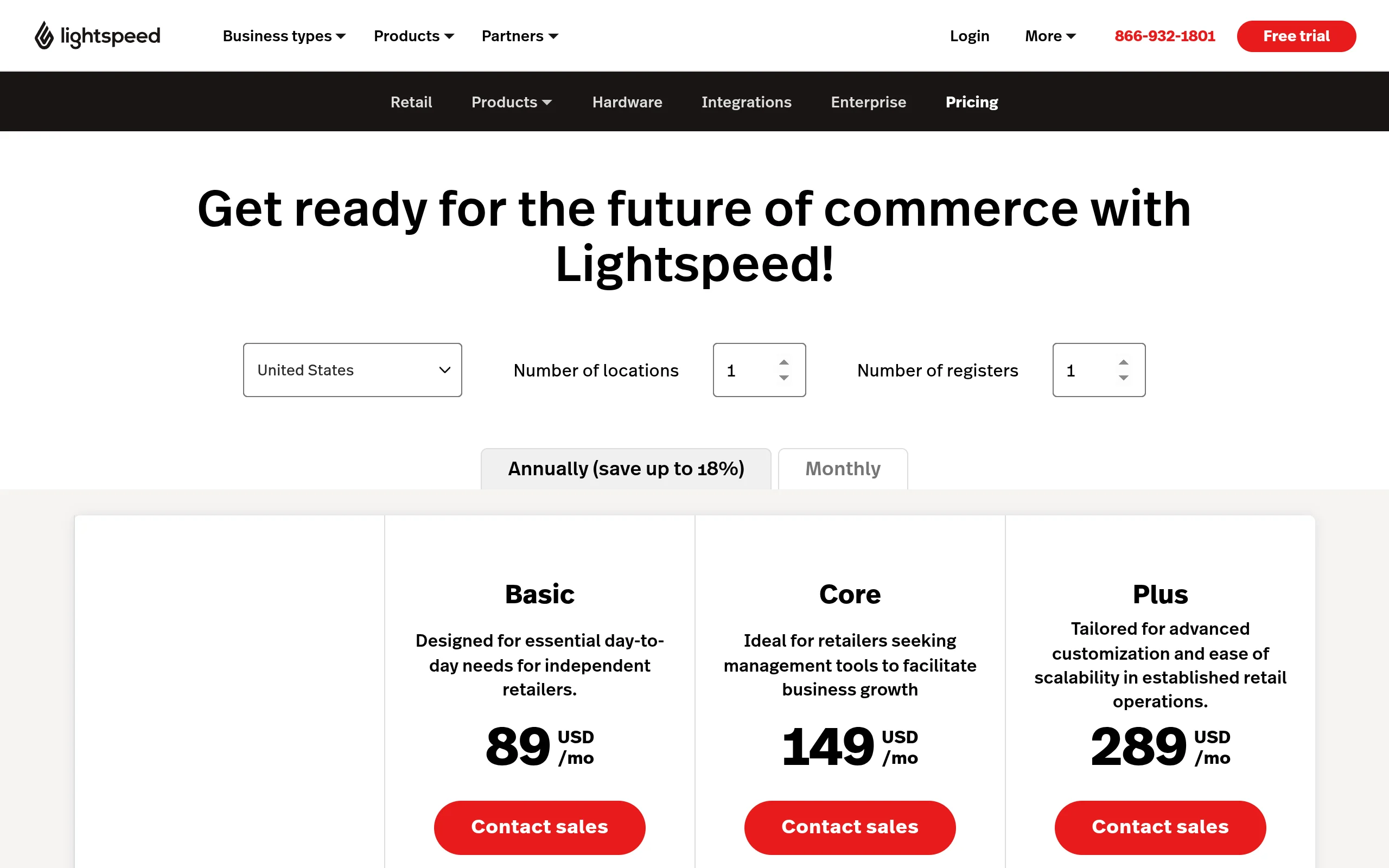
Billed annually, Basic is $89 a month, Core is $149 a month, and Plus is $289 a month. Lightspeed Payments charges 2.6% + 10¢ per card-present transaction. That rate matches Shopify Basic, so Lightspeed’s higher total comes from software, not processing.
Lightspeed AI is built-in intelligence inside Lightspeed Retail. It answers sales and inventory questions in plain language and drafts purchase orders and stock transfers, acting only with your approval. AI Doc Import, which turns supplier documents into stock records, is an add-on on Basic and Core and included on Plus.
That gate is the buying decision. A shop that wants the full AI and forecasting set is really shopping for Plus at $289 a month. Quoting Basic at $89 and then discovering the AI import tool is extra is exactly the kind of surprise this guide exists to prevent.
Best for: an established retailer with hundreds of SKUs, supplier orders every week, and more than one location on the roadmap.
Skip if: you run one small counter with simple stock. You would pay $12,468 a year on Plus for inventory depth you never open, while Square Free covers the same sales for $9,600.
Lightspeed also sells hardware separately, and its payments page states that existing terminal hardware cannot be reused because it lacks the certified firmware. Budget for new terminals even if your current ones work. For the stock side of the decision, our AI inventory management guide prices the dedicated tools.
4. Toast
Toast is the restaurant specialist. Its hardware, kitchen workflows, and reporting assume food service, and its pricing guide is unusually honest about the trade: pay a monthly software fee and get a lower processing rate, or pay nothing monthly and accept a higher rate on every card.

The Restaurant Starter Kit starts at $0 a month in software with pay-as-you-go processing. Toast’s shop summary puts that pay-as-you-go rate at 3.09% + 15¢. Restaurant Point of Sale starts at $69 a month, and Toast’s small-business page lists its flat in-person rate at 2.49% + 15¢. Build Your Own is custom priced.
The AI feature is the Toast IQ AI Assistant, which turns sales, inventory, and margin data into recommendations. For a café owner deciding whether the oat milk order or the Saturday roster is the problem, that is a more useful question than a raw sales chart.
Best for: a café or restaurant that wants kitchen-grade workflows and one vendor for hardware, software, and payments.
Skip if: you run a pure retail shop with no food service. Toast also sells a retail line, but its retail starting price and processing terms differ from the restaurant figures above, so retail buyers should confirm the retail quote in writing before comparing totals.
The break-even is clean. The paid plan saves 0.60 percentage point against pay-as-you-go, which covers the $69 fee at about $11,500 a month in card sales. Our scenario café at $25,000 a month saves $972 a year by paying the fee. A kiosk doing $6,000 a month should stay on the free starter terms.
Two contract details deserve attention. The pricing includes the first hardware terminal subscription, and additional devices cost extra. An early termination fee typically applies if the agreement ends before its term. Read the term length before signing, not after the first slow month.
5. SpotOn
SpotOn is the clearest AI offer in this list for food businesses. Its AI menu assistant is included with SpotOn POS at no extra cost, and it does one concrete job: bulk menu changes from plain prompts, such as raising all shareable prices by 5% or adding $0.50 to sides and rounding to .95.

The All-In Plan is $0 per station per month with card-present processing at 2.79% + 20¢. POS essentials is $55 per station per month with card-present processing at 2.45% + 15¢, except American Express at 3.19% + 15¢. Build Your Own uses custom rates. SpotOn also sells Profit Assist, which uses AI to analyse profit and loss and flag cost cuts.
The assistant confirms changes before publishing and allows undo, which matters when one prompt edits forty prices. Menu maintenance is unglamorous work, and it is exactly the kind of weekly task where an AI assistant earns its keep.
Best for: a restaurant or café that changes prices, specials, and modifiers often and wants the lowest paid-plan processing rate here.
Skip if: you need retail inventory depth or an online store as the main system. SpotOn’s strength is the menu and the dining room, not a 2,000-SKU stockroom.
At a $25 average ticket, POS essentials beats the All-In Plan once card sales pass about $10,200 a month. The American Express exception is the caveat: a business with heavy Amex volume should model that 3.19% rate separately before trusting the headline total. SpotOn Terminal for retail is a different product at $25 a month plus $200 hardware, so do not mix its price into a restaurant comparison.
One shop, priced five ways
Take one location with $25,000 a month in in-person card sales and a $25 average ticket. That is 1,000 transactions a month, $300,000 a year, and 12,000 transactions a year. One register, one station, hardware excluded.
Square Free charges no software. Processing is 2.6% of $300,000, which is $7,800, plus 15¢ on 12,000 transactions, which is $1,800. The year costs $9,600.
SpotOn POS essentials charges $660 in software. Processing is 2.45% of $300,000, which is $7,350, plus $1,800 in fixed fees. The year costs $9,810, before any American Express volume at the higher rate.
Square Plus charges $588 in software. Processing is 2.5% of $300,000, which is $7,500, plus $1,800. The year costs $9,888. Plus costs $288 more than Free at this volume, because its rate saving is worth $300 and its fee is $588.
Toast Point of Sale charges $828 in software. Processing is 2.49% of $300,000, which is $7,470, plus $1,800. The year costs $10,098. The free Starter Kit terms would cost $11,070 in processing alone.
Shopify Basic with POS Pro charges $1,416 in software. Processing is 2.6% of $300,000, which is $7,800, plus 10¢ on 12,000 transactions, which is $1,200. The year costs $10,416. Without POS Pro, the same shop pays $9,348, the lowest figure here, but gives up the retail features POS Pro exists for.
Lightspeed Plus charges $3,468 in software. Processing matches Shopify Basic at $9,000. The year costs $12,468. Lightspeed Basic would cost $10,068, but AI Doc Import is an add-on there rather than included.
The spread between the cheapest complete start and the most expensive is $2,868 a year for identical sales. That gap buys inventory depth and forecasting, not cheaper card acceptance. A buyer should name the feature that justifies it before paying it.
The traps that change the bill
The first trap is the free plan with an expensive rate. Toast’s $0 starter terms cost $11,070 a year at our volume, more than every paid plan in this guide. Free software is a pricing shape, not a saving.
The second trap is the fixed fee at small tickets. A shop selling $10 items pays 1.5% in fixed fees alone at 15¢ per transaction. Shopify and Lightspeed charge 10¢, which is worth $600 a year at 12,000 transactions before percentages enter the argument.
The third trap is the meter you did not notice. Square charges per location. SpotOn charges per station. Shopify charges a base plan plus POS Pro per location. Lightspeed prices by locations and registers. A second register is free in one model and a new monthly line in another.
The fourth trap is hardware lock-in. Lightspeed hardware is sold separately and old terminals cannot be reused. Toast includes the first terminal subscription and charges for additional devices, with an early termination fee on the agreement. Shopify’s own cost guide puts a starter hardware set at about $787, with card readers from $49.
The fifth trap is the AI gate. Lightspeed includes AI Doc Import only on Plus. Shopify includes Sidekick on every plan. SpotOn includes its menu assistant at no extra cost. The same word, AI, sits behind three different paywalls.
The sixth trap is the quote. Square offers custom pricing above $250,000 a year in processing, and Lightspeed invites higher-volume merchants to negotiate. Published rates are the starting point for a busy shop, not the ceiling of the conversation. For the payments side in depth, our Stripe alternatives guide compares processors on the same official-facts basis.
Strategic Pivot
Before you sign a POS contract, run your own numbers. The choice above turns on three figures only you know: monthly card volume, average ticket, and how many registers you run. A system that wins at $25,000 a month can lose at $8,000.
Our free AI Cost Calculator lets you compare software fees against processing savings with your own volume and ticket size. Put your real month into it, including your American Express share if you take Amex often. Two minutes of arithmetic here is cheaper than a termination fee later.
Pros and cons
Square
- Pros: $0 starting software, per-location pricing, no locked-in contract on the pricing page, Squaremates included in the dashboard.
- Cons: 15¢ fixed fee hurts small tickets, and retail inventory depth is thinner than Lightspeed.
Shopify POS
- Pros: one stock pool for online and in-person sales, 10¢ fixed fee, Sidekick included on every plan.
- Cons: POS Pro adds $89 a month per location, and the base plan is wasted money if you never sell online.
Lightspeed Retail
- Pros: deepest retail inventory tools, Lightspeed AI drafts purchase orders with approval, 2.6% + 10¢ processing.
- Cons: Plus at $289 a month is the real AI-complete tier, hardware is separate, and old terminals cannot be reused.
Toast
- Pros: restaurant-grade workflows, Toast IQ recommendations, paid plan rate of 2.49% + 15¢ beats its own free terms above $11,500 a month.
- Cons: early termination fee typically applies, extra devices cost more, and retail terms differ from restaurant terms.
SpotOn
- Pros: AI menu assistant included at no extra cost, lowest paid processing rate here at 2.45% + 15¢, month-to-month flexibility on essentials.
- Cons: American Express runs at 3.19% + 15¢, and the system is built for menus rather than retail stockrooms.
Verdict
For most one-location businesses, Square Free is the right start: $9,600 a year at our scenario volume, no contract, and a paid upgrade path when volume passes $49,000 a month. It is the lean choice because nothing in its bill is wasted.
A café or restaurant should compare SpotOn POS essentials at $9,810 against Toast Point of Sale at $10,098. SpotOn wins on price and menu automation. Toast wins when kitchen workflows and its hardware line matter more than $288 a year.
Choose Shopify POS when the online store is real revenue, not a someday plan. Choose Lightspeed Plus only when inventory complexity is costing you money every week. In both cases, name the feature you are buying, because the processing maths alone will not justify the fee.
FAQs
What is the cheapest AI POS for a small business?
Square Free is the cheapest complete start for a general small business. At $25,000 a month in card sales with a $25 average ticket, it costs $9,600 a year in processing and $0 in software. Shopify Basic without POS Pro totals $9,348, but it lacks the retail features POS Pro provides for permanent shops.
Is a free POS really free?
No. Free POS plans charge higher processing rates instead of a monthly fee. Toast’s $0 starter terms cost $11,070 a year at $300,000 in card sales, while its $69-a-month paid plan costs $10,098 for the same sales. Always compare the rate, not the sticker.
Square or Shopify POS: which is better for a small shop?
Square is better for a shop that sells mainly in person, because its free plan covers the counter at $0 software. Shopify POS is better when online sales share the same stock, since one inventory pool serves both channels. Shopify Basic with POS Pro costs $10,416 a year at our scenario volume.
When does a paid POS plan pay for itself?
A paid plan pays when its rate saving covers its fee. Square Plus needs about $49,000 a month in card sales. Toast’s paid plan needs about $11,500 a month against its free terms. SpotOn essentials beats its All-In Plan above about $10,200 a month at a $25 ticket.
Do AI POS features cost extra?
Sometimes. Shopify includes Sidekick on every plan and SpotOn includes its AI menu assistant at no extra cost. Lightspeed includes AI Doc Import only on Plus at $289 a month, with add-on pricing on lower tiers. Check which tier holds the AI feature before comparing headline prices.
Sources
- Square pricing
- Shopify pricing
- Shopify POS cost guide
- Lightspeed Retail pricing
- Lightspeed Payments
- Lightspeed AI
- Toast pricing guide
- Toast small business POS
- SpotOn AI menu assistant
Price note — updated 29 November 2026: Prices in this post were checked on 29 November 2026. When you are reading this, the price may be lower or higher, so check the official pricing page before you buy.
Pros
- Square: $0 starting software, per-location pricing, no locked-in contract on the pricing page, Squaremates included in the dashboard.
- Shopify POS: one stock pool for online and in-person sales, 10¢ fixed fee, Sidekick included on every plan.
- Lightspeed Retail: deepest retail inventory tools, Lightspeed AI drafts purchase orders with approval, 2.6% + 10¢ processing.
- Toast: restaurant-grade workflows, Toast IQ recommendations, paid plan rate of 2.49% + 15¢ beats its own free terms above $11,500 a month.
- SpotOn: AI menu assistant included at no extra cost, lowest paid processing rate here at 2.45% + 15¢, month-to-month flexibility on essentials.
Cons
- Square: 15¢ fixed fee hurts small tickets, and retail inventory depth is thinner than Lightspeed.
- Shopify POS: POS Pro adds $89 a month per location, and the base plan is wasted money if you never sell online.
- Lightspeed Retail: Plus at $289 a month is the real AI-complete tier, hardware is separate, and old terminals cannot be reused.
- Toast: early termination fee typically applies, extra devices cost more, and retail terms differ from restaurant terms.
- SpotOn: American Express runs at 3.19% + 15¢, and the system is built for menus rather than retail stockrooms.
For most one-location businesses, Square Free is the right start: $9,600 a year at our scenario volume, no contract, and a paid upgrade path when volume passes $49,000 a month. It is the lean choice because nothing in its bill is wasted.A café or restaurant should compare SpotOn POS essentials at $9,810 against Toast Point of Sale at $10,098. SpotOn wins on price and menu automation. Toast wins when kitchen workflows and its hardware line matter more than $288 a year.Choose Shopify POS when the online store is real revenue, not a someday plan. Choose Lightspeed Plus only when inventory complexity is costing you money every week. In both cases, name the feature you are buying, because the processing maths alone will not justify the fee.