
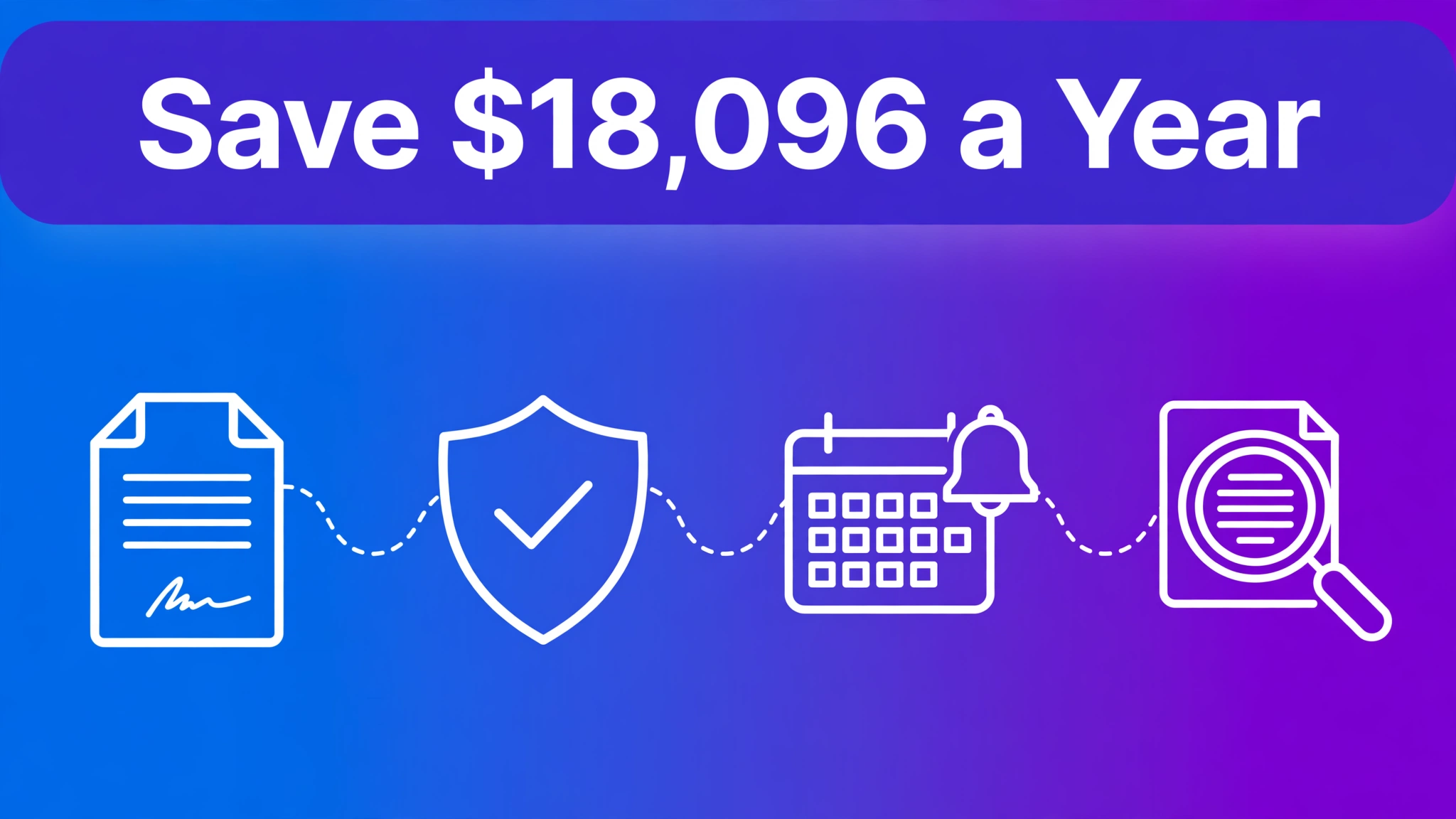
The best ai contract management tools for a small business are the ones that price like small-business software, not like a law firm retainer. For a three-person team signing about 15 contracts a month, PandaDoc Business is the cheapest sensible contract system at $49 per seat a month billed annually, which is $1,764 a year for three seats. DocuSign Standard is cheaper at $30 per user a month on an annual commitment, which is $1,080 a year for three users, but it is e-signature software, not a full contract system.Genie AI Business costs $259 a month billed annually, which is $3,108 a year for up to five users, and it is the pick when AI drafting and review matter more than signing. Concord Essentials costs $499 a month paid annually, which is $5,988 a year with five users included. ContractSafe Finalize starts at $660 a month billed annually, which is $7,920 a year at the smallest contract volume.Buying all five at those sensible tiers costs $19,860 a year. Picking PandaDoc Business alone costs $1,764 a year, so one right tool saves $18,096 a year. Every price below was checked on the vendor's official pricing page on 28 November 2026.
Quick Answer
The best ai contract management tools for a small business are the ones that price like small-business software, not like a law firm retainer. For a three-person team signing about 15 contracts a month, PandaDoc Business is the cheapest sensible contract system at $49 per seat a month billed annually, which is $1,764 a year for three seats. DocuSign Standard is cheaper at $30 per user a month on an annual commitment, which is $1,080 a year for three users, but it is e-signature software, not a full contract system.
Genie AI Business costs $259 a month billed annually, which is $3,108 a year for up to five users, and it is the pick when AI drafting and review matter more than signing. Concord Essentials costs $499 a month paid annually, which is $5,988 a year with five users included. ContractSafe Finalize starts at $660 a month billed annually, which is $7,920 a year at the smallest contract volume.
Buying all five at those sensible tiers costs $19,860 a year. Picking PandaDoc Business alone costs $1,764 a year, so one right tool saves $18,096 a year. Every price below was checked on the vendor’s official pricing page on 28 November 2026.
In this article
- How we compared the best ai contract management tools
- The five tools at a glance
- PandaDoc: contracts inside a wider document workflow
- Concord: full contract lifecycle, priced for five users
- ContractSafe: the repository that prices by contract count
- Genie AI: drafting and review first, signing second
- DocuSign: the signature standard, not a contract system
- The maths: a three-person team signing 15 contracts a month
- Five traps that catch contract-software buyers
- Strategic Pivot: count your contracts before you buy
- Pros and cons
- Our verdict
- Frequently asked questions
- Sources
How we compared the best ai contract management tools
A contract problem is rarely a signing problem. Signing takes four minutes. The expensive part is everything around it: finding the signed copy in March, remembering that a vendor contract renews in June, and knowing which version the client actually agreed to.
Our test business is a three-person team. One person sells, one person delivers, and one person does a bit of both. Together they sign about 15 contracts a month, which is 180 contracts a year, and their active contract repository stays at 100 contracts or fewer.
We compared the same four things for every tool. First, what a three-person team pays on annual billing. Second, which tier actually includes signing, approvals, and renewal tracking. Third, what the meter counts: seats, envelopes, documents, or stored contracts. Fourth, what a year costs at our test workload.
One honesty note before the detail. This category splits into three different products wearing one label. Some tools manage the whole contract lifecycle. Some draft and review contracts with AI. Some only collect signatures. The right pick depends on which of those three jobs is actually hurting.
The five tools at a glance
| Tool | Best for | Price checked 28 November 2026 | Free route |
|---|---|---|---|
| PandaDoc | Contracts plus proposals and forms | Starter $19/seat/mo; Business $49/seat/mo billed annually | Free plan, up to 5 documents a month |
| Concord | Full contract lifecycle for a team | Essentials $499/mo paid annually, 5 users included | Free trial; freemium by sales contact |
| ContractSafe | Searchable repository with renewal alerts | Organize from $450/mo; Finalize from $660/mo billed annually | Free trial |
| Genie AI | AI drafting, review, and redlines | Pro $59/mo billed annually; Business $259/mo billed annually | Trial plan at $0, no card needed |
| DocuSign | E-signatures everyone already trusts | Standard $30/user/mo; Business Pro $45/user/mo, annual commitment | Trial; no free plan |
The table hides the real split, which is the pricing unit. PandaDoc and DocuSign charge per seat. Concord charges a flat fee with five users included. ContractSafe charges by how many contracts you store, with unlimited users. Genie AI charges a flat team price with an AI usage meter behind it.
That split decides the winner. A three-person team pays for five Concord users whether it needs them or not. The same team pays ContractSafe nothing extra when a fourth person needs to read a contract, because users are unlimited.
PandaDoc: contracts inside a wider document workflow
PandaDoc is the broadest tool in this comparison. Its pricing page describes Starter as a plan for quickly creating and signing forms and agreements, and Business as the plan for sales proposals and integrated agreement workflows. Contracts sit comfortably inside both descriptions.
The Free plan costs $0 for up to 5 documents a month, according to PandaDoc’s own pricing FAQ. Starter costs $19 per seat a month billed annually, or $35 billed monthly. Business costs $49 per seat a month billed annually, or $65 billed monthly. Enterprise is quoted per seat or per document.
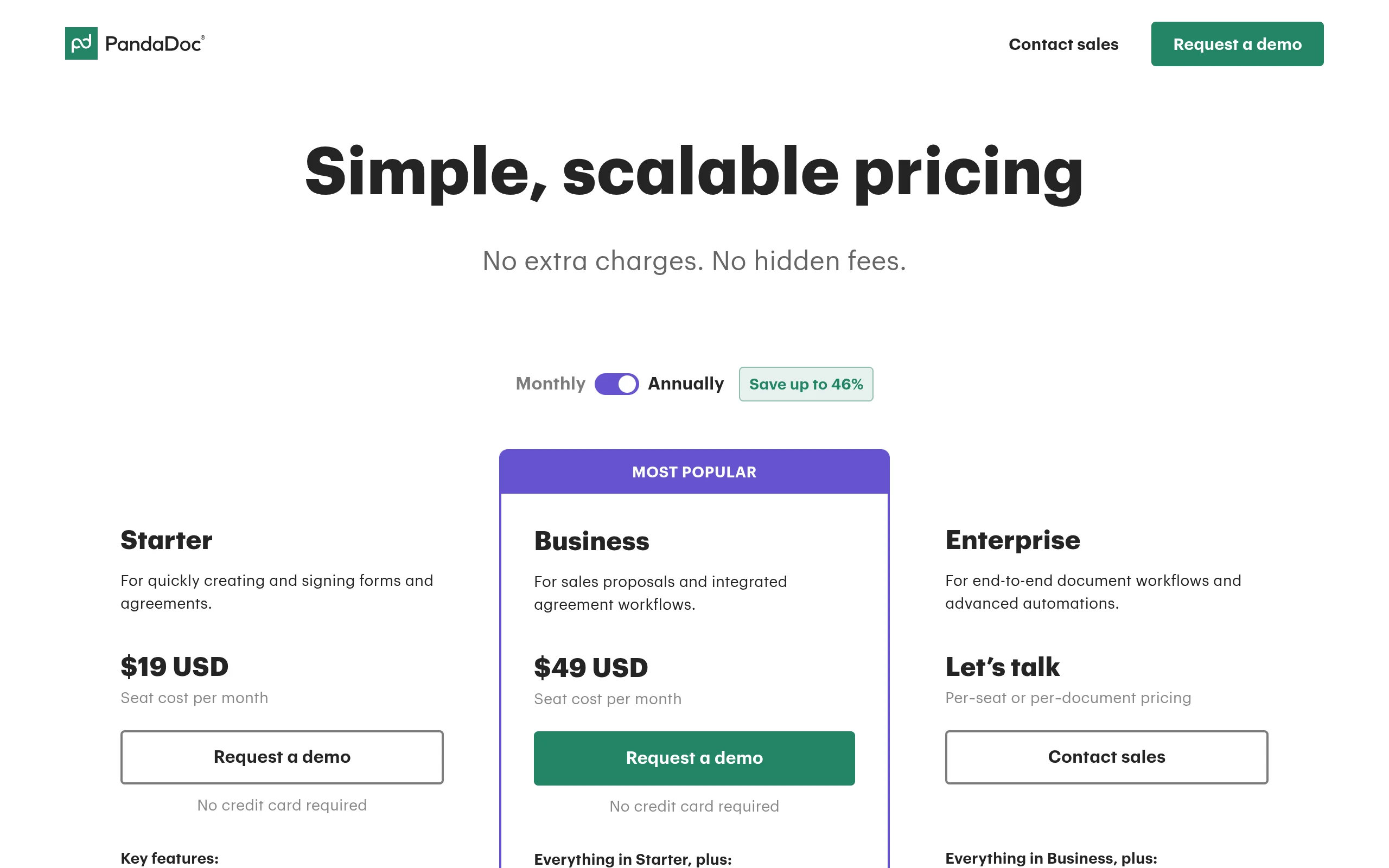
Business adds custom quotes and sales agreements, CRM integrations, custom branding and a content library, deal rooms, approval workflows, web forms, and bulk send. For our three-person team, Business costs $49 times 3 seats times 12 months, which is $1,764 a year billed annually.
Starter is the cheaper route when signing is the whole job. Three seats on Starter cost $19 times 3 times 12, which is $684 a year, with unlimited document uploads and e-signatures listed on the plan. The approval workflow and CRM integrations are the reasons to step up to Business.
The catch is the asterisk. Several Business features are marked as requiring Usage Credits, which PandaDoc uses when a document is created through an integration or an automated workflow like the API, Zapier, Make, forms, or bulk send. When credits run out, API document creation pauses, and other automated creation can be billed as overage at up to $5 per document if your order form has no per-unit price.
Manual work is simpler. A team that creates contracts by hand will not hit the credit meter often. A team that generates contracts from a CRM all day will, so that team should price the credit pack before signing up.
PandaDoc fits businesses that sign more than contracts: proposals, forms, renewals, and sales agreements in one system. If your only problem is a contract repository with renewal alerts, you are paying for a wider platform than your problem.
Concord: full contract lifecycle, priced for five users
Concord is the most complete contract lifecycle tool in this list that a small business can buy at a published price. Its pricing page headline promises contract management without the fine print, and the plans are Essentials, Business, and Enterprise.
Essentials costs $499 per month paid annually, with 5 users included and additional users at $49 a month. Business costs $899 per month paid annually, with additional users at $69 a month. Enterprise costs $1,299 per month paid annually, with additional users at $89 a month and volume discounts available.
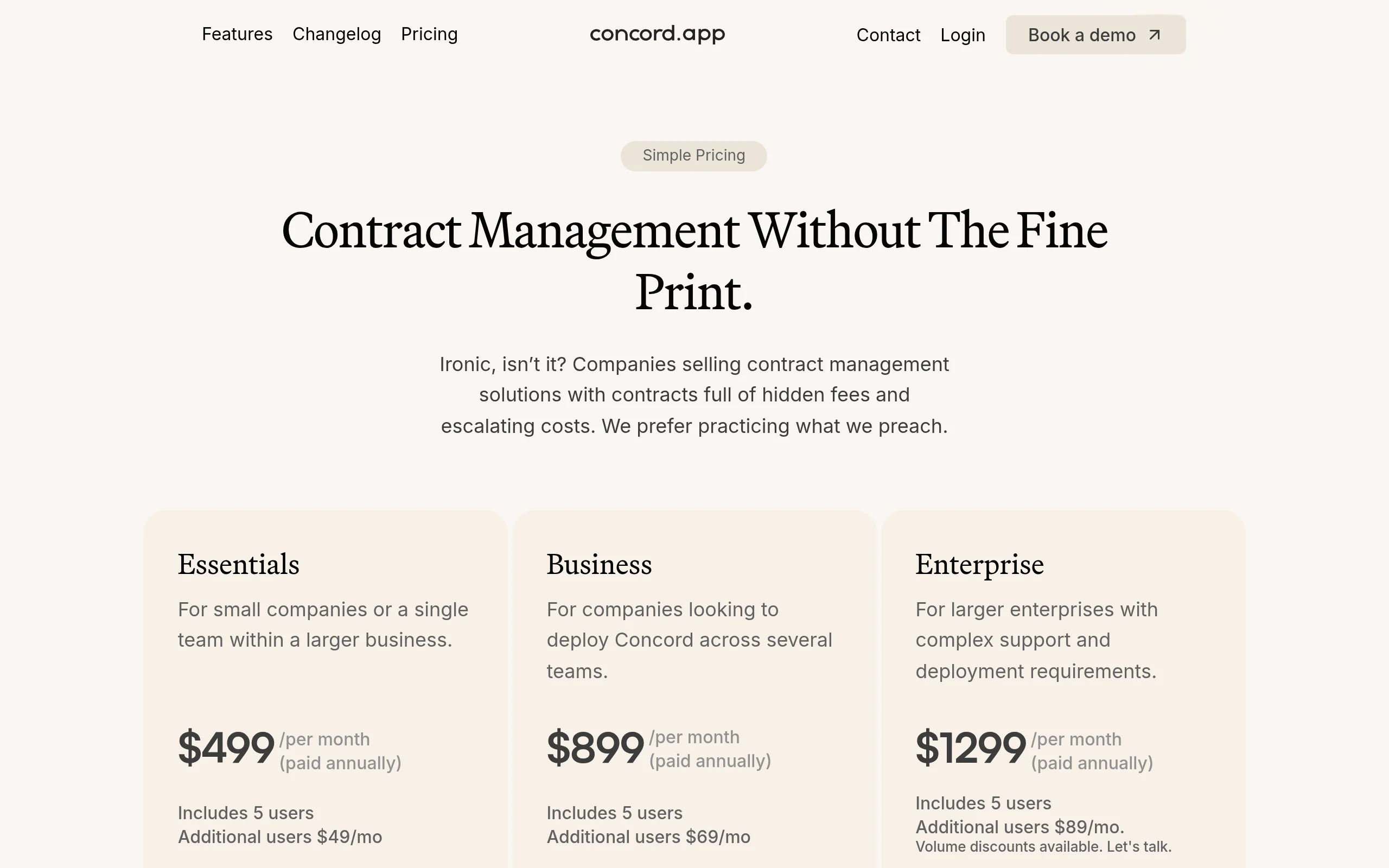
Essentials includes AI Copilot and extraction, unlimited e-signatures, unlimited documents, unlimited free viewers and guests, collaboration and negotiation tools, deadline reminders, and amendment management. For a contract workflow, that is a genuinely complete starting set.
Business adds intake forms, approval workflows, custom roles, custom teams, customized reports, and integrations with Salesforce, HubSpot, Google Drive, Box, Dropbox, and Zapier. Enterprise adds a clause library, subsidiary management, bulk send, an open API, and custom branding.
For our three-person team, Essentials costs $499 times 12, which is $5,988 a year. The five included users are the whole story: a three-person team pays the same $5,988 as a five-person team, because the price is a platform fee, not a seat price.
Concord also states that there are no setup or onboarding fees, and that the subscription includes support from a designated Customer Success Manager. That matters in a category where implementation fees often appear after the demo.
Concord fits a business whose contract volume has outgrown a shared drive and whose team is at least four or five people. It fits less well when three people sign 15 contracts a month, because the platform fee buys capacity the team will not use.
ContractSafe: the repository that prices by contract count
ContractSafe starts from the opposite end of the contract problem. Instead of drafting, it focuses on organizing the contracts you already have: secure storage, smart search, AI data extraction, and date reminders, with signing added on higher plans.
Organize starts at $450 a month billed annually, or $540 billed monthly. Finalize starts at $660 a month billed annually, or $792 billed monthly. Maximize starts at $815 a month billed annually, or $978 billed monthly. Annual billing is shown as saving 20% against monthly billing.
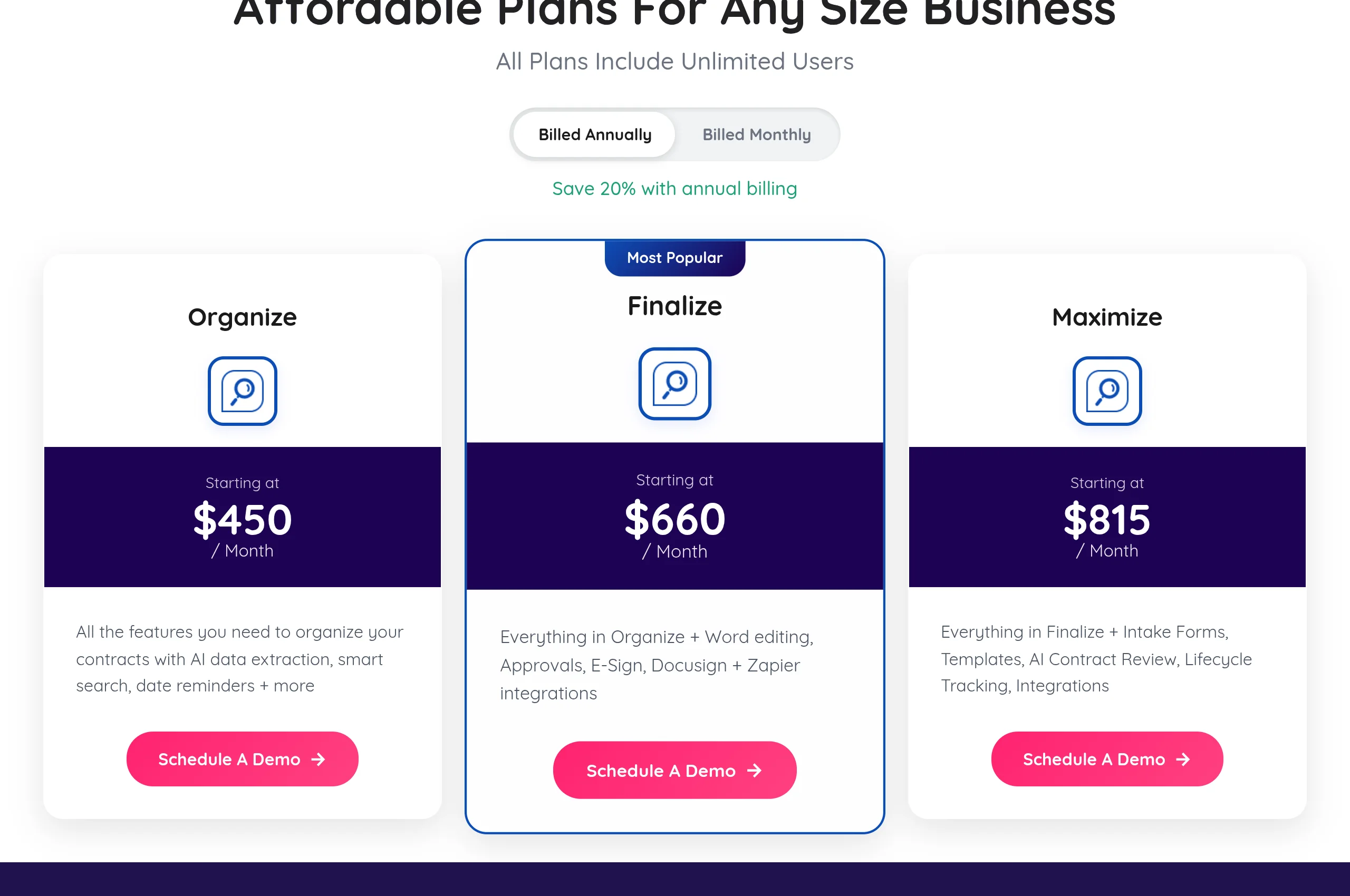
Every plan includes unlimited users. That single line changes the maths for growing teams: a new hire who needs to read contracts costs nothing extra, on any plan.
Organize covers AI data extraction, smart search, and date reminders. Finalize adds Word editing, approvals, e-sign, and DocuSign and Zapier integrations. Maximize adds intake forms, templates, AI Contract Review, lifecycle tracking, and integrations.
The word to watch is “starting.” ContractSafe prices rise with contract volume, so the starting prices above belong to the smallest repository band. Our test team keeps 100 active contracts or fewer, which is the band those starting prices describe. A business storing thousands of contracts will pay more, and should confirm its band before budgeting.
For our test team, Finalize is the sensible tier because it is the first plan with approvals and e-sign. Finalize costs $660 times 12, which is $7,920 a year billed annually. Organize alone costs $5,400 a year, but it organizes contracts without signing them.
ContractSafe fits a business drowning in signed contracts it cannot search, where renewal dates are the expensive surprise. It fits less well when the real problem is drafting new contracts quickly, because drafting depth sits in the Maximize plan’s templates and intake forms.
Genie AI: drafting and review first, signing second
Genie AI is the drafting specialist in this list. Its pricing page says Genie drafts, reviews, redlines, and negotiates on every paid plan, and the plans are Trial, Pro, Business, and Enterprise.
The Trial plan costs $0 for 1 user with limited AI tokens, and no card is needed. Downloads unlock on Pro, so the trial is for trying one task, not for producing finished documents.
Pro costs $59 a month billed annually, which is $708 a year, or $75 a month billed monthly. Pro covers 1 user, with AI usage of about 5 documents a month and tabular insights from 50 documents.
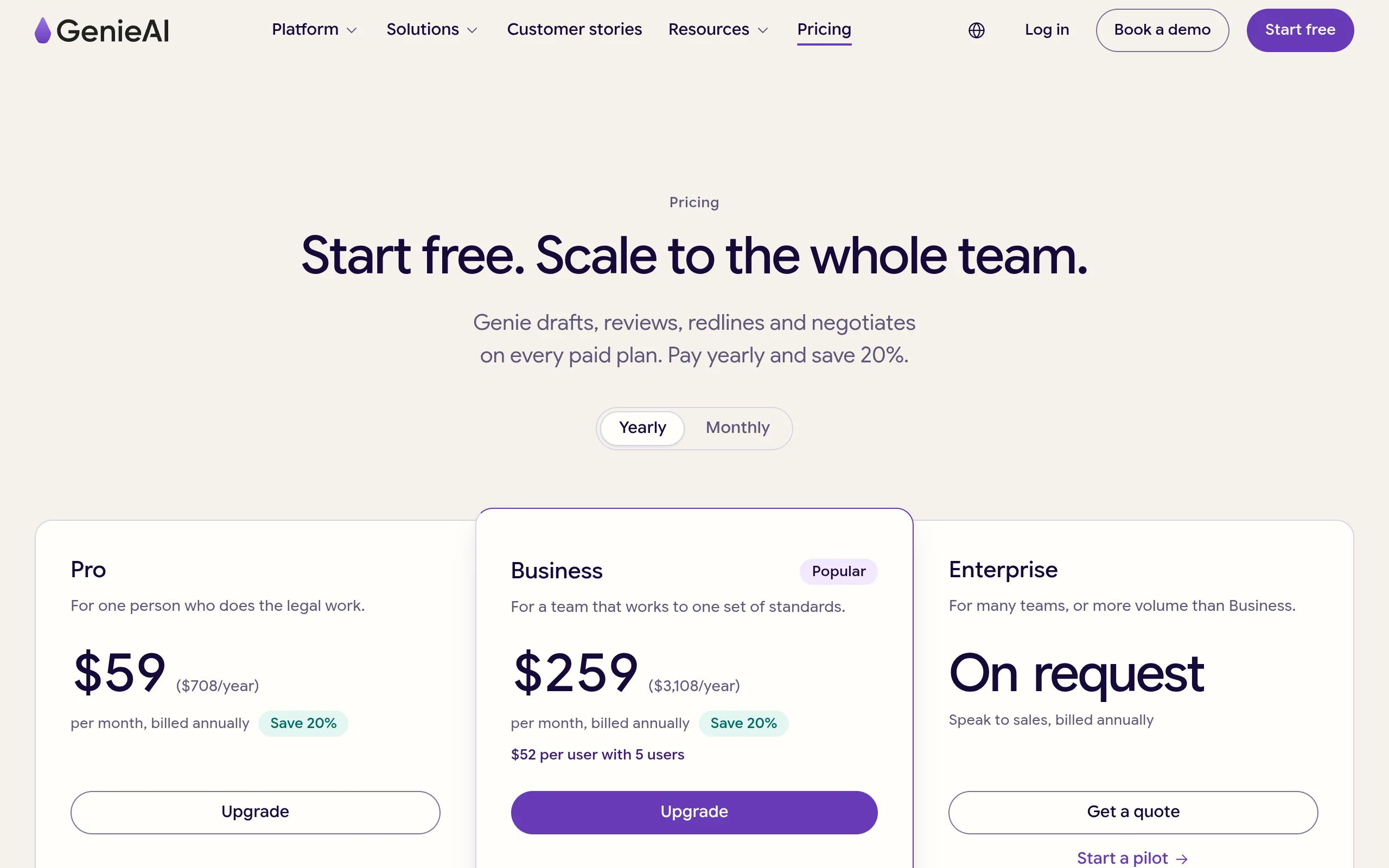
Business costs $259 a month billed annually, which is $3,108 a year, or $320 a month billed monthly. Business covers up to 5 users, with AI usage of about 50 documents a month shared by the team, and tabular insights from 250 documents.
Business is also where contract management appears. The Business plan adds Agentic Departments, described as a CLM with a signed-agreements repository, renewal and notice-period tracking, and obligation tracking, plus a company-wide library with team playbooks and templates.
For our three-person team, Business costs $3,108 a year, because Pro is a one-user plan and the repository features sit on Business. A solo founder who only needs drafting help can stay on Pro at $708 a year.
The meter here is AI tokens, expressed as roughly 5 documents a month on Pro and about 50 documents a month on Business. Our test team signs 15 contracts a month, so Business has headroom, but a team reviewing long counterparty contracts all day should count documents, not seats.
Genie AI fits businesses that receive contracts from clients and vendors and need AI review against their own standards. It fits less well as a pure signing tool, because signing runs through connected services rather than a built-in signature flow.
DocuSign: the signature standard, not a contract system
DocuSign is the name clients already recognize, and its pricing page is built around eSignature plans: Personal, Standard, Business Pro, and Enhanced plans priced by sales contact.
Personal costs $11 a month on an annual commitment billed monthly, which is $132 a year, with 5 envelopes every month. Standard costs $30 per user a month, which is a $360 annual commitment per user. Business Pro costs $45 per user a month, which is a $540 annual commitment per user. Additional tax may apply.
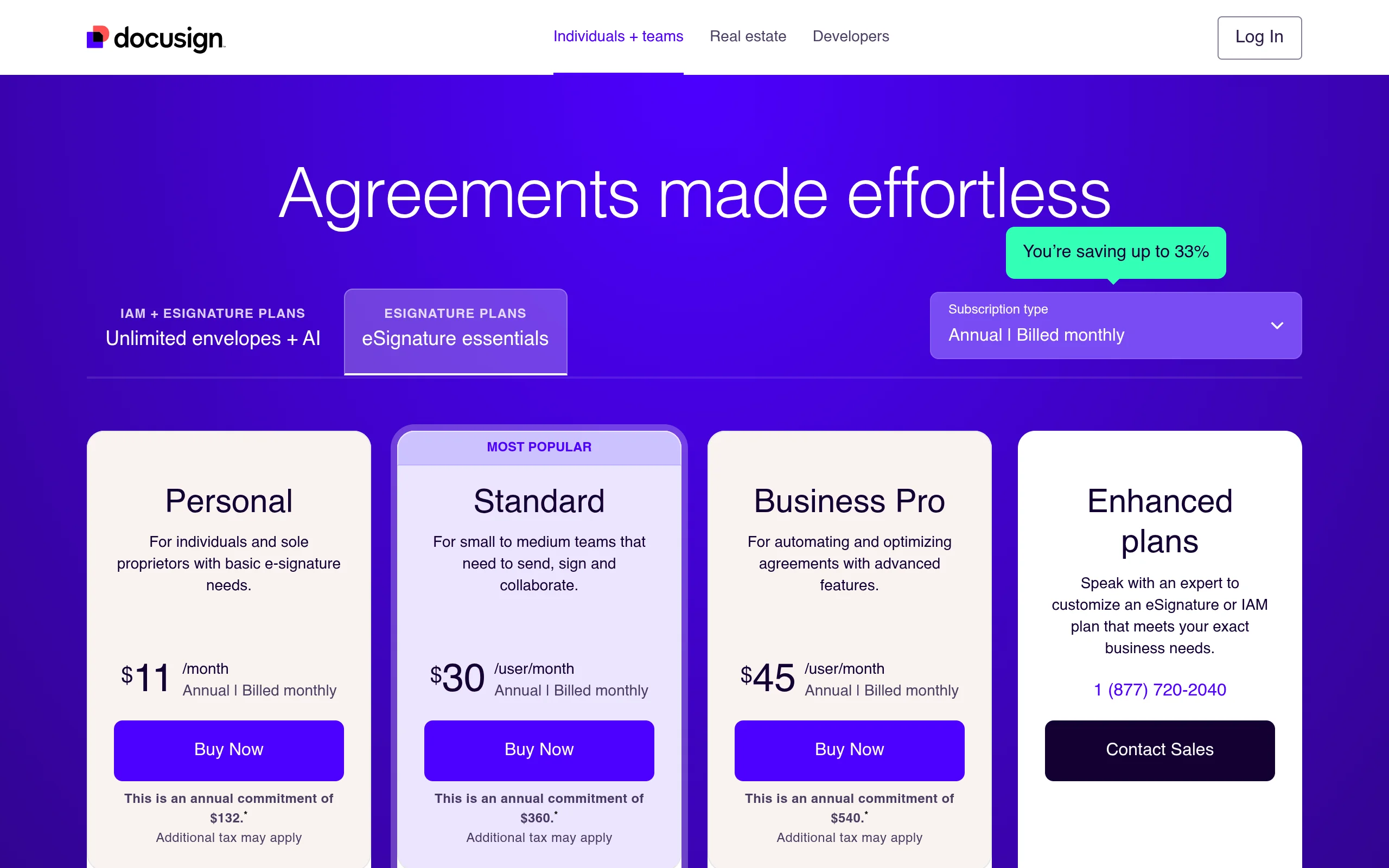
Standard and Business Pro annual plans include an envelope allowance of up to 100 envelopes per user per year. An envelope is one signature transaction, and it counts once when sent, whether or not it gets signed. Envelopes beyond the allowance are billed pay-as-you-go at a per-envelope rate.
For our three-person team on Standard, the cost is $30 times 3 users times 12 months, which is $1,080 a year. That buys 300 envelopes a year across the team, which covers our test workload of 180 contracts a year with room to spare.
DocuSign also sells Intelligent Agreement Management, described as an AI-assisted platform that can store, manage, and analyze signed agreements. That AI repository is a separate product line from the eSignature plans priced above, so a buyer who wants AI contract management should price IAM, not assume Standard includes it.
The honest summary is that DocuSign Standard is excellent signing software with a meter attached. It does not draft your contracts, track your renewal dates as a repository, or review counterparty paper against your playbook.
DocuSign fits businesses whose contracts are already written and whose only friction is getting them signed by people who trust the brand. It fits less well when the signed copies then disappear into an inbox, because the repository problem returns the moment the envelope closes.
The maths: a three-person team signing 15 contracts a month
Our test team has three users and signs 15 contracts a month, which is 180 contracts a year. All figures below use annual billing at the sensible tier for that team, checked on 28 November 2026.
PandaDoc Business costs $1,764 a year. Concord Essentials costs $5,988 a year. ContractSafe Finalize starts at $7,920 a year at the smallest contract volume. Genie AI Business costs $3,108 a year. DocuSign Standard costs $1,080 a year.
Buying all five costs $1,764 plus $5,988 plus $7,920 plus $3,108 plus $1,080, which is $19,860 a year. Nobody needs five contract tools, but the stack total shows what scattered subscriptions quietly add up to.
Picking PandaDoc Business alone costs $1,764 a year, so one right tool saves $18,096 a year against the full stack. Per contract, the lean choice costs about $9.80, while the full stack costs about $110.33 for the same 180 contracts.
Now price the signing-only route honestly. If your contracts are already written and you only need signatures, DocuSign Standard at $1,080 a year is the lean choice, at about $6.00 per contract. Against the same $19,860 stack, that saves $18,780 a year.
Concord shows why included seats belong in every comparison. A five-person team pays the same $5,988 as our three-person team, so Concord gets cheaper per person as the team grows. ContractSafe shows the opposite shape: users are unlimited, but the bill grows with stored contracts instead.
Five traps that catch contract-software buyers
The first trap is the label. Drafting tools, repositories, and signature tools all call themselves contract management. Buying a signature tool to solve a renewal-tracking problem leaves the expensive problem untouched.
The second trap is the included-seat floor. Concord’s $499 a month includes 5 users, so a three-person team pays for two seats it does not use. Platform fees reward teams that grow into them and punish teams that do not.
The third trap is the envelope meter. DocuSign Standard includes 100 envelopes per user per year, and every sent envelope counts, signed or not. A team that sends contracts that die unsigned still spends its allowance.
The fourth trap is the volume band. ContractSafe’s starting prices belong to the smallest repository. A business that stores every signed contract forever will climb bands, so budget for the repository you will have in year three, not month one.
The fifth trap is the AI meter. Genie AI expresses usage as documents a month, and PandaDoc charges Usage Credits for automated document creation. AI help is rarely unlimited, so count your busiest month before you choose a tier.
Strategic Pivot: count your contracts before you buy
Before you buy any of these tools, write down three numbers: how many contracts you sign in your busiest month, how many signed contracts you need to search, and whether your pain is drafting, signing, or remembering renewal dates. Those three answers delete most of this list in about a minute.
Then run the surviving tool through our free AI Cost Calculator with your real seat count and contract volume. A tool that prevents one missed renewal pays for itself quickly, and a tool nobody opens is expensive at any price.
Pros and cons
Pros of buying contract software at all:
- Renewal and deadline reminders turn expensive surprises into calendar events.
- A searchable repository ends the hunt through inboxes and shared drives.
- Templates and approvals stop every contract starting from a blank page.
- AI extraction and review, where the plan includes them, surface key dates and risky clauses in minutes.
Cons to weigh before you pay:
- Platform fees punish small teams that sign few contracts.
- Envelope, document, and credit meters can raise the bill in your busiest month.
- Tier gates push approvals, repositories, and AI review into higher plans.
- A new tool only pays back if every signed contract actually lands in it.
Our verdict
For most three-person businesses, start with PandaDoc Business at $1,764 a year. It covers creating, approving, and signing contracts, and it handles proposals and forms in the same system. If signing is truly the whole job, PandaDoc Starter at $684 a year is the cheaper start.
Choose DocuSign Standard at $1,080 a year when your contracts are already written and client trust in the signature brand is the deciding factor. Count your envelopes first, because 100 per user per year is the real limit.
Choose Genie AI Business at $3,108 a year when counterparty contracts land on your desk and AI review against your own standards is the real problem. A solo operator can start on Pro at $708 a year.
Choose Concord Essentials at $5,988 a year when your team is four or five people and you want one lifecycle system with unlimited documents and signatures. Choose ContractSafe Finalize, starting at $7,920 a year, when the repository and renewal alerts matter more than drafting, and confirm your contract-volume band before you budget.
Whatever you pick, trial it on one real, awkward contract. The right tool is the one your team still opens when a renewal notice arrives, not the one that demos best on a quiet Tuesday.
Frequently asked questions
What is the cheapest ai contract management tool for a small team?
PandaDoc Business is the cheapest sensible contract system here at $49 per seat a month billed annually, which is $1,764 a year for three seats. DocuSign Standard is cheaper at $1,080 a year for three users, but it is e-signature software rather than a full contract system.
Which contract tool includes AI drafting and review?
Genie AI drafts, reviews, redlines, and negotiates on every paid plan, with Pro at $59 a month billed annually for one user. Its Business plan at $259 a month billed annually adds the signed-agreements repository with renewal and obligation tracking.
Does PandaDoc have a free plan?
Yes. PandaDoc’s pricing FAQ says the Free plan is $0 for up to 5 documents a month. Starter costs $19 per seat a month billed annually, and Business costs $49 per seat a month billed annually.
Why does ContractSafe say prices start at $450 a month?
ContractSafe prices rise with contract volume, so $450 a month billed annually is the Organize starting price for the smallest repository band. Finalize, the first plan with approvals and e-sign, starts at $660 a month billed annually, and every plan includes unlimited users.
How much should a three-person business budget for contract software?
Budget $1,080 to $1,764 a year for a lean three-person setup with DocuSign Standard or PandaDoc Business. Budget $3,108 to $5,988 a year if you choose Genie AI Business for AI review or Concord Essentials for a full lifecycle platform with five users included.
Sources
Prices were checked on each vendor’s official pricing page on 28 November 2026: PandaDoc pricing, Concord pricing, ContractSafe pricing, Genie AI pricing, and DocuSign pricing. Feature and limit details come from those same official pages.
Price note — updated 28 November 2026: Prices in this post were checked on 28 November 2026. When you are reading this, the price may be lower or higher — always check the official pricing page before you buy.
Pros
- Renewal and deadline reminders turn expensive surprises into calendar events.
- A searchable repository ends the hunt through inboxes and shared drives.
- Templates and approvals stop every contract starting from a blank page.
- AI extraction and review, where the plan includes them, surface key dates and risky clauses in minutes.
Cons
- Platform fees punish small teams that sign few contracts.
- Envelope, document, and credit meters can raise the bill in your busiest month.
- Tier gates push approvals, repositories, and AI review into higher plans.
- A new tool only pays back if every signed contract actually lands in it.
For most three-person businesses, start with PandaDoc Business at $1,764 a year. It covers creating, approving, and signing contracts, and it handles proposals and forms in the same system. If signing is truly the whole job, PandaDoc Starter at $684 a year is the cheaper start.Choose DocuSign Standard at $1,080 a year when your contracts are already written and client trust in the signature brand is the deciding factor. Count your envelopes first, because 100 per user per year is the real limit.Choose Genie AI Business at $3,108 a year when counterparty contracts land on your desk and AI review against your own standards is the real problem. A solo operator can start on Pro at $708 a year.Choose Concord Essentials at $5,988 a year when your team is four or five people and you want one lifecycle system with unlimited documents and signatures. Choose ContractSafe Finalize, starting at $7,920 a year, when the repository and renewal alerts matter more than drafting, and confirm your contract-volume band before you budget.Whatever you pick, trial it on one real, awkward contract. The right tool is the one your team still opens when a renewal notice arrives, not the one that demos best on a quiet Tuesday.