
For a 12-room hotel or B&B taking 1,200 bookings a year, eviivo is the cheapest route to real AI: its Guest Manager add-on puts an AI concierge in your inbox for $3 per room a month, and its published 10-room calculator floor with Guest and Payment Manager is $140 a month before booking fees. Little Hotelier Pro costs $215 a month at 12 rooms on its pricing selector. RoomRaccoon bundles everything but keeps its AI pricing on the Pro tier at $542 a month on annual billing. Duve adds AI guest messaging on top of a PMS you already run, with AI priced by quote. Mews is the most complete operating system here and publishes no price at all.
A 12-room property rarely loses money on the room itself. It leaks money in the gaps around the room: the guest message answered six hours late, the Saturday rate left at Tuesday’s price, the review nobody replied to, the direct booking that went to an OTA because the website engine was clunky.
That gap work is what the best ai tools for hotels and bed and breakfasts are supposed to absorb. The honest version is narrower. Some of these tools run your reservations and answer guests with real AI. Some reprice your rooms from demand data. One sits on top of a system you already own. One will not tell you its price until a sales call.
We compared five tools for the same 12-room property and checked every price on the vendor’s own page on 26 November 2026. No roundup prices, and no tool here pays us anything. Where a vendor does not print a price, we say so instead of filling the gap with a guess.
Quick Answer
For a 12-room hotel or B&B taking 1,200 bookings a year, eviivo is the cheapest route to real AI: its Guest Manager add-on puts an AI concierge in your inbox for $3 per room a month, and its published 10-room calculator floor with Guest and Payment Manager is $140 a month before booking fees. Little Hotelier Pro costs $215 a month at 12 rooms on its pricing selector. RoomRaccoon bundles everything but keeps its AI pricing on the Pro tier at $542 a month on annual billing. Duve adds AI guest messaging on top of a PMS you already run, with AI priced by quote. Mews is the most complete operating system here and publishes no price at all.
In this article
- How we compared the best ai tools for hotels and bed and breakfasts
- The five tools at a glance
- eviivo: the cheapest native AI for a small property
- Little Hotelier: the small-property all-in-one, with a booking-fee trap
- RoomRaccoon: everything bundled, AI pricing at the top
- Duve: the guest-journey layer on top of your PMS
- Mews: the full operating system, priced by quote
- The maths: what five tools really cost a 12-room property
- Five traps that catch small hotels and B&Bs
- What to buy first
- Pros and cons
- Our verdict
- Frequently asked questions
How we compared the best ai tools for hotels and bed and breakfasts
Every price in this guide is for the same imaginary business: one 12-room hotel or B&B, open all year, taking 1,200 confirmed bookings at an average booking value of $300. That is $360,000 of booked revenue a year, roughly 55% occupancy at two-night average stays. Where a vendor charges per room, per booking, or a percentage of booking value, we run those same 12 rooms and 1,200 bookings through the formula.
We judged each tool on five things: year-one cost for 12 rooms on the cheapest sensible configuration; whether the AI is real, and which plan or add-on unlocks it; whether reservations, channel sync, and guest messaging live in one system or three; how the price moves when bookings grow; and which fees the vendor refuses to print.
One honesty note before the numbers. These five tools do three different jobs. eviivo, Little Hotelier, and RoomRaccoon are property systems: reservations calendar, channel manager, booking engine, and payments in one subscription. Duve is a guest-journey layer that connects to a property system you already have. Mews is a full hotel operating system that replaces the property system and much more. You would run one property system, maybe add Duve on top, and treat Mews as the alternative universe.
A second honesty note: the AI labels vary in honesty. eviivo sells an AI concierge and dynamic AI pricing inside its own platform. RoomRaccoon reserves its AI pricing for the Pro tier and gives every plan an AI support assistant. Little Hotelier’s pricing intelligence is data-driven recommendations powered by SiteMinder’s AI engine, not a guest-facing chatbot. Duve’s AI replies and prioritisation are paid add-ons priced by quote. We price each tool for the job it actually does, not the badge on the homepage.
The five tools at a glance
| Tool | Best for | Starting price | Free plan or trial | Year-one cost for 12 rooms |
|---|---|---|---|---|
| eviivo | Cheapest native AI messaging and pricing | From $50 a month, single property | No free trial; first 30 days free on onboarding | From $2,280 at the 10-room calculator floor; 12-room base volume-quoted |
| Little Hotelier | Small-property all-in-one with broad distribution | Pro from $215 a month at 12 rooms, excluding tax | 30-day free trial | $2,580 subscription; variable booking fees apply |
| RoomRaccoon | Bundled PMS, channel manager, booking engine, payments | Entry $207 a month at 12 rooms, annual billing | 14-day demo account after a demo call | $2,484 on Entry; $6,504 on Pro with AI pricing |
| Duve | AI guest messaging and upsells on top of your PMS | Minimum packages from $120 a month | No public trial | From $2,400 on Premium, AI add-ons unpriced |
| Mews | Full operating system for growing hotels | Custom quote, per room | No public trial | Quote only |
The table hides the two numbers that decide most real bills. The first is the percentage or per-booking fee: Little Hotelier’s page defines a 1% booking fee where it applies, while eviivo takes a flat $0.50 per confirmed booking when you use its messaging or payment services. The second is the AI gate: the feature in the headline often sits one tier or one add-on above the price in the headline. The sections below price both.
eviivo: the cheapest native AI for a small property
eviivo is the only tool here that sells AI guest messaging and AI pricing as priced line items inside a small-property system. Its core subscription covers the booking calendar and property management system, a booking engine and website, a channel manager with two-way sync to the major booking sites, and a mobile app, with unlimited users. The AI sits in two places: Guest Manager, which unifies guest messages and adds an AI-powered 24/7 concierge, and a dynamic AI pricing tool that explains every price change it recommends.
The pricing page starts single-property pricing at $50 a month and multi-property at $125, then tailors the exact subscription to your inventory. Its calculator prices 10 bedrooms at $100 a month with no add-ons and $140 a month with Guest Manager and Payment Manager added; above 10 rooms it moves to volume pricing by contact, so a 12-room base price is quoted rather than printed. The add-ons are printed per room: Payment Manager adds $1 per room, Performance Manager $2, Guest Manager $3, and Owner Manager $3. For 12 rooms, Guest Manager costs $36 a month, or $432 a year, and Payment Manager costs $12 a month, or $144 a year.
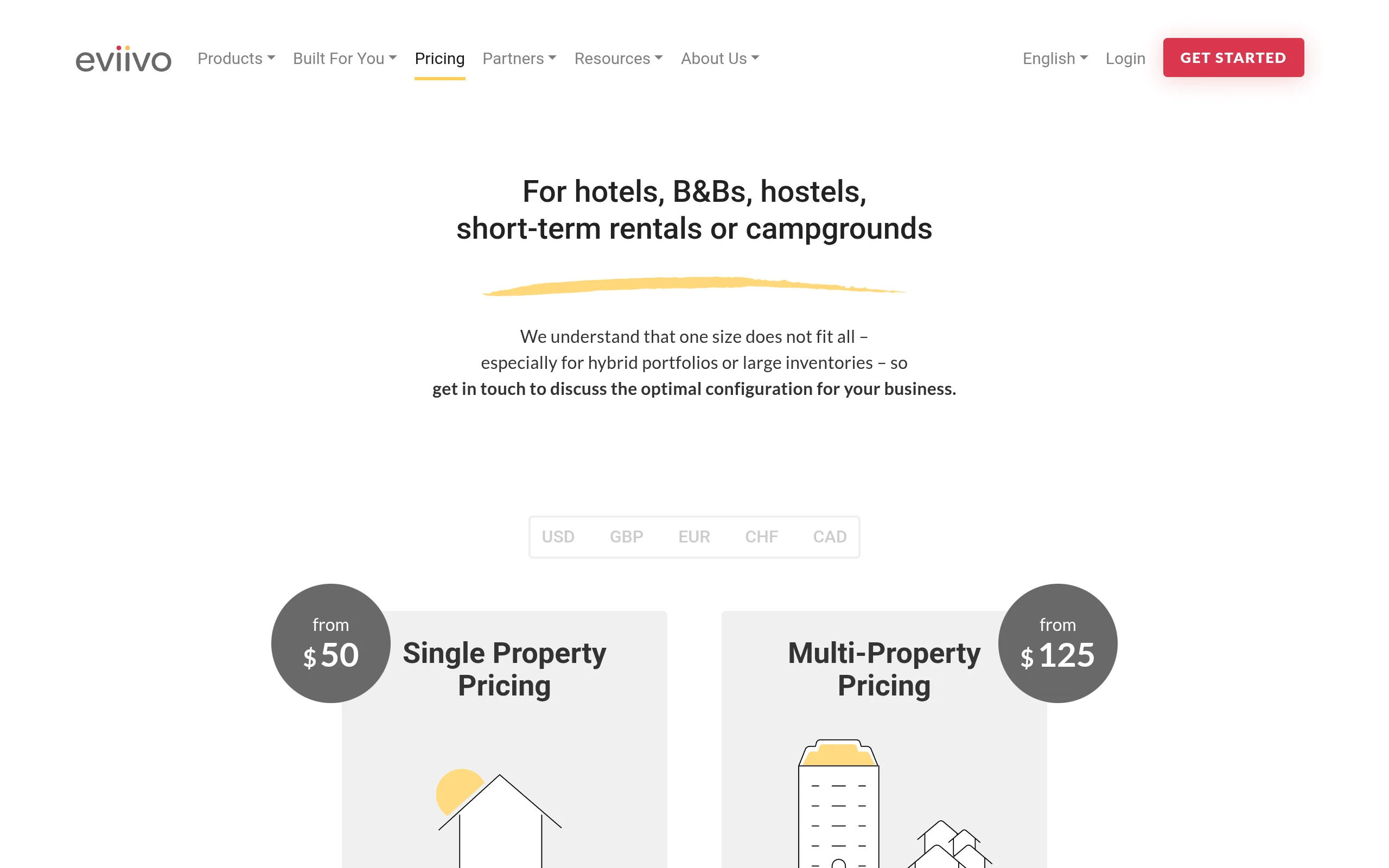
One usage fee needs care. eviivo charges no percentage booking fee and no commission, but if you use its messaging or payment services it adds a flat $0.50 per confirmed booking, however many messages or payments that booking involves. At 1,200 bookings a year that fee is $600. It is predictable in a way percentage fees are not: a $600 booking and a $120 booking cost you the same fifty cents.
There is no free trial in the usual sense. eviivo’s FAQ says so plainly and offers a personalised demo instead, then gives new customers the first 30 days free after onboarding, with billing in arrears, even though the pricing page also carries a “14 Days Free!” badge. Budget on the FAQ version, not the badge. For a 12-room property, the AI configuration to price is the base subscription plus Guest Manager, with Payment Manager added only if you want eviivo’s payment automation. That combination is the cheapest verified route in this guide to an AI that answers guests inside the same system that holds the reservation.
Little Hotelier: the small-property all-in-one, with a booking-fee trap
Little Hotelier is SiteMinder’s system built only for small properties: a synchronised calendar for bookings, rooms, and guests, a channel manager connecting to 450+ booking channels, a direct booking engine, payments, and a mobile app. Its revenue help comes from data-driven pricing recommendations and competitor rate comparisons, powered by SiteMinder iQ, the AI engine SiteMinder describes as analysing nearly 4 billion data points across its platform. It is pricing intelligence, not a guest chatbot, and the distinction matters if answering messages is your pain.
The pricing page asks how many bookable rooms you have, then prices the plan from that count. Set to 12 rooms, the selector showed Pro from $215 a month excluding tax, with a “Free 3 months” badge and a footnote that variable booking fees apply on Little Hotelier bookings net of cancellations. A 30-day free trial covers the full product you subscribe to, with payment details taken but nothing charged until the free period ends, and there is no lock-in contract.
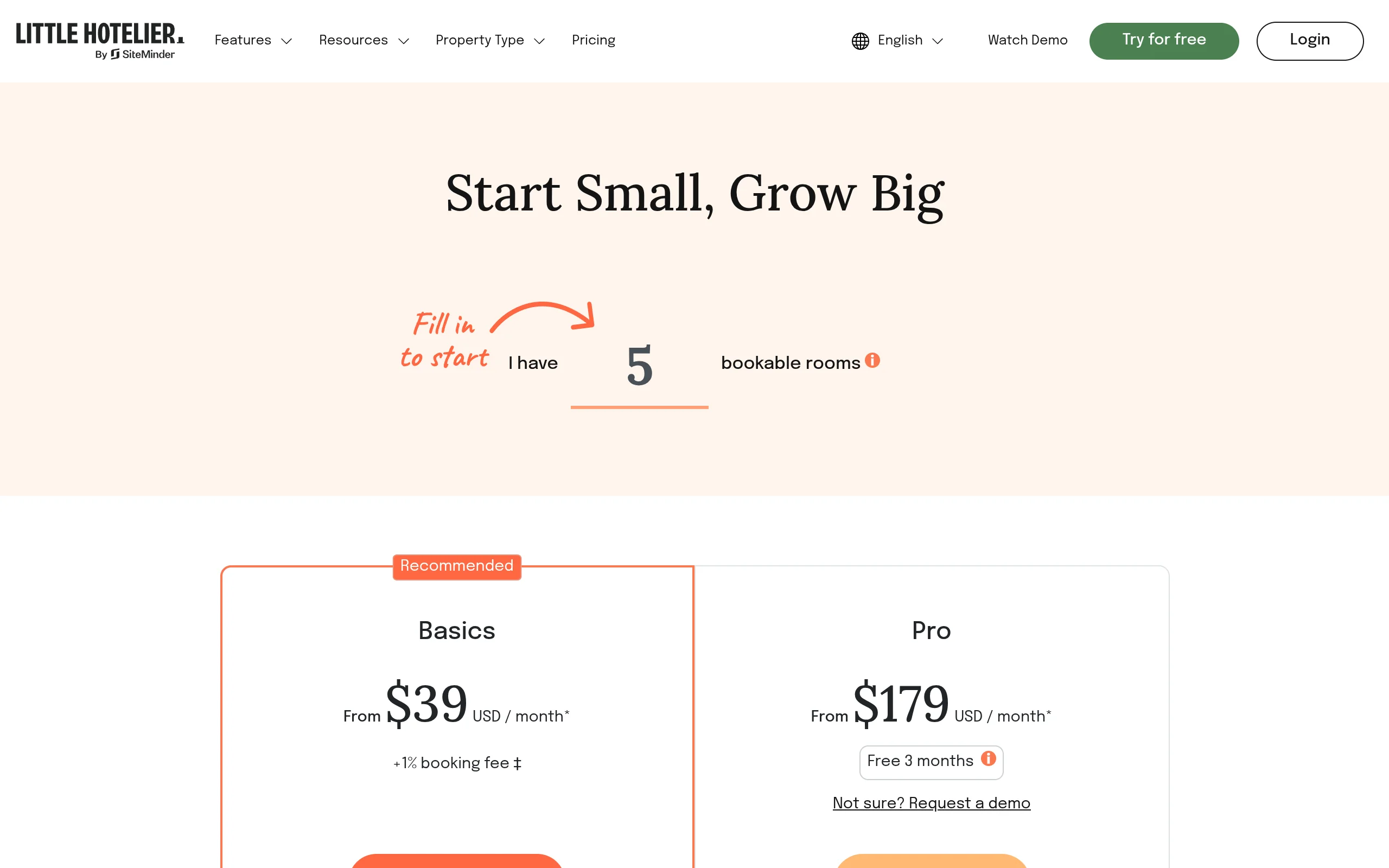
The booking fee is the number to pin down before you budget. Little Hotelier’s own FAQ defines the booking fee as 1% of gross booking value excluding taxes, add-ons, and cancellations, giving the example of $10 on $1,000 of bookings. If a 1% fee applied to all of our property’s $360,000 of annual bookings, it would add $3,600 a year on top of Pro’s $2,580 subscription. Which bookings attract the variable fee is exactly what to confirm in the trial, in writing, because at this volume the fee line can exceed the subscription itself.
Little Hotelier’s strength is distribution depth in a tool a small team can actually run, plus 24/7 support in 10 languages. Its limits are the ones the pricing page does not shout about: the price comes from the room-count selector rather than a printed rate card, so 5 rooms showed $179 a month where 12 rooms showed $215; add-ons such as the website builder and guest engagement sit outside the headline price; and payment transaction rates are not printed on the pricing page. Confirm all three in the trial before treating $215 as the whole bill.
RoomRaccoon: everything bundled, AI pricing at the top
RoomRaccoon sells the bundle small properties usually assemble from three vendors: property management system, channel manager, booking engine, and integrated payments in every plan, with online check-in, automatic invoices, and guest email templates included from Entry. Its pricing page is a calculator: enter your room count, toggle monthly or annual billing (annual saves 20%), and four tiers price themselves. Entry allows 2 users and 3 booking channels; Essentials raises both and adds dynamic pricing rules; Premium removes the channel cap; Pro adds unlimited users, financial reporting, and AI pricing with RaccoonRev Plus.
That last line is the catch. RaccoonRev Plus, the AI tool that analyses booking pace, competitor rates, local events, and weather to recommend rates up to a year ahead, is a Pro feature. Every plan includes Rocco, a 24/7 AI support assistant, but support AI is not revenue AI. A property that wants the pricing brain must budget the top tier, not the tier in the advertisement.
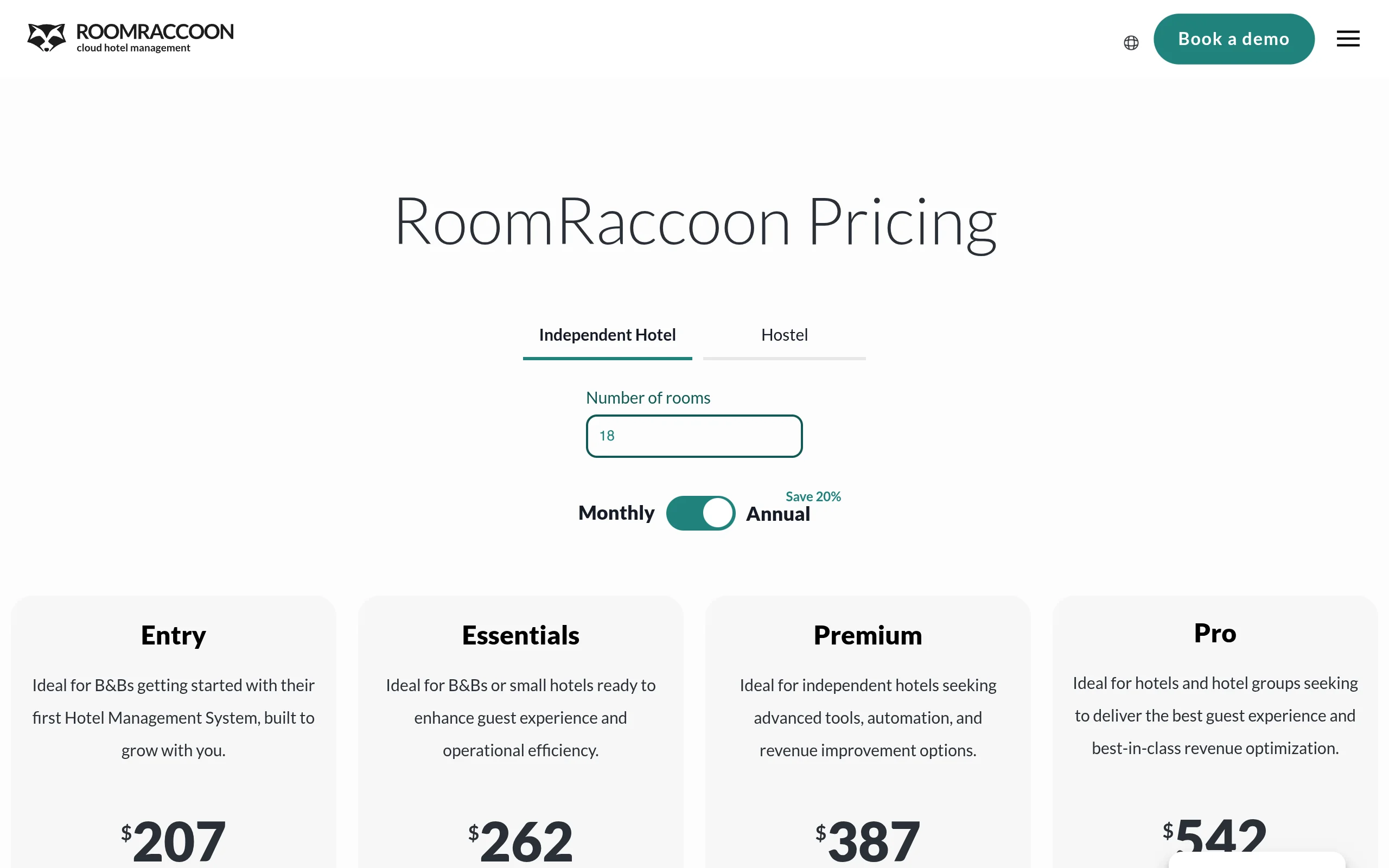
At 12 rooms on annual billing, the calculator prices the tiers at $207 a month for Entry, $262 for Essentials, $387 for Premium, and $542 for Pro; monthly billing runs $248, $315, $464, and $651. The trial is also gated: you complete a demo call first, then request a 14-day demo account, with no credit card required. Payment transaction fees and card-machine fees sit outside the subscription and are charged separately, at rates the pricing page does not print.
For our 12-room property, RoomRaccoon’s appeal is consolidation with a visible price: one bill for the system, the channels, the booking engine, and payments. Its cost is the climb to Pro for AI pricing, plus upgrade slots for tools like upsells, housekeeping, and a website. Price the tier you would still be on in your busiest month, because that is the tier the AI lives on.
Duve: the guest-journey layer on top of your PMS
Duve does not run your reservations. It connects to the property system you already have and owns everything the guest touches before, during, and after the stay: online check-in with ID upload, a branded guest app, a communication hub across SMS, WhatsApp, email, and chat, upsells such as room upgrades and late checkout, and payments. For a property whose front desk drowns in arrival-day messages, that layer is the product.
The AI is real and it is metered by quote. DuveAI includes SmartReply, which drafts or sends AI replies as an AI team member, and SmartPriority, which triages incoming conversations. Duve’s own help center states both are paid add-ons on top of the subscription, with current pricing available from support or your customer success manager. WhatsApp usage adds Meta’s conversation fees plus Duve’s operational fee of €0.012 per message, and SMS is priced per country.
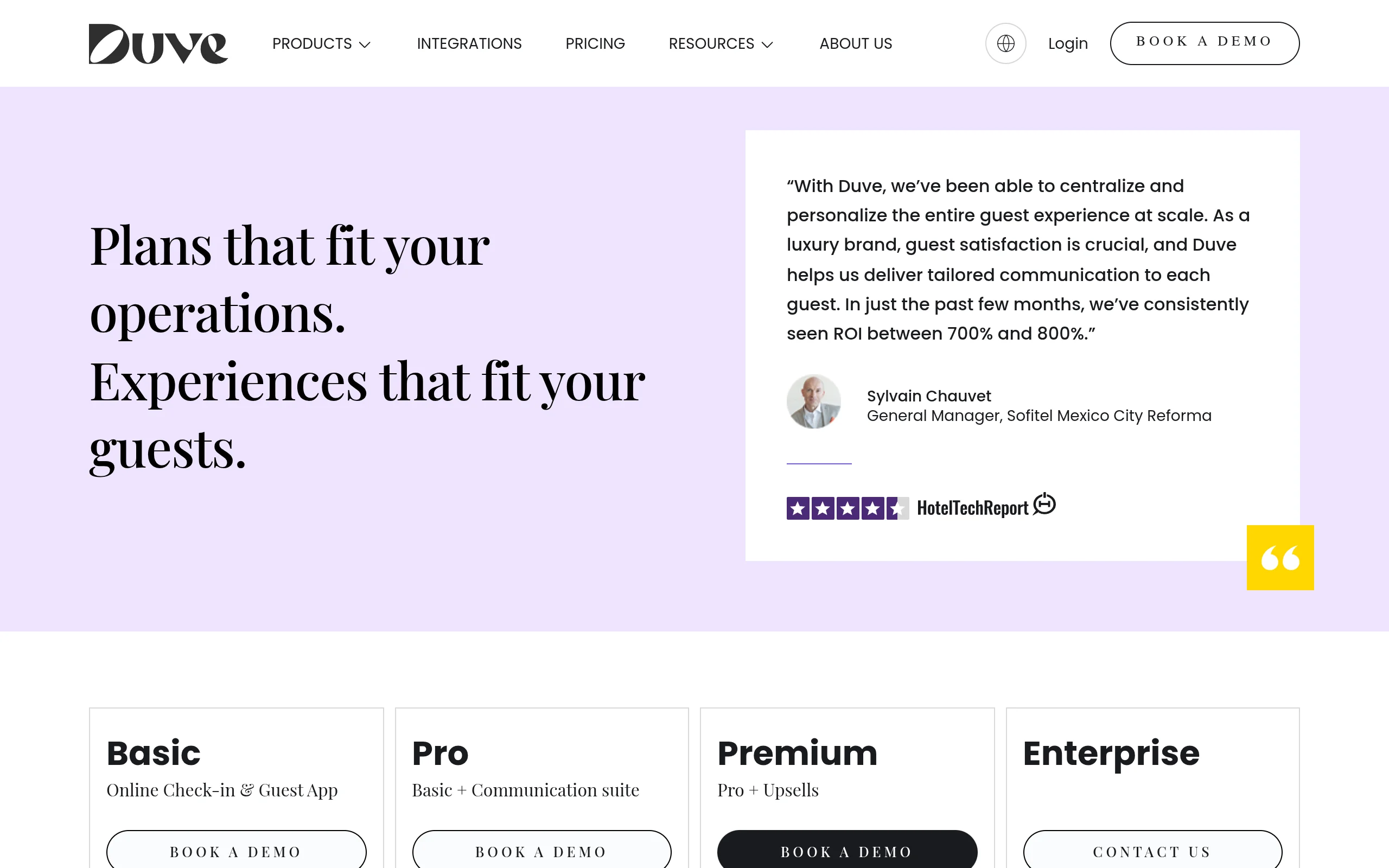
Duve’s pricing page sells three minimum packages: Basic at $120 a month for online check-in and the guest app, Pro at $150 a month adding the communication suite, and Premium at $200 a month adding upsells. Enterprise is contact-us. The page publishes no per-room rate and no onboarding fee, and every plan’s call to action is a demo booking, so a 12-room property should treat $200 a month as the floor for Premium, not a quote. The communication hub itself starts at the Pro plan; Basic accounts get an upgrade prompt where the chat feature should be.
For our property, Duve only makes sense as a second purchase: a property system first, then Duve if guest messaging volume justifies it. Its year-one floor on Premium is $2,400, before the AI add-ons it does not price publicly and before WhatsApp and SMS usage fees. A 12-room B&B whose owner answers messages from the same phone that takes bookings should trial its property system’s inbox first and add Duve when message volume, not marketing, demands it.
Mews: the full operating system, priced by quote
Mews is the heavyweight of the five. Its pricing page sells two depths of one operating system: Mews Core for less complex properties, and Mews Pro with property management, revenue management with autopilot optimisation up to 24 months ahead, a 400-channel manager, AI messaging via WhatsApp and SMS, self-serve kiosks, digital keys, embedded payments, a booking engine, business intelligence, and a housekeeping suite. On features alone, it is the most complete answer to the brief.
On price, Mews publishes nothing. Both plans say “Get pricing,” Enterprise says “talk to sales,” and the page explains that pricing is per room, varies by business, and is quoted by the sales team. Payment processing is charged separately, with full details shared as part of the quote. Third-party directories quote per-room ranges for Mews, and this guide does not repeat them, because a directory’s range is not a price you can budget against.
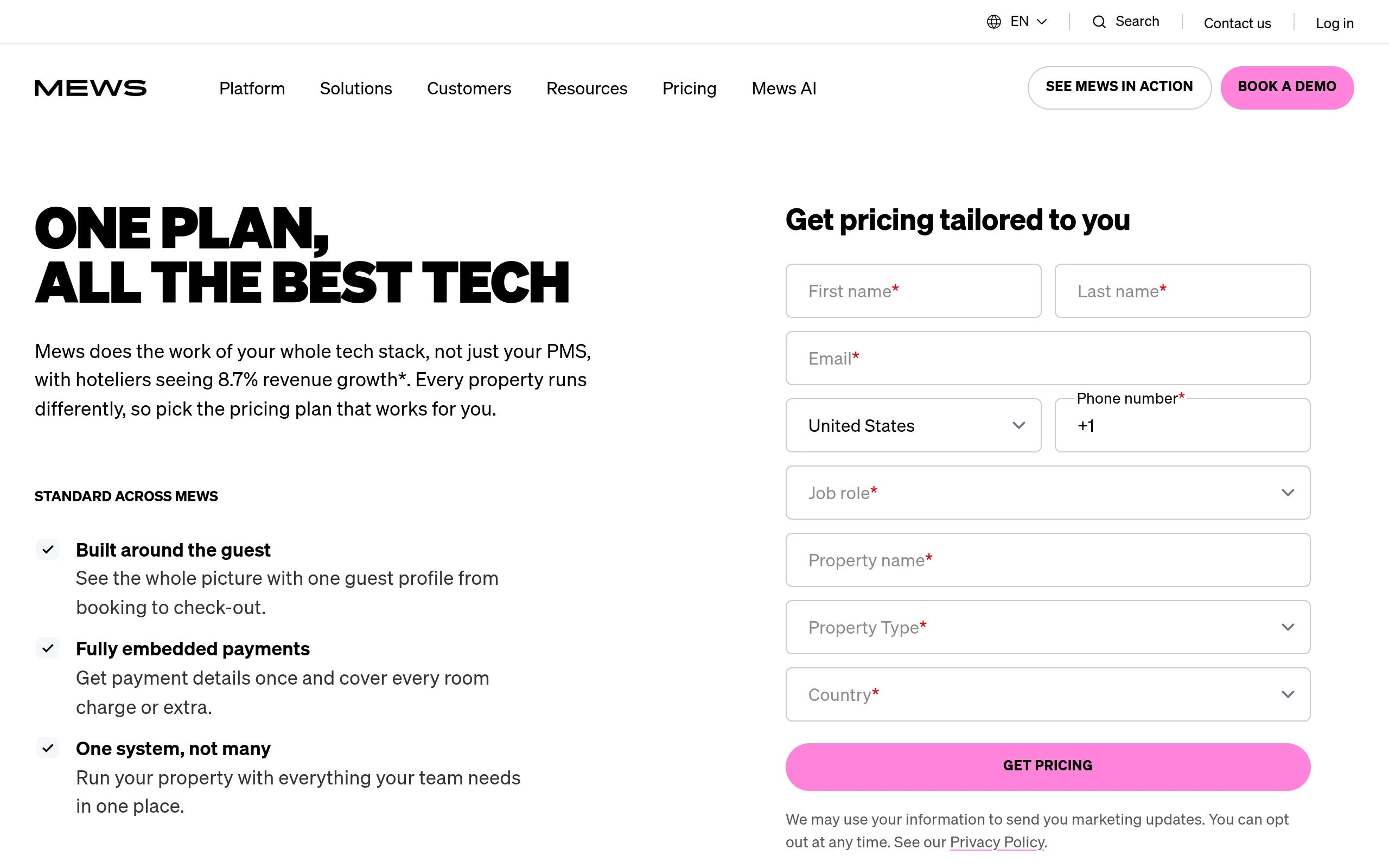
That opacity is a real cost for a 12-room property. You cannot compare Mews against a $215 selector price or a calculator total without a sales process, and per-room pricing with a monthly floor can make small properties pay more per room than large ones. Mews earns its place here because growing hotels will outgrow the other four, and its AI messaging and revenue tools are native rather than bolted on. For a 12-room B&B deciding this month, it is the quote you request in parallel, not the price you plan around.
The maths: what five tools really cost a 12-room property
Start with the property system, because every property needs exactly one. eviivo’s published calculator floor is $140 a month at 10 bedrooms with Guest Manager and Payment Manager, which is $1,680 a year, plus $600 of confirmed-booking fees at 1,200 bookings: a $2,280 year-one floor, with the 12-room base itself volume-quoted above 10 rooms and the add-ons at $48 a month for 12 rooms. Little Hotelier Pro at 12 rooms is $215 a month, or $2,580 a year of subscription. RoomRaccoon at 12 rooms on annual billing runs $2,484 on Entry, $3,144 on Essentials, $4,644 on Premium, and $6,504 on Pro, with AI pricing only on Pro.
Per booking, at 1,200 bookings a year, those subscriptions run $1.90 for eviivo at its calculator floor, $2.15 for Little Hotelier Pro, $2.07 for RoomRaccoon Entry, and $5.42 for RoomRaccoon Pro. The per-booking view is the honest one for a small property, because software is a fixed cost spread over however many guests actually arrive. A quiet year does not shrink the subscription; it raises the cost hiding inside every stay.
Now add the fees the headlines hide. Little Hotelier defines its booking fee as 1% of gross booking value where it applies; applied to all $360,000 of bookings that would be $3,600 a year, more than the subscription, which is why the variable-fee footnote matters more than the $215 headline. eviivo’s flat $0.50 fee is $600 at the same volume and does not grow when your rates rise. RoomRaccoon charges payment transaction fees separately at unprinted rates. Duve adds WhatsApp conversation fees and a €0.012 per-message operational fee on top of its subscription. Mews shares its payment fees only inside a quote.
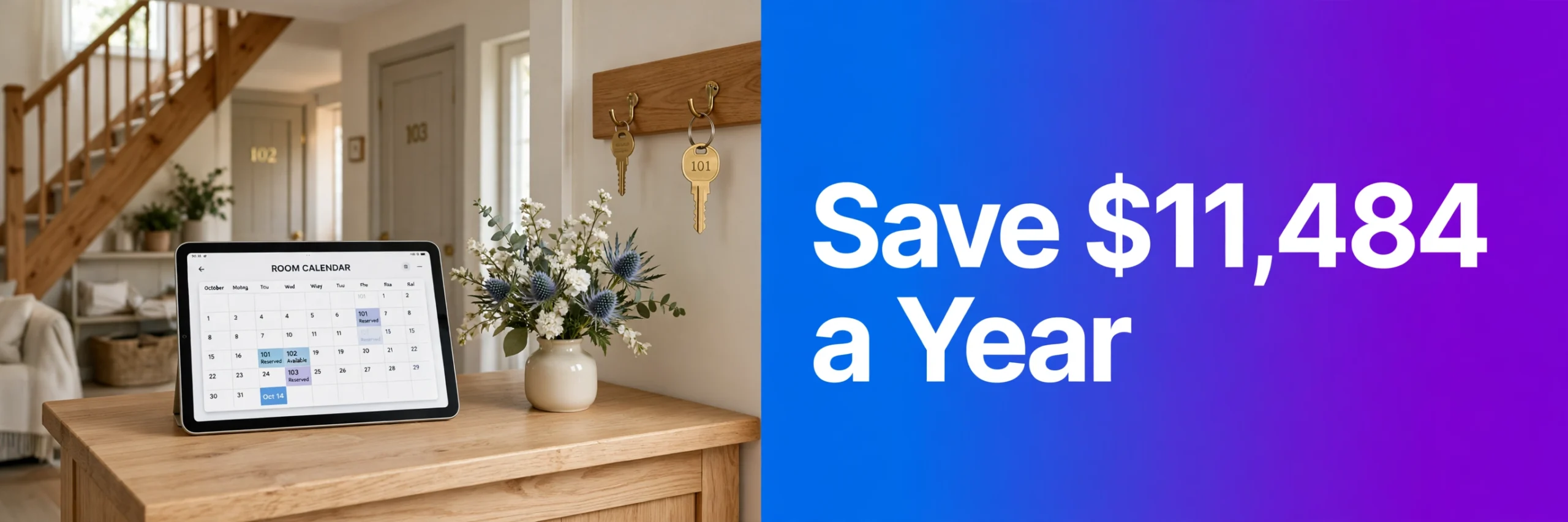
The stack test shows the real saving. Buying eviivo at its $2,280 calculator floor, Little Hotelier Pro at $2,580, RoomRaccoon Pro at $6,504, and Duve Premium from $2,400 together costs $13,764 in year one, for three overlapping reservation calendars. Running one property system instead saves $11,484 a year against that stack, which is the combined price of the three systems you did not buy. Duve is the only legitimate second purchase in the list, and only after the property system’s own inbox proves too small.
Growth flips some of the order. Percentage fees grow with revenue, so a 1% booking fee punishes a good year. Per-room add-ons grow with inventory, so eviivo’s Guest Manager costs $36 a month at 12 rooms and $72 at 24. Calculator pricing grows in steps, so RoomRaccoon’s 12-room price is not its 25-room price. A property planning to add rooms should price the system at next year’s room count, not this year’s.
Five traps that catch small hotels and B&Bs
First, the percentage fee under the headline. Little Hotelier’s $215 Pro price carries a variable booking-fee footnote, and its FAQ defines that fee as 1% of gross booking value where it applies. At $360,000 of bookings, 1% is $3,600 a year. Price the plan at your real booking volume, and confirm which bookings attract the fee, not at the volume in the advertisement.
Second, the AI gate. RoomRaccoon’s AI pricing lives on Pro. Duve’s AI replies are paid add-ons above the plan. eviivo’s AI concierge lives in Guest Manager, not the base subscription. The feature in the headline and the price in the headline are rarely the same tier. Find the gate before you compare prices.
Third, the calculator price. eviivo, Little Hotelier, and RoomRaccoon all price by inventory, so a starting price is a floor, not a quote. Set the calculator to your room count, screenshot the result, and budget that figure. A price that “starts at” a number is advertising until your rooms are in it.
Fourth, the second system. Duve needs a property system under it, and Mews replaces one. Comparing Duve’s per-room price against a full property system’s subscription flatters Duve and misleads you. Price the stack you would actually run: one system of record, plus any guest layer on top.
Fifth, the unprinted fee. Payment transaction rates, WhatsApp conversation charges, onboarding fees, and AI add-on prices all sit outside at least one headline here. Where a vendor prints no rate, treat the missing number as a cost you have not been shown, not a cost of zero, and get it in writing before you move guest payments into the platform.
What to buy first
Buy one property system first, and let message volume decide the rest. A 12-room property whose pain is guest messages and stale rates should start with eviivo plus Guest Manager, run the onboarding month on real bookings, and watch whether the AI concierge’s replies survive contact with real guests. If distribution depth and a simple all-in-one matter more, Little Hotelier Pro connects to 450+ channels from one small-property system. If one bundled bill and AI pricing justify the top tier, RoomRaccoon Pro is the consolidation play.
Add Duve only when the property system’s inbox is demonstrably too small, and request a Mews quote in parallel if you expect to grow past 30 rooms. Cloudbeds and SiteMinder, two tools originally shortlisted for this comparison, publish no usable price: Cloudbeds quotes every property individually and SiteMinder’s pricing page shows placeholder figures with a “Talk to us” button. They were swapped out for eviivo and RoomRaccoon, which print their prices.
Our free AI Cost Calculator takes the prices above and turns them into a monthly and yearly figure for your own room count and booking volume, so you can test the percentage fees and per-room add-ons before any trial starts. Run your real numbers there, then trial the cheapest system that survives your busiest week.
Pros and cons
eviivo. Pros: the cheapest verified route to native AI, with Guest Manager at $3 per room a month adding an AI 24/7 concierge to a unified inbox; dynamic AI pricing explains every recommendation; a flat $0.50 per confirmed booking instead of a percentage fee; unlimited users. Cons: no free trial, only a demo plus a free first month after onboarding; the exact base price is tailored by inventory rather than printed as a rate card; the AI concierge needs the Guest Manager add-on.
Little Hotelier. Pros: built only for small properties, with a 450+ channel manager, booking engine, payments, and mobile app in one system; Pro is $215 a month at 12 rooms on the selector; a 30-day trial with no lock-in contract; 24/7 support in 10 languages. Cons: the variable booking-fee footnote needs pinning down, since the FAQ defines the fee as 1% of booking value where it applies; prices move with room count; its pricing intelligence is recommendations, not a guest-facing AI assistant; payment rates are not printed on the pricing page.
RoomRaccoon. Pros: PMS, channel manager, booking engine, and payments bundled in every plan; a public calculator prices your exact room count; annual billing saves 20%; Rocco AI assistant included on all plans. Cons: AI pricing with RaccoonRev Plus is Pro-only, so the revenue brain costs the top tier; the trial requires a demo call first; payment transaction fees are separate and unprinted; upgrade slots ration tools like upsells and housekeeping on lower tiers.
Duve. Pros: a polished guest journey with online check-in, branded app, unified messaging, and upsells; AI replies and prioritisation through DuveAI; connects to the property system you already run. Cons: it is a second purchase, not a property system; AI features are paid add-ons priced by quote; minimum packages set the floor at small room counts; WhatsApp and SMS usage fees stack on top of the subscription.
Mews. Pros: the most complete operating system here, with AI messaging, revenue management, kiosks, digital keys, and business intelligence native to one platform; built to grow with a property. Cons: no published price at all, so budgeting needs a sales quote; payment fees are shared only inside that quote; per-room pricing with floors can penalise very small properties; no public trial.
Our verdict
eviivo with Guest Manager is the best first buy for a 12-room hotel or B&B that wants AI doing real work: a $2,280 year-one floor at its published 10-room calculator prices for the system, the AI concierge, and the booking fees at our volume, with the 12-room base volume-quoted. Its flat per-booking fee stays honest as rates rise, and its dynamic AI pricing explains itself. Little Hotelier Pro is the better buy when distribution depth and simplicity outweigh the price gap, at $2,580 a year of subscription at 12 rooms, provided the variable booking fee is confirmed in the trial. RoomRaccoon suits properties that want one bundled bill and will pay $6,504 a year for Pro to unlock AI pricing.
Duve earns its place only as the layer above a working property system, once message volume proves the need. Mews is the growth quote to request in parallel, not a price to plan around. Whichever system wins your trial, buy one system of record, price the AI gate and the percentage fees before the headline, and let the free trial month argue with your busiest week.
Frequently asked questions
What is the cheapest AI tool for a 12-room B&B?
eviivo is the cheapest verified route to working AI. Its subscription starts at $50 a month for a single property, its calculator prices 10 bedrooms with Guest Manager and Payment Manager at $140 a month, and Guest Manager adds the AI 24/7 concierge for $3 per room a month, which is $36 a month at 12 rooms. Add the flat $0.50 per confirmed booking when using its messaging or payment services. Above 10 rooms the base price is volume-quoted, so confirm it before budgeting.
How much does Little Hotelier cost at 12 rooms?
Set to 12 bookable rooms, Little Hotelier’s pricing selector showed Pro from $215 a month excluding tax, which is $2,580 a year of subscription; at 5 rooms it showed $179 a month. The plan card carries a footnote that variable booking fees apply on Little Hotelier bookings net of cancellations, and the FAQ defines the booking fee as 1% of gross booking value excluding taxes, add-ons, and cancellations. Confirm which of your bookings attract that fee during the 30-day trial, because 1% of $360,000 of bookings would be $3,600 a year.
Which RoomRaccoon plan includes AI pricing?
Only Pro. RoomRaccoon’s pricing page lists AI pricing with RaccoonRev Plus as a Pro feature, alongside unlimited users and financial reporting. Lower tiers include dynamic pricing rules and Rocco, a 24/7 AI support assistant, but the predictive rate recommendations that analyse booking pace, competitor rates, events, and weather sit on the top tier. Price Pro at your room count before comparing RoomRaccoon against rivals.
Can Duve replace my property management system?
No. Duve connects to a property management system and handles the guest journey on top of it: online check-in, guest app, messaging hub, upsells, and payments. It does not hold your reservation calendar as the system of record. Its AI replies and prioritisation are paid add-ons, and its plans are minimum packages from $120 a month, so a small property should budget it as a second subscription after its property system.
Why do Mews and Cloudbeds not show prices?
Both quote per property. Mews’ pricing page says pricing is per room, varies by business, and is created by its sales team, with payment fees shared inside the quote. Cloudbeds states its pricing differs by property needs and directs buyers to sales for a custom quote. SiteMinder’s pricing page shows placeholder figures instead of prices. This guide swapped Cloudbeds and SiteMinder out for eviivo and RoomRaccoon, which print theirs.
Price note — updated 26 November 2026: Prices in this post were checked on 26 November 2026. When you are reading this, the price may be lower or higher, plans may have changed, and trial terms may differ. Check the official pricing page before you buy, and confirm any unprinted fee, such as payment processing or AI add-on pricing, with the vendor in writing.
Sources
- eviivo pricing: https://eviivo.com/pricing/
- Little Hotelier pricing: https://www.littlehotelier.com/pricing/
- Little Hotelier features: https://www.littlehotelier.com/features/
- RoomRaccoon pricing: https://roomraccoon.com/pricing/
- Duve Communication Hub: https://helpcenter.duve.com/hc/en-us/articles/7729571351069-Communication-Hub
- Duve SMS and WhatsApp pricing: https://helpcenter.duve.com/hc/en-us/articles/8600598435485-SMS-and-WhatsApp-Pricing
- Mews pricing: https://www.mews.com/en/pricing
Pros
- eviivo: the cheapest verified route to native AI, with Guest Manager at $3 per room a month adding an AI 24/7 concierge to a unified inbox; dynamic AI pricing explains every recommendation; a flat $0.50 per confirmed booking instead of a percentage fee; unlimited users
- Little Hotelier: built only for small properties, with a 450+ channel manager, booking engine, payments, and mobile app in one system; Pro is $215 a month at 12 rooms on the selector; a 30-day trial with no lock-in contract; 24/7 support in 10 languages
- RoomRaccoon: PMS, channel manager, booking engine, and payments bundled in every plan; a public calculator prices your exact room count; annual billing saves 20%; Rocco AI assistant included on all plans
- Duve: a polished guest journey with online check-in, branded app, unified messaging, and upsells; AI replies and prioritisation through DuveAI; connects to the property system you already run
- Mews: the most complete operating system here, with AI messaging, revenue management, kiosks, digital keys, and business intelligence native to one platform; built to grow with a property
Cons
- eviivo: no free trial, only a demo plus a free first month after onboarding; the exact base price is tailored by inventory rather than printed as a rate card; the AI concierge needs the Guest Manager add-on
- Little Hotelier: the variable booking-fee footnote needs pinning down, since the FAQ defines the fee as 1% of booking value where it applies; prices move with room count; its pricing intelligence is recommendations, not a guest-facing AI assistant; payment rates are not printed on the pricing page
- RoomRaccoon: AI pricing with RaccoonRev Plus is Pro-only, so the revenue brain costs the top tier; the trial requires a demo call first; payment transaction fees are separate and unprinted; upgrade slots ration tools like upsells and housekeeping on lower tiers
- Duve: it is a second purchase, not a property system; AI features are paid add-ons priced by quote; minimum packages set the floor at small room counts; WhatsApp and SMS usage fees stack on top of the subscription
- Mews: no published price at all, so budgeting needs a sales quote; payment fees are shared only inside that quote; per-room pricing with floors can penalise very small properties; no public trial
eviivo with Guest Manager is the best first buy for a 12-room hotel or B&B that wants AI doing real work: a $2,280 year-one floor at its published 10-room calculator prices for the system, the AI concierge, and the booking fees at our volume, with the 12-room base volume-quoted. Its flat per-booking fee stays honest as rates rise, and its dynamic AI pricing explains itself. Little Hotelier Pro is the better buy when distribution depth and simplicity outweigh the price gap, at $2,580 a year of subscription at 12 rooms, provided the variable booking fee is confirmed in the trial. RoomRaccoon suits properties that want one bundled bill and will pay $6,504 a year for Pro to unlock AI pricing.Duve earns its place only as the layer above a working property system, once message volume proves the need. Mews is the growth quote to request in parallel, not a price to plan around. Whichever system wins your trial, buy one system of record, price the AI gate and the percentage fees before the headline, and let the free trial month argue with your busiest week.