
An optometry practice rarely loses money in the exam lane. It loses money in the gaps around it: the recall that never went out, the vision-plan eligibility checked at the front desk while the patient waits, the chart finished at 9 p.m. because the day had no slack in it. Add a no-show with no waitlist to fill the slot, and the doctor who should be examining is doing admin instead.
That is the job the best ai tools for optometrists are supposed to do: chart the exam, check the benefits, send the recall, and fill the schedule. Honesty first: most optometry software still has little AI in it. Two tools here use AI to write notes, one answers patients with AI, and the rest earn their place on billing, recalls, and the optical workflow.
We compared five tools for the same solo practice, and we checked every price on the vendor’s own page on 25 November 2026. No roundup prices, and no tool here pays us anything. Where a vendor does not publish a price, we say so plainly.
Quick Answer
For a solo optometrist at one location, Eye Cloud Pro, with plans starting at $259 a month per location, is the lowest published starting price among the best ai tools for optometrists, with a one-time $1,000 setup fee per location on top.
Eyefinity Encompass Essential starts at $340 a month for one location and one doctor, and its Enhanced plan, at $758 a month, adds automated recalls and two-way texting. RevolutionEHR Core costs $455 a month with an AI scribe built in at no extra cost, and Advanced starts at $660 a month. Weave starts at $199 a month for phones and texting, with recall bundles starting at $149 more. Freed, the AI scribe, costs $79 a month for unlimited notes.
In this article
- How we compared the five tools
- The five tools at a glance
- RevolutionEHR: the optometry-native EHR with a built-in AI scribe
- Eyefinity Encompass: the VSP-first platform
- Eye Cloud Pro: the lowest published starting price
- Weave: phones, texting, and recalls for the front desk
- Freed: the AI scribe that works beside any EHR
- The maths: what five tools really cost a solo practice
- Five traps that catch optometry practice owners
- What to buy first
- Pros and cons
- Our verdict
- Frequently asked questions
How we compared the five tools
Every price in this guide is for the same imaginary practice, so the numbers can be compared fairly: one location, one full-time optometrist, a small front-desk and optical team, and 320 exams a month. That is 3,840 exams a year, busy enough that recall and charting time matter, and small enough that a per-doctor fee still stings.
We judged each tool on five things: optometry-native charting that fits refraction, slit lamp, and fundus findings; vision-plan and medical billing handled without retyping; recall and reminder coverage that fills the schedule; AI help that is real, not a label on a reminder; and year-one cost, including setup fees, add-ons, and the plan tier a working practice actually needs.
The best ai tools for optometrists are not the ones with the longest feature list. They fit a practice of this size without charging it for doctors it does not have or AI features it will never open. A tool that looks cheap for one doctor can turn expensive once the recall tier and the setup fee are counted.
One honesty note before the numbers. Three tools here are EHR and practice-management systems, and two are AI add-ons that sit beside an EHR. We compare them together because that is how a solo practice actually buys: one system of record, plus the AI layer that writes the notes and works the phones.
The five tools at a glance
| Tool | Best for | Starting price | Free plan or trial | Year-one cost at our practice size |
|---|---|---|---|---|
| RevolutionEHR | Optometry-native EHR, built-in AI scribe | Core $455 a month | No free plan; demo-led | $5,460 |
| Eyefinity Encompass | VSP-heavy practices | Essential from $340 a month | No free trial | $4,080 |
| Eye Cloud Pro | Lowest published start, optical included | From $259 a month per location | No trial on pricing page; demo-led | $3,108 plus $1,000 setup |
| Weave | Front-desk phones, texting, recalls | Base $199 a month | No free trial for full platform | From $4,176 with Coordinate |
| Freed | AI scribe beside any EHR | Starter $39 a month | 7-day free trial, no card | $948 for Core |
Year one means the first twelve months at our practice size: one doctor at one location. Eyefinity’s figure is Essential at $340 a month, which its pricing page limits to one location and one doctor in the first year of a one-year contract. RevolutionEHR’s figure is Core at $455 a month; its pricing is based on the number of doctors, so a second doctor changes the quote.
Eye Cloud Pro’s figure is its published starting price of $259 a month per location, plus the $1,000 one-time setup fee in year one; exact plan prices are given during a demo. Weave’s figure is the $199 base plus a Coordinate bundle starting at $149. Freed’s figure is Core at $79 a month for one clinician. Setup and onboarding fees sit on top of several figures and are priced separately in the maths section.
RevolutionEHR: the optometry-native EHR with a built-in AI scribe
RevolutionEHR is the closest thing this category has to a default choice, and it is built only for optometry. Exams, optical dispensing, claims, and patient communication live in one cloud system, so a prescription written in the exam room flows to the dispensary without retyping. Scheduling, intake forms, reminders, billing, and payments sit in the same login.
The published plans are three tiers plus a limited-location rate. Exam-only or optical-only locations start at $319 a month. Core costs $455 a month. Advanced starts at $660 a month with a 15% bundle saving, and Premium starts at $830 a month with a 20% bundle saving. The pricing page notes that bundle pricing is currently available for new customers only.
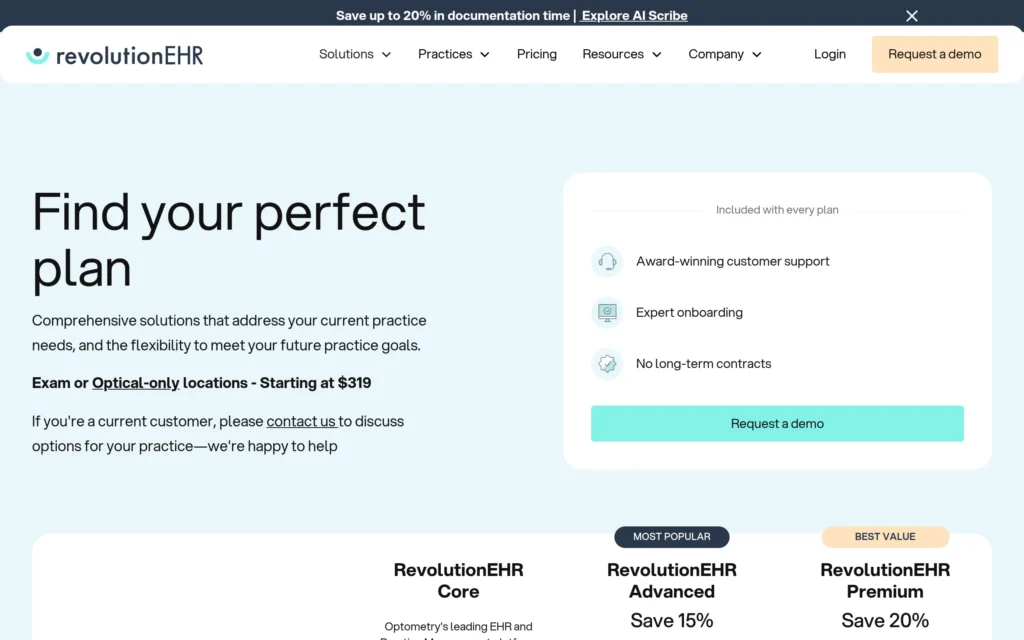
The counting rule matters as much as the headline. RevolutionEHR’s pricing is based on the number of doctors in the practice, and the subscription includes software features, updates, and data management. One-time service and database conversion fees support implementation and migration, and their amounts are not printed on the pricing page. There are no long-term contracts; billing is month to month.
The AI layer is the headline. RevolutionEHR’s AI Scribe is built into the platform at no extra cost, and the vendor says it captures notes as you speak, structures them for fast review, and can cut charting time by up to 20%. Treat the percentage as a vendor claim to test in a demo, but the pricing point is real: the scribe is not a separate subscription here.
At our practice size, Core costs $455 a month, or $5,460 a year, before the one-time setup and conversion fees. Advanced, which the pricing page describes as adding patient growth tools and seamless payments, starts at $660 a month, or $7,920 a year. A solo practice that wants recalls and two-way texting inside the EHR should budget from the Advanced figure, not the Core one.
Who is RevolutionEHR actually best for? A solo or small-group practice that wants one optometry-native system with the AI scribe included, and that values month-to-month billing over the lowest headline price. Get the setup and conversion fees in writing for your exact doctor count before you sign.
Eyefinity Encompass: the VSP-first platform
Eyefinity Encompass is the VSP-native option: the cloud platform from the company behind the VSP vision-plan network. Practice management, EHR, patient engagement, and analytics sit in one login, and the reason to pick it is the vision-plan workflow. Real-time VSP eligibilities and authorizations, electronic remittance advice, and a VSP out-of-pocket calculator are in the entry plan, not an add-on.
The published plans are two tiers plus an enterprise option. Essential starts at $340 a month. Enhanced, marked as the customer favorite with a 20% saving, starts at $758 a month. Enterprise pricing varies. Essential includes the iPad exam app, patient portal, exam protocols, ePrescribing, online forms, online scheduling, and basic analytics.

Enhanced is where the patient-engagement tools live. It adds two-way patient text messaging, automated recalls, reminders, and eyewear notifications, plus patient access to order statuses, receipts, and prescriptions, and image management with unlimited cloud storage. A practice buying Encompass for recalls is buying Enhanced, and should budget $758 a month, not $340.
The fine print matters more here than anywhere else in this guide. The pricing page states that prices exclude onboarding fees, apply to one location and one doctor for the first year of a one-year contract, and require the practice to use EncompassPay. Each doctor also incurs a one-time onboarding fee, and each account a one-time AMA royalty fee, with amounts not printed. A $50 a month statement credit per practice for one year softens the first year.
There is no free trial, and onboarding for Essential and Enhanced typically takes about 90 days. The platform is HIPAA-compliant, SOC 2 Type 2 certified, and EHNAC accredited. At our practice size, Essential costs $4,080 a year before onboarding fees, and Enhanced costs $9,096 a year. A second doctor or a second location changes the quote, so price the practice you are growing into.
Who is Eyefinity Encompass actually best for? A practice where VSP plans dominate the schedule and eligibility checks eat front-desk hours every morning. If VSP is a small share of your payer mix, the same money buys more elsewhere in this guide.
Eye Cloud Pro: the lowest published starting price
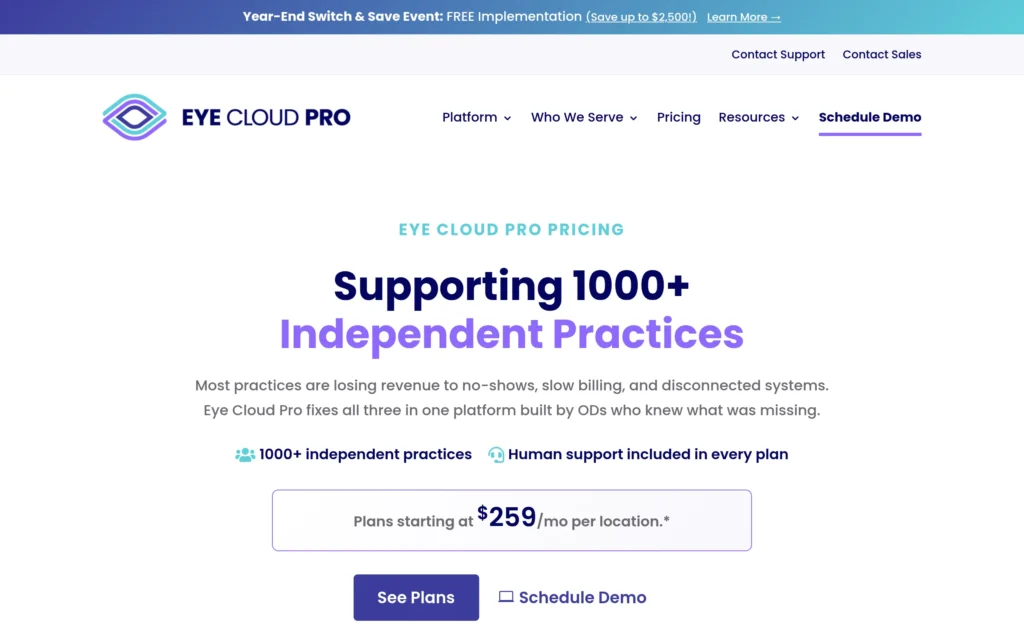
Eye Cloud Pro is a cloud EHR, practice-management, and optical point-of-sale platform built by optometrists for independent practices. Its pitch is consolidation: scheduling, records, billing, frame inventory, and checkout in one system, so the exam flows to the dispensary without switching software. The vendor says it supports more than 1,000 independent practices.
The published pricing is a starting point, not a plan list. Plans start at $259 a month per location, and exact plan prices are given during a demo, with a customized proposal built around practice size and workflow. A one-time setup fee of $1,000 per location covers data migration, onboarding, and a dedicated specialist. That setup fee is disclosed openly in the pricing FAQ, which is more than some vendors here manage.
The three plans build on each other. Eye Cloud Doctor covers online scheduling, digital intake, automated reminders, a HIPAA-compliant cloud EMR, built-in billing and insurance claims, and integrated payments. Eye Cloud Retail adds real-time frame inventory, integrated POS checkout, marketing and patient communications, VisionWeb lab integrations, and automated contact-lens ordering through ABB and OOGP. The Pro plan adds advanced inventory controls and end-to-end order tracking.
The add-on list is where a working budget grows. ePrescribing, optometry device integrations, and SMS messaging are available as add-ons, and the pricing page notes that additional fees may apply. A practice with a dispensary should also note that the entry Doctor plan has no POS or frame inventory; those sit in Retail and above, at prices given in the demo.
At our practice size, the published starting figure is $259 a month, or $3,108 a year, plus the $1,000 setup fee in year one. That makes Eye Cloud Pro the lowest published entry price in this guide, with the honest caveat that the exact plan price for an optical practice is a demo conversation, not a printed number.
Who is Eye Cloud Pro actually best for? A solo practice that wants the lowest published start, per-location pricing that does not punish a second doctor, and optical POS in the same system. Ask for the Retail plan price and the add-on fees in writing during the demo, because the starting price alone will not run a dispensary.
Weave: phones, texting, and recalls for the front desk
Weave is not an EHR, and it does not pretend to be one. It is a patient-communication platform for healthcare practices: business phones, two-way texting, online scheduling, digital forms, reminders, recalls, reviews, and payments in one front-desk system. For an optometry practice, its job is the schedule: fewer no-shows, faster recall responses, and no missed call left unanswered.
The published pricing is built in layers. The base bundle starts at $199 a month, and pre-bundled options start at $149 a month on top. The Coordinate bundle is built around bringing patients in on time, with scheduling, forms, reminders, and recall; the Attract bundle is built around reviews and new-patient growth. Individual solutions are also sold at varying prices.
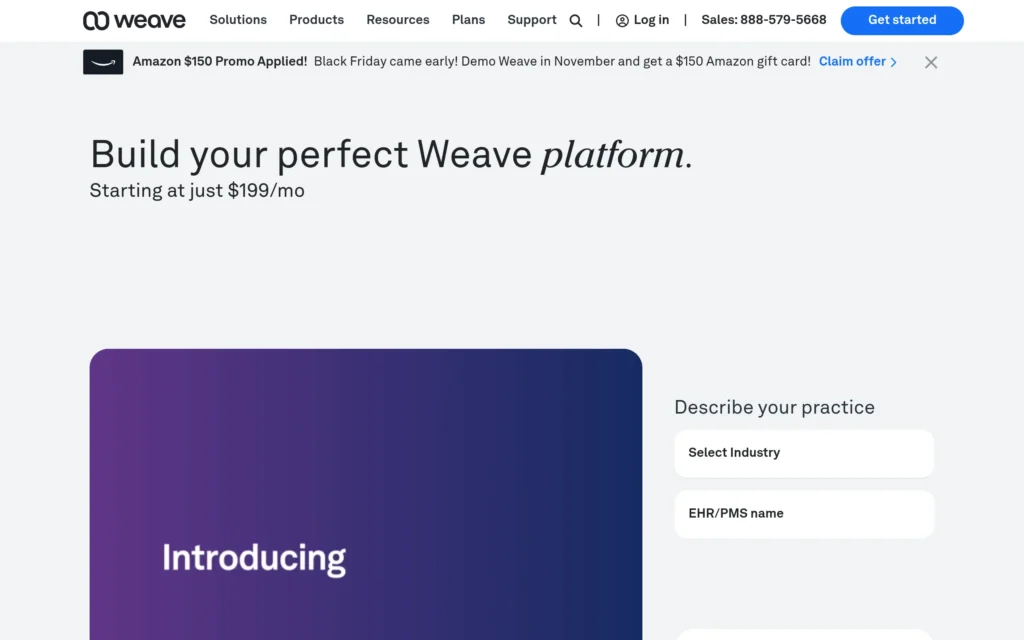
At our practice size, the working configuration is the base plus Coordinate: from $348 a month, or from $4,176 a year. The word from matters. The plans page prices bundles as starting at $149, and the final figure depends on the configuration, so get the whole order form in writing, including any setup or per-location terms.
The AI layer is Weave’s AI Receptionist, which the plans page promotes as a way to cover calls and messages around the clock. Its price is not printed on the plans page, so budget it only from a written quote. Weave requires no long-term contract, offers discounts on year-long contracts, and does not offer a free trial of the full platform.
Who is Weave actually best for? A practice whose EHR is fine but whose front desk is drowning: phones ringing during exams, recalls going out late, and no-shows leaving gaps. It earns its money beside an EHR, not instead of one, so add its price to your EHR price before comparing stacks.
Freed: the AI scribe that works beside any EHR
Freed is an ambient AI scribe: it listens to the visit and drafts the clinical note, so the doctor reviews and signs instead of typing. It is the most genuinely AI tool in this guide, and the only one that can be added to any of the three EHRs above without changing systems. A 7-day free trial needs no credit card.
The published plans are three per-clinician tiers. Starter costs $39 a month for one clinician, capped at 40 notes a month. Core costs $79 a month with unlimited note generation, an instant template builder, and Clinical Evidence answers from medical sources. Premier costs $119 a month, or $104 a month billed annually, and adds visit summaries, patient instructions and referral letters, EHR push integration, dictation, and ICD-10 and CPT coding. Group pricing is custom.
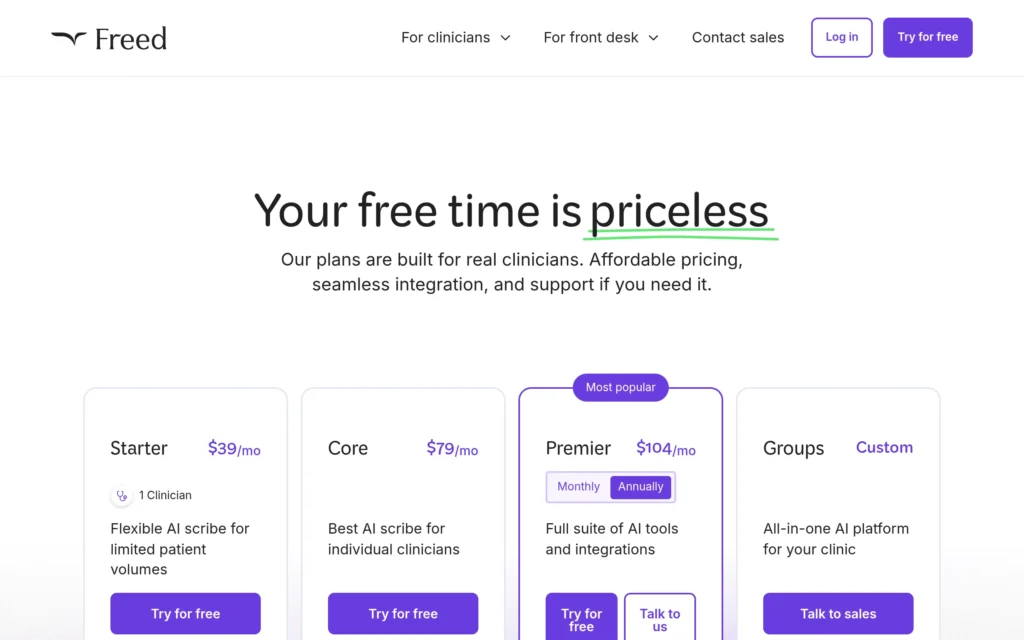
At our practice size, the maths is simple. A solo doctor running 320 exams a month outgrows Starter’s 40-note cap in the first week, so Core at $79 a month, or $948 a year, is the honest starting point. Premier on annual billing costs $1,248 a year, and its EHR push sends notes into a browser-based EHR with one click, which is the feature that decides whether the scribe saves time or creates copy-paste work.
The honest comparison is with RevolutionEHR’s built-in scribe. If you already run RevolutionEHR, its AI Scribe is included at no extra cost, and Freed has to beat free. If you run Eyefinity or Eye Cloud Pro, Freed Core at $948 a year is the cheapest published way here to stop typing notes at night.
Who is Freed actually best for? A solo doctor whose EHR has no scribe, or whose built-in scribe disappoints in a trial. Run the 7-day trial on real exam days, including a busy morning, and count how many notes you sign without edits before you pay.
The maths: what five tools really cost a solo practice
Put the year-one subscription figures side by side and the spread is wide. Eye Cloud Pro starts at $3,108 a year plus a $1,000 setup fee. Eyefinity Essential costs $4,080 before onboarding fees. RevolutionEHR Core costs $5,460 before setup and conversion fees. Weave with Coordinate starts at $4,176, and Freed Core costs $948. The EHR choice alone swings year one by more than $2,000.
Stacks are where the real decision lives, because no solo practice buys one tool. A lean stack of Eye Cloud Pro at its $259 starting price plus Freed Core at $79 costs $338 a month, or $4,056 a year, plus the $1,000 setup fee in year one. That buys records, billing, reminders, and an AI scribe, with the caveat that the exact Eye Cloud plan price comes from a demo.
A full stack costs a different kind of money. Eyefinity Enhanced at $758, plus Weave base and Coordinate from $348, plus Freed Premier at $104 on annual billing, totals $1,210 a month, or $14,520 a year. The gap between the lean stack and the full stack is $10,464 a year, which at 3,840 exams is the difference between about $1.06 and about $3.78 of software cost per exam.
The middle is where most solo practices should land. RevolutionEHR Advanced from $660 plus Freed Core at $79 costs $739 a month, or $8,868 a year, and pairs patient-growth tools with unlimited AI notes. Eyefinity Essential at $340 plus Freed Core costs $419 a month, or $5,028 a year, for a VSP-heavy practice that can live without automated recalls.
First-year fees are the quiet giant in this budget. Eye Cloud Pro charges $1,000 per location once. Eyefinity excludes onboarding fees from its prices and adds a per-doctor onboarding fee plus an AMA royalty fee. RevolutionEHR charges one-time service and database conversion fees with amounts unpublished. None of these is unreasonable, but a budget built only on the monthly price will be wrong by the second invoice.
Five traps that catch optometry practice owners
The first trap is counting the wrong heads. RevolutionEHR prices by the number of doctors. Eyefinity’s published prices cover one location and one doctor. Eye Cloud Pro prices per location. Freed prices per clinician. The same practice is one billable unit on one platform and two on another, so price your actual roster on each vendor’s definition, not on the headline.
The second trap is the recall tier. Eyefinity keeps automated recalls and two-way texting on Enhanced at $758 a month, not Essential at $340. RevolutionEHR’s patient-growth tools sit in Advanced and above. Weave sells recall inside a bundle starting at $149 on top of its $199 base. A budget built on the entry price buys a system that cannot work your recall list.
The third trap is the first-year rate. Eyefinity’s prices apply to the first year of a one-year contract and require EncompassPay. RevolutionEHR’s bundle savings are for new customers only. Freed’s Premier drops from $119 to $104 a month only on annual billing. Year two is the price you will actually live with, so ask what each plan costs when the offer ends.
The fourth trap is the unpublished fee. RevolutionEHR does not print its setup and conversion amounts. Eyefinity does not print its onboarding or AMA royalty amounts. Eye Cloud Pro prints its $1,000 setup fee but gives exact plan prices only in a demo. Weave does not print its AI Receptionist price. Get every one of these lines in writing before you compare totals.
The fifth trap is ignoring the exit. Ask how your patient records, exam history, optical orders, and recall lists export if you leave, in what format, and whether export help costs extra. A practice’s charts and recall list are its memory and its future schedule. The cheapest platform in year one can be the most expensive to leave in year three.
What to buy first
Start with the system of record, because the chart is the one part of a practice that cannot be improvised. If VSP dominates your schedule, shortlist Eyefinity Encompass first. If you want the lowest published start with optical POS in the same system, shortlist Eye Cloud Pro. If you want an optometry-native EHR with the AI scribe included and no long-term contract, shortlist RevolutionEHR.
Then add the AI layer your day actually needs. If notes follow you home, trial Freed for 7 days on real exam days, or test RevolutionEHR’s built-in scribe in a demo. If the phones and recall list are the leak, price Weave’s Coordinate bundle or the recall tier of your EHR, and compare the two honestly.
Finally, run one real week through the trial or demo before you sign. Chart a full exam day, check a vision-plan eligibility, send a recall batch, and export a patient list. The tool that survives your busiest morning is the right one.
If you want to run these numbers for your own doctor count before booking demos, Our free AI Cost Calculator takes the monthly prices in this guide and turns them into a year-one figure you can compare line by line. It will not choose for you, but it will stop a headline price from choosing for you.
Pros and cons
RevolutionEHR
Pros: built only for optometry, with exams, optical, claims, and communication in one cloud system; AI Scribe included at no extra cost; published tier prices; month-to-month billing with no long-term contract.
Cons: Core at $455 a month is the highest EHR entry price here; pricing is based on doctor count, so a second doctor changes the quote; setup and database conversion fees are not published; bundle savings are for new customers only.
Eyefinity Encompass
Pros: real-time VSP eligibilities and authorizations in the entry plan; iPad exam app, patient portal, and online scheduling included; Enhanced adds automated recalls, two-way texting, and unlimited image storage; HIPAA-compliant and SOC 2 Type 2 certified.
Cons: published prices cover one location and one doctor in year one only; EncompassPay use is required; onboarding and AMA royalty fees sit on top, unpublished; no free trial, and onboarding typically takes about 90 days.
Eye Cloud Pro
Pros: lowest published starting price here at $259 a month per location; per-location pricing does not punish a second doctor; optical POS, frame inventory, and lab integrations in the Retail and Pro plans; $1,000 setup fee disclosed openly.
Cons: exact plan prices are given only during a demo; the entry Doctor plan has no POS or frame inventory; ePrescribing, device integrations, and SMS are add-ons; no trial is mentioned on the pricing page.
Weave
Pros: phones, texting, scheduling, forms, reminders, and recall in one front-desk system; no long-term contract required; published base and bundle starting prices; AI Receptionist available for after-hours coverage.
Cons: it is a communication layer, not an EHR, so its price stacks on top of your EHR; bundles are priced as starting at $149, with the final figure by configuration; AI Receptionist price is not published; no free trial of the full platform.
Freed
Pros: unlimited AI notes on Core at $79 a month; 7-day free trial with no credit card; works beside any EHR, with one-click EHR push on Premier; ICD-10 and CPT coding and referral letters on Premier.
Cons: Starter’s 40-note monthly cap is too small for a full exam schedule; EHR push and coding sit on Premier, not Core; per-clinician pricing multiplies with each doctor; RevolutionEHR users already get a scribe included.
Our verdict
For most solo practices, the answer is Eye Cloud Pro plus Freed. Eye Cloud Pro’s published start of $259 a month per location is the lowest entry price here, its per-location pricing suits a practice adding a part-time doctor, and Freed Core at $79 a month removes the evening charting pile. Together they cost $338 a month, or $4,056 a year, plus the $1,000 setup fee in year one. Confirm the exact Eye Cloud plan price in the demo, because a dispensary needs the Retail tier.
Eyefinity Encompass is the pick if VSP runs your schedule. Real-time eligibilities and authorizations in the entry plan save front-desk hours every single morning, and no other tool here matches that workflow. Budget honestly: Essential at $340 a month has no automated recalls, so a recall-driven practice is really buying Enhanced at $758 a month, plus onboarding fees, on a one-year contract.
RevolutionEHR suits a practice that wants one optometry-native system with the AI scribe included and the freedom of month-to-month billing. Core at $455 a month is fair money when the built-in scribe replaces a separate $948-a-year subscription, and Advanced from $660 a month is the tier to price if recalls and patient-growth tools matter.
Weave earns its place when the front desk, not the chart, is the leak: missed calls, late recalls, and no-shows with no waitlist. The best ai tools for optometrists are the ones that fit the practice you actually run: your payer mix, your doctor count, your recall list. Start with the tool that fixes your biggest leak, and let the saving pay for the next one.
Frequently asked questions
What is the best AI tool for optometrists?
For most solo practices, Eye Cloud Pro from $259 a month plus Freed Core at $79 a month is the best-value combination among the best ai tools for optometrists, covering records, billing, and AI notes for $338 a month. Eyefinity Encompass is better if VSP plans dominate your schedule, and RevolutionEHR is better if you want the AI scribe built into the EHR.
How much does optometry software cost per month?
At a solo practice, the EHRs here start at $259 to $455 a month: Eye Cloud Pro from $259 per location, Eyefinity Essential from $340 for one location and one doctor, and RevolutionEHR Core at $455. Recall-ready tiers cost more: Eyefinity Enhanced is $758 a month and RevolutionEHR Advanced starts at $660. Add Freed Core at $79 a month for AI notes, and budget setup and onboarding fees on top.
Which tool is best for VSP and vision-plan billing?
Eyefinity Encompass, because real-time VSP eligibilities and authorizations, electronic remittance advice, and a VSP out-of-pocket calculator are included in its Essential plan. RevolutionEHR and Eye Cloud Pro both handle insurance claims and eligibility checks, but neither is built around the VSP network the way Eyefinity is.
Which tool is best for patient recalls and reminders?
Eyefinity Enhanced includes automated recalls, reminders, and eyewear notifications at $758 a month. Weave’s Coordinate bundle, starting at $149 a month on top of its $199 base, covers scheduling, reminders, and recall beside any EHR. RevolutionEHR’s patient-growth tools sit in Advanced and above, and Eye Cloud Pro includes automated reminders in every plan.
What should a solo optometrist buy first?
Buy the EHR first, then the AI layer. A solo doctor should shortlist Eye Cloud Pro for the lowest published start, Eyefinity Essential if VSP dominates, or RevolutionEHR Core if a built-in AI scribe and month-to-month billing matter most. Then trial Freed free for 7 days, and add Weave only if phones and recalls are the bigger leak.
Price note
Price note — updated 25 November 2026: Prices in this post were checked on 25 November 2026. When you are reading this, the price may be lower or higher, a plan may have been renamed, or a trial may have changed, so check the vendor’s own pricing page before you buy.
Eyefinity Encompass prices exclude onboarding fees, apply to one location and one doctor for the first year of a one-year contract, and require EncompassPay; its onboarding and AMA royalty amounts are not published. RevolutionEHR’s setup and database conversion fees are not published, and its bundle savings are for new customers only. Eye Cloud Pro gives exact plan prices during a demo, and Weave does not publish its AI Receptionist price. Freed’s Premier price of $104 a month requires annual billing.
Sources
- RevolutionEHR pricing: https://www.revolutionehr.com/pricing
- Eyefinity Encompass pricing: https://www.eyefinity.com/pricing
- Eye Cloud Pro pricing: https://eyecloudpro.com/pricing/
- Weave plans: https://www.getweave.com/plans
- Freed pricing: https://www.getfreed.ai/pricing
Try it with your own numbers
Every figure here is for one imaginary practice, and yours is not imaginary. Our free AI Cost Calculator takes the prices above, your doctor count, and your exam volume, and works out what each tool costs you per year, per month, and per exam. Run your own numbers before you buy, and let the saving decide.