

For a small music school with five teachers, one office manager, and 150 students, My Music Staff at $46.65 a month ($559.80 a year) is the cheapest honest start among the best ai tools for music schools: scheduling, invoicing, payments, and reminders, with unlimited students.If you want one tool that also runs group classes, recitals, and teacher payroll, Opus1 Starter at $99 a month ($1,188 a year) is the only all-in-one built for music schools. Jackrabbit Music is the strongest for group classes at $89 a month, Tutorbase costs nothing until you invoice and then takes 1% of everything, and Fons looks cheap at $19.95 a month until its fees are added.
A music school owner does not have a teaching problem. She has a Tuesday problem: at 4pm three piano teachers need three rooms, a parent wants to move Thursday’s violin lesson to Saturday, a group guitar class has two empty seats, and the recital hall needs booking for June. Every one of those jobs lands on the same person, and most schools still handle them with a paper diary and a group chat.
That is the job the best ai tools for music schools are supposed to do: take the scheduling, the reminders, the billing, and the parent messages off the owner’s desk, and leave the teaching to the teachers. Some tools here were built only for music schools; others are general tools that happen to fit. The difference matters, because a general scheduler cannot run a recital, track practice, or stop two teachers booking the same room.
We compared five tools at the same school size, and we checked every price on the vendor’s own page on 25 November 2026. No roundup prices, no guesses, and no tool here pays us anything. If a price is not published, we say so.
Quick Answer
For a small music school with five teachers, one office manager, and 150 students, My Music Staff at $46.65 a month ($559.80 a year) is the cheapest honest start among the best ai tools for music schools: scheduling, invoicing, payments, and reminders, with unlimited students.
If you want one tool that also runs group classes, recitals, and teacher payroll, Opus1 Starter at $99 a month ($1,188 a year) is the only all-in-one built for music schools. Jackrabbit Music is the strongest for group classes at $89 a month, Tutorbase costs nothing until you invoice and then takes 1% of everything, and Fons looks cheap at $19.95 a month until its fees are added.
In this article
- How we compared the five tools
- The five tools at a glance
- My Music Staff: the cheapest honest start
- Jackrabbit Music: the heavyweight for group classes
- Tutorbase: the free start that takes 1% of everything
- Fons: the billing machine with a fee schedule to read twice
- Opus1: the all-in-one built for music schools
- The maths: what five tools really cost a small school
- Five traps that catch music schools
- What to buy first
- Pros and cons
- Our verdict
- Frequently asked questions
How we compared the five tools
Every price in this guide is for the same imaginary school, so the numbers can be compared fairly: five teachers, one office manager, and the owner, teaching 150 students piano, guitar, violin, drums, and voice. It teaches 600 lessons a month, or 7,200 a year, at $50 a lesson, so the school invoices about $30,000 a month before costs — small enough that a per-teacher fee still stings, and big enough that a percentage-of-revenue price hurts.
We judged each tool on five things: can parents book online day and night; does it stop double-booking of teachers and rooms; does it handle packages, payments, and reminders; does it track practice, run group classes, and manage recitals; and what does year one cost, including setup fees, student bands, and payment surcharges?
The best ai tools for music schools are not the ones with the longest feature list. They fit a school of this size without charging it for seats it does not have, students it has already lost, or revenue it has not collected yet. A tool that is cheap for one teacher can be the most expensive here once the percentage applies, and a tool that looks free can turn expensive once its fee schedule is read.
The five tools at a glance
| Tool | Best for | Starting price | Free plan or trial | Year-one cost at our school size |
|---|---|---|---|---|
| My Music Staff | Cheap scheduling, invoicing, and reminders | $16.95 a month, plus $4.95 per extra teacher | 30-day free trial | $559.80 |
| Jackrabbit Music | Group classes with heavy billing | $49 a month (0–100 students); $89 at 150 students | Demo; no trial stated on the pricing page | $1,068 |
| Tutorbase | Uneven income, hates fixed bills | Free core; 1% of what you invoice | Free core, no card needed | $3,600 |
| Fons | Billing that runs itself | $19.95 a month, plus $4.95 per extra teacher | 14-day free trial | $2,035.80 |
| Opus1 | One system for lessons, groups, and recitals | $99 a month per location (Starter) | Free trial | $1,188 |
Year one means the first twelve months at our school size: five teachers, one office manager, and the owner, 150 students, 600 lessons a month. My Music Staff’s figure is seven accounts at $16.95 plus six times $4.95. Fons’ figure is the same seven accounts plus the 0.4% surcharge on $30,000 a month, which is $120 a month on its own. Tutorbase’s figure is 1% of $30,000 a month invoiced. All three are flagged again in the maths section.
My Music Staff: the cheapest honest start
My Music Staff is the default answer for independent music teachers. One plan includes everything: scheduling, invoicing, a student portal with a practice log, two-way Google Calendar sync, and a website builder. There are no tiers and nothing is locked behind a higher plan. For a small school, that simplicity is the product.
The price is the clearest here. It is $16.95 a month for the first teacher, plus $4.95 a month for each additional teacher or staff member. Students and lessons are unlimited, and there is no per-lesson fee. SMS reminders are included, with no extra charge. File storage is unlimited for files under 2GB, and website hosting is free if you build your site with it. A 30-day free trial needs no credit card, and a 90-day money-back guarantee sits behind it.
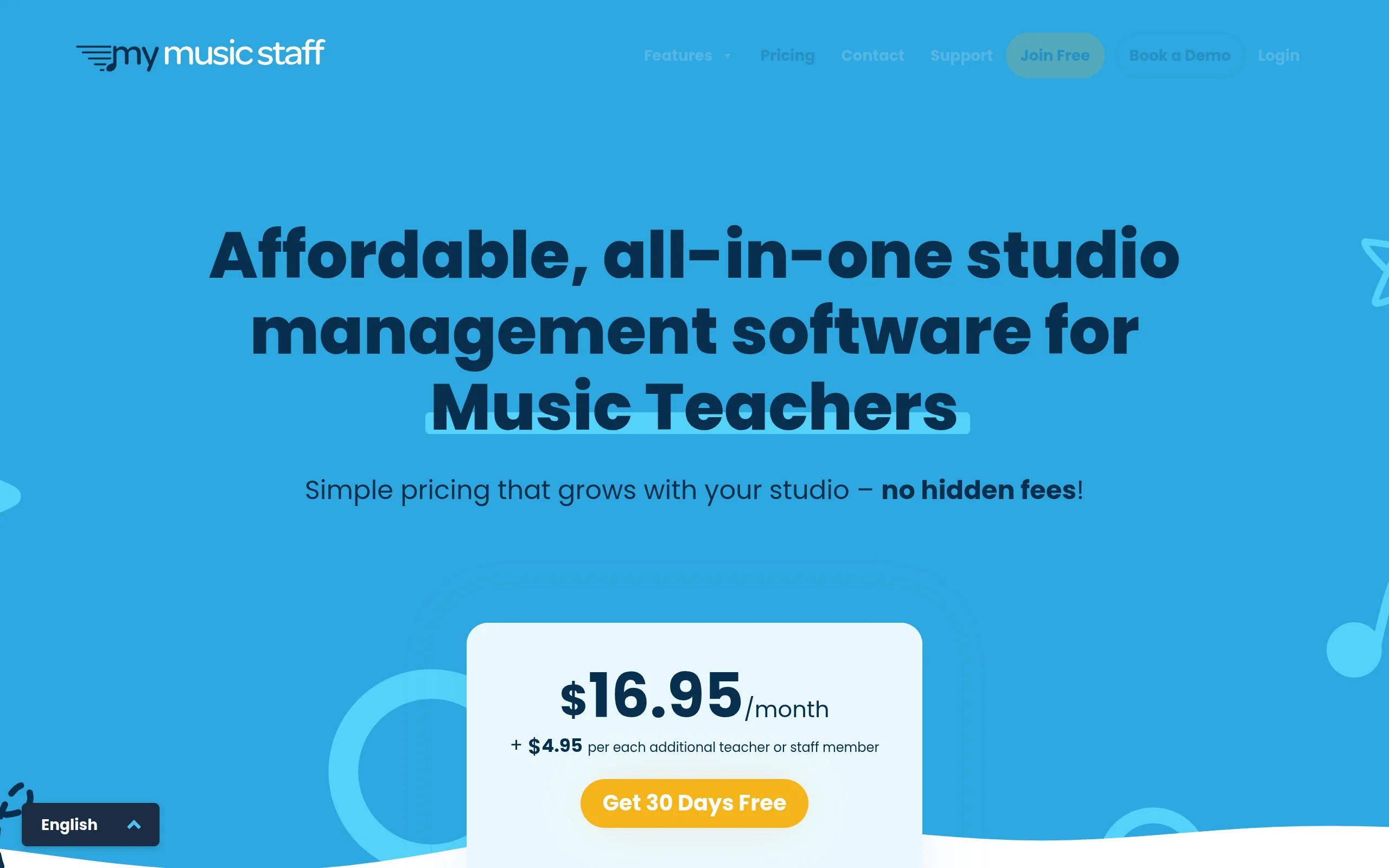
At our school size, the maths is kind. Seven accounts — owner, five teachers, office manager — cost $16.95 plus six times $4.95, which is $46.65 a month, or $559.80 a year. That is the cheapest year one in this guide by a wide margin, and the most honest price here, because every figure is printed on the vendor’s own page. My Music Staff cannot run a recital, it has no teacher payroll module, and its group-class support is basic. What it can do is schedule lessons, invoice families, take payments, and send reminders, all day and all night, for less than two dollars a day.
One caution before you budget on it: the pricing page shows its figures with a dollar sign and names no currency anywhere, and the maker, Port 443 Inc., is a Canadian company. If those figures are Canadian dollars, they are roughly a quarter lower in US terms than they look. Ask which currency you will be billed in. We use the figures as printed.
Buy My Music Staff if you want the cheapest working system and you are happy to keep recitals, exams, and payroll somewhere else. Skip it if your school runs mostly group classes, or if you need payroll.
Jackrabbit Music: the heavyweight for group classes
Jackrabbit Music is the music-school face of Jackrabbit Class, a class-management system running youth activity businesses since 2004, with more than 7,000 clients across gymnastics, dance, swim, and music. Its strengths are robust class and group scheduling, tuition billing with pro-rating and discount rules, ePayments, a parent portal, and reporting built for schools with hundreds of enrolments.
The price is the most distinctive here: you pay by the total number of students in your database, active and inactive, sampled at the end of each month. The bands are $49 a month for 0 to 100 students, $89 for 101 to 250, $129 for 251 to 500, $169 for 501 to 1,000, $209 for 1,001 to 3,000, and $245 above 3,000. Every plan includes all core features, a product coach, free data imports, and unlimited support, with no contracts and no setup fees on the standard plan.
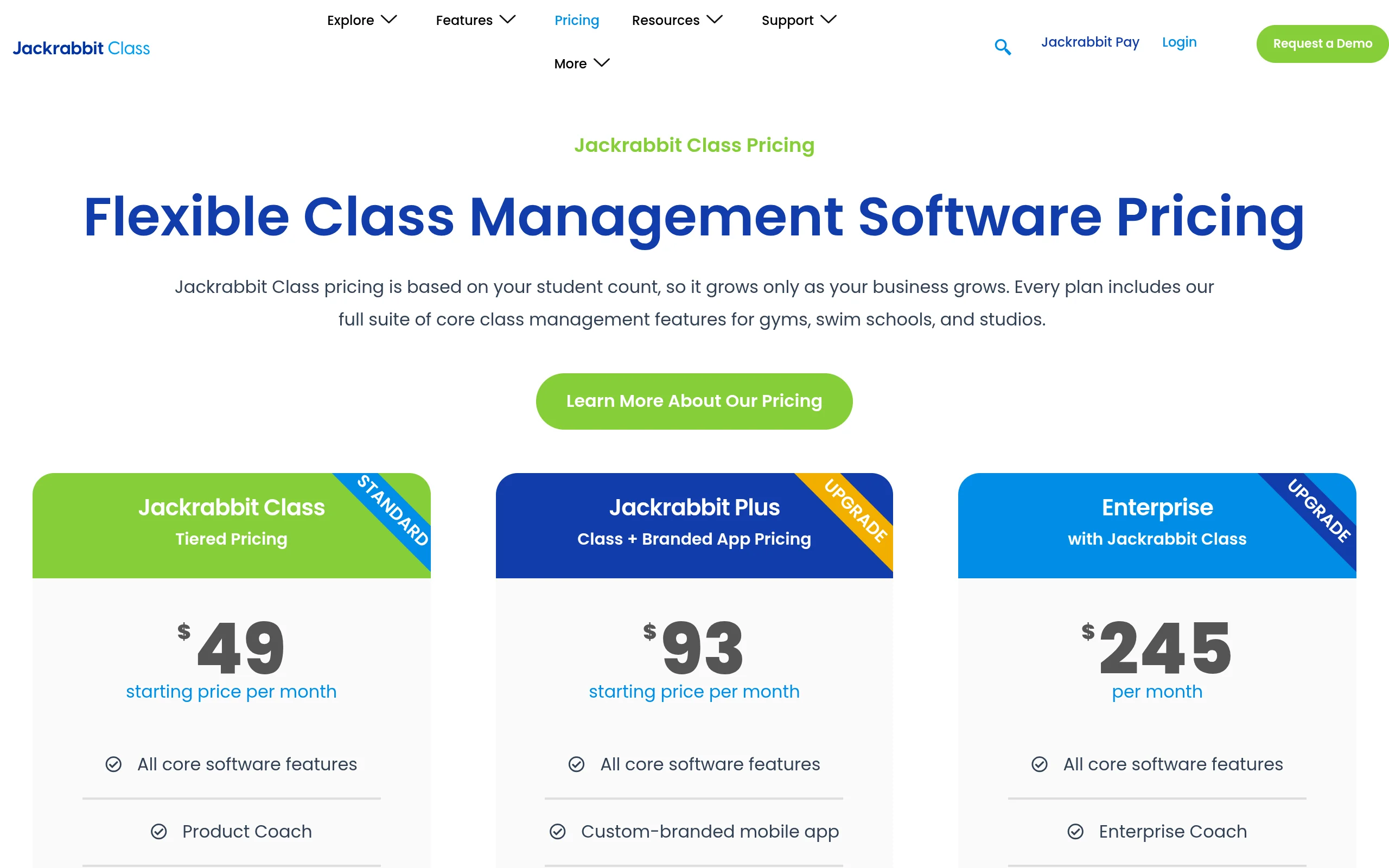
Jackrabbit Plus adds a custom-branded parent app, starting at $93 a month on the same bands, with a one-time, non-refundable setup fee of $169 plus app store fees. Enterprise is $245 a month flat and adds a Business Intelligence Dashboard; Enterprise with the branded app is $331 a month. Jackrabbit’s own pricing page suggests archiving inactive families to lower the billed count, which is worth doing: students who left two years ago are a monthly bill for nothing.
At our school size, 150 students puts the school in the 101 to 250 band: $89 a month, or $1,068 a year. That is $508.20 more than My Music Staff in year one, and the gap buys group-class power: enrolment windows, class capacities, and tuition rules a lesson-first tool lacks. It does not buy payroll or a practice log, and a school teaching mostly one-to-one lessons is bending a group tool to a private-lesson shape.
Buy Jackrabbit Music if your school runs group classes and ensembles, bills tuition by term, and needs a parent portal that handles registration without the office. Skip it if you teach mostly one-to-one lessons, and clean up your student database before you sign up, because inactive students cost real money here.
Tutorbase: the free start that takes 1% of everything
Tutorbase is the odd one out, and the most interesting for a school with uneven income. It connects scheduling, billing, CRM, and WhatsApp in one system, and its core is genuinely free. You sign up, set up in five minutes, and run the whole platform — scheduling with rooms, automatic invoicing with lesson credits, teacher payroll, and a portal where families book and pay by card — without a monthly subscription.
The price is one sentence, printed in large type on the vendor’s own pricing page: 1% when you invoice, and that is it. No per-student, per-lesson, or per-teacher fee. No invoices means no charge, so a slow month or a summer break costs nothing. Card and bank processing fees are charged separately by your payment provider, and no credit card is needed to start.
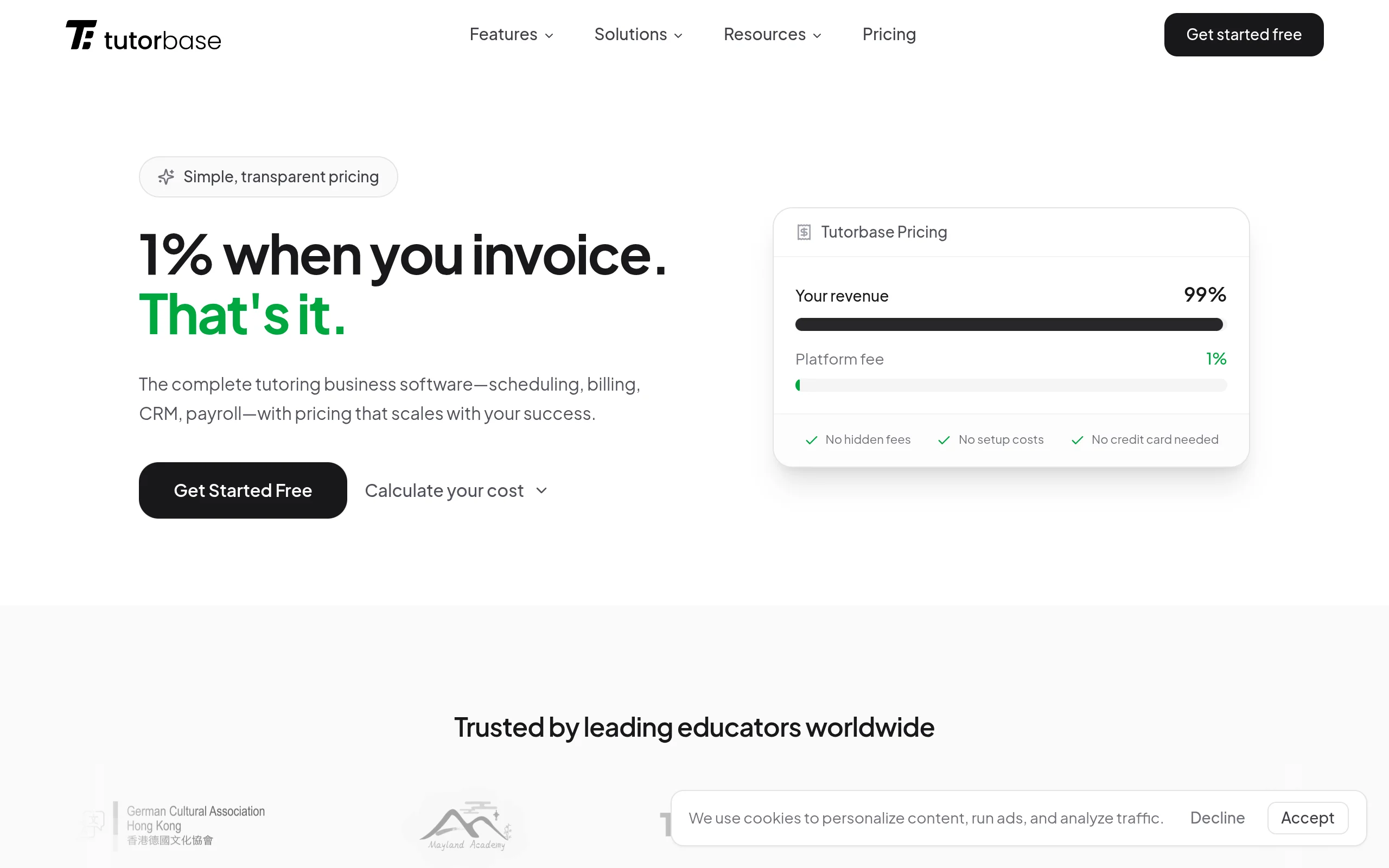
At our school size, that sentence is expensive. The school invoices $30,000 a month, so 1% is $300 a month, or $3,600 a year — the most expensive tool here at this size, by more than double the next one. The same tool costs a school invoicing $5,000 a month only $50 a month. The fee grows with everything you bill, and never stops growing. That is the whole trade: no bill in a bad month, and the biggest bill in the guide in a good one.
Tutorbase is also the least music-specific tool here. It is built for tutoring businesses and language schools, not for music schools. It has rooms and centres, but no recital management, no practice log, and no exam tracking, and its own pages do not state a classroom for online lessons. The CRM and WhatsApp integration are useful for chasing trial-lesson enquiries, but the music-specific jobs stay with the teachers.
Buy Tutorbase if your income is uneven, enrolment is still growing, and you would rather pay a share of what you collect than a fixed bill in a slow month. Skip it once monthly invoicing passes about $10,000, because at that point 1% costs more than the best fixed-price tool here — and do the multiplication yourself before you commit to a percentage.
Fons: the billing machine with a fee schedule to read twice
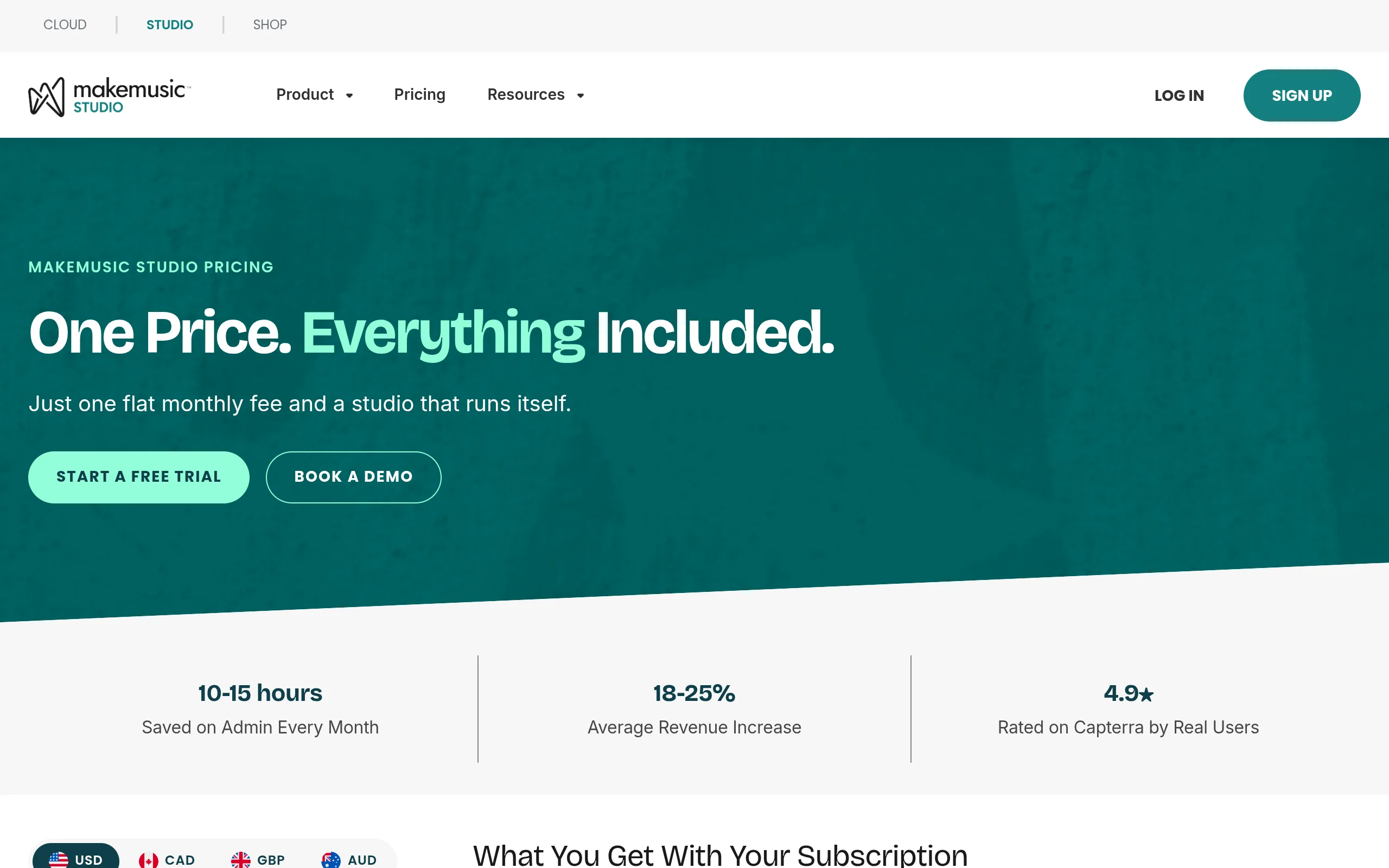
Fons is the billing specialist here. Since 2017 it has done one job for private teachers: make the money arrive without anyone chasing it. In June 2026 it became MakeMusic Studio, after MakeMusic acquired it in 2023 — same product, same price, new name. It centres on automatic payments and recurring collection, so revenue stops leaking through forgotten invoices.
The headline price is simple: $19.95 a month flat, plus $4.95 a month for each additional teacher or admin staff member, with unlimited students and no appointment limits, and a 14-day free trial. It buys scheduling with self-booking links and recurring lessons, automatic payments by subscription, tuition, package, or per-lesson, enforced cancellation policies, automated reminders, transaction reports, and expense tracking. Partner benefits include Alfred and Suzuki Association offers, and QuickBooks and Zoom are built in.
The fee schedule is where the reading matters. Card charges cost 2.9% plus $0.30 each, international cards add another 1%, bank payments by ACH cost 1.8% with no cap, and subscription billing carries an extra 0.4% of subscription volume. The card rate matches Stripe’s published rate, but the 0.4% and the 1.8% ACH rate are Fons’ own additions. Fons charges the card when the lesson ends — its real edge: no invoice, no waiting, no chasing.
At our school size, the headline and the real bill are different numbers. Seven accounts cost $49.65 a month, $595.80 a year. If the school’s $30,000 a month is billed as subscriptions, the 0.4% surcharge adds $120 a month, or $1,440 a year, bringing the effective year one to $2,035.80 — before card processing, which every tool passes through, and before the 1.8% on any family that pays by bank transfer. The subscription looks almost identical to My Music Staff’s $46.65 a month — the fee schedule is what separates them.
Buy Fons if late payments and no-shows are your most expensive problem and you want each lesson charged the moment it ends. Skip it if most of your families pay by subscription, because the 0.4% surcharge quietly becomes your second-biggest software cost.
Opus1: the all-in-one built for music schools
Opus1 is the only tool here built from the ground up for music and performing arts schools, and it shows. It handles scheduling of private and group lessons, automated billing and payments, teacher payroll, student and teacher messaging, smart metrics, recital management, and reporting. Families self-book lessons, trials, and makeups from a booking link.
Plans are sized by active students, per location, per month. Starter covers up to 200 active students and 50 services. Growth covers up to 500 with unlimited services, and adds automation, advanced reporting, and marketing tools. Ultimate covers up to 1,000 and is tailored to large, multi-location schools, with named support. Every plan includes the same core: scheduling, billing, payroll, messaging, recitals, and reporting. Billing is month to month, with no annual contract, and a free trial is advertised.

The prices need a careful sentence, because Opus1’s own pages disagree by a dollar. The pricing page says packages start at just $98 a month, and its FAQ on the same page says $99. Opus1’s AI information page lists Starter at $99, Growth at $199, and Ultimate at $325 a month per location. We use $99 in the maths, so the saving here could be $12 higher. Ask for the number in writing before you budget on it.
Add-ons cost extra and matter to a busy school. Opus1 Plus adds reputation management, prospect and CRM management, and automated marketing. Opus1 SMS is a two-way SMS chat with 5,000 messages a month included in the US and Canada. Opus1 Voice is a built-in voice tool with click-to-call, available in the US. SMS is a paid add-on, so a school that reminds every family by text should price it before comparing.
At our school size, Starter fits exactly: 150 students sits inside the 200-student cap, so the bill is $99 a month, or $1,188 a year. That is $628.20 more than My Music Staff in year one, and the gap buys what it does not have: group classes, teacher payroll, recital management, and a parent self-booking portal, in one login. It is the only tool here covering the whole school in a single bill.
Buy Opus1 if you want one system for lessons, group classes, billing, payroll, and recitals. Skip it if you teach only one-to-one lessons with no groups and no recitals, and get the SMS add-on price in writing before you sign, because reminders are not in the headline figure.
The maths: what five tools really cost a small school
Here is the whole guide in one table, for our school: five teachers, one office manager, and the owner, 150 students, 600 lessons a month, 7,200 a year, $50 a lesson.
| Stack | What you get | Year-one cost | Cost per lesson |
|---|---|---|---|
| Full stack: all five tools | My Music Staff + Jackrabbit + Tutorbase + Fons + Opus1 | $8,451.60 | $1.17 |
| Lean stack: My Music Staff alone | Scheduling, invoicing, payments, and reminders for a 150-student school | $559.80 | $0.08 |
| Honest middle: Opus1 alone | Lessons, group classes, billing, payroll, and recitals in one tool | $1,188 | $0.17 |
The full stack costs $8,451.60 a year, or $704.30 a month. The lean stack costs $559.80 a year, or $46.65 a month. The difference is $7,892 a year, and that is the saving on the cover of this post. It is a real number from published prices — but nobody should buy all five tools. The full stack exists to show what the “buy everything” instinct costs, not as a recommendation.
The honest middle is the number that matters most. Opus1 alone, at $1,188 a year, is about 17 cents a lesson at our volume, and the only tool here that covers scheduling, billing, payroll, group classes, and recitals in one bill. If you want one tool and one login, that is the price.
Two gaps sit inside the full-stack number, and we flag them plainly. Fons’ $2,035.80 includes the 0.4% surcharge on $30,000 a month; if your families pay per lesson instead of by subscription, that surcharge falls away. Opus1’s $99 comes from its own information page, while its pricing page also prints $98, so the true total could be $12 lower. If either figure turns out different at your volume, the $7,892 saving moves with it.
The break-even test is short. At $50 a lesson, the lean stack pays for itself after 12 lessons, the honest middle after 24 lessons, and the full stack after 170 lessons. A school teaching 600 lessons a month clears the lean stack’s whole year in a single morning, and the full stack’s whole year in under two weeks. The question is never whether the software pays for itself. The question is whether you are paying for five tools when one would do.
Two more comparisons sharpen the choice. Tutorbase’s year one is $3,600, which is $3,040 more than My Music Staff’s $559.80, and the gap is entirely the 1%. Fons’ effective $169.65 a month is more than triple its $49.65 subscription, and the gap is entirely the 0.4% surcharge. Both are cases where the headline price is not the bill.
Five traps that catch music schools
First, the percentage that grows with you. Tutorbase’s 1% and Fons’ 0.4% surcharge both look tiny until they are multiplied by real revenue. At $30,000 a month invoiced, Tutorbase costs $300 a month and Fons’ surcharge alone costs $120 a month. A percentage price is cheap when you are small, expensive when you succeed. Do the multiplication at your current invoicing, and again at next year’s target, before you choose a percentage tool.
Second, the student band you cross. Jackrabbit’s bands turn on a single student: 100 students costs $49 a month, and 101 costs $89. A school growing from 98 to 102 students sees its bill jump $40 a month overnight, for the same features. Jackrabbit itself tells you to archive inactive families to lower the billed count, so do that before you sign up, and check your count at the end of every month, when it is sampled.
Third, the teacher you forgot to count. My Music Staff and Fons both charge $4.95 a month per additional teacher or staff member, and the office manager counts. Seven accounts add $29.70 a month — more than half the base price again. Count every login before you compare monthly prices. A $16.95 tool with seven users costs $46.65, while a $99 flat tool costs $99 no matter how many teachers you add.
Fourth, the trial that is really a demo. Jackrabbit offers a demo, not a trial. A demo is a sales call with a screen share; a trial is thirty days of your real diary running on the tool. Opus1 advertises a free trial, but its trial page is a form to book a demo, so ask what the trial actually includes before you count on it. Do not pay a setup fee before you have run your own lessons through it.
Fifth, the price the page does not print. Opus1’s own pages print $98 in one place and $99 in another. My Music Staff prints a dollar sign and names no currency. Jackrabbit’s student bands live in an image on its pricing page, not in searchable text. None of these is a lie, but all three mean the number you budget on is the one you confirm in writing, not the one from a screenshot. Get the figure, the currency, and the band in writing before you sign.
What to buy first
Buy in this order, and stop when the problem is solved. First, buy the booking: if parents cannot book themselves online, every other feature is decoration. My Music Staff at $46.65 a month solves this for a five-teacher school.
Second, buy the reminders. No-shows are the most expensive line in a music school’s week: an empty room still costs rent and a teacher’s hour. Make sure automated SMS and email reminders are switched on before your first lesson, and count their cost in the price. My Music Staff includes SMS reminders; Opus1 charges extra for its SMS plan.
Third, buy the group classes and recitals only when they hurt. If your school runs ensembles, group classes, and two recitals a year, Opus1 earns its $99 a month. If all you need is a diary and an invoice, My Music Staff plus a spreadsheet earns its $46.65. Do not buy payroll for a team of five, or a recital manager for a school that has never held a recital.
If you teach mostly group classes, start with Jackrabbit instead: the class timetable is the reason to pay $89 a month. If your income is uneven, start with Tutorbase, and move to a flat price once monthly invoicing passes $10,000. If late payments are the pain, start with Fons, and read the fee table first.
Pros and cons
My Music Staff
Pros: cheapest honest price here; unlimited students and lessons; SMS reminders included; 30-day trial and 90-day money-back guarantee. Cons: no recital or exam management; no teacher payroll; basic group classes; the pricing page names no currency.
Jackrabbit Music
Pros: strongest group-class and enrolment system here; tuition billing with pro-rating and discount rules; parent portal with online registration; no contracts or setup fees. Cons: priced by total student count, including inactive students; one extra student can jump the bill a band; no payroll or practice log; demo only, no self-serve trial stated.
Tutorbase
Pros: genuinely free core with every feature included; no subscription, no per-student or per-teacher fees; nothing to pay in a slow month; CRM and WhatsApp built in. Cons: 1% of everything you invoice — $300 a month at our size; no recital or practice tracking; the least music-specific tool here; processing fees are extra.
Fons
Pros: automatic payments that end invoicing; charges the card when the lesson ends; enforced cancellation policies; automated reminders; 4.9 stars on Capterra. Cons: the 0.4% surcharge and 1.8% ACH fee sit on top of the headline price; the effective bill is triple the subscription at our size; trial only, no free plan; no payroll module.
Opus1
Pros: the only all-in-one built for music schools; group classes, payroll, and recitals in one bill; parent self-booking and automatic trial conversion. Cons: its own pages print $98 in one place and $99 in another; SMS is a paid add-on; the trial page is a demo-booking form; Starter caps at 200 students.
Our verdict
The best ai tools for music schools are the ones that match the size of the school buying them. At the size in this guide the honest answer is boring: start with My Music Staff. At $559.80 a year it schedules lessons, invoices families, takes payments, and sends reminders for 8 cents a lesson; a school teaching 600 lessons a month recovers the whole year in twelve lessons. It will not run your recitals, but most small schools do not need a specialist for recitals they can already organise.
If you want one tool to run the whole school, the answer changes. Opus1 Starter at $1,188 a year is the only tool that teaches, bills, pays teachers, and stages recitals in one place, and 17 cents a lesson is a fair price for that. Get the $98 or $99 figure in writing first, and price the SMS add-on before you compare.
Jackrabbit Music is the right tool for a school built on group classes: with 150 students in classes and ensembles, its $89 a month earns its price, but with mostly one-to-one lessons the bands charge you for class features you never open. Tutorbase is the right start for uneven income, as long as you know the 1% grows with you and you move to a flat price once invoicing passes $10,000 a month. Fons is the right tool when late payments are the pain, as long as you read the fee schedule first. Buy the booking first, the reminders second, and the rest only when the diary tells you to.
Frequently asked questions
What is the best AI tool for a small music school?
For a school with up to five teachers, My Music Staff at $46.65 a month is the cheapest honest start among the best ai tools for music schools, covering scheduling, invoicing, payments, and reminders. If you also run group classes and recitals, Opus1 Starter at $99 a month is the better single tool.
How much does music school software cost per month?
Published prices in November 2026 run from free to $300 a month at our school size. Tutorbase’s core is free, then takes 1% of invoiced revenue — $300 a month on $30,000 invoiced. My Music Staff costs $46.65 a month for seven accounts, Jackrabbit Music $89 a month at 150 students, and Opus1 Starter $99 a month per location.
Does Tutorbase really cost nothing to start?
Yes, with one condition: the core platform is free, with no credit card and no monthly subscription, and you pay 1% only when you create an invoice. If you invoice nothing, you pay nothing. At our school size that 1% is $300 a month, so the free start is cheap only while invoicing is small.
Why is Fons more expensive than its $19.95 price?
Because the headline price is only the subscription. Fons also charges 2.9% plus $0.30 on card payments, 1.8% on bank transfers, and an extra 0.4% of subscription volume. At our school size the subscription is $49.65 a month for seven accounts, and the 0.4% surcharge on $30,000 a month adds $120 a month, bringing the effective bill to $169.65 a month before card processing.
Can a general booking tool run a music school?
It can run the bookings, and that is often enough. A general scheduler handles lesson times and payments well, but it cannot run group classes, track practice, manage recitals, or pay teachers. A music-built tool such as My Music Staff, Jackrabbit Music, or Opus1 covers those jobs.
Price note
Price note — updated 25 November 2026: Prices in this post were checked on 25 November 2026 on the vendors’ own pricing pages. When you are reading this, the price may be lower or higher, a plan may have been renamed, or a free trial may have changed. Check the official pricing page before you buy.
Three figures are deliberately flagged in this post: Opus1’s own pages print $98 in one place and $99 in another, and we use $99 in the maths; My Music Staff shows its prices with a dollar sign and names no currency, and we use the figures as printed; Jackrabbit Music’s student bands are published in an image on its pricing page, and we read the 101 to 250 band as $89 a month from that image.
Sources
- My Music Staff pricing: https://www.mymusicstaff.com/pricing
- Jackrabbit Class pricing: https://www.jackrabbitclass.com/pricing
- Tutorbase pricing: https://tutorbase.com/pricing
- MakeMusic Studio (Fons) pricing: https://www.fons.com/pricing
- Opus1 pricing: https://opus1.io/pricing/
- Opus1 plan prices: https://opus1.io/ai-info/
Our free AI Cost Calculator
Before you pay for any of these tools, add up what your school actually spends on software today. Our free AI Cost Calculator takes the monthly prices of the tools you already use and shows the real yearly total, so you can see whether a $99 tool replaces three $30 tools or just joins them. It takes two minutes, and uses your numbers, not ours.
Pros
- My Music Staff: cheapest honest price here; unlimited students and lessons; SMS reminders included; 30-day trial and 90-day money-back guarantee.
- Jackrabbit Music: strongest group-class and enrolment system here; tuition billing with pro-rating and discount rules; parent portal with online registration; no contracts or setup fees.
- Tutorbase: genuinely free core with every feature included; no subscription, no per-student or per-teacher fees; nothing to pay in a slow month; CRM and WhatsApp built in.
- Fons: automatic payments that end invoicing; charges the card when the lesson ends; enforced cancellation policies; automated reminders; 4.9 stars on Capterra.
- Opus1: the only all-in-one built for music schools; group classes, payroll, and recitals in one bill; parent self-booking and automatic trial conversion.
Cons
- My Music Staff: no recital or exam management; no teacher payroll; basic group classes; the pricing page names no currency.
- Jackrabbit Music: priced by total student count, including inactive students; one extra student can jump the bill a band; no payroll or practice log; demo only, no self-serve trial stated.
- Tutorbase: 1% of everything you invoice — $300 a month at our size; no recital or practice tracking; the least music-specific tool here; processing fees are extra.
- Fons: the 0.4% surcharge and 1.8% ACH fee sit on top of the headline price; the effective bill is triple the subscription at our size; trial only, no free plan; no payroll module.
- Opus1: its own pages print $98 in one place and $99 in another; SMS is a paid add-on; the trial page is a demo-booking form; Starter caps at 200 students.
The best ai tools for music schools are the ones that match the size of the school buying them. At the size in this guide the honest answer is boring: start with My Music Staff. At $559.80 a year it schedules lessons, invoices families, takes payments, and sends reminders for 8 cents a lesson; a school teaching 600 lessons a month recovers the whole year in twelve lessons. It will not run your recitals, but most small schools do not need a specialist for recitals they can already organise.If you want one tool to run the whole school, the answer changes. Opus1 Starter at $1,188 a year is the only tool that teaches, bills, pays teachers, and stages recitals in one place, and 17 cents a lesson is a fair price for that. Get the $98 or $99 figure in writing first, and price the SMS add-on before you compare.Jackrabbit Music is the right tool for a school built on group classes: with 150 students in classes and ensembles, its $89 a month earns its price, but with mostly one-to-one lessons the bands charge you for class features you never open. Tutorbase is the right start for uneven income, as long as you know the 1% grows with you and you move to a flat price once invoicing passes $10,000 a month. Fons is the right tool when late payments are the pain, as long as you read the fee schedule first. Buy the booking first, the reminders second, and the rest only when the diary tells you to.