

This guide to the best AI tools for therapists in private practice compares five tools a solo therapist can actually buy and use: Mentalyc, Upheal, Blueprint, Freed, and Supanote. Start with Mentalyc Basic at $29.99 a month billed annually if you want the cheapest workable AI scribe at a full caseload of 80 sessions a month, with therapy-specific note formats. Pick Upheal EHR at $1 a session if you want notes and a practice system in one place and would rather pay per session than pay a subscription. Pick Blueprint at $69 a seat a month if you hold a busy caseload and want unlimited sessions for one flat price, with no per-session counting. Pick Freed Core at $79 a month if you want unlimited notes and the fastest setup, and do not need therapy-specific formats. Pick Supanote Pro at $39.99 a month billed annually if you want the cheapest therapy-specific scribe that fills in your EHR. Four of the five tools charge a flat monthly price and Upheal charges per session, and the note caps matter more than the headline price. A solo therapist holding 80 sessions a month pays $29.99 a month for Mentalyc Basic and $80 a month for Upheal EHR, for the same 80 sessions.
Best AI Tools for Therapists in Private Practice (2026): 5 Compared by Real Price
In this article: Quick Answer Box / What AI Actually Does Inside a Therapy Practice / How We Picked These Five / The Five Tools at a Glance / Mentalyc — The Cheapest Workable Scribe at a Full Caseload / Upheal — The AI-Native EHR That Charges by the Session / Blueprint — The Flat-Rate Scribe That Rewards a Busy Caseload / Freed — The Fastest General Scribe With an Unlimited Tier / Supanote — The Budget Therapy Scribe With EHR Autofill / Cost Maths / The Hidden Costs and Gotchas / Work Out What the Hour Is Worth / Pros and Cons / Our Verdict / Frequently Asked Questions / Price Note
Quick Answer Box
This guide to the best AI tools for therapists in private practice compares five tools a solo therapist can actually buy and use: Mentalyc, Upheal, Blueprint, Freed, and Supanote. Start with Mentalyc Basic at $29.99 a month billed annually if you want the cheapest workable AI scribe at a full caseload of 80 sessions a month, with therapy-specific note formats. Pick Upheal EHR at $1 a session if you want notes and a practice system in one place and would rather pay per session than pay a subscription.
Pick Blueprint at $69 a seat a month if you hold a busy caseload and want unlimited sessions for one flat price, with no per-session counting. Pick Freed Core at $79 a month if you want unlimited notes and the fastest setup, and do not need therapy-specific formats. Pick Supanote Pro at $39.99 a month billed annually if you want the cheapest therapy-specific scribe that fills in your EHR.
Four of the five tools charge a flat monthly price and Upheal charges per session, and the note caps matter more than the headline price. A solo therapist holding 80 sessions a month pays $29.99 a month for Mentalyc Basic and $80 a month for Upheal EHR, for the same 80 sessions.
What AI Actually Does Inside a Therapy Practice
A therapy practice is not a clinic with a back office. It is one person, usually working alone, seeing clients all day and writing notes at night. Therapists spend about 35 percent of their working hours on documentation, roughly 16 minutes of paperwork after every encounter, so a 30-client week means more than eight hours of progress notes alone. Documentation is tied as the single most common driver of burnout in the Tebra 2025 survey, where 77 percent of mental-health clinicians reported significant mental exhaustion, the highest rate of any medical specialty.
AI inside a therapy tool does three things. First, it listens to the session, with the client’s consent, and drafts the progress note, in SOAP, DAP, BIRP, or whatever format your practice uses. Second, it drafts the treatment plan and pulls out the goals, interventions, and homework. Third, it fills in your EHR so you do not retype the same note twice.
The note is the part to be careful with. An AI note is a draft, not a record. It can mishear a medication name, flatten a client’s exact words into a summary, or miss the risk factor you noticed in the room. Every tool here requires you to review and sign the note. OntarioMD research found providers save three to four hours a week with AI documentation, and 76 percent reported reduced information overload. That saving only counts if the note you sign is the note you would have written yourself.
The second thing to be careful with is privacy, and it is the line this whole guide is built on. No identifiable client information goes into a general chatbot.
ChatGPT Free and Plus and Claude on a consumer plan do not sign a business associate agreement with you, and without one, pasting a session transcript into them is a HIPAA problem, not a shortcut. A therapy tool must sign a BAA, encrypt data in transit and at rest, and state in plain words what happens to the recording and the transcript after the note is written. All five tools here offer a BAA. They differ on which plan it comes with and whether your de-identified data is used to improve the product.
How We Picked These Five
We picked the five AI tools for therapists in private practice in this guide by one rule: a solo therapist holding about 80 sessions a month must be able to buy the tool, see the price on the vendor’s own pricing page, and use the AI on day one. That rule cut the list hard.
Every price in this guide was read on the vendor’s own pricing page on 19 November 2026, and the publishing run re-reads them on the day this post goes live. Where a price could not be read live, the guide says so instead of printing a stale figure as fact. The volume is fixed for the whole guide: one therapist, 80 sessions a month, 960 sessions a year.
The Five Tools at a Glance
| Tool | Entry price at 80 sessions/mo | How it charges | Free plan | Free trial | AI that matters |
|---|---|---|---|---|---|
| Mentalyc | $29.99/mo | Flat per month, note cap | No | 14 days | Therapy note formats, treatment plans, Alliance Genie |
| Upheal | $80/mo | Per session | Yes, $0 | 30 days | AI notes, treatment plans, Assistant chat, EHR |
| Blueprint | $69/mo | Flat per seat, unlimited | No | 5 free sessions | AI notes, outcome measures (PHQ-9, GAD-7, PCL-5) |
| Freed | $79/mo | Flat per month, note cap | No | 7 days | Ambient notes, template builder, Clinical Evidence answers |
| Supanote | $39.99/mo | Flat per month, unlimited | Trial $0 | 14 days | Therapy notes, EHR autofill (Super Fill), style learning |
Mentalyc — The Cheapest Workable Scribe at a Full Caseload
Mentalyc is the cheapest workable scribe in this guide. Basic is $29.99 a month billed annually, or $39.99 billed monthly, read live on mentalyc.com/pricing on 19 November 2026. Basic covers 100 notes a month, which fits our 80 sessions. The page currently shows a Black Friday banner (code BF30), an extra 30 percent off the first year on top of the annual prices, so the figures above are the standard annual prices.
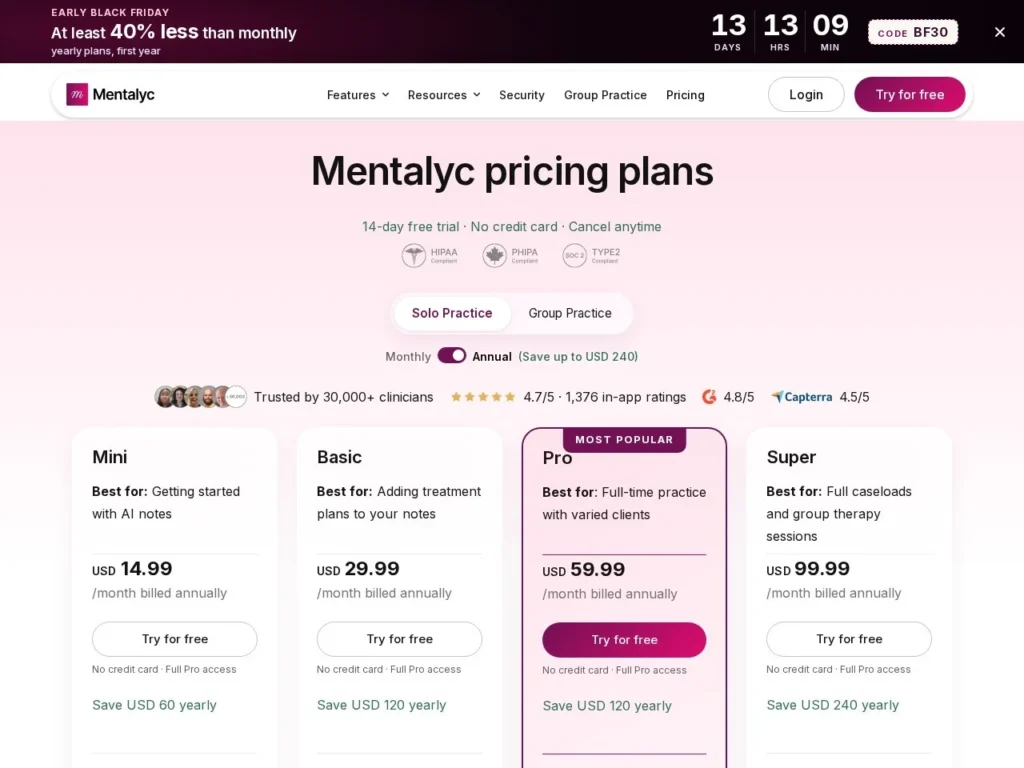
Mini is $14.99 billed annually, or $19.99 monthly, but it covers only 40 notes a month, half our volume. Pro is $59.99 a month billed annually, or $69.99 monthly, with 160 notes, and Super is $99.99 billed annually, or $119.99 monthly, with 330 notes. Team is $49.99 a seat billed annually, or $59.99 monthly, with unlimited notes under fair use.
What the $29.99 buys is a scribe built for therapy, not adapted from medicine. Basic includes treatment plans and the Alliance Genie score, which rates the therapeutic alliance in the session, plus more than 100 custom templates and the full set of therapy formats: SOAP, DAP, BIRP, GIRP, PIRP, SIRP, PIE, and intake notes. The 14-day trial gives full Pro access for 15 notes with no card. There is no free plan.
The privacy terms are the cleanest here. Mentalyc is HIPAA and PHIPA compliant, SOC 2 Type II certified, and signs a BAA on every plan, including Mini. Audio is deleted once the note is ready, and the company states it never trains on your sessions, while two tools here use de-identified data to improve their AI unless you opt out.
The catch is the cap. One hundred notes a month fits 80 sessions, and it breaks the first month you hold 101 sessions, or the month a client needs two notes. The fix is Pro at $59.99 a month billed annually, which doubles the bill for one extra note. The second catch is the Team seat price: the pricing page shows a promotional strikethrough, but the price is locked in once you subscribe, so $49.99 a seat is the price you keep. Mentalyc pricing: https://www.mentalyc.com/pricing
Upheal — The AI-Native EHR That Charges by the Session
Upheal is the only tool here that can replace your whole practice system, and the only one that charges by the session. The EHR route is $1 a session, pay as you go, with AI notes included, read live on upheal.io/pricing on 19 November 2026. At 80 sessions a month that is $80. EHR Pro is $99 a month flat, with unlimited sessions and Assistant Pro included. The AI Notes route is $39 a month flat, with unlimited sessions, and it works alongside whatever EHR you already use. Assistant Pro is a $39-a-month add-on, or included in EHR Pro.
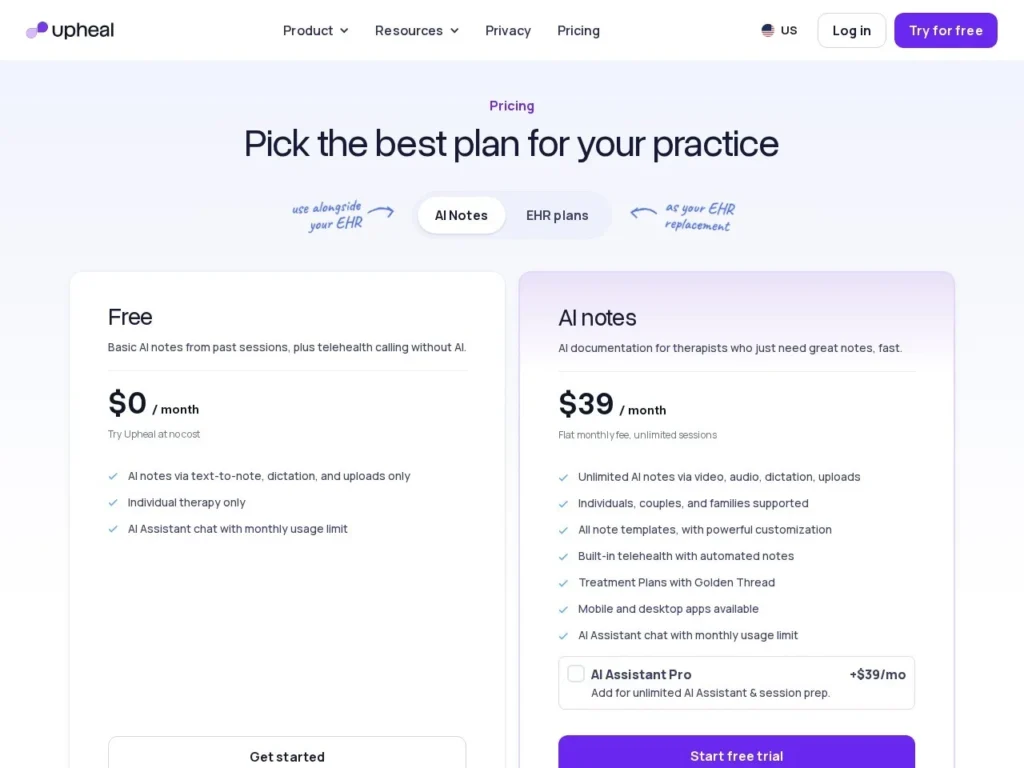
The maths has a clear crossover. If you keep your own EHR, AI Notes at $39 a month is the cheapest way to get Upheal’s scribe. If you move your whole practice to Upheal, the EHR at $1 a session costs $80 at our volume, and EHR Pro at $99 a month becomes cheaper once you pass about 99 sessions a month. If you also use Assistant Pro, the crossover comes sooner: EHR plus Assistant Pro is $119 at 80 sessions, while EHR Pro is $99 flat with Assistant Pro included, so EHR Pro already wins at 60 sessions.
There is also a free plan at $0, with basic AI notes from text, dictation, or uploads only, and no live recording. Paid plans carry a 30-day free trial with no card and a 30-day money-back guarantee.
The privacy terms need one check from you. Upheal is HIPAA compliant, SOC 2 Type II certified, and signs a BAA, and recordings are deleted by default. But de-identified data is used to improve the AI unless your practice opts out, so find the setting on day one. The small fees add up: insurance claims are $0.30 each, eligibility checks are $0.15, and card payments are 2.9 percent plus $0.30, none of which appears in the headline price.
The catch is the volume trap in reverse. At 40 sessions a month the EHR costs $40, cheaper than every flat-rate tool here. At 120 sessions it costs $120, more than EHR Pro, so the per-session model rewards a light month and punishes a busy one. The second catch is the old $69 cap: older sources from August and September 2026 say the Individual EHR was capped at $69 a month, but the live pricing page today shows no $69 cap, only $1 a session and the $99 EHR Pro flat, so do not budget on $69. Upheal pricing: https://www.upheal.io/pricing
Blueprint — The Flat-Rate Scribe That Rewards a Busy Caseload
Blueprint is the tool to buy when your caseload runs hot. Alongside your EHR, the price is $69 a seat a month for unlimited sessions, read on a live screenshot of blueprint.ai/pricing on 19 November 2026. All-in-one EHR, the route that replaces your practice system, is $1.49 a session, or $119.20 a month at our volume, and it adds scheduling, telehealth, forms, a client portal, and billing.
The page names the two options Alongside your EHR and All-in-one EHR, not Plus and Pro. Older comparisons quoted $0.99 a session for the alongside route, and one FAQ answer on the same page still quotes that figure, but the main price on the live page today is the $69 flat rate, so this guide uses $69.
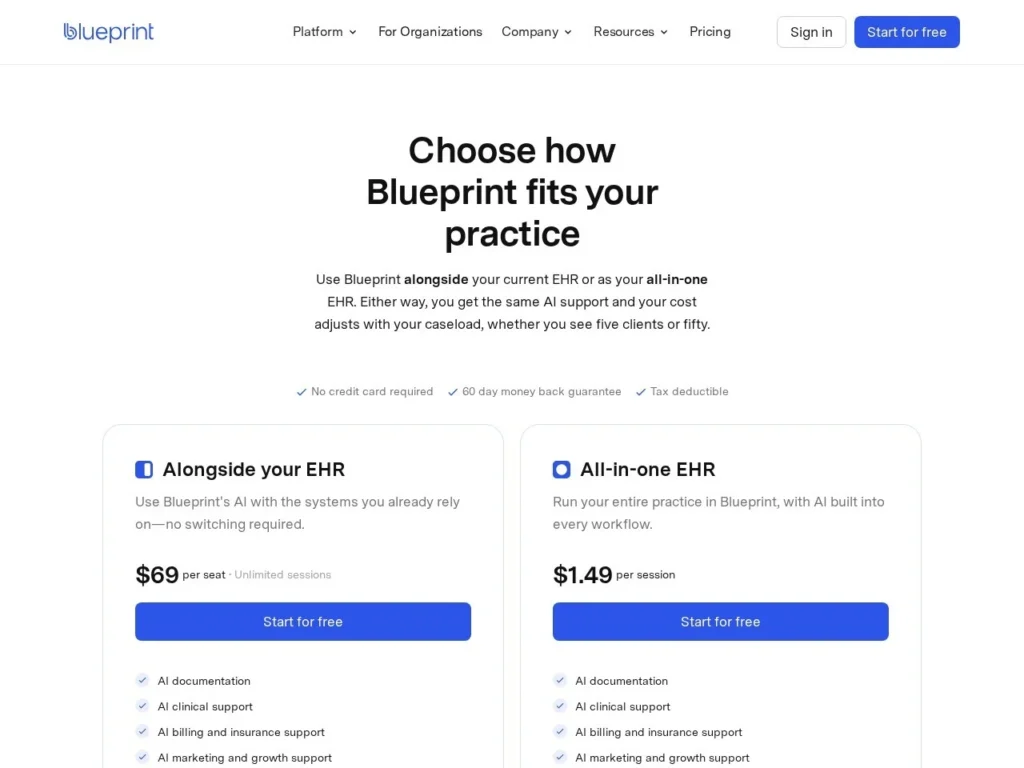
What makes Blueprint different is not the price, it is the measurement. Blueprint is built around measurement-based care, and its outcome measures, PHQ-9, GAD-7, and PCL-5 among them, track whether clients are actually getting better, session by session. The AI is identical in both routes; the vendor’s FAQ says so, and the difference is only where your practice runs. The free start is five free sessions with no card on the add-on route, and a 30-day free trial on the EHR route. There is no permanent free plan, and there is a 60-day money-back guarantee, the longest in this guide.
The privacy terms are strong: HIPAA and PHIPA compliant, SOC 2 Type II certified, and a BAA on every plan. The privacy page states client data is never sold, shared, or used to train AI.
The catch is the flat rate itself. Sixty-nine dollars a seat a month for unlimited sessions is a bargain at 120 sessions, at $0.58 a session, and a poor deal at 30 sessions, at $2.30 a session, so the flat rate rewards a busy caseload and punishes a light one. The second catch is the ghost price: the old $0.99-a-session figure still appears in older comparisons and in one FAQ answer on the same page, so confirm at sign-up that $69 flat is the price you will actually pay. Blueprint pricing: https://www.blueprint.ai/pricing
Freed — The Fastest General Scribe With an Unlimited Tier
Freed is the fastest tool in this guide to set up. Core is $79 a month, with unlimited notes, an instant template builder, and Clinical Evidence answers, read live on getfreed.ai/pricing on 19 November 2026. Starter is $39 a month, with up to 40 notes a month, specialty templates, and live support. Premier is $119 a month billed monthly, or $104 billed annually ($1,248 a year), and it adds visit summaries, patient instructions, letters and referrals, EHR push, dictation with saved phrases, and ICD-10 and CPT coding.
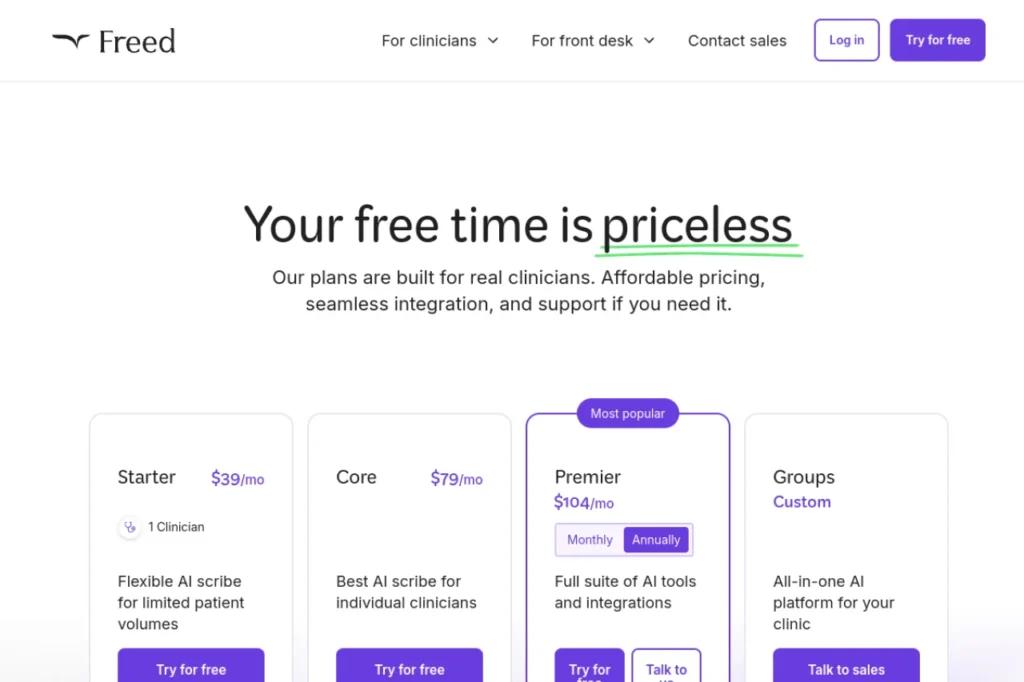
The catch is the Starter cap, and it is the sharpest cap in this guide. Forty notes a month is half our volume of 80 sessions, so Starter is not a real option at a full caseload, and Core at $79 is the real entry price.
The second catch is the billing toggle. Starter and Core cost the same on both toggles, $39 and $79, so there is no annual discount on those two plans, and only Premier drops from $119 monthly to $104 annually. The crossed-out $59 figures from earlier checks do not appear on the live page. The trial is seven days with no card, the shortest here, so set it up on a normal week. There is no permanent free tier, although residents, students, and trainees get Core free or 50 percent off monthly plans, so confirm that if it applies to you.
What Core buys is simplicity. Freed is a general ambient scribe, not a therapy-specific one, so it does not ship Mentalyc’s therapy formats or Blueprint’s outcome measures. What it does ship is speed: it listens, drafts, and gets out of the way, and Clinical Evidence answers questions from the note instead of making you search it. Freed is HIPAA compliant and signs a BAA on paid plans, and audio is deleted after the summaries and quality checks. Freed pricing: https://www.getfreed.ai/pricing
Supanote — The Budget Therapy Scribe With EHR Autofill
Supanote is the budget therapy-specific scribe in this guide. Pro is $39.99 a month billed annually, read on Supanote’s own blog pages and corroborated by two independent November 2026 checks of supanote.ai/pricing, and the publishing run re-reads the official page live. Starter is $19.99 a month billed annually, with 40 notes a month, which is half our volume. XL is $69.99 a month billed annually, with unlimited notes, group sessions, and the most advanced AI model. Group Practice is custom priced.
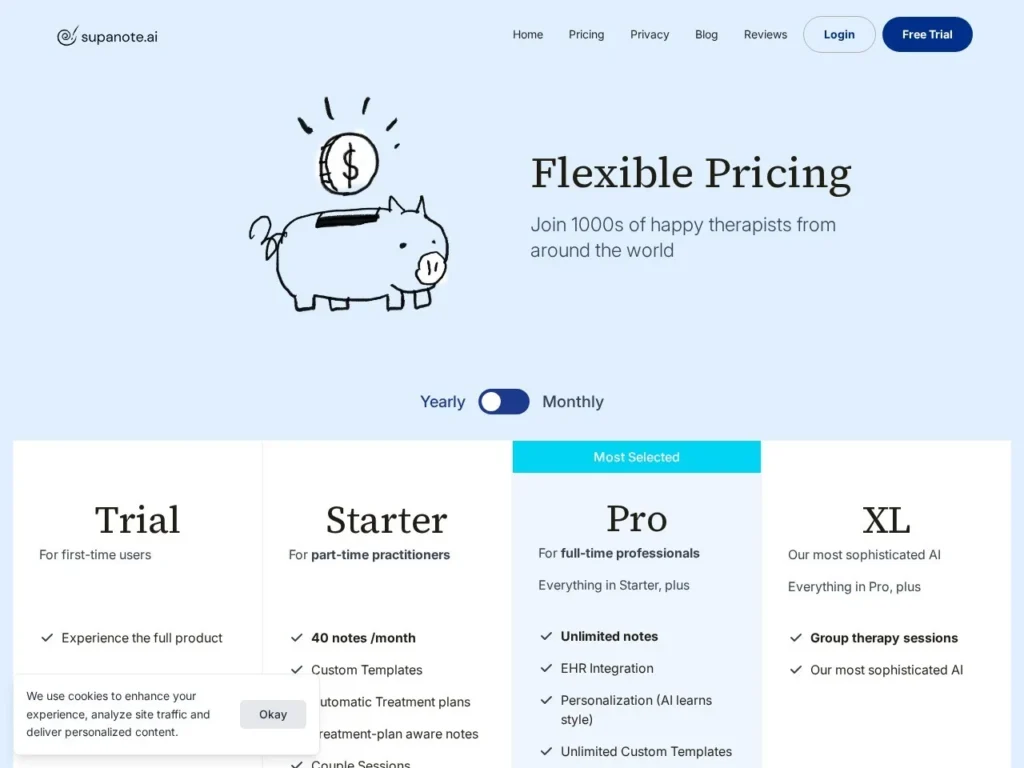
At 80 sessions a month, Pro at $39.99 is the plan that fits, ten dollars a month more than Mentalyc Basic for a different strength. Pro includes Super Fill, which fills in your EHR from the note instead of making you retype it, and the AI learns your writing style on Pro. Supanote supports more than 120 languages, the widest here, and it is HIPAA and PHIPA compliant with a BAA from Starter up. Recordings are deleted after scribing, and the trial is 14 days of the full product with no card.
The catch is that Supanote’s own sources disagree with each other, and you should know exactly where. The Pro note cap is 100 notes a month on Supanote’s blog, but the live pricing page shows Pro with unlimited notes, so the blog figure looks stale, and a 101-session month should no longer force XL at $69.99.
The plan names differ across sources too, but the live page uses Pro and XL, so use those. The trial length is 14 days on the live page, and the live page shows a Trial plan at $0 for first-time users, so treat the free plan as a 14-day trial, not a permanent free tier. Read the live pricing page yourself before you pay: this guide’s $39.99 is the annual-billing price, and the monthly-billing price is $49.99. Supanote pricing: https://www.supanote.ai/pricing
Cost Maths
Here is what the five AI tools for therapists in private practice cost when one therapist holds 80 sessions a month for a year, all on annual billing where an annual price is published, with no add-ons.
| Tool | Plan at 80 sessions | Monthly | Yearly | Cost per session (960 sessions) |
|---|---|---|---|---|
| Mentalyc | Basic (100 notes) | $29.99 | $359.88 | $0.37 |
| Supanote | Pro | $39.99 | $479.88 | $0.50 |
| Blueprint | Alongside EHR ($69/seat) | $69.00 | $828.00 | $0.86 |
| Freed | Core (unlimited) | $79.00 | $948.00 | $0.99 |
| Upheal | EHR (80 × $1) | $80.00 | $960.00 | $1.00 |
| All five together | $296.98 | $3,563.76 | $3.71 |
The realistic stack is one tool, not five: for a solo therapist at 80 sessions a month, Mentalyc Basic at $29.99 a month, or $359.88 a year. The cheapest credible start is Upheal’s free plan at $0, then AI Notes at $39 a month alongside the EHR you already use.
The monthly-billing penalty is the quietest cost in this guide. Pay monthly instead of annually and Mentalyc Basic costs $120 a year more, $39.99 a month against $29.99. Upheal EHR has no monthly penalty, because it charges per session. Blueprint is $69 a seat a month, confirmed as the monthly billing rate. Supanote Pro costs $120 a year more on monthly billing, $49.99 a month against $39.99. Freed’s Starter and Core cost the same on both toggles, so there is no monthly penalty there, but Premier costs $180 a year more monthly, $119 against $104.
Then there are the costs outside the subscription. Upheal’s insurance claims at $0.30 each and eligibility checks at $0.15 add up across 80 sessions a month, and card payments at 2.9 percent plus $0.30 apply to every client who pays by card. And the biggest outside cost is a wrong cap: a 101-session month on Mentalyc Basic is a forced upgrade to a plan that costs twice as much. Run the numbers in the AI Cost Calculator (https://aitbizhub.com/ai-cost-calculator/) before you buy, with your real session count, not the round number in this guide.
The Hidden Costs and Gotchas
First, Mentalyc Basic’s 100-note cap. One hundred notes fits 80 sessions, and it breaks the first month you hold 101 sessions, or the month a client needs a second note. The fix is Pro at $59.99 a month billed annually, which doubles the bill for one note over the cap, so count your sessions before you choose Basic.
Second, Upheal’s volume trap in reverse. At 40 sessions the EHR costs $40, cheaper than every flat-rate tool here. At 120 sessions it costs $120, more than EHR Pro at $99, so the per-session model rewards a light month and punishes a busy one.
Third, Blueprint’s $0.99 ghost price. Older comparisons and one FAQ answer on the official page quote $0.99 a session for the alongside-EHR route, but the main price on the live page today is $69 a seat a month for unlimited sessions. Budgeting on $0.99 a session overstates the bill at a full caseload and understates it at a light one, so use the $69 flat rate and confirm it at sign-up.
Fourth, Freed Starter’s 40-note cap. Forty notes a month is half our volume, so Starter at $39 is not a real option at a full caseload, and Core at $79 is the real entry price. The crossed-out $59 figures from earlier checks do not appear on the live page.
Fifth, Supanote’s monthly prices are now plain. The $19.99, $39.99, and $69.99 figures are the annual-billing rates, and the monthly rates are $29.99, $49.99, and $89.99, so read the toggle before you pay. The good news is the note cap: the live page shows Pro with unlimited notes, so the 100-note cap in Supanote’s own blog is stale, and a 101-session month no longer forces the XL plan.
Sixth, Upheal’s data opt-out. De-identified data is used to improve the AI unless you opt out, so find the setting on day one.
Seventh, the BAA trap, which is the only one that can cost you more than the software. A general chatbot on a consumer plan does not sign a BAA with you, so pasting a session transcript into ChatGPT or Claude is a HIPAA problem, not a shortcut. Even inside these five tools, check which plan the BAA comes with.
Eighth, Freed’s seven-day trial. Seven days is the shortest trial in this guide, and a week with a light caseload is not a real test. Set it up on a normal week.
Ninth, Mentalyc’s Team promo. The pricing page shows a promotional strikethrough on the Team tier, but the price locks in once you subscribe, so $49.99 a seat a month is the price you keep.
Tenth, Mentalyc’s Black Friday code is a first-year extra. The BF30 code takes an extra 30 percent off the first year on top of the annual prices, so a $29.99 plan costs less in year one and returns to $29.99 in year two. Do not budget the promo price as the standing price.
Eleventh, the consent and review trap, which is the only one that can cost you your licence. An AI scribe records the session, and most US states require one-party consent while a dozen, including California, Illinois, Florida, and Pennsylvania, require all-party consent, so get the client’s consent in writing, tell them what is recorded and what happens to it, and check your own state’s law before the first recording. And review every note before you sign it, because an AI note with a wrong medication is your liability, not the vendor’s. The scribe drafts, you sign.
Work Out What the Hour Is Worth
The price of the tool is the smallest number in this decision. Sixteen minutes of paperwork after every session, at 80 sessions a month, is more than 21 hours a month spent writing notes, and that is the conservative figure, before treatment plans and intake paperwork. That is the cost the tools here are competing to remove, and it is the number you should put into the AI Time-Saving Calculator (https://aitbizhub.com/ai-time-saving-calculator/) before you buy anything.
Run it with honest numbers. At $100 an hour, 21 hours of documentation is $2,100 a month of your time. Mentalyc Basic costs $29.99 a month. Even if the AI only cuts the note-writing in half, you have traded about $1,000 of your time for $30 of software. Documentation is tied as the top driver of burnout, and the NIH figure Freed cites puts the cost of physician burnout at about $4.6 billion a year across the US healthcare system.
Pros and Cons
Pros of Mentalyc: the cheapest workable scribe here, with therapy-specific formats in the $29.99 plan; treatment plans and the Alliance Genie score from Basic; the cleanest privacy terms, with a BAA on every plan and no training on your sessions.
Cons of Mentalyc: the 100-note cap on Basic is a wall in a busy month, and Pro doubles the bill; the Team seat price shows a promotional strikethrough, but the price locks in once you subscribe.
Pros of Upheal: the only tool here that can replace your whole practice system; pay-per-session pricing rewards a light month; a genuinely free plan at $0.
Cons of Upheal: the EHR at $1 a session becomes the most expensive tool here at 120 sessions; de-identified data is used to improve the AI unless you opt out; claims and card payments are all extra.
Pros of Blueprint: unlimited sessions for one flat $69 a month, with no per-session counting; the only outcome measures here, PHQ-9, GAD-7, and PCL-5; the longest money-back guarantee here at 60 days.
Cons of Blueprint: the pricing page still carries the old $0.99-a-session figure in one FAQ answer, so confirm $69 flat at sign-up; the flat rate is a poor deal in a light month, working out to $2.30 a session at 30 sessions.
Pros of Freed: unlimited notes on Core, with the fastest setup here; Clinical Evidence answers questions from the note.
Cons of Freed: no therapy-specific note formats, so you build your own templates; the 7-day trial is the shortest here; the monthly-versus-annual prices are now plain: Starter and Core cost the same on both toggles.
Pros of Supanote: the cheapest therapy-specific scribe that fills in your EHR for you, with Super Fill on Pro; the AI learns your writing style; more than 120 languages, the widest here.
Cons of Supanote: the Pro note cap is 100 on Supanote’s own blog but unlimited on the live pricing page, so trust the live page, not the blog; the plan names and trial length differ across older sources.
Our Verdict
The best AI tools for therapists in private practice for a solo therapist holding 80 sessions a month start with Mentalyc Basic at $29.99 a month billed annually. It costs $359.88 a year, about 37 cents a session, with a BAA on every plan.
Buy Upheal EHR at $1 a session if you want notes and a practice system in one place and your caseload sits under about 99 sessions a month, because the per-session model is the cheapest way to run a light practice, and EHR Pro at $99 flat takes over once you cross 99 sessions. If you already have an EHR you like, buy Upheal AI Notes at $39 a month instead.
Buy Blueprint at $69 a seat a month if you hold a busy caseload and want unlimited sessions for one flat price, and the outcome measures show whether clients are getting better. At 80 sessions that is $0.86 a session, and at 120 sessions it is $0.58, so the flat rate gets cheaper the busier you are.
Buy Freed Core at $79 a month if you want unlimited notes and the fastest setup, and you are happy building your own therapy templates. Buy Supanote Pro at $39.99 a month billed annually if you want the cheapest therapy-specific scribe that fills in your EHR for you, and read the live pricing page before you pay, because the note cap is the one figure here that two sources cannot agree on. And whichever tool you buy, get the client’s consent in writing before the first recording, review every note before you sign it, and never paste identifiable client information into a general chatbot.
Frequently Asked Questions
What are the best AI tools for therapists in private practice? Mentalyc Basic is the cheapest workable scribe at $29.99 a month billed annually; Upheal EHR puts notes and a practice system in one place at $1 a session; Blueprint is unlimited sessions for a $69-a-month flat rate; Freed Core is unlimited notes at $79 a month; and Supanote Pro is the cheapest therapy scribe with EHR autofill at $39.99 a month billed annually.
Is it HIPAA compliant to use AI for therapy notes? Yes, if the tool signs a business associate agreement with you, encrypts data in transit and at rest, and states what happens to recordings and transcripts. All five tools here offer a BAA. A general chatbot on a consumer plan does not sign one, so never paste identifiable client information into ChatGPT or Claude.
How much does AI note-taking software cost a therapist? At 80 sessions a month, Mentalyc Basic costs $29.99 a month, Supanote Pro costs $39.99 a month, Blueprint costs $69 a month, Freed Core costs $79 a month, and Upheal EHR costs $80 a month, all on annual billing where an annual price is published.
Do I need my client’s consent to record a session for AI notes? Yes. Get consent in writing before the first recording, tell the client what is recorded and what happens to it, and check your state’s law: most states require one-party consent, while about a dozen, including California, Illinois, Florida, and Pennsylvania, require all-party consent.
Can AI write my therapy notes for me? It can draft them, but you must review and sign every note. AI can mishear a medication or miss a risk factor you noticed in the room, and the note you sign is your professional record, not the vendor’s.
Price Note
Price note — updated 19 November 2026: Prices in this post were checked on 19 November 2026. When you are reading this, the price may be lower, higher, or structured differently. Mentalyc, Upheal, and Freed prices were read live on the vendors’ own pricing pages on that date. Blueprint’s $69-a-seat flat rate and $1.49-a-session EHR price were read on a live screenshot of the official pricing page, and Supanote’s prices were read live on the official pricing page; all five were re-checked live on the day of publishing.
Mentalyc’s page currently shows a Black Friday offer (code BF30), an extra 30 percent off the first year on top of the annual prices, so the figures above are the standard annual prices. Always check the official pricing page before you buy.
Pros
- Mentalyc: The cheapest workable scribe here, with therapy-specific formats in the $29.99 plan; treatment plans and the Alliance Genie score from Basic; the cleanest privacy terms, with a BAA on every plan and no training on your sessions.
- Upheal: The only tool here that can replace your whole practice system; pay-per-session pricing rewards a light month; a genuinely free plan at $0.
- Blueprint: Unlimited sessions for one flat $69 a month, with no per-session counting; the only outcome measures here, PHQ-9, GAD-7, and PCL-5; the longest money-back guarantee here at 60 days.
- Freed: Unlimited notes on Core, with the fastest setup here; Clinical Evidence answers questions from the note.
- Supanote: The cheapest therapy-specific scribe that fills in your EHR for you, with Super Fill on Pro; the AI learns your writing style; more than 120 languages, the widest here.
Cons
- Mentalyc: The 100-note cap on Basic is a wall in a busy month, and Pro doubles the bill; the Team seat price shows a promotional strikethrough, but the price locks in once you subscribe.
- Upheal: The EHR at $1 a session becomes the most expensive tool here at 120 sessions; de-identified data is used to improve the AI unless you opt out; claims and card payments are all extra.
- Blueprint: The pricing page still carries the old $0.99-a-session figure in one FAQ answer, so confirm $69 flat at sign-up; the flat rate is a poor deal in a light month, working out to $2.30 a session at 30 sessions.
- Freed: No therapy-specific note formats, so you build your own templates; the 7-day trial is the shortest here; the monthly-versus-annual prices are now plain: Starter and Core cost the same on both toggles.
- Supanote: The Pro note cap is 100 on Supanote's own blog but unlimited on the live pricing page, so trust the live page, not the blog; the plan names and trial length differ across older sources.
The best AI tools for therapists in private practice for a solo therapist holding 80 sessions a month start with Mentalyc Basic at $29.99 a month billed annually. It costs $359.88 a year, about 37 cents a session, with a BAA on every plan. Buy Upheal EHR at $1 a session if you want notes and a practice system in one place and your caseload sits under about 99 sessions a month, because the per-session model is the cheapest way to run a light practice, and EHR Pro at $99 flat takes over once you cross 99 sessions. If you already have an EHR you like, buy Upheal AI Notes at $39 a month instead. Buy Blueprint at $69 a seat a month if you hold a busy caseload and want unlimited sessions for one flat price, and the outcome measures show whether clients are getting better. At 80 sessions that is $0.86 a session, and at 120 sessions it is $0.58, so the flat rate gets cheaper the busier you are. Buy Freed Core at $79 a month if you want unlimited notes and the fastest setup, and you are happy building your own therapy templates. Buy Supanote Pro at $39.99 a month billed annually if you want the cheapest therapy-specific scribe that fills in your EHR for you, and read the live pricing page before you pay, because the note cap is the one figure here that two sources cannot agree on. And whichever tool you buy, get the client's consent in writing before the first recording, review every note before you sign it, and never paste identifiable client information into a general chatbot.