

For a solo travel agent booking 120 trips a year, TravelJoy Pro on annual billing is the cheapest all-in-one of the best ai tools for travel agents: $32 a month billed annually, or $384 a year, with AI and automations included. Tern costs $420 a year for one seat and meters its AI. Travefy costs $468 a year for one advisor. AXUS costs $329 a year per seat but sells itinerary building, not a full business system. GuideGeek is free for personal use and useful for destination research, but it has no CRM, no client documents, and no payments.
A travel agent rarely loses a booking on the destination. The booking leaks away in the hours around it: the itinerary rebuilt from three supplier emails, the proposal sent a day after a rival agent replied, the commission chased from a spreadsheet at month end.
That backstage work is what the best ai tools for travel agents are supposed to absorb. The honest version is narrower. Some of these tools draft and import itineraries with real AI. Some are CRM and invoicing systems wearing an AI badge. One is a free chatbot built for travelers, not for your business at all.
We compared five tools for the same solo advisor and checked every price on the vendor’s own page on 26 November 2026. No roundup prices, and no tool here pays us anything. Where a vendor does not print a price, we say so instead of filling the gap with a guess.
Quick Answer
For a solo travel agent booking 120 trips a year, TravelJoy Pro on annual billing is the cheapest all-in-one of the best ai tools for travel agents: $32 a month billed annually, or $384 a year, with AI and automations included. Tern costs $420 a year for one seat and meters its AI. Travefy costs $468 a year for one advisor. AXUS costs $329 a year per seat but sells itinerary building, not a full business system. GuideGeek is free for personal use and useful for destination research, but it has no CRM, no client documents, and no payments.
In this article
- How we compared the five tools
- The five tools at a glance
- Travefy: proposals, CRM, and cheap extra seats
- TravelJoy: the cheapest all-in-one, with a card-fee catch
- Tern: one platform, metered AI
- AXUS: itinerary building without the business system
- GuideGeek: free AI research, not agent software
- The maths: what five tools really cost one advisor
- Five traps that catch travel agents
- What to buy first
- Pros and cons
- Our verdict
- Frequently asked questions
How we compared the five tools
Every price in this guide is for the same imaginary business: one home-based travel agent booking 10 trips a month, or 120 trips a year. Where card fees matter, we assume $500 per trip runs through the platform as planning fees and client payments, which is $60,000 a year. If your suppliers charge clients directly, your card-fee exposure is smaller, and we flag where that changes the answer.
We judged each tool on five things: year-one cost for one advisor on the cheapest sensible billing; whether the AI is real, and what meter or cap sits on it; whether itineraries, proposals, and client documents come out of the same system as the CRM; how the price moves when a second or third advisor joins; and which fees the vendor refuses to print.
One honesty note before the numbers. These five tools do three different jobs. Travefy, TravelJoy, and Tern are advisor business platforms: CRM, itineraries, proposals, and client payments in one subscription. AXUS is an itinerary building and collaboration platform that sits alongside a CRM. GuideGeek is a consumer AI assistant that travelers message on WhatsApp, Instagram, and Messenger. You would run one business platform, maybe add AXUS for itinerary delivery, and use GuideGeek the way you would use any free research chat.
A second honesty note: the AI labels vary in honesty. TravelJoy gates its AI behind the Pro plan. Tern includes AI usage, then pauses AI features when a monthly allowance runs out unless you buy an add-on. Travefy’s clearest AI feature is Smart Import, which pulls booking details into an itinerary. AXUS does not sell itself on AI at all. We price each tool for the job it actually does, not the badge on the homepage.
The five tools at a glance
| Tool | Best for | Starting price | Free plan or trial | Year-one cost for one advisor |
|---|---|---|---|---|
| Travefy | Proposals, CRM, website, and team seats | $39 a month billed annually | 10-day free trial with every feature | $468 |
| TravelJoy | Cheapest all-in-one with AI on Pro | $19 a month on Starter | 7-day free trial, no card | $384 on Pro annual |
| Tern | CRM-first platform with capped AI | $35 per seat a month billed annually | Free trial | $420 |
| AXUS | Itinerary building and DMC collaboration | $35 per seat a month | 14-day free trial, no card | $329 yearly |
| GuideGeek | Free destination research in chat apps | Free for personal use | Free personal assistant | $0 |
The table hides the two numbers that decide most real bills. The first is card processing: TravelJoy prints its rates, and at $60,000 a year the percentage fee costs more than the subscription. The second is team counting: Travefy discounts extra seats, Tern charges per seat by team-size band, AXUS charges one flat seat rate, and TravelJoy does not print its team-member price on the pricing page. The sections below price both.
Travefy: proposals, CRM, and cheap extra seats
Travefy is the proposal-first platform of the five. Its pricing page now sells one full platform rather than feature tiers: itineraries and proposals, a CRM with forms and automations, a website and landing page builder, invoicing and commission tracking, a client mobile app, and live flight tracking are listed as included for every advisor. The AI claim is specific rather than decorative. Smart Import is labelled AI, the page credits 200+ supplier integrations with filling in booking details, and team plans add AI reconciliation and payouts.
The price is printed as a seat calculator. For one advisor, Travefy is $39 a month billed annually, or $49 a month if you pay monthly. That is $468 a year on annual billing, or $588 on monthly. Extra advisors are cheaper than the first seat: the page states $39 for your first seat, then $20 for each additional advisor, billed annually. A three-advisor team on annual billing therefore pays $39 plus $20 plus $20, which is $79 a month or $948 a year.
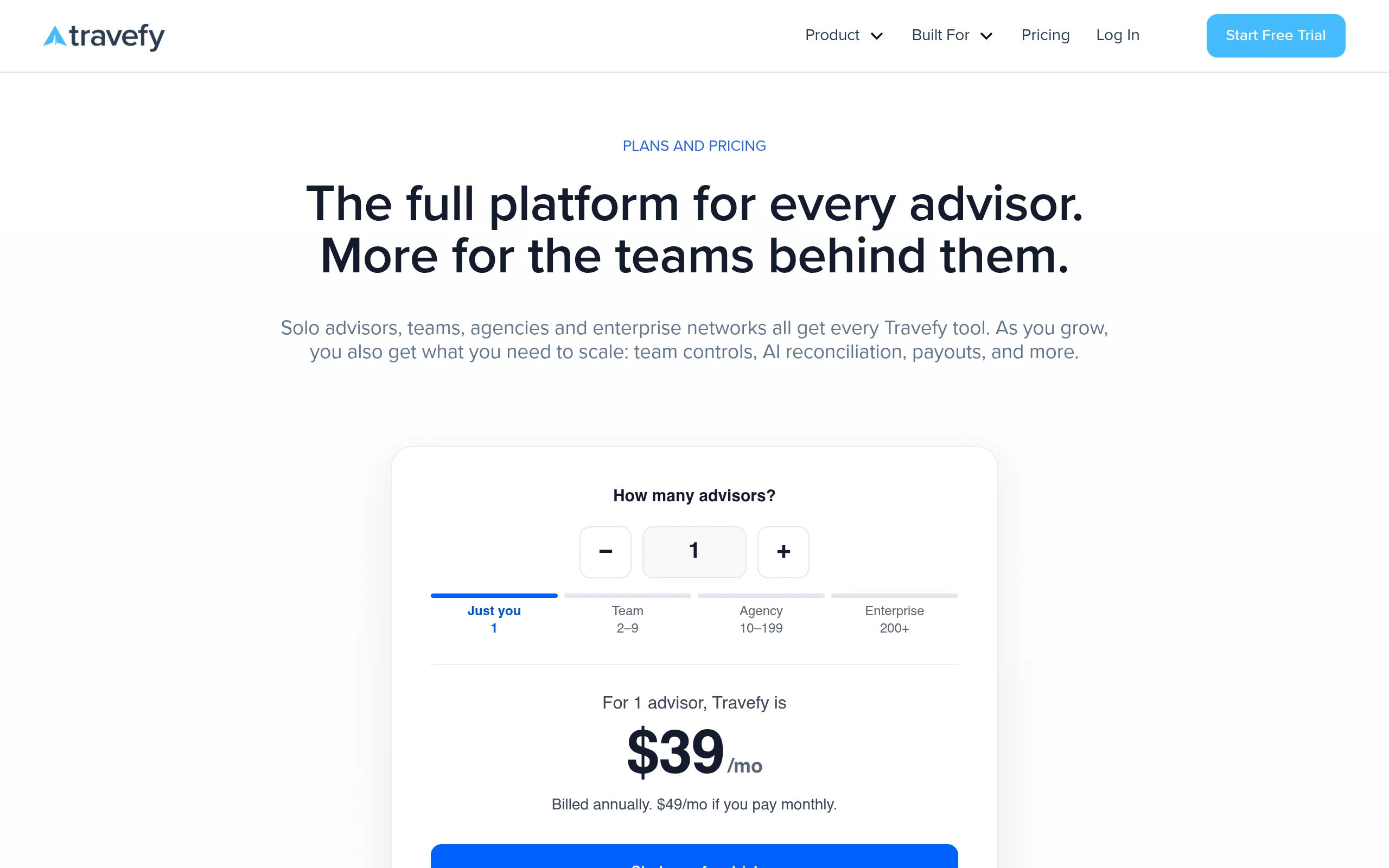
That seat shape is Travefy’s quiet advantage. Per-seat rivals charge the full rate for every login, so a second advisor doubles the bill. Travefy’s second advisor costs about half the first. For a solo agent planning to bring on an assistant or a partner within the year, the team maths matters more than the solo headline.
What Travefy does not print is just as important. The pricing page says all prices are in USD and that the 10-day free trial includes every feature, but it does not print a card-processing rate for client payments. Travefy handles credit card authorization and branded invoices, so payments exist inside the platform; the percentage you would pay on them is a question for checkout or sales, not something this guide will invent.
For our solo advisor, Travefy’s $468 buys the broadest bundle here: proposals, CRM, website, invoicing, commission tracking, and the client app in one seat. At 120 trips a year that is $3.90 of subscription per trip. The catch is commitment shape, not features: the $39 rate is the annual-billing rate, and the monthly escape hatch costs $49 a month.
TravelJoy: the cheapest all-in-one, with a card-fee catch
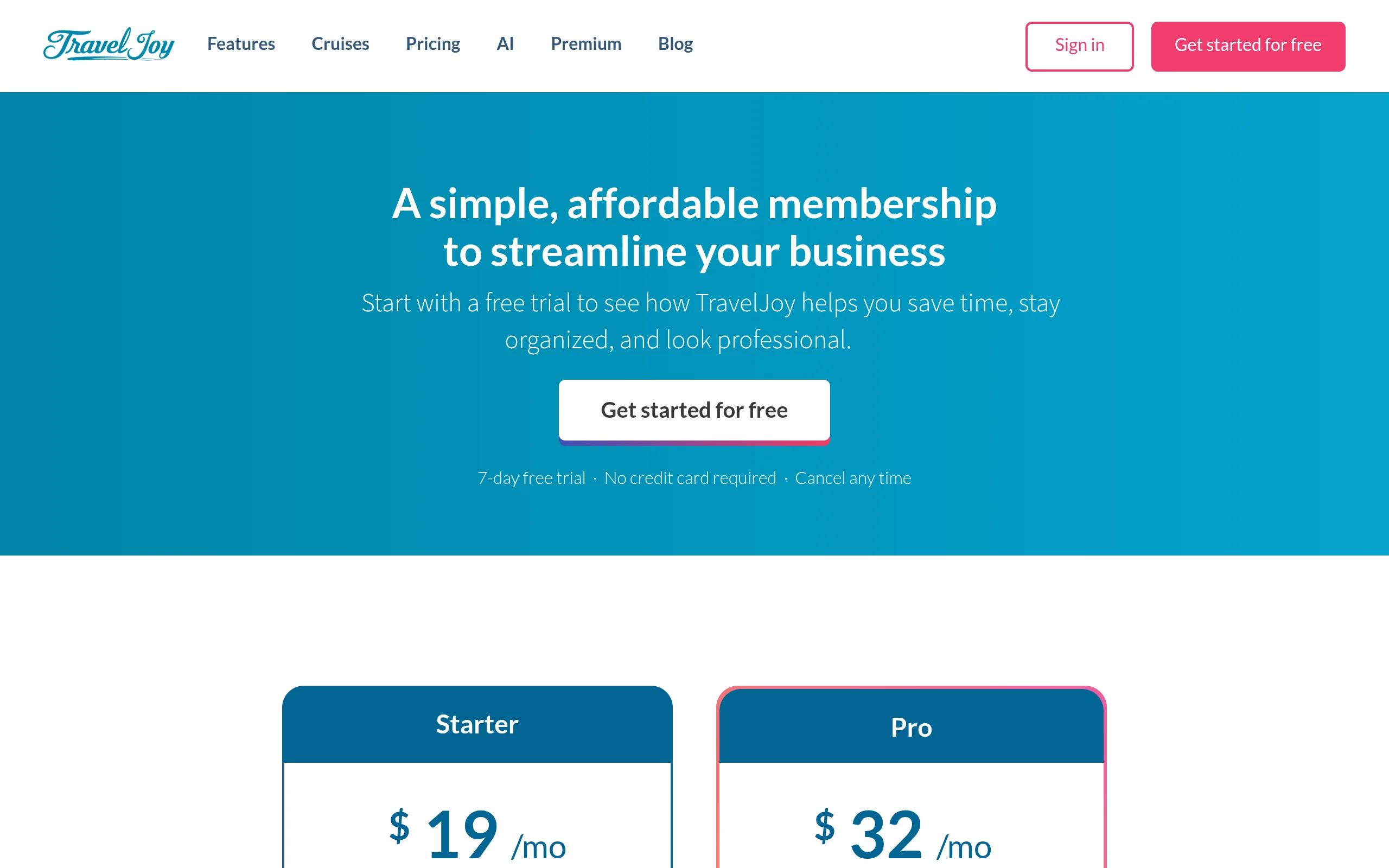
TravelJoy is the price leader among the true business platforms, and its pricing page is unusually blunt about limits. Starter costs $19 a month and caps you at 12 trips a year, with unlimited clients, forms, and invoices, but no AI and automations, no group bookings, and no team members. For an agent booking 120 trips a year, Starter is not a cheaper plan. It is a trial with a ceiling.
Pro is the working plan. It costs $39 a month billed monthly, or $32 a month billed annually, which is $384 a year. Pro removes the trip cap and adds AI and automations, group bookings, and add-on team members. The page also lists the wider Pro platform: CRM, proposals, itineraries, travel insurance, payments, authorizations, and messaging. A 7-day free trial needs no credit card.
TravelJoy is also the only vendor here that prints its payment fees on the pricing page, and those fees rewrite the comparison. On Pro, credit card processing is 3.5% plus 30 cents per transaction, with funds available in 2 business days. Bank transfers by ACH cost 1.5%, available in 4 business days. Starter pays more: 5% plus 30 cents by card and 3% by ACH.
Run our advisor’s $60,000 a year through Pro card processing and the fee is $2,100 in percentage charges plus $36 in per-transaction charges, or $2,136 a year. That is more than five times the $384 subscription. The same volume by ACH costs $900, which is why the payment method your clients accept matters more than the $7 a month between rival subscriptions. If your suppliers charge clients directly and you only collect planning fees through TravelJoy, scale those fees down to your real volume before judging.
Two TravelJoy prices stay unprinted. Team members are add-ons, but the pricing page does not show the per-member price. Premium, with 10x Copilot usage, Zapier, SMS, integrated cruise booking, and enhanced support, is teased on the pricing page without a price beside it. Both figures live behind a learn-more page or an account, so a growing team should confirm them before treating $384 as the whole bill.
For a solo advisor, none of that changes the headline. TravelJoy Pro at $384 a year is $3.20 per trip at 120 trips, the cheapest all-in-one subscription here, with the AI included rather than metered by a separate add-on. Just price the card fees before you celebrate the subscription.
Tern: one platform, metered AI
Tern pitches itself as the consolidation play: it replaces your CRM, itinerary builder, scheduler, forms, and back-office tools in one platform. The advisor plan lists stunning itineraries, a full-featured CRM, AI tools with included usage, email integration, scheduling and booking, credit card authorization, client forms and intake, and reports and analytics. For an agent tired of retyping the same booking into four tools, that single-system promise is the product.
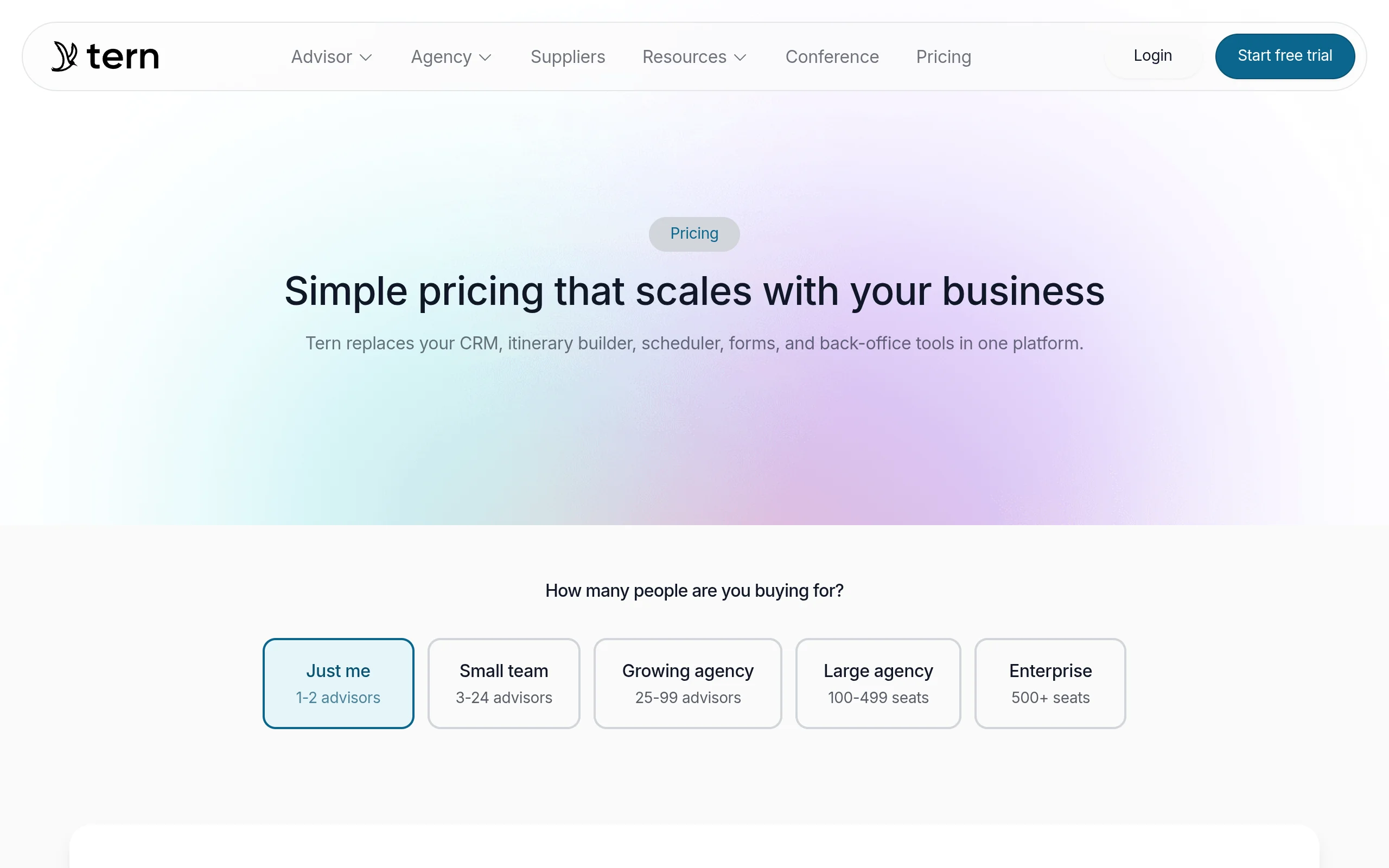
The seat price depends on billing term. Tern for Advisors costs $49 per seat a month billed monthly, or $35 per seat a month billed quarterly or annually. One advisor on annual billing pays $420 a year; monthly billing costs $588. The pricing page also asks how many people you are buying for, with bands from 1–2 advisors up to 500+ seats, so agency per-seat rates move with team size. Confirm your band’s rate on the page selector before budgeting a team.
Tern’s AI is real, and it is metered in the open. The pricing page states that included AI usage limits apply starting July 1, 2026. Tern’s help center explains the mechanics: each advisor has their own monthly AI allowance, usage resets monthly with no rollover, and at 100% AI features pause until the reset or an upgrade, while the rest of Tern keeps working. Tern charges no overage fees, which is fairer than a surprise bill, but a paused AI assistant in your busiest week is still a workflow problem.
The escape hatch is Tern Pro, an optional add-on that expands AI usage and unlocks Custom Reporting. Its official tiers run from $19 a month for about 5x the base allowance to $149 a month for the largest tier, billed monthly only, even on an annual subscription. Add the entry tier to our solo advisor and the year costs $420 plus $228, or $648. Heavy AI users should budget the add-on from day one rather than discovering the cap mid-season.
Tern does not print a card-processing rate on its pricing page, so payment costs sit outside the $420. It does offer a free trial from the pricing page. For our solo advisor, Tern at $420 is $3.50 per trip, $36 a year more than TravelJoy Pro, with a cleaner one-platform story and an AI meter TravelJoy does not impose in the same way. Agents who live inside AI drafting and imports all day will feel that meter first.
AXUS: itinerary building without the business system
AXUS is the specialist of the five. Its homepage calls it the complete itinerary building and collaboration platform for travel professionals, and the pricing section sells seats, not tiers. Monthly billing is $35 per seat, charged monthly with no contract commitments. Yearly billing is $329 per seat, which the page frames as saving 21% over a monthly subscription. DMC and tour operator team pricing is contact-us, with special pricing for select consortia memberships and team subscriptions.
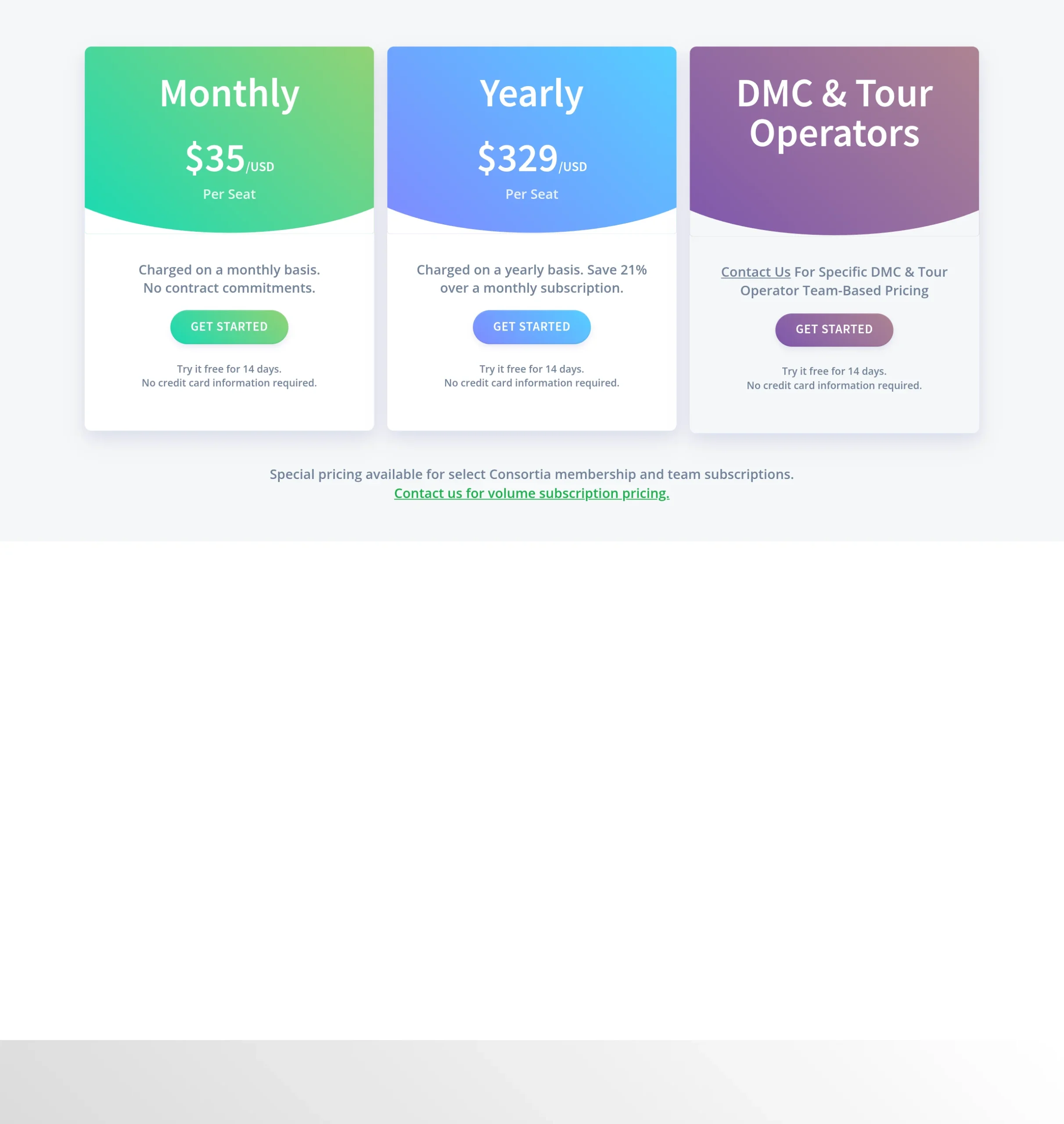
At $329 a year, AXUS is the cheapest paid seat in this guide: $2.74 per trip for our advisor. The 14-day free trial needs no credit card information, the longest card-free trial printed here. If your daily pain is building beautiful itineraries, collaborating with destination partners, and putting a branded trip app in the client’s hand, AXUS aims straight at that job.
The limit is scope. AXUS’s pricing section bundles no CRM, no invoicing, and no commission tracking, because that is not the product it sells. An agent who buys AXUS still needs somewhere for client records, forms, payments, and back-office tracking, whether that is a host agency’s system or another subscription. Comparing $329 against TravelJoy’s $384 as if both bought the same business system would flatter AXUS and mislead you.
AXUS also makes no AI claim on its homepage or pricing section. Its value is structured itinerary building, reusable content, and collaboration, which is automation of a different kind: the trip document assembles once and updates in one place. For agents whose host agency already provides the CRM, that focus is a feature. For a solo agent with no system at all, AXUS alone leaves the business half of the job undone.
GuideGeek: free AI research, not agent software
GuideGeek is the odd one out, and it earns its place by being genuinely free AI rather than by running an agency. Matador Network’s assistant answers travel questions inside WhatsApp, Instagram, and Facebook Messenger, with no separate app to install. Its homepage promises personalized destination ideas, price checks for flights, hotels, and activities, booking in one conversation, and real-time maps and local tips while traveling.

For a travel agent, the use case is research speed. A client asks for a quieter Greek island, a national-parks road trip shape, or restaurant ideas near a hotel, and GuideGeek drafts a starting answer in the chat apps already on your phone. Personal use carries no subscription price on its site, and Matador sells custom versions to destinations and brands, which is how the consumer assistant stays free.
What GuideGeek cannot do is run your bookings. It has no client CRM, no branded itinerary documents under your agency’s name, no forms, no payment authorizations, and no commission tracking. Its prices and availability claims are a traveler’s starting point, not a supplier quote. Anything you pass to a client still needs checking against the supplier or booking channel you will actually ticket through, because your name, not the chatbot’s, sits on the itinerary.
Treat GuideGeek as the free notebook, not the office. At $0 it belongs in every agent’s pocket for first-draft destination research. It does not belong in a software budget comparison as a replacement for Travefy, TravelJoy, or Tern, and this guide does not count it as one.
The maths: what five tools really cost one advisor
Start with subscriptions alone, on annual billing where it exists. TravelJoy Pro costs $384 a year. Tern costs $420. Travefy costs $468. AXUS costs $329. GuideGeek costs $0. On monthly billing the same seats cost $468, $588, $588, and $420, which is why every vendor here nudges you toward the annual term.
Per trip, at 120 trips a year, the subscriptions run $3.20 for TravelJoy Pro, $3.50 for Tern, $3.90 for Travefy, and $2.74 for AXUS. Those are small numbers against a single booking’s commission, which is exactly why agents overbuy. Nobody needs four systems that each hold the same client list.
Now add the fees the subscription hides. TravelJoy Pro card processing on $60,000 a year costs $2,136, taking the effective year to $2,520. The same volume by ACH costs $900, for an effective $1,284. Tern’s entry AI add-on takes its year from $420 to $648 for an advisor who outgrows the included allowance. Travefy, Tern, and AXUS do not print card rates on their pricing pages, so their payment costs cannot be added honestly here. That silence is itself a budgeting risk: get the rate in writing before you move client payments into any of them.
The stack test shows the real saving. Buying all four paid systems for one advisor costs $384 plus $420 plus $468 plus $329, which is $1,601 a year, for four overlapping client databases. Running one all-in-one instead, TravelJoy Pro at $384, saves $1,217 a year against that stack. AXUS at $329 is cheaper still, but it buys itinerary building only, so the honest lean comparison for a full business system is the $384 seat.
Team growth flips some of the order. Three advisors on Travefy annual billing pay $948 a year, because extra seats cost $20 against the $39 first seat. Three AXUS seats cost $987 yearly, at one flat rate. Tern’s per-seat rate changes by team-size band on its pricing selector, and TravelJoy’s team-member price is not printed on its pricing page, so both need a live quote at your headcount before a team decision. A solo agent choosing today should still ask how the second seat is priced, because switching CRMs with a live client list is the expensive way to learn.
Five traps that catch travel agents
First, the cheap plan with a trip cap. TravelJoy Starter at $19 looks like the budget answer until the 12-trips-a-year limit and the missing AI, automations, group bookings, and team members are read closely. An agent booking monthly already outgrows it. Price the plan you would still be on in December, not the one that fits a quiet January.
Second, the percentage fee that eats the subscription. TravelJoy prints 3.5% plus 30 cents on Pro card payments, and at real volume that line costs several times the membership. Agents who collect planning fees and deposits through their platform should run their own volume through the percentage before comparing $32 against $35. Where a vendor prints no rate, treat the missing number as a cost you have not been shown, not a cost of zero.
Third, the AI meter. Tern pauses AI features at 100% of a monthly allowance and sells relief from $19 a month, billed monthly only. TravelJoy reserves its full AI for Pro and sells 10x Copilot usage inside Premium. Travefy’s Smart Import is included, but import quality still depends on supplier data. Whichever platform you pick, test the AI on your messiest real supplier email during the trial, not on the vendor’s demo itinerary.
Fourth, the second seat. Solo pricing is advertising; team pricing is the contract. Travefy discounts additional advisors, AXUS charges every seat alike, Tern bands its rate by headcount, and TravelJoy keeps its team price off the pricing page. A part-time assistant who needs a login can double one bill and barely move another.
Fifth, free research treated as a booking source. GuideGeek and tools like it draft ideas fast, but a chatbot’s flight price or hotel claim is not a held fare or a confirmed room. Verify every price, date, and availability against the supplier before it reaches a client proposal. The agent’s reputation absorbs the error, not the model’s.
What to buy first
Buy one business platform first, and let the trials decide between the finalists. A solo agent booking past 12 trips a year should start with TravelJoy Pro on annual billing at $384, run the 7-day trial on real client work, and confirm the card-versus-ACH mix clients will actually use. If proposals, a website, and a cheaper second seat matter more, Travefy’s $468 buys the broader bundle. If one-platform consolidation and AI drafting are the priority, Tern’s $420 earns its place, with the AI allowance watched from the first month.
Add AXUS only when itinerary delivery is the bottleneck and a CRM already exists, whether from a host agency or your chosen platform. Keep GuideGeek free in your pocket for research drafts, and verify its suggestions before quoting. That order, one system plus free research, keeps the year at $384 to $468 instead of the $1,601 stack.
Our free AI Cost Calculator takes the prices above and turns them into a monthly and yearly figure for your own trip volume, so you can test your card-fee exposure and seat count before any trial starts. Run your real numbers there, then trial the cheapest platform that survives your busiest week.
Pros and cons
Travefy. Pros: the broadest bundle in one seat, including proposals, CRM, website builder, invoicing, commission tracking, and a client app; extra advisors cost $20 against the $39 first seat on annual billing; Smart Import and 200+ supplier integrations target the retyping problem directly. Cons: the $39 rate needs annual billing, with monthly at $49; the pricing page does not print a card-processing rate.
TravelJoy. Pros: the cheapest all-in-one at $384 a year on Pro annual billing; AI and automations included on Pro rather than sold as a metered add-on; payment fees printed plainly, with ACH at 1.5% undercutting card costs; 7-day trial with no card. Cons: Starter’s 12-trip cap and missing AI make the $19 headline unusable for working agents; card processing at 3.5% plus 30 cents can dwarf the subscription; team-member and Premium prices are not printed on the pricing page.
Tern. Pros: one platform replacing CRM, itinerary builder, scheduler, forms, and back-office tools; AI tools included with a per-advisor allowance and no overage fees; quarterly billing matches the annual seat rate. Cons: AI features pause at 100% of the monthly allowance until reset or a Tern Pro upgrade from $19 a month; agency seat rates need the pricing selector to confirm; no card rate printed on the pricing page.
AXUS. Pros: the cheapest paid seat at $329 yearly; 14-day trial with no credit card; itinerary building and collaboration focus with a branded traveler app. Cons: no CRM, invoicing, or commission tracking in the pricing section, so a second system is still needed; no AI claim on its homepage or pricing section; DMC and volume pricing is contact-us.
GuideGeek. Pros: free for personal use inside WhatsApp, Instagram, and Messenger; fast destination ideas, price checks, and in-trip local tips with nothing to install. Cons: built for travelers, not agencies, with no CRM, client documents, payments, or commission tools; its prices and suggestions still need supplier verification before client use.
Our verdict
TravelJoy Pro on annual billing is the best first buy for a solo travel agent: $384 a year for the full business system, AI included, with the only printed payment fees in the group. Its card rate is the number to manage, by steering volume to ACH where clients allow it. Travefy is the better buy when proposals, a website, and a low-cost second seat outweigh the $84 yearly gap. Tern suits agents who want one modern platform and will watch the AI allowance, budgeting the $19 add-on if drafting volume is high.
AXUS is the right specialist when a host agency already supplies the CRM and itinerary delivery is the pain, at $329 a seat. GuideGeek stays in the pocket as free research. Lemax, one of the tools originally shortlisted for this comparison, publishes no price and targets mid-to-large tour operators from 15 users, so it was swapped out for AXUS, which prints its seat price. Whichever platform wins your trial, buy one system, verify its payment rate in writing, and let the free tools do the free work.
Frequently asked questions
What is the cheapest AI tool for a solo travel agent?
GuideGeek is free for personal research, but it is not agent software. The cheapest paid seat is AXUS at $329 a year, which buys itinerary building only. The cheapest all-in-one business platform with AI is TravelJoy Pro at $384 a year on annual billing, or $32 a month. Tern costs $420 a year and Travefy $468 for one advisor on annual billing.
Does TravelJoy Starter include AI?
No. TravelJoy’s pricing page lists Starter at $19 a month with 12 trips a year and no AI and automations, no group bookings, and no team members. AI sits on Pro, which costs $39 a month billed monthly or $32 a month billed annually, with unlimited trips and a 7-day free trial that needs no credit card.
How much does TravelJoy charge for card payments?
On Pro, credit card processing is 3.5% plus 30 cents per transaction, with funds available in 2 business days, and ACH bank transfers cost 1.5% with funds in 4 business days. Starter pays 5% plus 30 cents by card and 3% by ACH. At $60,000 a year on Pro, card fees total $2,136 against $900 by ACH, so payment method matters more than small subscription gaps.
What happens when Tern’s AI limit runs out?
Each Tern advisor has a monthly AI allowance that resets monthly with no rollover. At 100%, AI features pause until the reset while the rest of Tern keeps working, and Tern charges no overage fees. The Tern Pro add-on restores and expands usage from $19 a month, billed monthly only, with higher tiers at $39, $99, and $149 a month.
Can a travel agent rely on GuideGeek for client itineraries?
Use it for first-draft research, not as the booking record. GuideGeek answers inside WhatsApp, Instagram, and Messenger with destination ideas, price checks, and local tips, and personal use is free. It has no CRM, branded client documents, payments, or commission tracking, and its prices still need checking against the supplier before you quote a client.
Price note — updated 26 November 2026: Prices in this post were checked on 26 November 2026. When you are reading this, the price may be lower or higher, plans may have changed, and trial terms may differ. Check the official pricing page before you buy, and confirm any unprinted fee, such as card processing or team-seat pricing, with the vendor in writing.
Sources
- Travefy pricing: https://travefy.com/pricing
- TravelJoy pricing: https://traveljoy.com/pricing.html
- Tern pricing: https://tern.travel/pricing
- Tern AI usage limits: https://help.tern.travel/en/articles/15303956-ai-usage-limits-coming-july-1st-2026
- AXUS pricing section: https://www.axustravelapp.com/
- GuideGeek: https://guidegeek.com/
Pros
- Travefy: the broadest bundle in one seat, including proposals, CRM, website builder, invoicing, commission tracking, and a client app; extra advisors cost $20 against the $39 first seat on annual billing; Smart Import and 200+ supplier integrations target the retyping problem directly
- TravelJoy: the cheapest all-in-one at $384 a year on Pro annual billing; AI and automations included on Pro rather than sold as a metered add-on; payment fees printed plainly, with ACH at 1.5% undercutting card costs; 7-day trial with no card
- Tern: one platform replacing CRM, itinerary builder, scheduler, forms, and back-office tools; AI tools included with a per-advisor allowance and no overage fees; quarterly billing matches the annual seat rate
- AXUS: the cheapest paid seat at $329 yearly; 14-day trial with no credit card; itinerary building and collaboration focus with a branded traveler app
- GuideGeek: free for personal use inside WhatsApp, Instagram, and Messenger; fast destination ideas, price checks, and in-trip local tips with nothing to install
Cons
- Travefy: the $39 rate needs annual billing, with monthly at $49; the pricing page does not print a card-processing rate
- TravelJoy: Starter's 12-trip cap and missing AI make the $19 headline unusable for working agents; card processing at 3.5% plus 30 cents can dwarf the subscription; team-member and Premium prices are not printed on the pricing page
- Tern: AI features pause at 100% of the monthly allowance until reset or a Tern Pro upgrade from $19 a month; agency seat rates need the pricing selector to confirm; no card rate printed on the pricing page
- AXUS: no CRM, invoicing, or commission tracking in the pricing section, so a second system is still needed; no AI claim on its homepage or pricing section; DMC and volume pricing is contact-us
- GuideGeek: built for travelers, not agencies, with no CRM, client documents, payments, or commission tools; its prices and suggestions still need supplier verification before client use
TravelJoy Pro on annual billing is the best first buy for a solo travel agent: $384 a year for the full business system, AI included, with the only printed payment fees in the group. Its card rate is the number to manage, by steering volume to ACH where clients allow it. Travefy is the better buy when proposals, a website, and a low-cost second seat outweigh the $84 yearly gap. Tern suits agents who want one modern platform and will watch the AI allowance, budgeting the $19 add-on if drafting volume is high.AXUS is the right specialist when a host agency already supplies the CRM and itinerary delivery is the pain, at $329 a seat. GuideGeek stays in the pocket as free research. Lemax, one of the tools originally shortlisted for this comparison, publishes no price and targets mid-to-large tour operators from 15 users, so it was swapped out for AXUS, which prints its seat price. Whichever platform wins your trial, buy one system, verify its payment rate in writing, and let the free tools do the free work.