

For a three-person walking business doing 300 walks a month at $25 a walk, Precise Petcare is the cheapest of the best ai tools for dog walkers: $45 a month for 2–5 active staff, or $540 a year, with every feature on every plan. Pet Sitter Plus Team costs $63 a month on its advertised affiliate rates. SchedulingKit Pro costs $60 a month for three seats on monthly billing. Time To Pet Team costs $88 a month. Rover charges no subscription, but its 20% service fee takes $18,000 a year at this volume.
A dog walking business rarely loses money on the walk. It loses money in the gaps between walks: the midday slot double-booked by text message, the invoice chased on a Sunday night, the new client who booked someone else because your reply came three hours late.
That gap work is what the best ai tools for dog walkers are supposed to do: take bookings while you are holding a leash, send the visit report before the owner asks, and bill every walk without a spreadsheet. None of the five tools here walks a dog.
We compared five tools for the same small walking business, and we checked every price on the vendor’s own page on 26 November 2026. No roundup prices, and no tool here pays us anything. One honesty note up front: most dog walking software is scheduling and billing with very little AI in it, and we say plainly below where the actual AI sits.
Quick Answer
For a three-person walking business doing 300 walks a month at $25 a walk, Precise Petcare is the cheapest of the best ai tools for dog walkers: $45 a month for 2–5 active staff, or $540 a year, with every feature on every plan. Pet Sitter Plus Team costs $63 a month on its advertised affiliate rates. SchedulingKit Pro costs $60 a month for three seats on monthly billing. Time To Pet Team costs $88 a month. Rover charges no subscription, but its 20% service fee takes $18,000 a year at this volume.
In this article
- How we compared the five tools
- The five tools at a glance
- Time To Pet: the polished all-rounder
- Precise Petcare: flat bands by staff count
- Pet Sitter Plus: full software, affiliate rates
- SchedulingKit: booking pages with a real AI add-on
- Rover: the marketplace that takes a fifth
- The maths: what five tools really cost one walking business
- Five traps that catch dog walkers
- What to buy first
- Pros and cons
- Our verdict
- Frequently asked questions
How we compared the five tools
Every price in this guide is for the same imaginary business: you plus two walkers, three active staff in total, doing 300 walks a month at $25 a walk. That is $7,500 a month in walk revenue, before tips, holiday surcharges, or pet sitting add-ons.
We judged each tool on five things: how the price moves when you add a walker; whether recurring walks, GPS proof, and owner updates are genuinely handled; whether billing runs itself or still needs your Sunday night; honest AI pricing, with the meter named in plain sight; and year-one cost at our business’s size, including percentage fees where they exist.
One honesty note before the numbers. These five tools do three different jobs. Time To Pet, Precise Petcare, and Pet Sitter Plus are pet care management systems built for sitting and walking businesses. SchedulingKit is a general booking tool that dog walkers borrow. Rover is a marketplace that finds you clients and takes a cut of every booking. You would only ever run one management system, though many walkers pair one with Rover while they build a client list.
A second honesty note: the AI in this category is thin. SchedulingKit sells a genuine AI chatbot add-on that books appointments in conversation. The other three software tools are automation: recurring schedules, GPS check-ins, reminders, and reports. That automation is useful, but it is not AI, and we do not pretend otherwise below.
That honesty matters because walkers searching for the best ai tools for dog walkers expect one product to fill the calendar, prove the walk happened, and chase payment at once. No tool here does all three. The realistic choice is one scheduling and billing system, picked on how it counts your walkers.
The five tools at a glance
| Tool | Best for | Starting price | Free plan or trial | Year-one cost at our business size |
|---|---|---|---|---|
| Time To Pet | Polished scheduling, invoicing, and staff tools | $25 a month on Lite | 14-day free trial, no card | $1,056 on Team |
| Precise Petcare | Flat staff bands, every feature included | $20 a month solo | Free trial offered | $540 on the 2–5 staff band |
| Pet Sitter Plus | Full software with free coaching | $30 a month solo, affiliate rate | 30-day free trial, no card | $756 on Team affiliate rates |
| SchedulingKit | Booking pages and an AI chatbot | $0 Free plan | Free forever plan; 14-day paid trial | $720 on Pro, monthly billing |
| Rover | Finding clients without marketing | No subscription | No subscription to join | $18,000 in service fees |
Year one means twelve months at our business’s size: three active staff and 300 walks a month at $25. Rover’s figure is the 20% service fee on $90,000 of annual walk revenue, because that is what the marketplace model costs a walker who books everything through it. The software figures are subscriptions only; card-processing fees sit outside them where the vendor does not print a rate.
Time To Pet: the polished all-rounder
Time To Pet is the best-known name in this guide. It covers scheduling with recurring bookings, client service requests, invoicing with automatic charging, a client portal and app, conversation feeds with owners, and staff tools with GPS tracking on the team plan.
The pricing has four shapes. Lite costs $25 a month billed monthly, or $250 a year billed yearly, for solo operators getting started. Solo costs $50 a month, or $500 a year, and adds visit videos, email campaigns, text messaging, Zapier, QuickBooks Online, and calendar integration. Team costs a $40 monthly base plus $16 per active staff member, shown as $72 a month for two active staff. Facility costs $79 a month for daycare and boarding operations, which our walking business does not need.
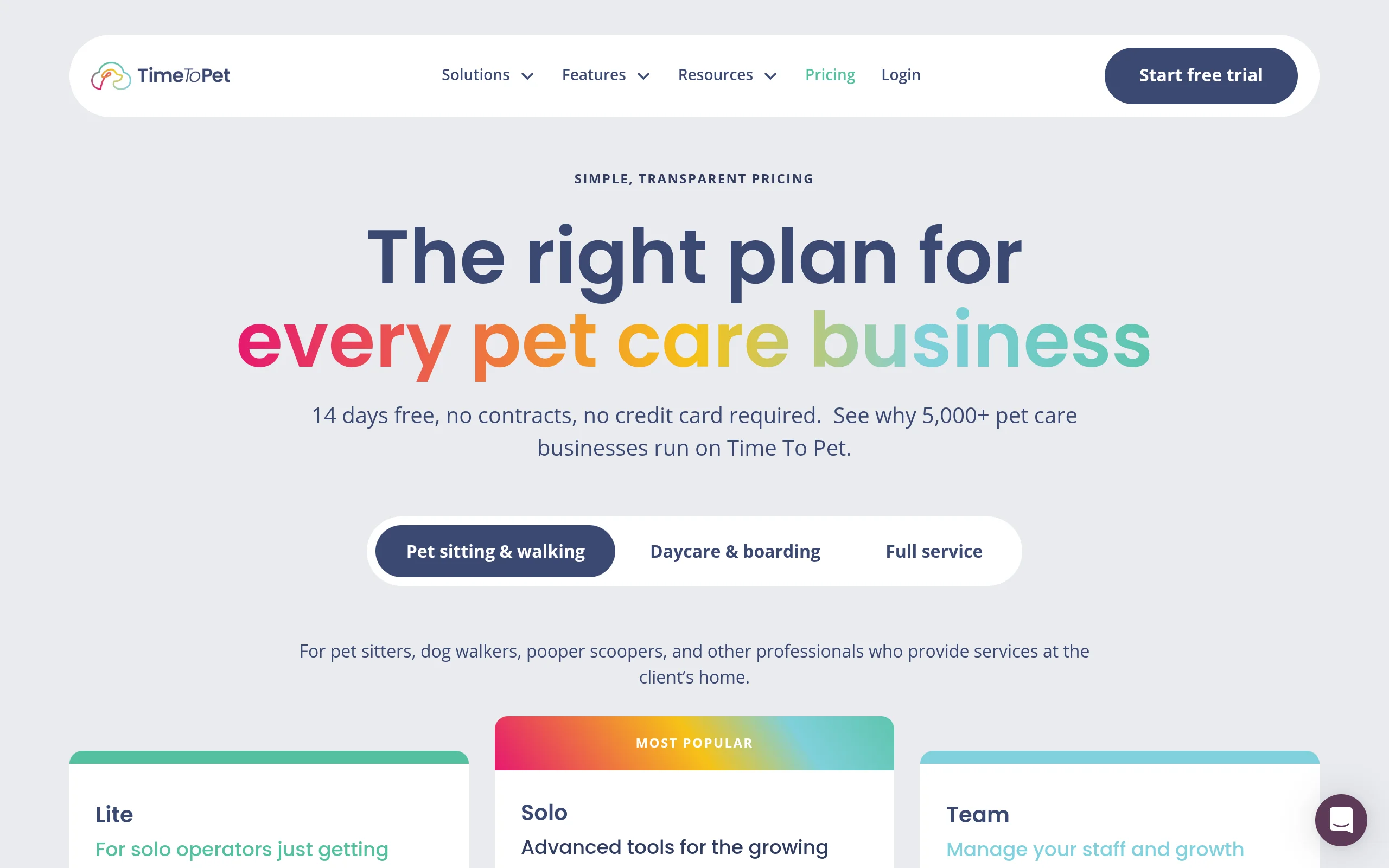
At our business’s size, Team costs $40 plus three times $16, which is $88 a month, or $1,056 a year. That is about 29 cents per walk. An active staff member is anyone with at least one scheduled service in the billing period, and admins and office managers always count, so a quiet month genuinely costs less.
Two details deserve a close read. Lite requires Time To Pet Payments, the company’s own processor, and the pricing page does not print the card rate, so that cost sits outside the figures above. Annual billing is offered on Lite and Solo only, billed as ten months for twelve; Team stays monthly.
Where is the AI? Time To Pet’s pricing page makes no AI claim we could verify. Its value is polish: bookings repeat themselves, invoices charge themselves, and owners message inside the app instead of your personal phone. Call that automation, because that is what it is.
Who is Time To Pet actually best for? A walker who wants the most refined client experience in this guide and does not mind paying per active walker for it. A solo walker should look hard at Lite first: at $25 a month it covers scheduling and invoicing, and the jump to Solo only pays if you will use videos, texting, and the integrations.
Precise Petcare: flat bands by staff count
Precise Petcare is cloud software for professional pet sitting and dog walking companies. It covers scheduling and visit management, a mobile app with GPS tracking and a live sitter map, client communication with pet care journals, client self-service, billing and payments, and staff management with payroll tools.
Its pricing model is the simplest to predict in this guide. You pay by band of total staff including yourself, and only active staff are counted. Solo costs $20 a month. The 2–5 staff band costs $45 a month. Then 6–10 staff costs $90, 11–20 costs $160, 21–30 costs $200, 31–50 costs $250, 51–100 costs $315, and 101 or more costs $390 a month.
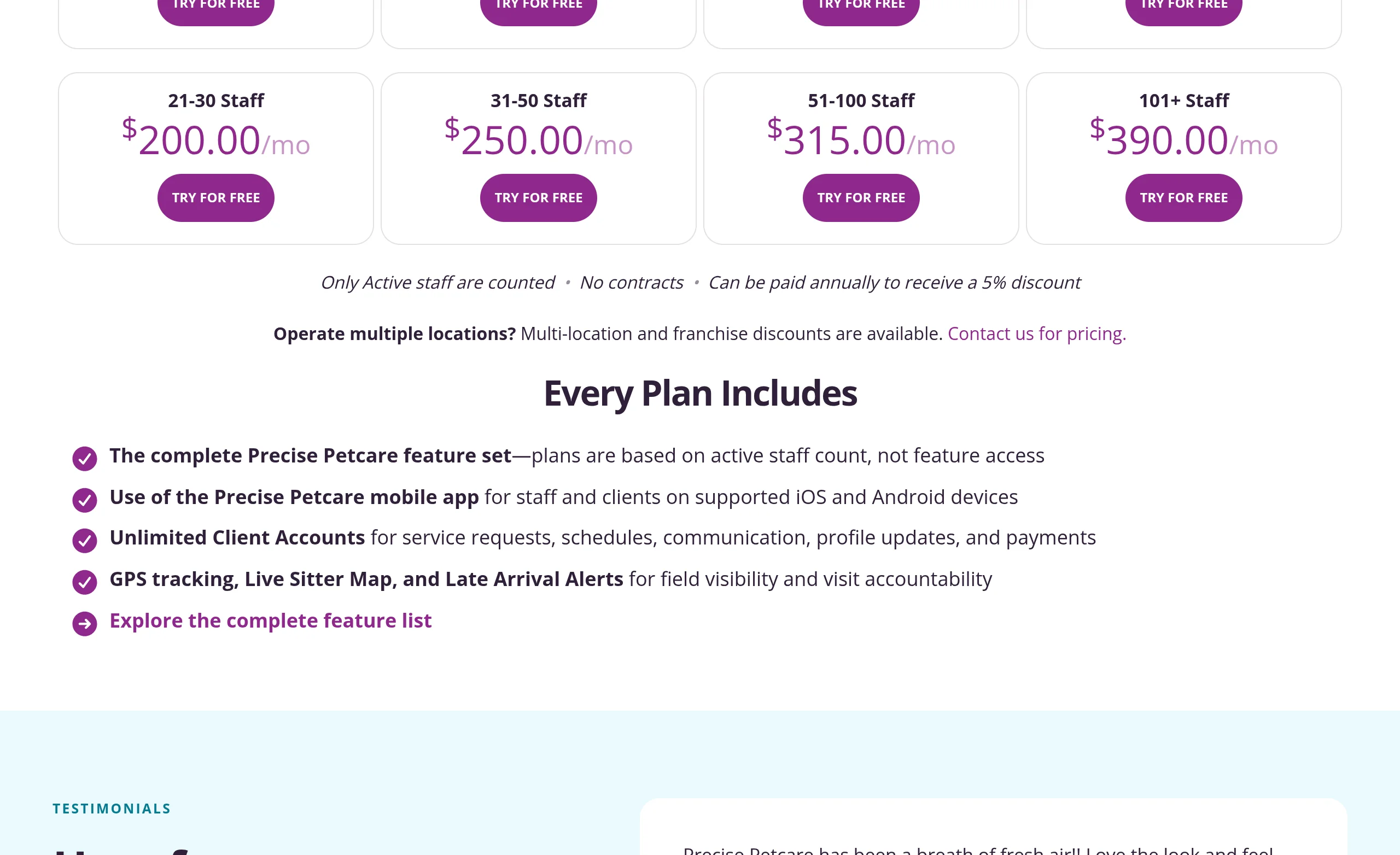
Every band includes the complete feature set, the mobile app for staff and clients, unlimited client accounts, GPS tracking, the live sitter map, and late arrival alerts. There are no contracts, and paying annually takes 5% off. Multi-location and franchise discounts are quoted on request.
At our business’s size, the 2–5 band costs $45 a month, or $540 a year on monthly billing and $513 a year with the annual discount. That is 15 cents per walk. Grow to five walkers and the bill does not move; the sixth active staff member steps it to $90.
The meter to watch is not in the subscription. Precise Petcare’s pricing page excludes payment processing and messaging charges from its cost comparisons, and it does not print a card rate, so ask what processing adds before you sign. The subscription itself, though, is exactly what the page says.
Where is the AI? Precise Petcare’s pricing page sells a complete feature set, not an AI assistant. Its GPS tracking, late arrival alerts, and journals are field-operations automation. That is the honest label, and for most walking businesses it is the automation that matters.
Who is Precise Petcare actually best for? A small team that wants every feature from day one and a bill that only moves when the team crosses a band. A solo walker pays $20 a month, the cheapest paid start in this guide, and never has to upgrade for a feature.
Pet Sitter Plus: full software, affiliate rates
Pet Sitter Plus is pet sitting and dog walking software with scheduling, repeat services, GPS check-in and check-out, visit reports, a client portal, invoicing, QuickBooks Online and Stripe integrations, and free one-to-one onboarding and coaching. Every plan includes the complete software.
Its pricing needs one careful sentence. The pricing page opens on affiliate rates, which the company calls its best price, with a switch to standard rates at the top. On affiliate rates, Solo costs $30 a month for one person. Team, for 2–25 staff, costs $24 a month plus $13 per active staff member. Enterprise 25+ caps pricing at 25 users, so extra staff beyond that carry no per-user fee.
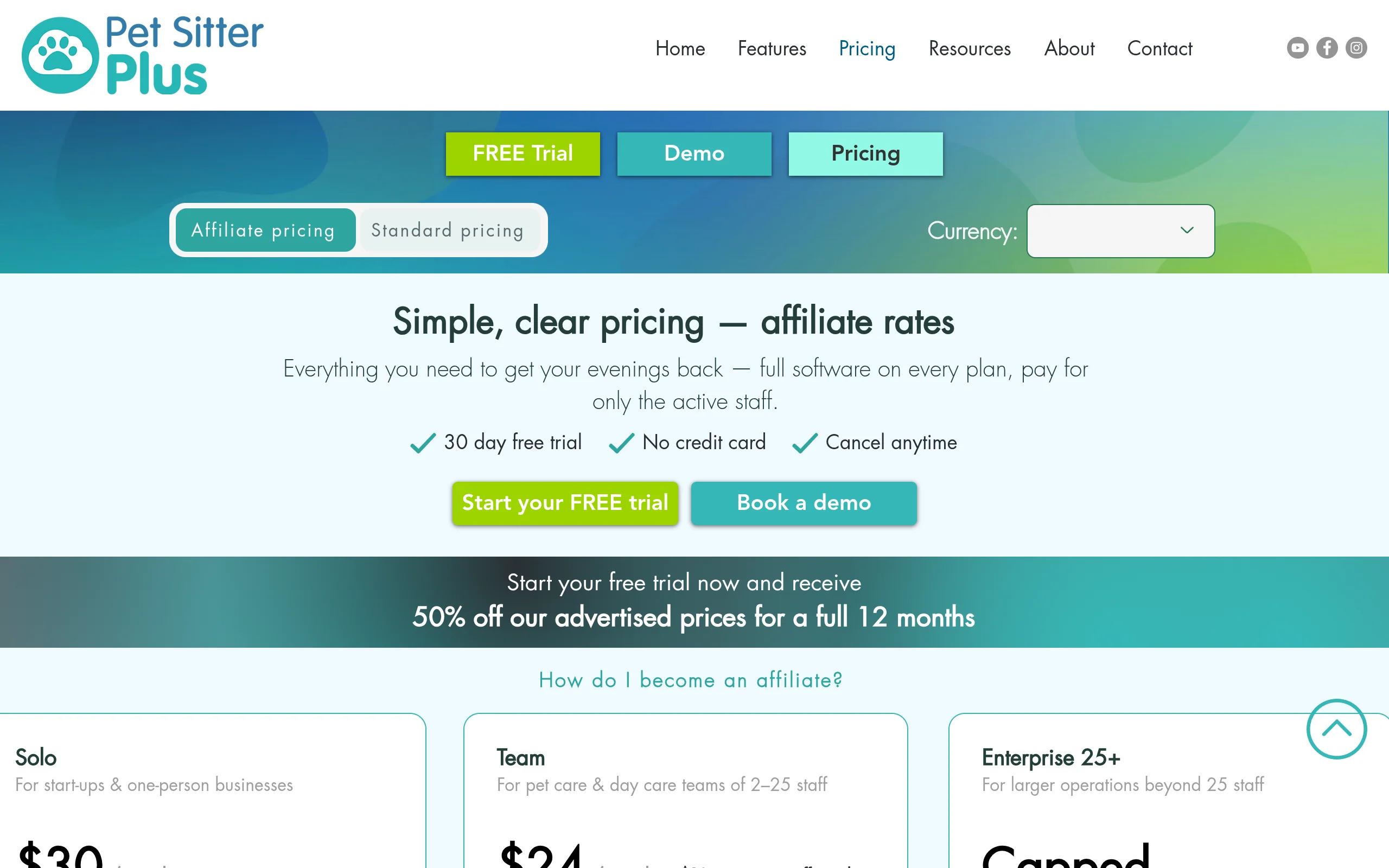
The page’s own team price calculator puts two active staff at $50 a month, which matches $24 plus two times $13. At our business’s size, Team costs $24 plus three times $13, which is $63 a month, or $756 a year on affiliate rates. Standard rates are higher; the page asks you to switch views to compare, so check the standard column before you budget.
Two more lines on the page matter. A free 30-day trial needs no credit card, and the company advertises up to 50% off the first 12 months when you subscribe through the software early in your trial. We priced year one at the advertised affiliate rates without that promotion, so your first year could cost less; month thirteen is the number to plan around. A standard card-processing fee also applies to online payments, and the page does not print the rate.
Where is the AI? Pet Sitter Plus sells scheduling, GPS, and reporting, with coaching from a human included. Its pricing page makes no AI claim we could verify. For a walker who wants a person to help set the system up, that coaching is arguably worth more than a chatbot.
Who is Pet Sitter Plus actually best for? A growing team that wants the full software with no locked features and help getting started. Just budget from the rate column you will actually pay, not the affiliate headline, unless you join the affiliate program.
SchedulingKit: booking pages with a real AI add-on
SchedulingKit is a general booking tool, not pet care software. Clients book meet-and-greets, walks, and drop-ins from your booking page, bookings land on your Google, Outlook, or iCloud calendar, and staff-only notes on each client record hold lockbox codes and pet quirks.
The pricing is per seat. Free costs $0 forever for one team member, with one event type, 50 bookings a month, one calendar connection, and email notifications. Standard costs $12 per seat a month, or $10 billed annually, and adds unlimited bookings, payments through Stripe, PayPal, Apple Pay, and Google Pay, SMS reminders, and a client portal. Pro costs $20 per seat a month, or $16 annually, and adds recurring bookings, prepaid packages, team scheduling, and analytics. Business costs $36 per seat a month, or $30 annually.
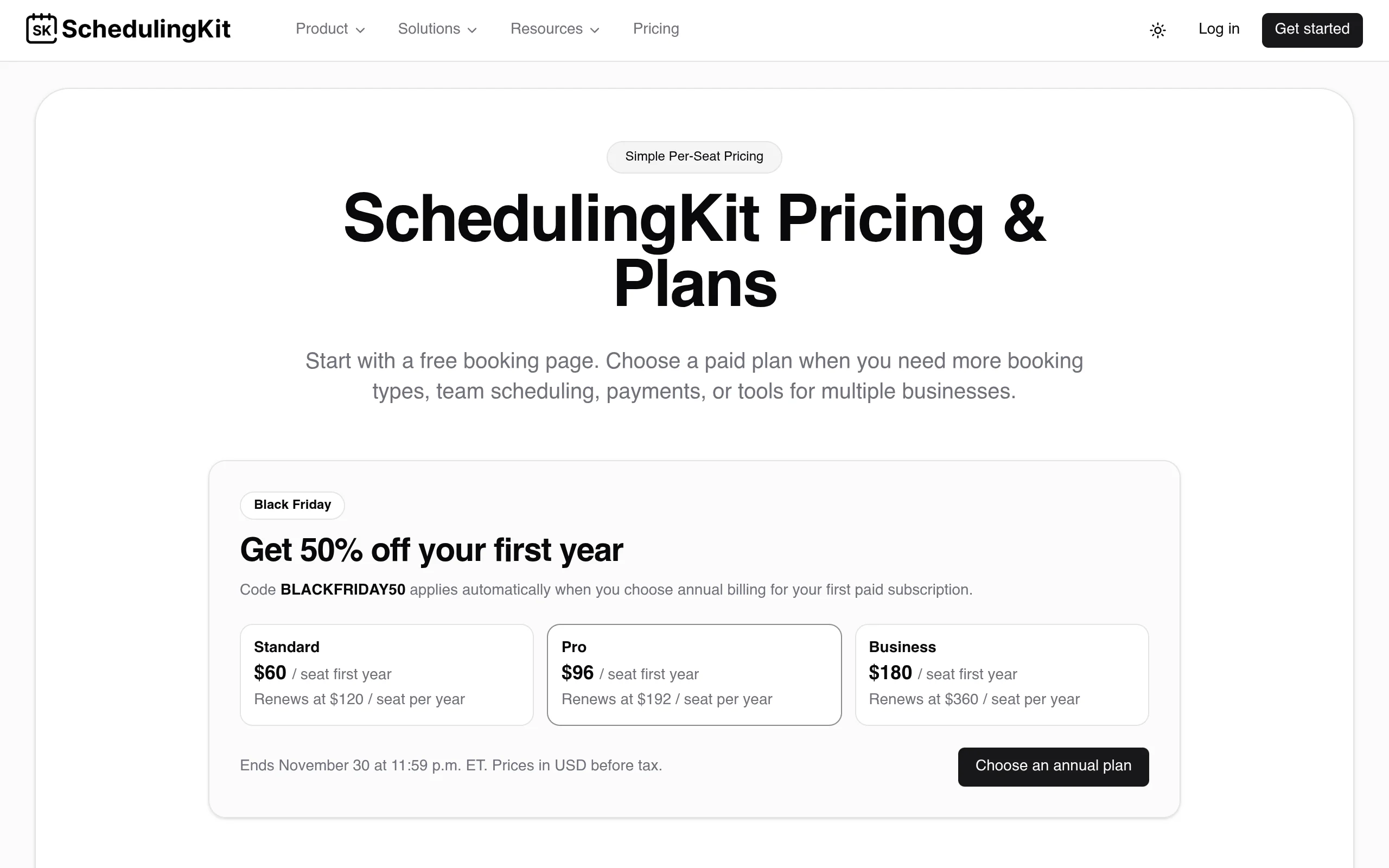
Recurring weekday walks and prepaid walk packages are Pro features, so our business needs Pro: three seats at $20 is $60 a month, or $720 a year on monthly billing and $576 a year billed annually. The Free plan’s 50-booking cap covers a brand-new solo walker, not a 300-walk month.
SchedulingKit is honest about what it does not do, and the list matters for walkers: no GPS check-ins, no photo report cards, no route planning, and no sitter pay. Owners who expect a map and photos after every walk will not get them here.
Where is the AI? Here, finally, is a real one. SchedulingKit sells an AI chatbot add-on for $12 a month on Standard and higher plans. The chatbot answers from your services and availability and creates the booking inside the conversation. It does not reschedule or cancel, hand off to live chat, or run on social media, so it covers the booking question and leaves the rest to you.
Who is SchedulingKit actually best for? A solo walker or tiny team whose main pain is booking back-and-forth, especially one starting from zero who can live inside the Free plan’s limits. The moment GPS proof and visit reports become how you keep clients, you have outgrown it.
Rover: the marketplace that takes a fifth
Rover is not software you run your business on. It is a marketplace where owners find sitters and dog walkers, book through the platform, and pay through the platform. There is no subscription; the cost is a percentage of every booking.
Rover’s own help page states the US terms plainly. Pet care providers pay a 20% service fee per booking, which means you take home 80% of your earnings. Owners separately pay an 11% booking fee at checkout, which does not come out of your side. The same page notes that some US providers are in a pilot program where fees differ, and that California fees are different for legal reasons, so check the terms that apply to your account.
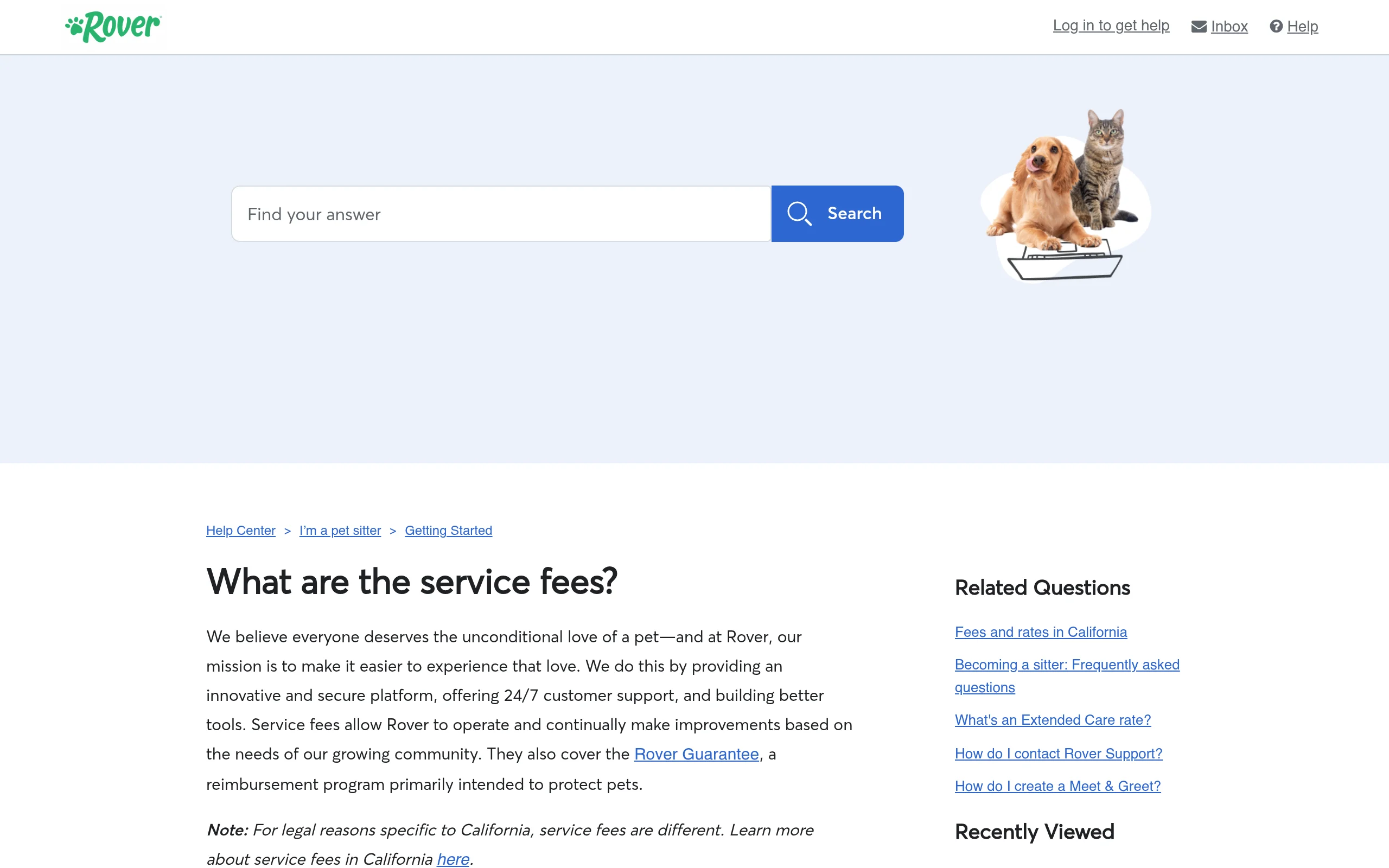
At our business’s volume, the maths is stark. Twenty percent of $7,500 a month is $1,500 a month, or $18,000 a year. That is $5 taken from every $25 walk, forever, on every client the platform sends you and every repeat booking that stays on it.
What that fifth buys is real: a stream of owners already looking for a walker, payments handled, and the Rover Guarantee reimbursement program the fees help fund. For a walker with an empty calendar, paying 20% of something beats paying a subscription to manage nothing.
Where is the AI? Rover is a marketplace with matching and messaging tools, not an AI product for your business. Its value is demand, not automation.
Who is Rover actually best for? A new walker building a client list, or an established walker filling gaps. The trap is staying there: a client who books you weekly for two years costs you a fifth of two years of walks, which is why most walkers eventually move repeat clients onto their own booking system where their agreements allow it.
The maths: what five tools really cost one walking business
Our business runs 300 walks a month at $25, which is $7,500 a month and $90,000 a year in walk revenue. Three active staff do the walking. Here is what each tool takes from that year.
Precise Petcare’s 2–5 staff band costs $45 a month, which is $540 a year, or $513 with the 5% annual discount. That is 15 cents per walk, and it is the cheapest complete system in this guide.
Pet Sitter Plus Team on affiliate rates costs $63 a month, which is $756 a year, or about 21 cents per walk. Its first-year promotion could cut that, but the ongoing rate is the one to plan around, and standard rates sit above the affiliate column.
SchedulingKit Pro costs $60 a month for three seats on monthly billing, which is $720 a year, or $576 billed annually. That buys booking pages, recurring walks, and packages, but no GPS proof or report cards. Adding the AI chatbot add-on at $12 a month brings the monthly-billing total to $864 a year.
Time To Pet Team costs $88 a month, which is $1,056 a year, or about 29 cents per walk. The gap to Precise Petcare is $516 a year, which buys Time To Pet’s polish: visit videos, texting, and the deeper client app experience.
Rover’s 20% service fee on $90,000 of walks is $18,000 a year. Set against Precise Petcare’s $540, the difference is $17,460 a year. That comparison only holds for clients who are already yours: Rover’s fee buys the clients themselves, while software assumes you found them. The honest reading is that a marketplace is a client-acquisition cost, and like every acquisition cost it should shrink as your own client list grows.
The solo picture is worth one line. A walker alone pays $20 a month on Precise Petcare, $25 on Time To Pet Lite, $30 on Pet Sitter Plus Solo affiliate rates, $20 on SchedulingKit Pro, or $0 on SchedulingKit Free inside its 50-booking cap. At solo scale the differences are small; the pricing models only separate when walkers join.
Five traps that catch dog walkers
The first trap is the per-walker meter. Time To Pet adds $16 for every active staff member, and SchedulingKit charges per seat, so a fourth walker raises both bills immediately. Banded pricing like Precise Petcare’s absorbs growth until the next band, which is why the models separate as teams grow.
The second trap is the free plan that cannot hold your month. SchedulingKit Free allows 50 bookings a month and one event type. A walker doing three walks a day passes 50 bookings in the third week, so the free plan is a starting ramp, not a home.
The third trap is the rate column you did not read. Pet Sitter Plus opens its pricing page on affiliate rates. If you are not joining the affiliate program, your bill is the standard column, and budgeting from the headline understates your year.
The fourth trap is the unpublished card rate. Time To Pet requires its own payments on Lite, Pet Sitter Plus applies a standard card-processing fee, and Precise Petcare excludes processing from its comparisons. None of the three prints the percentage on its pricing page, so the subscription is never the whole bill. Ask each vendor for the rate in writing before you migrate your clients.
The fifth trap is the marketplace fifth. Rover’s 20% feels painless on a first booking and compounds on a loyal client. On $7,500 a month of walks it is $1,500 a month, every month, which is more than every software subscription in this guide combined, several times over.
What to buy first
Buy the system that matches where your clients come from. If your calendar is empty, start on Rover and treat the 20% as marketing spend, then add software when repeat clients arrive. If clients already find you, buy the management system first and skip the marketplace tax.
For our three-person business with its own clients, Precise Petcare is the buy: $45 a month, every feature, GPS proof and journals included, and a bill that does not move until the sixth walker. Choose Time To Pet instead if the client-facing polish matters more than the $516 yearly gap. Choose SchedulingKit only if booking back-and-forth is your whole problem and your owners do not expect GPS reports.
Before you commit, run your own numbers. Our free AI Cost Calculator takes the prices above and shows what each tool costs at your walker count and walk volume, so you can see the year-one difference before a trial ends.
Pros and cons
Time To Pet. Pros: the most polished scheduling, invoicing, and client app in this guide; recurring bookings and automatic charging remove the Sunday-night admin; a 14-day trial needs no card. Cons: Team pricing adds $16 per active walker, so growth is metered; Lite requires Time To Pet Payments with no card rate printed on the pricing page.
Precise Petcare. Pros: $45 a month for 2–5 staff with every feature included, GPS tracking, live sitter map, and journals; only active staff count, and annual billing takes 5% off. Cons: payment processing and messaging charges sit outside the subscription and the card rate is not printed; the interface serves operations more than marketing.
Pet Sitter Plus. Pros: the full software on every plan with free one-to-one onboarding and coaching; a 30-day trial with no card; pricing caps at 25 users for large teams. Cons: the pricing page opens on affiliate rates, so the standard column costs more; the card-processing rate is not printed.
SchedulingKit. Pros: a genuine free plan to start, clean booking pages, and the only real AI here, a $12-a-month chatbot that books in conversation. Cons: no GPS check-ins, photo report cards, or route planning; recurring walks and packages need the Pro plan.
Rover. Pros: clients arrive without marketing spend; payments and the Rover Guarantee are handled by the platform; no subscription to join. Cons: the 20% service fee never stops, costing $18,000 a year at our volume; pilot and California terms differ, so your rate depends on your account.
Our verdict
For a dog walking business that already has clients, Precise Petcare wins this comparison on price and completeness: $540 a year for a three-person team, every feature included, and no per-walker meter until the sixth staff member. Time To Pet is the pick when client experience matters more than the $516 yearly difference. SchedulingKit suits a new solo walker who needs bookings taken care of and can live without GPS reports. Rover is a client source, not a management system, and its 20% should be treated as marketing spend that shrinks as your own list grows.
Frequently asked questions
What is the cheapest software for a solo dog walker?
SchedulingKit’s Free plan costs $0 for one team member, but it caps you at 50 bookings a month and one event type. The cheapest paid start with pet care features is Precise Petcare Solo at $20 a month, followed by Time To Pet Lite at $25 a month.
How much does Rover take from dog walkers?
Rover’s US help page states a 20% service fee per booking for pet care providers, so you take home 80% of your earnings. Owners separately pay an 11% booking fee at checkout. Some US providers are in a pilot program with different fees, and California terms differ.
Do dog walking tools actually use AI?
Mostly, no. SchedulingKit sells a genuine AI chatbot add-on for $12 a month on Standard and higher plans, which books appointments inside a conversation. Time To Pet, Precise Petcare, and Pet Sitter Plus are scheduling, GPS, and billing automation, which is useful but is not AI.
What does dog walking software cost for a small team?
At three active staff, Precise Petcare costs $45 a month, Pet Sitter Plus Team costs $63 a month on affiliate rates, SchedulingKit Pro costs $60 a month for three seats, and Time To Pet Team costs $88 a month. All four figures were checked on the vendors’ own pricing pages on 26 November 2026.
Should a new dog walker start on Rover or buy software?
Start where the clients are. With no client list, Rover’s 20% buys bookings you would not otherwise have. Once repeat clients fill your week, management software at $20–$88 a month costs far less than a fifth of every walk, and you keep the client relationship.
Price note — updated 26 November 2026: Prices in this post were checked on 26 November 2026. When you are reading this, the price may be lower or higher, so check the vendor’s official pricing page before you buy. Card-processing rates are not printed on every pricing page above; ask each vendor for its current rate before you commit.
Sources
- Time To Pet pricing
- Precise Petcare pricing
- Pet Sitter Plus pricing
- SchedulingKit pricing
- Rover service fees
Pros
- Time To Pet: the most polished scheduling, invoicing, and client app in this guide; recurring bookings and automatic charging remove the Sunday-night admin; a 14-day trial needs no card.
- Precise Petcare: $45 a month for 2–5 staff with every feature included, GPS tracking, live sitter map, and journals; only active staff count, and annual billing takes 5% off.
- Pet Sitter Plus: the full software on every plan with free one-to-one onboarding and coaching; a 30-day trial with no card; pricing caps at 25 users for large teams.
- SchedulingKit: a genuine free plan to start, clean booking pages, and the only real AI here, a $12-a-month chatbot that books in conversation.
- Rover: clients arrive without marketing spend; payments and the Rover Guarantee are handled by the platform; no subscription to join.
Cons
- Time To Pet: Team pricing adds $16 per active walker, so growth is metered; Lite requires Time To Pet Payments with no card rate printed on the pricing page.
- Precise Petcare: payment processing and messaging charges sit outside the subscription and the card rate is not printed; the interface serves operations more than marketing.
- Pet Sitter Plus: the pricing page opens on affiliate rates, so the standard column costs more; the card-processing rate is not printed.
- SchedulingKit: no GPS check-ins, photo report cards, or route planning; recurring walks and packages need the Pro plan.
- Rover: the 20% service fee never stops, costing $18,000 a year at our volume; pilot and California terms differ, so your rate depends on your account.
For a dog walking business that already has clients, Precise Petcare wins this comparison on price and completeness: $540 a year for a three-person team, every feature included, and no per-walker meter until the sixth staff member. Time To Pet is the pick when client experience matters more than the $516 yearly difference. SchedulingKit suits a new solo walker who needs bookings taken care of and can live without GPS reports. Rover is a client source, not a management system, and its 20% should be treated as marketing spend that shrinks as your own list grows.