
For a single studio with 150 active students, Jackrabbit Dance is the cheapest starting point among the best ai tools for dance studios: $89 a month at that size, or $1,068 a year, because its price follows your student count instead of a flat location fee.Wellyx Exceed costs $119 a month for up to 200 active members and includes every feature on every plan. iClassPro Signature costs $139 a month per location with no student limit. Amilia Standard starts at $99 a month, but its card fees and 1% service fee take our studio past $11,000 in year one. Mindbody starts at $79 a month, with its higher tiers priced only on a sales call.
A dance studio rarely loses money in the studio. It loses money at the front desk: the tuition run chased by text message, the recital costume sizes kept in a notebook, the parent who quit in March still counted in April’s software bill.
That is the work the best ai tools for dance studios are supposed to do: register students online, bill tuition automatically, message parents without a personal phone, and keep recital season from swallowing the office. None of the five tools here teaches a plié.
We compared five tools for the same single studio, and we checked every price on the vendor’s own page on 26 November 2026. No roundup prices, and no tool here pays us anything. One honesty note up front: most dance studio software is registration and billing with very little AI in it, and we say plainly below where the actual AI sits.
Quick Answer
For a single studio with 150 active students, Jackrabbit Dance is the cheapest starting point among the best ai tools for dance studios: $89 a month at that size, or $1,068 a year, because its price follows your student count instead of a flat location fee.
Wellyx Exceed costs $119 a month for up to 200 active members and includes every feature on every plan. iClassPro Signature costs $139 a month per location with no student limit. Amilia Standard starts at $99 a month, but its card fees and 1% service fee take our studio past $11,000 in year one. Mindbody starts at $79 a month, with its higher tiers priced only on a sales call.
In this article
- How we compared the five tools
- The five tools at a glance
- Jackrabbit Dance: priced by student count
- iClassPro: flat per location, no student limit
- Amilia: recreation registration with a service fee
- Wellyx: every feature on every plan
- Mindbody: the marketplace with unpublished tiers
- The maths: what five tools really cost one studio
- Five traps that catch studio owners
- What to buy first
- Pros and cons
- Our verdict
- Frequently asked questions
How we compared the five tools
Every price in this guide is for the same imaginary studio: one location, 150 active students, and average tuition of $125 per student per month. That is $18,750 a month in tuition, collected as 150 card charges. We price every tool at that size, including the fees the pricing pages put in smaller print.
We judged each tool on five things: how the price moves as enrollment grows; whether tuition billing and parent communication are genuinely automated; whether recital-season work is handled or ignored; honest AI pricing, with the meter named in plain sight; and year-one cost at our studio’s size, including setup fees, texting credits, and percentage fees.
One honesty note before the numbers. These five tools do three different jobs. Jackrabbit Dance and iClassPro are class-management systems built for children’s activity schools. Amilia is recreation registration software that also serves dance. Wellyx and Mindbody are fitness and wellness platforms that dance studios borrow. You would only ever buy one of them.
A second honesty note: the AI in this category is thin. Mindbody sells a genuine AI front desk, and Amilia names an in-product assistant. The other three are automation: scheduled billing, waitlists, reminders, and reports. That automation is useful, but it is not AI, and we do not pretend otherwise below.
That honesty matters because studio owners search for the best ai tools for dance studios expecting one product to fill classes, chase tuition, and run recitals at once. No tool here does all three. The realistic choice is one registration and billing system, picked on how it counts your students.
The five tools at a glance
| Tool | Best for | Starting price | Free plan or trial | Year-one cost at our studio size |
|---|---|---|---|---|
| Jackrabbit Dance | Dance-first registration, billing, and recital tools | $49 a month, tiered by student count | No free plan stated; demo offered | $1,068 on Standard |
| iClassPro | Flat pricing with no student limit | $139 a month per location | No free plan stated | $1,776 on Signature with texting |
| Amilia | Dance inside a bigger recreation program | $99 a month on Standard | Free trial mentioned; demo offered | $11,290 all-in on Standard |
| Wellyx | Every feature included, priced by active members | $79 a month up to 100 members | Free trial offered, length not stated | $1,428 on Exceed |
| Mindbody | Marketplace reach and an AI front desk | From $79 a month | No free plan stated; demo offered | From $948 on Starter |
Year one means twelve months at our studio’s size. Jackrabbit’s figure is the subscription at 180 students on file, because its count includes inactive students. Amilia’s figure includes card fees, the 1% service fee, and implementation, because those charges are published on its pricing page. Mindbody’s figure is a starting price only, because its higher tiers have no published dollar figures.
Jackrabbit Dance: priced by student count
Jackrabbit Dance is the specialist in this guide. It covers class management, online registration, automated tuition billing, attendance, a parent portal, skill tracking, and recital and costume tools built for how dance studios actually run their year.
The pricing is tiered by student count. Standard starts at $49 a month for 0 to 100 students, then rises to $89 for 101 to 250, $129 for 251 to 500, $169 for 501 to 1,000, $209 for 1,001 to 3,000, and $245 for 3,001 and above. Every tier includes the full core feature set, a product coach, and unlimited support.
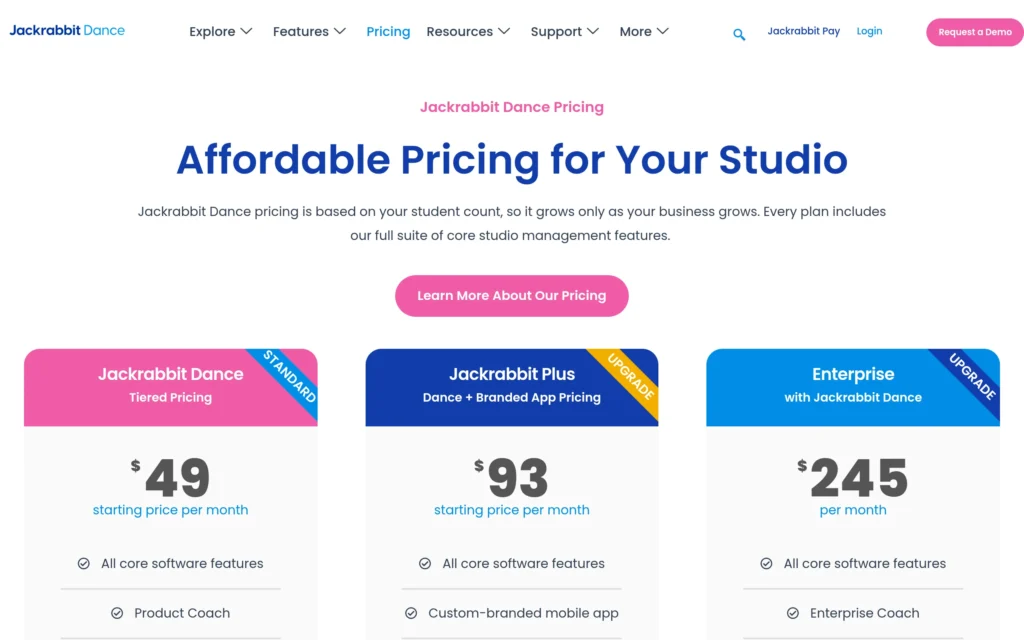
Here is the part the headline price does not shout. The count is your total student count at the end of each month, including inactive students who are not enrolled in any class. Our studio has 150 active students, and we assume 30 former students still on file, which puts the count at 180 and the bill at $89 a month.
At $89 a month, year one costs $1,068, which is about 59 cents per active student per month. Let the file grow past 250 total students and the bill steps to $129 a month, or $1,548 a year, even if active enrollment never changed. Jackrabbit’s own advice is to archive inactive families into its Lead File to keep the count down.
Jackrabbit Plus adds a custom-branded parent app. It starts at $93 a month and follows the same student tiers, reaching $146 a month at our studio’s size. Plus carries a one-time, non-refundable setup fee of $169 plus app store fees, and the app typically takes about 30 days to go live. At our size, Plus costs $1,921 in year one.
Enterprise costs a flat $245 a month regardless of student count and adds an Enterprise Coach and a business intelligence dashboard. Enterprise with Plus costs $331 a month.
There are no contracts and no setup fees on Standard, and Jackrabbit includes free data imports and a free data export if you cancel. Payment processing runs through integration partners, and the pricing page does not print a card rate, so that cost sits outside the figures above.
Where is the AI? Jackrabbit’s pricing page makes no AI claim we could verify. Its value is structure: billing runs itself, parents register themselves, and recital data lives in one place. Call that automation, because that is what it is.
Who is Jackrabbit Dance actually best for? A dance-first studio that runs recitals, tracks skills, and wants the deepest dance toolset at the lowest subscription in this guide. Archive your inactive families from day one, or you will pay for students who left.
iClassPro: flat per location, no student limit
iClassPro is class management software for gymnastics, dance, swim, cheer, and martial arts schools. It covers class, camp, and event booking, appointments and private lessons, point of sale with inventory, skill tracking and evaluations, check-in kiosk mode, waivers, make-up tokens, and a staff time clock.
The pricing model is the differentiator. Signature costs $139 a month per location with no commitment. Elite costs $199 a month per location, also with no commitment. Premium costs $299 a month per location and requires a 12-month commitment. None of the three tiers charges by student count.
At our studio’s size, Signature costs $1,668 a year, which is about 93 cents per active student per month. Grow to 300 students and the subscription does not move. That flat rate is the whole pitch: a studio that expects to double enrollment locks its software cost today.
The meter to watch is texting. Two-way texting is included, inbound messages are free, and outbound messages are billed per credit at $0.03 per credit in the US and Canada. Credits are based on character count, so long messages and emojis can use more than one credit each.
Our studio sends about 300 outbound credits a month, which is two short texts per family. That costs $9 a month, or $108 a year. Signature with texting therefore costs $1,776 in year one. Elite with the same texting costs $2,496, and Premium costs $3,696.
Two add-ons sit outside the subscription. A branded app and the Autopilot add-on are each priced at a $499 setup fee plus $150 a month on the pricing page, which is $2,299 in year one for either one. Pro Insights includes one seat with Premium, and each additional seat costs $19 a month.
An integrated DIY website is included at one per location, with an optional Kickstart Package starting at $899. Multi-location pricing is available on request, which matters because flat per-location pricing punishes operators with several small sites: each location pays the full $139 whether it has 40 students or 400.
Where is the AI? iClassPro’s pricing page sells automation, including Autopilot features and QuickBooks on Autopilot. It makes no AI assistant claim we could verify on the pricing page. The product is a complete class-management system, and its honesty is in the flat rate.
Who is iClassPro actually best for? A growing studio that wants its software bill fixed while enrollment climbs, and an owner who hates per-student meters. A small, stable studio pays $139 a month for headroom it may never use.
Amilia: recreation registration with a service fee
Amilia’s SmartRec platform handles online registration, memberships, facility scheduling, custom forms, and payments for recreation programs, camps, arts schools, and nonprofits. Dance is one of the industries it serves, alongside after-school programs, community centers, and parks departments.
Standard costs $99 a month for small and growing recreation businesses and nonprofits. It allows up to 5,000 active accounts, one online store, and up to 10 facilities. Advanced costs $499 a month, allows up to 10,000 active accounts, up to three online stores, and up to 20 facilities, and includes two premium add-ons of your choice. Custom is priced by quote for YMCAs, JCCs, and parks departments.
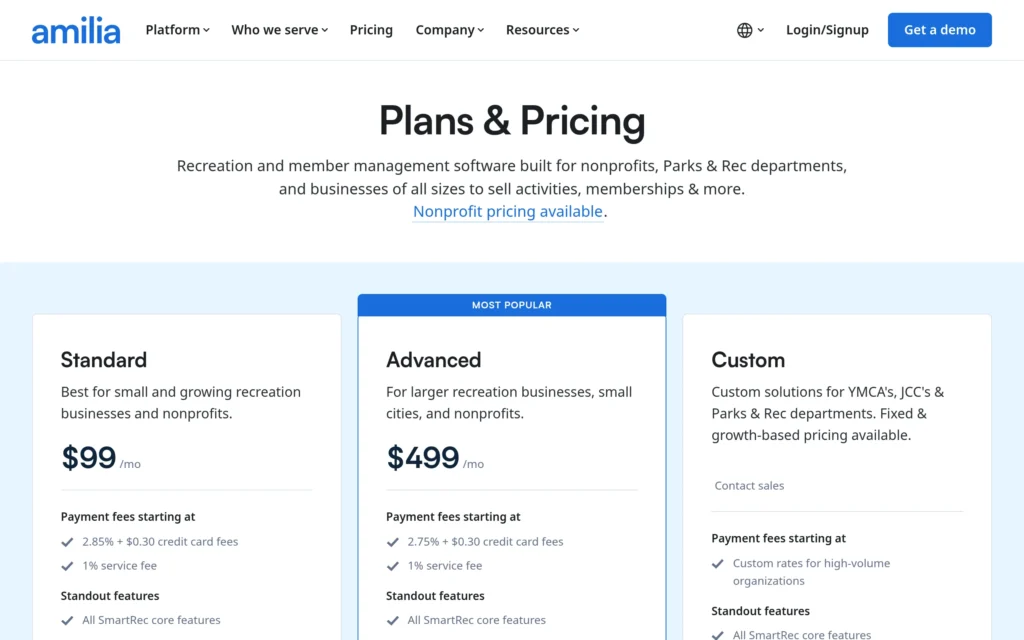
Now the honest part. The subscription is the smallest number on Amilia’s pricing page. Every plan adds a 1% service fee on payments. Card fees run 2.85% plus $0.30 per transaction on Standard and 2.75% plus $0.30 on Advanced. eCheck fees run 1% plus $0.50 on both plans.
Implementation and onboarding start at $899 on Standard and $2,999 on Advanced. Those figures are published openly, which is to Amilia’s credit, but they land in year one whether your studio is ready or not.
At our studio’s size, the maths is stark. Standard’s subscription and implementation come to $2,087 in year one. Card fees on $18,750 a month across 150 charges come to about $579 a month. The 1% service fee adds $187.50 a month. Together, fees run about $767 a month, or $9,203 a year.
Add it up and Standard costs about $11,290 in year one at our studio’s volume. That is more than ten times Jackrabbit’s subscription, and most of the difference is percentage fees on tuition you were going to collect anyway. Advanced, with its higher subscription and implementation, lands near $17,965 all-in.
Where is the AI? Amilia names an in-product AI assistant, Cecilia, which guides staff inside the platform, and its site carries a dedicated AI capability page. That is a real, named assistant rather than a marketing adjective, and it is included rather than sold as a separate meter on the pricing page.
Who is Amilia actually best for? An organization running dance alongside camps, gymnastics, rentals, or after-school programs, where facility scheduling and registration rushes matter more than recital tools. A single dance school paying a 1% service fee on every tuition dollar should do the arithmetic first.
Wellyx: every feature on every plan
Wellyx is gym and studio management software covering memberships, class and appointment booking, billing, point of sale, lead management, marketing automation, staff tools, family accounts, and door access control. Dance is one of the studio types it serves.
Its pricing model is the simplest in this guide. Every plan includes all features, and you pay only by your number of active members. Excel costs $79 a month for up to 100 active members. Exceed costs $119 a month for up to 200. Ultimate costs $189 a month for up to 400. Ultimate plus costs $219 a month for 400 and above.
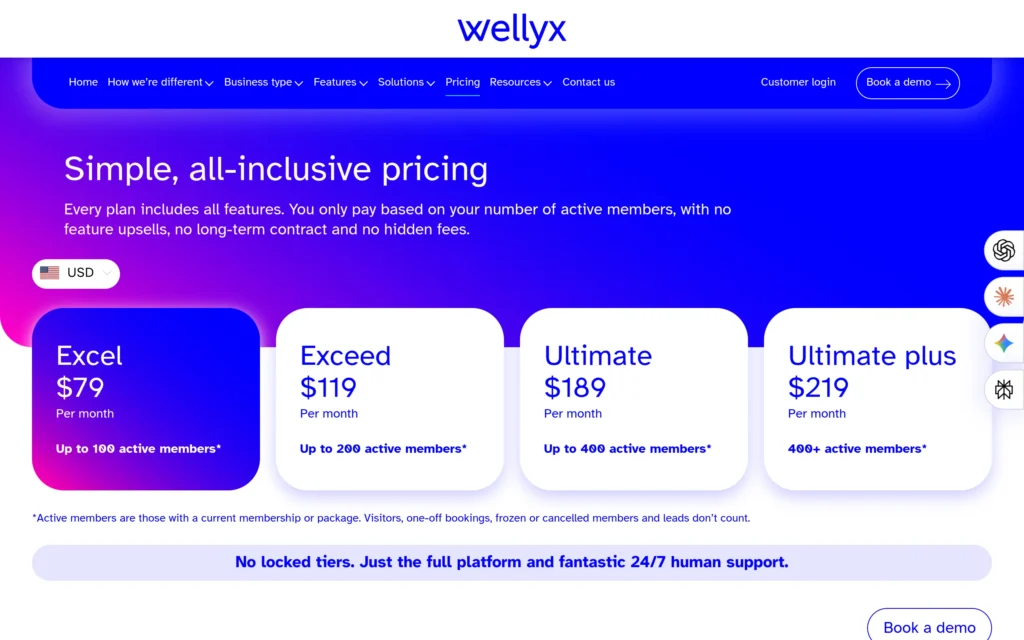
Active members are those with a current membership or package. Visitors, one-off bookings, frozen or cancelled members, and leads do not count. That definition is the opposite of Jackrabbit’s: a student who quits stops costing you money at the next count.
At our studio’s 150 active students, Wellyx lands on Exceed at $119 a month, or $1,428 a year. That is about 79 cents per active student per month, with scheduling, billing, marketing automation, lead management, and the member and staff apps all included. There is no cheaper tier hiding the features you need.
Two extras are priced up front. A fully branded mobile app, listed under your studio’s name in the app stores, costs $39 a month on any plan. Access control hardware costs $499 per door as a one-time purchase, with no monthly access fee. Exceed with the branded app costs $1,896 a year.
Billing is month-to-month, with quarterly and yearly billing available, and there is no long-term contract. You can cancel with 30 days’ notice or freeze your plan. Data migration is free, onboarding sessions are unlimited, and support runs 24/7 by phone, chat, WhatsApp, email, and Zoom.
The trade-off is fit. Wellyx is built for memberships, class packs, and appointments, which suits adult dance, fitness-style classes, and drop-in programs well. It has no recital planning, costume sizing, or skill-level progression tools of the kind a children’s dance school lives on.
Where is the AI? Wellyx’s pricing page sells included marketing automation and lead workflows. It makes no AI assistant claim we could verify on the pricing page. Its honesty is structural: the feature list does not change when the price does.
Who is Wellyx actually best for? An adult-focused studio selling memberships and class packs that wants every feature from day one and a bill that only counts students who still attend. A recital-centered children’s school will miss dance-specific tools.
Mindbody: the marketplace with unpublished tiers
Mindbody is the biggest name in fitness and wellness software, and dance studios meet it through adult classes, workshops, and drop-in programs. It covers booking, payments, reporting, a business website, branded booking widgets, and a listing on the Mindbody app.
The pricing page publishes exactly one dollar figure. Plans start at $79 a month in North America and Asia, and every plan button above Starter says “Let’s talk.” Accelerate adds advanced analytics, room and resource management, and promo codes. Ultimate adds automated email and text campaigns, a sales pipeline, and next-level analytics.
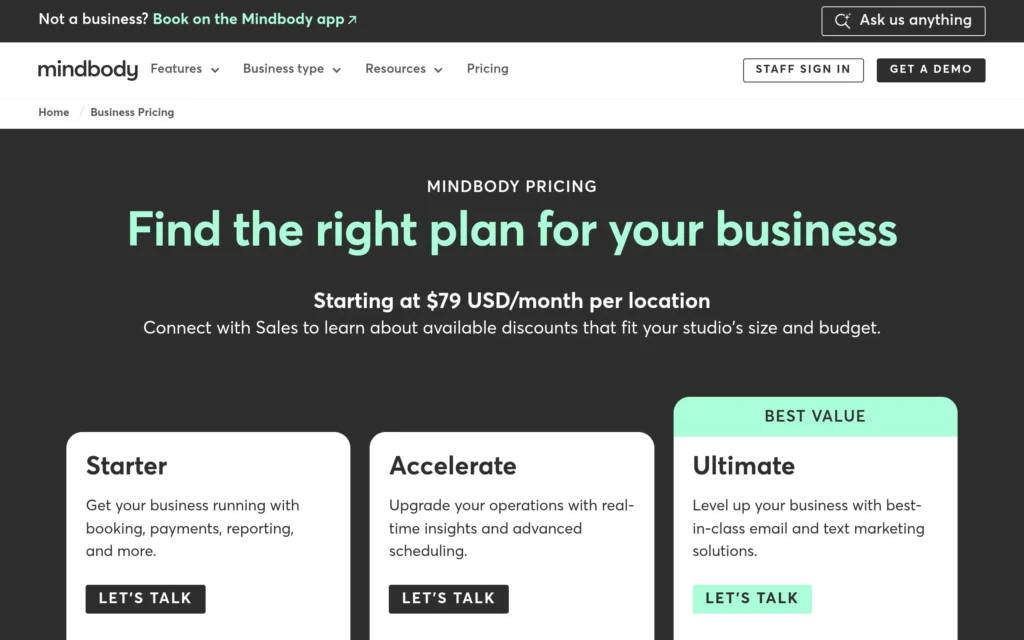
At the $79 starting price, year one comes to $948, which looks like the cheapest figure in this guide. It is also the least complete. The $79 figure is an entry price, and the features most growing studios need sit on tiers whose prices Mindbody does not publish.
There is no onboarding fee on any plan, and every customer gets one-on-one setup support. Unlimited users are included per location, so adding front-desk logins does not raise the subscription. Those are genuine strengths, and they are stated plainly on the page.
Payment processing is described without a rate. Mindbody Payments applies a processing rate plus a fixed fee of $0.10 to $0.30 per transaction in North America and Asia, varying by card-present or card-not-present and by payment type. The percentage itself is not printed, so a studio cannot compute its card cost from the pricing page alone.
The marketplace fee is printed, and it is the number to understand. Listing on the Mindbody app is free, and bookings from existing clients carry no fee. When the app delivers a client who is new to your business, the fee is 20% of the first purchase, capped at $30. On a $125 first purchase, that fee is $25.
Where is the AI? Mindbody sells AI Concierge, a 24/7 front desk assistant that answers client questions, responds to missed calls, and drives bookings and rescheduling. It appears as an add-on on the middle tier and as part of the top tier’s pitch. Of the five tools here, this is the clearest AI product, and its price is not published either.
Who is Mindbody actually best for? An adult dance and wellness studio that wants marketplace discovery, a website, and an AI front desk under one roof, and that is comfortable negotiating its real price on a sales call. A children’s studio that needs family billing and recital tools is shopping in the wrong aisle.
The maths: what five tools really cost one studio
Put the five tools side by side at 150 active students, and the subscription ranking is not the cost ranking. Jackrabbit Standard costs $1,068 a year. Wellyx Exceed costs $1,428. iClassPro Signature with texting costs $1,776. Mindbody starts at $948, with its real tier unpublished. Amilia Standard costs about $11,290 all-in.
The Amilia gap deserves one more look, because it teaches the general lesson. Amilia’s $99 subscription is not expensive. Its percentage fees are. Card fees and the service fee together take about $767 of every $18,750 tuition month, which is roughly $5.11 per student per month before the subscription is counted.
Per-student subscription maths tells the calmer story. Jackrabbit costs about 59 cents per active student per month at our size. Wellyx costs about 79 cents. iClassPro Signature costs about 93 cents.
Tier boundaries are where bills jump. Jackrabbit steps from $89 to $129 a month when total students on file pass 250, inactive students included. Wellyx steps from $119 to $189 when active members pass 200. iClassPro never steps by student count at all, which is worth real money to a studio growing from 150 to 400 students.
The branded-app decision is worth pricing separately, because three vendors sell it three ways. Jackrabbit Plus costs $146 a month at our size plus $169 setup, or $1,921 in year one. Wellyx adds its branded app for $39 a month, or $468 a year. iClassPro prices its branded app at $499 setup plus $150 a month, or $2,299 in year one.
Compare the top of the range with the bottom, and the saving on our featured image appears. iClassPro Premium costs $3,588 a year in subscription alone. Jackrabbit Standard costs $1,068 at our size. The difference is $2,520 a year, which is twenty students’ tuition for a month.
Break-evens keep the choice honest. Wellyx Exceed costs $360 a year more than Jackrabbit Standard, which is about three students’ monthly tuition. iClassPro Signature costs $600 a year more than Jackrabbit before texting, which buys a fixed bill at any enrollment. Mindbody’s marketplace fee breaks even the first time a $25 fee delivers a student who stays.
None of these figures includes card processing except Amilia’s, because Amilia is the only vendor here that publishes its full fee stack on its pricing page. Every studio pays processing somewhere. A fair comparison asks each vendor for its card rate in writing before signing.
Five traps that catch studio owners
The first trap is counting students who left. Jackrabbit bills on total student count including inactive students, so a studio that never archives old families drifts into a higher tier on history alone. Wellyx counts only active members. Read the counting definition before you compare the prices.
The second trap is the percentage fee under the subscription. Amilia’s 1% service fee sounds small until it meets $18,750 a month in tuition, where it costs $187.50 every month. Percentage fees scale with your revenue, which is exactly when you can least afford surprises.
The third trap is the unpublished tier. Mindbody publishes a $79 starting price and prices everything above it on a call. A starting price is not a quote, and the tier with automated marketing and the AI front desk is not the tier in the headline.
The fourth trap is the contract hiding in the top tier. iClassPro’s Signature and Elite tiers carry no commitment, while Premium requires a 12-month commitment. The most expensive plan is also the hardest to leave, which is worth knowing before recital season locks you in.
The fifth trap is buying fitness software for a recital school. Wellyx and Mindbody handle memberships, packs, and drop-ins beautifully, and neither plans a recital, sizes a costume, or tracks a child’s level progression. Match the tool to the school you run, not the school in the demo video.
What to buy first
Buy the billing and registration system first, because tuition collection is where studios leak money every month. For most children’s dance schools, that means Jackrabbit Standard at $89 a month at our size, with inactive families archived into the Lead File from the first week.
Choose iClassPro instead if your enrollment is climbing fast and you want the bill fixed. Signature at $139 a month never steps up by student count, and the $600-a-year premium over Jackrabbit buys certainty. Price the texting credits honestly, because they are the one meter that moves.
Choose Wellyx if you run adult classes, memberships, and class packs, and you want every feature included without tier games. Exceed at $119 a month counts only active members, and the branded app is the cheapest in this guide at $39 a month.
Choose Amilia only when dance is one program among several and facility scheduling is a real job. Its registration engine is strong, but budget the full fee stack, not the $99 headline. Choose Mindbody when marketplace discovery and an AI front desk matter more than published prices, and get the tier price in writing.
Whichever system you pick, ask for three numbers before you sign: the card processing rate, the texting or messaging meter, and the price at your enrollment in two years, not today. Those three answers predict your real bill better than any feature list.
Our free AI Cost Calculator takes the prices above and turns them into a monthly and yearly total for your own student count, so you can test each tool at 80 students, 150 students, or 300 students before a sales call does it for you.
Pros and cons
Jackrabbit Dance pros: the deepest dance-specific toolset here, including recital and costume tools; the lowest subscription at our studio’s size; no contracts or setup fees on Standard; free data imports and a free export if you cancel.
Jackrabbit Dance cons: inactive students count toward your tier until archived; the branded app adds a $169 setup fee and about 30 days of waiting; card processing rates are not printed on the pricing page.
iClassPro pros: flat per-location pricing with no student limit; no commitment on Signature and Elite; skill tracking, kiosk check-in, and make-up tokens included; texting rates published to the cent.
iClassPro cons: the highest entry subscription of the dance-first tools; Premium requires a 12-month commitment; branded app and Autopilot each cost $499 setup plus $150 a month; per-location pricing punishes multi-site operators.
Amilia pros: strong registration, forms, and facility scheduling; a named AI assistant included; support response times published by tier; implementation prices stated openly.
Amilia cons: a 1% service fee on payments plus card fees; implementation from $899 in year one; built for recreation programs rather than recital schools; Advanced jumps to $499 a month.
Wellyx pros: every feature on every plan; pricing counts active members only; month-to-month with no long-term contract; the cheapest branded app here at $39 a month; free migration and 24/7 support.
Wellyx cons: no recital, costume, or level-progression tools; a fitness-first feature set that children’s schools must adapt; access control hardware costs $499 per door.
Mindbody pros: marketplace exposure to millions of app users; a genuine AI front desk in AI Concierge; no onboarding fee; unlimited users per location; a business website included.
Mindbody cons: only the $79 starting price is published; higher tiers require a sales call; the card processing percentage is not printed; new-client bookings through the app carry a 20% first-purchase fee capped at $30.
Our verdict
For a children’s dance studio, Jackrabbit Dance is the right first purchase. At $89 a month for our 150-student studio, it costs $1,068 a year, handles registration, billing, and recital work in one system, and carries no contract. Archive inactive families and the tier stays honest.
For a studio growing fast, iClassPro Signature is the calm choice. The $139 flat rate never moves with enrollment, and $1,776 a year with texting buys a complete class-management system. Skip Premium unless you need its top-tier access, because the 12-month commitment is real.
For adult dance and membership studios, Wellyx Exceed at $119 a month is the cleanest deal here: every feature included, active members only, and a $39 branded app. Amilia fits multi-program recreation organizations that accept its fee stack with open eyes. Mindbody fits studios buying discovery and an AI front desk, priced in writing before signing.
The best ai tools for dance studios turn out to be mostly honest automation with two real AI assistants among them. Pick by how each vendor counts your students, price the percentage fees before the subscription, and your software bill will stay as predictable as your class schedule.
Frequently asked questions
How much does dance studio software cost per month?
At 150 active students, published subscriptions run from $89 a month on Jackrabbit Dance to $139 a month on iClassPro Signature. Wellyx Exceed costs $119 a month, Amilia Standard starts at $99 a month before fees, and Mindbody starts at $79 a month with higher tiers unpublished.
Does Jackrabbit Dance charge for inactive students?
Yes. Jackrabbit’s monthly fee is based on total student count at month-end, including inactive students who are not enrolled in any class. Archiving inactive families into the Lead File keeps the count, and the bill, down.
Which dance studio software has real AI?
Mindbody sells AI Concierge, a 24/7 front desk assistant that answers questions and drives bookings. Amilia names an in-product assistant called Cecilia. Jackrabbit Dance, iClassPro, and Wellyx sell automation such as scheduled billing and reminders, with no AI assistant claim on their pricing pages.
Is flat pricing or per-student pricing cheaper?
Per-student pricing is cheaper while you are small: Jackrabbit costs $1,068 a year at our studio’s size. Flat pricing wins as you grow, because iClassPro’s $139 a month never steps up with enrollment. The crossover depends on your student count and how fast it climbs.
What hidden fees should dance studios watch for?
Watch percentage fees first: Amilia adds a 1% service fee plus card fees of 2.85% plus $0.30 on Standard. Then check texting credits, branded-app setup fees, implementation charges, and marketplace commissions such as Mindbody’s 20% first-purchase fee capped at $30.
Price note — updated 26 November 2026: Prices in this post were checked on 26 November 2026. When you are reading this, the price may be lower or higher — always check the official pricing page before you buy.
Sources
- Jackrabbit Dance pricing: https://www.jackrabbitdance.com/pricing/
- iClassPro pricing: https://iclasspro.com/iclasspro-pricing
- Amilia pricing: https://amilia.com/pricing
- Wellyx pricing: https://wellyx.com/pricing/
- Mindbody pricing: https://www.mindbodyonline.com/pricing
Pros
- Jackrabbit Dance: the deepest dance-specific toolset here, including recital and costume tools; the lowest subscription at our studio's size; no contracts or setup fees on Standard; free data imports and a free export if you cancel.
- iClassPro: flat per-location pricing with no student limit; no commitment on Signature and Elite; skill tracking, kiosk check-in, and make-up tokens included; texting rates published to the cent.
- Amilia: strong registration, forms, and facility scheduling; a named AI assistant included; support response times published by tier; implementation prices stated openly.
- Wellyx: every feature on every plan; pricing counts active members only; month-to-month with no long-term contract; the cheapest branded app here at $39 a month; free migration and 24/7 support.
- Mindbody: marketplace exposure to millions of app users; a genuine AI front desk in AI Concierge; no onboarding fee; unlimited users per location; a business website included.
Cons
- Jackrabbit Dance: inactive students count toward your tier until archived; the branded app adds a $169 setup fee and about 30 days of waiting; card processing rates are not printed on the pricing page.
- iClassPro: the highest entry subscription of the dance-first tools; Premium requires a 12-month commitment; branded app and Autopilot each cost $499 setup plus $150 a month; per-location pricing punishes multi-site operators.
- Amilia: a 1% service fee on payments plus card fees; implementation from $899 in year one; built for recreation programs rather than recital schools; Advanced jumps to $499 a month.
- Wellyx: no recital, costume, or level-progression tools; a fitness-first feature set that children's schools must adapt; access control hardware costs $499 per door.
- Mindbody: only the $79 starting price is published; higher tiers require a sales call; the card processing percentage is not printed; new-client bookings through the app carry a 20% first-purchase fee capped at $30.
For a children's dance studio, Jackrabbit Dance is the right first purchase. At $89 a month for our 150-student studio, it costs $1,068 a year, handles registration, billing, and recital work in one system, and carries no contract. Archive inactive families and the tier stays honest.For a studio growing fast, iClassPro Signature is the calm choice. The $139 flat rate never moves with enrollment, and $1,776 a year with texting buys a complete class-management system. Skip Premium unless you need its top-tier access, because the 12-month commitment is real.For adult dance and membership studios, Wellyx Exceed at $119 a month is the cleanest deal here: every feature included, active members only, and a $39 branded app. Amilia fits multi-program recreation organizations that accept its fee stack with open eyes. Mindbody fits studios buying discovery and an AI front desk, priced in writing before signing.The best ai tools for dance studios turn out to be mostly honest automation with two real AI assistants among them. Pick by how each vendor counts your students, price the percentage fees before the subscription, and your software bill will stay as predictable as your class schedule.