
For a single truck taking $20,000 a month in card sales, Square Free is the cheapest starting point among the best ai tools for food trucks: $0 a month per location, with card processing at 2.6% + 15¢ per tap, dip, or swipe.Add FoodTruckPub for pre-orders and a map pin at $0 to the owner, Roaming Hunger for catering bids with no setup or membership fees, and Canva Free for daily location posts. That lean stack costs $8,490 a year at our truck's volume, and every cent of it is card processing. Toast Point of Sale starts at $69 a month with a lower 2.49% + 15¢ in-person rate, which only beats Square Free above about $62,727 a month in card sales.
A food truck rarely loses money at the window. It loses money around the window: the lunch line that walks away because card payment is slow, the regular who never finds today’s location, the office manager who wanted catering and got no reply until the event was booked elsewhere.
That is the work the best ai tools for food trucks are supposed to do: take payment fast, let people pre-order, post where you are today, and turn catering enquiries into booked jobs. None of the five tools here cooks, drives, or finds you a legal parking spot.
We compared five tools for the same single truck, and we checked every price on the vendor’s own page on 26 November 2026. No roundup prices, and no tool here pays us anything. Two of the five charge the truck owner nothing at all, and we show exactly where their money comes from instead.
Quick Answer
For a single truck taking $20,000 a month in card sales, Square Free is the cheapest starting point among the best ai tools for food trucks: $0 a month per location, with card processing at 2.6% + 15¢ per tap, dip, or swipe.
Add FoodTruckPub for pre-orders and a map pin at $0 to the owner, Roaming Hunger for catering bids with no setup or membership fees, and Canva Free for daily location posts. That lean stack costs $8,490 a year at our truck’s volume, and every cent of it is card processing. Toast Point of Sale starts at $69 a month with a lower 2.49% + 15¢ in-person rate, which only beats Square Free above about $62,727 a month in card sales.
In this article
- How we compared the five tools
- The five tools at a glance
- Square: the free POS that carries the truck
- Toast: restaurant-grade POS with a paid plan
- Roaming Hunger: catering bids with no vendor fees
- FoodTruckPub: free pre-orders and a map pin
- Canva: daily location posts and menus
- The maths: what five tools really cost one truck
- Five traps that catch truck owners
- What to buy first
- Pros and cons
- Our verdict
- Frequently asked questions
How we compared the five tools
Every price in this guide is for the same imaginary truck: one truck, one location at a time, $20,000 a month in in-person card sales across 1,250 transactions, which is a $16 average ticket. Online pre-orders and catering sit on top of that, and we price them separately where they apply.
We judged each tool on five things: how fast and cheaply it takes payment at the window; whether customers can pre-order and find today’s location; whether it brings catering work in; honest AI pricing, with the meter named in plain sight; and year-one cost at our truck’s volume, including processing fees, per-location charges, and promo terms.
One honesty note before the numbers. These five tools do four different jobs. Square and Toast are rival point-of-sale systems: you buy one, not both. Roaming Hunger is a booking marketplace, FoodTruckPub is ordering and mapping software, and Canva is a design tool. The AI in this stack lives mainly in Square’s built-in assistant, Toast’s reporting assistant, and Canva’s design features.
A second honesty note: two vendors here charge the truck nothing. Roaming Hunger pays catering bids in full, and FoodTruckPub charges the customer a small convenience fee instead. We show both meters plainly, because free to you is not the same as free.
The five tools at a glance
| Tool | Best for | Starting price | Free plan or trial | Year-one cost at our truck size |
|---|---|---|---|---|
| Square | Payments, menu, and online ordering at the window | Free $0 a month per location | Free plan; Plus and Premium 30-day trial | $8,490 in processing on Free |
| Toast | Restaurant-grade POS with lower paid-plan rate | Point of Sale from $69 a month | Starter Kit from $0 a month | $9,054 on Point of Sale |
| Roaming Hunger | Catering bids and vending events | No setup or membership fees | Free to join; catering bids paid in full | $0 in vendor fees on catering |
| FoodTruckPub | Pre-orders, map pin, and order alerts | Free for truck owners | Free; customers pay $1.25 per order | $0 to the owner |
| Canva | Daily location posts, menus, and flyers | Pro US$18 a month for one person | Free plan; 50% off first 3 months on Pro | $216 a year on Pro monthly |
Year one means twelve months at our truck’s volume. Square’s figure is processing only: 2.6% of $20,000 plus 15¢ on 1,250 transactions, times twelve. Toast’s figure is $69 a month plus 2.49% + 15¢ on the same sales. Online-order processing sits on top of both.
Square: the free POS that carries the truck
Square is the default starting point for a single truck because the entry plan costs nothing to subscribe to. You take payments, manage your menu, and sell through a branded online ordering page from the same account, with pickup and local delivery built into the food and beverage features.
Square’s restaurant pricing page, checked on 26 November 2026, lists Square Free at $0 a month per location. In-person processing on Free is 2.6% + 15¢ per tap, dip, or swipe, and online processing is 3.3% + 30¢. Free includes item and menu management, pickup and local delivery, and a branded online ordering page.
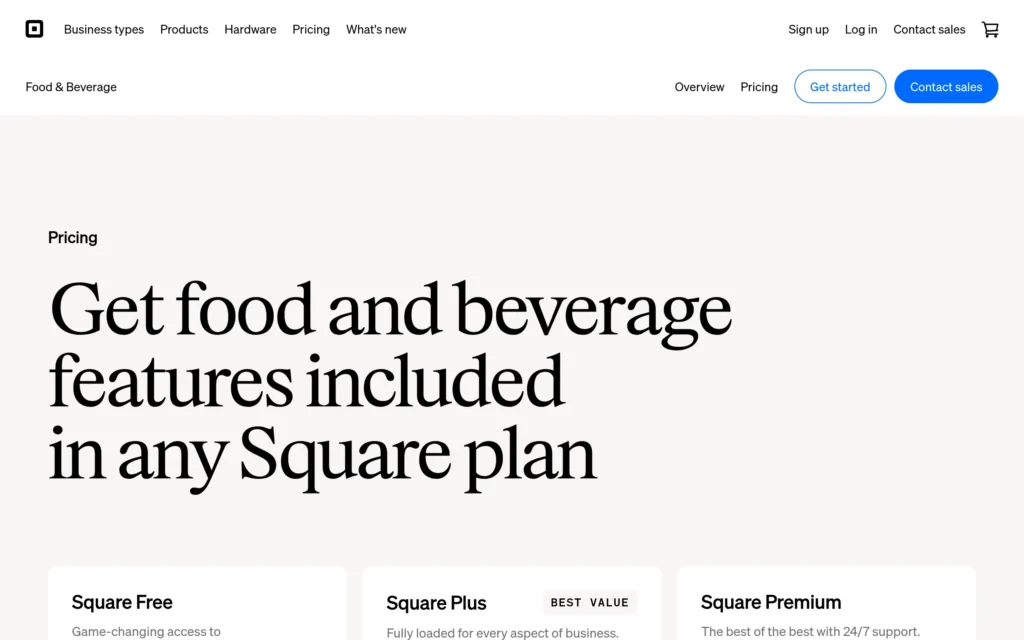
Square Plus costs $49 a month per location and lowers in-person processing to 2.5% + 15¢ and online processing to 2.9% + 30¢. Plus adds integrated inventory tracking and close-of-day reports, and it unlocks paid add-ons: the Square KDS kitchen display app at $30 a month per device, Square Kiosk at $99 a month per device, and Square Kiosk Lite at $50 a month per device.
Square Premium costs $149 a month per location, with in-person processing at 2.4% + 15¢ and online processing at 2.9% + 30¢. Premium adds 24/7 support and cheaper device pricing, but its coursing and seat management are dining-room furniture on a truck. Premium is priced for multi-location operators, not for you.
Plus and Premium each offer a free 30-day trial, and Square says you can cancel or switch plans anytime. With Free there are no monthly subscription costs: you only pay processing fees when you take a payment.
The AI layer is Squaremates, which Square describes as the AI business partner built into Square. The pricing page also lists an auto-polish item image feature that removes backgrounds from menu photos. For a truck, that pair covers two repeated jobs: reading yesterday’s sales and making today’s menu photo look edible.
Now the meter that matters. At our truck’s $20,000 a month across 1,250 transactions, Square Free processing costs $520 in percentage fees plus $187.50 in per-transaction fees, which is $707.50 a month or $8,490 a year. Plus costs $736.50 a month all-in, and Premium costs $816.50 a month all-in, because the rate saving is smaller than the subscription at this volume.
Choose Square if you want to start selling today with no subscription. Stay on Free until the maths or the features say otherwise: Plus earns its $49 when in-person card sales pass about $49,000 a month, or when its reports save real hours weekly.
Toast: restaurant-grade POS with a paid plan
Toast is built for restaurants first and trucks second. It runs on its own Android-based hardware, bundles payments with the POS, and prices its plans around a trade-off between a monthly software fee and your processing rate.
Toast’s pricing guide, checked on 26 November 2026, lists three restaurant options. The Starter Kit starts at $0 a month for software, includes one terminal, and uses pay-as-you-go processing at a higher per-transaction rate. The Point of Sale plan starts at $69 a month with a lower processing rate, and Build Your Own is custom-priced.
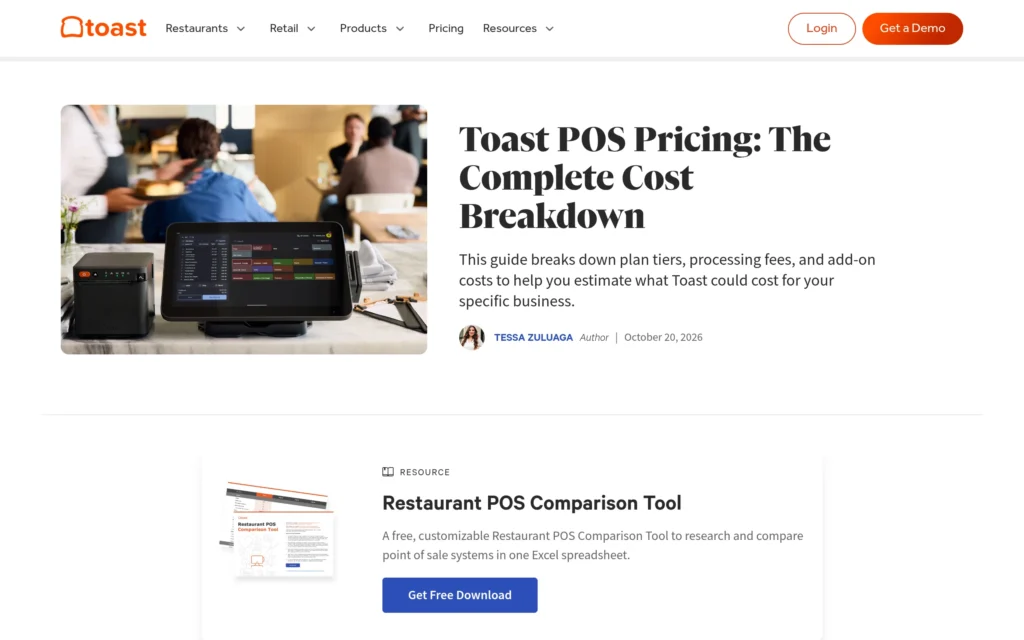
Toast’s own small-business guide prints the Point of Sale in-person rate as 2.49% + $0.15 per transaction. The pricing guide does not print the Starter Kit pay-as-you-go rate, so this guide does not invent one: Toast says the rate varies by plan, and your quote is where that number lives.
Published prices apply to new customers and single locations only, and the plan price includes the first terminal’s subscription, with additional charges for subsequent devices. Add-ons such as online ordering and payroll are billed separately, and Toast points you to a custom quote for their cost.
The Starter Kit covers a single-location setup with one terminal, with a second available at additional cost. It includes order management, payment processing, basic reporting, and 24/7 support, and Toast Care support is included in every software subscription.
The AI layer is Toast IQ, which Toast describes as turning your data into clear insights and recommendations, and as helping you uncover insights and take action inside the chat. Toast also highlights offline backup that keeps you running when the internet does not, which matters at a festival field with one bar of signal.
Two terms deserve a slow read. With pay-as-you-go, inactivity and cancellation fees may apply if you do not begin processing within 120 days or stop processing for a set period. Ending a Toast agreement before the current term is over typically triggers an early termination fee.
At our truck’s volume, Toast Point of Sale costs $69 plus $498 in percentage fees plus $187.50 in per-transaction fees, which is $754.50 a month or $9,054 a year. That is $47 a month more than Square Free, because the 0.11 percentage point rate saving is worth only $22 on $20,000 of sales.
Choose Toast if you expect to outgrow a single window: multiple terminals, a kitchen display workflow, and reporting depth you will actually open every day. Get the Starter Kit rate and the add-on prices in writing before you compare, because the $0 headline is a rate trade-off, not a gift.
Roaming Hunger: catering bids with no vendor fees
Roaming Hunger is not POS software and it is not AI software. It is a booking marketplace that connects event hosts with food trucks, trailers, carts, and pop-ups. For a truck owner, its job is simple: put paid catering and vending opportunities in front of you, and let you bid on the ones that fit your calendar.
Roaming Hunger’s vendor help page, checked on 26 November 2026, states the price plainly: there are no setup or membership fees to sign up. The company says it will not charge you to be on the site, to book on the site, or to get dedicated support for your business on the platform.
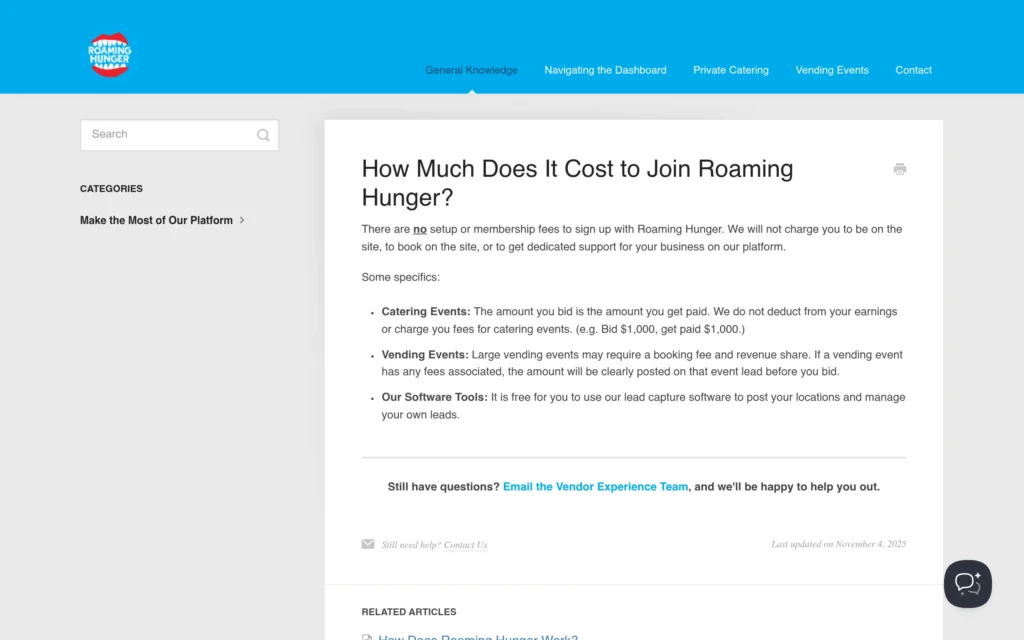
Catering events carry the cleanest terms in this guide. The amount you bid is the amount you get paid, with no deductions from your earnings and no fees for catering events. Roaming Hunger’s own example is bid $1,000, get paid $1,000. Its lead capture software, used to post your locations and manage your own leads, is also free.
Vending events are the exception, and the exception is labelled. Large vending events may require a booking fee and revenue share, and if a vending event has fees, the amount is clearly posted on that event lead before you bid. Events labelled Booked by Roaming Hunger are the only ones that may come with a fee.
Roaming Hunger’s worked example shows the vending maths. At a sample event with a $1,000 minimum guarantee, a $50 deposit, and a 10% revenue share, selling $1,500 keeps you $1,400 after the share and deposit. The deposit is nonrefundable, so read the lead before you reserve the space.
The host side of the marketplace tells you what to bid. Roaming Hunger says catering packages typically range from $1,000 to $3,000, with taco trucks at $15 to $25 per person and a $1,200 minimum for 1 to 100 eaters. Price bids from those ranges, not from hope.
Roaming Hunger says its network totals over 23,000 independent food trucks, trailers, carts, and pop-ups nationally. Every catering is protected by its service guarantee: if the caterer does not show, it finds a replacement or refunds the host. That guarantee is why office managers trust the platform with a company lunch.
Choose Roaming Hunger if your calendar has empty weekdays that catering could fill. Joining costs nothing, catering bids pay in full, and the only money at risk is a vending deposit you choose to pay after reading the lead. Bid fast and price from the published per-person ranges, not from hope.
FoodTruckPub: free pre-orders and a map pin
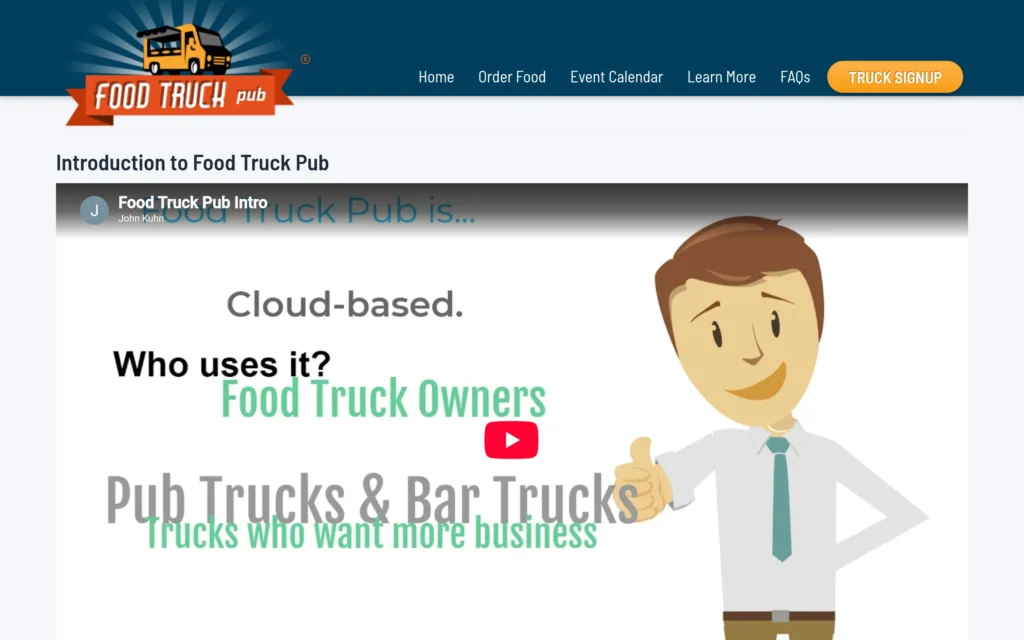
FoodTruckPub, at foodtruck.pub, is a free food truck ordering and mapping system for truck owners. Customers find you on the map, or you give them a link to order with your unique food truck number. It is not AI software either: its job is to turn a line of waiting people into orders that arrive before the customer does.
FoodTruckPub’s information page, checked on 26 November 2026, states that the site and apps are 100% free for food truck owners. Customers pay a convenience fee at checkout of $1.25 per order, or $0.60 on the Premium Plan for Square and PayPal and $0.85 on the Premium Plan for Clover. The page does not print a Premium subscription price for owners, so this guide prices the standard route only.
The money for the food goes directly into your Square, Clover, or PayPal account, and all you need is a free business account with one of those processors. FoodTruckPub notes that you will still incur the processor’s transaction fee on the food money, at whatever rate that processor charges. Free ordering software does not make card processing free.
The workflow is built for a truck window. Customers see you on the map or on printed flyers, place orders, and pay in real time. You receive email and SMS alerts as orders arrive, or watch an order tracking screen or the iOS and Android apps.
Receipts print on any wireless or Bluetooth printer you already carry in the truck. Under Settings you can print a Food Truck Sign with your unique number on it for the truck, tables, or host businesses. That sign is the cheapest marketing in this guide: a number people can order from next time.
At our truck’s volume, 200 online orders a month at the standard $1.25 customer fee means customers pay $250 a month in convenience fees while your subscription stays $0. On the Premium fee levels the same orders would cost customers $120 with Square or PayPal, or $170 with Clover.
One compatibility fact decides where FoodTruckPub fits. Its payments run through Square, Clover, or PayPal, so it pairs naturally with a Square truck. A Toast truck would need Toast’s own online ordering add-on instead, at a custom-quoted price.
Choose FoodTruckPub if your regulars already ask to order ahead, or if your lunch line loses people who cannot wait. The honest cost to watch is the customer’s $1.25, small on a $16 ticket and noticeable on a $6 coffee.
Canva: daily location posts and menus
Canva is the design tool in this stack, and for a truck its job is the daily post: today’s location, today’s menu, the catering flyer for the office park. Its AI features help generate and clean up designs, but the reason it earns a place here is speed: a location post in minutes, not an evening in a design app.
Canva’s pricing page, checked on 26 November 2026, lists Free at US$0 a month for one person. Pro costs US$18 a month for one person at the regular monthly price, and Business costs US$25 a month per person. Prices exclude applicable tax, and the page’s yearly toggle is labelled as saving from 16 percent, with the yearly total shown when you switch the toggle.
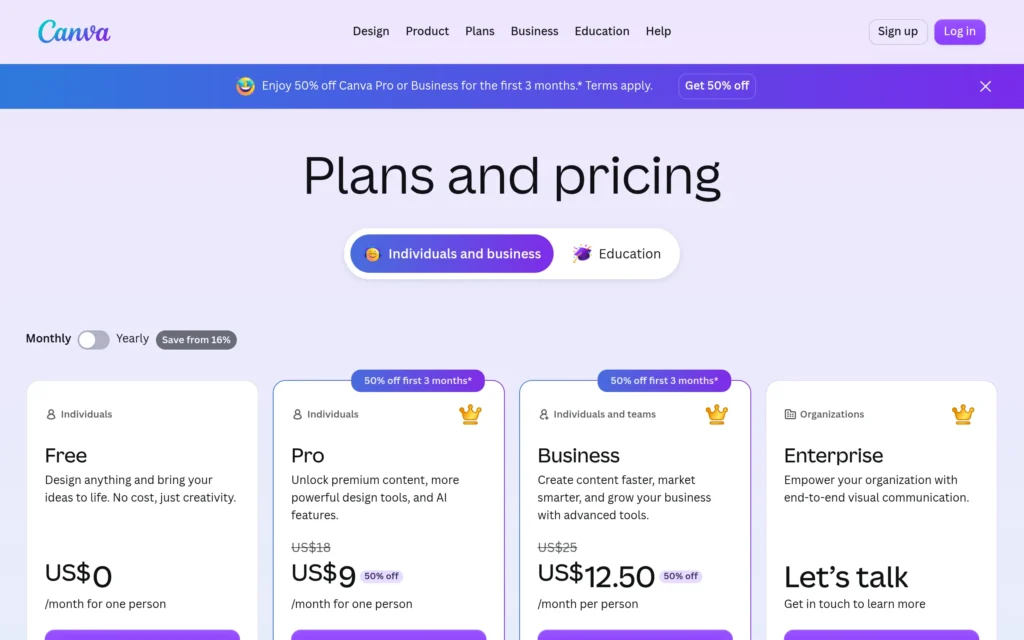
A promotion sits on top of those regular prices. The pricing page advertises 50% off Canva Pro or Business for the first 3 months on monthly plans, which shows Pro at US$9 a month and Business at US$12.50 a month per person during the offer. Terms apply, and every figure in this guide’s maths uses the regular prices, not the promotion.
Pro unlocks premium content, more powerful design tools, and AI features for one person. Business adds collaboration and team admin tools at US$25 a month per person, so a second paid seat moves you off Pro pricing. Enterprise is contact-sales pricing for organizations, which no single truck needs.
For one truck, Free covers occasional posts and simple menus. Pro at US$18 a month, or $216 a year on monthly billing, earns its place when you post daily and want the premium content and AI features in the same editor.
Choose Canva Free first and upgrade only when the free plan slows a post down. A location post that goes out at 10 a.m. sells lunch; a perfect post at 2 p.m. sells nothing.
The maths: what five tools really cost one truck
Now the honest arithmetic, all for the same truck: $20,000 a month in in-person card sales, 1,250 transactions, a $16 average ticket, plus 200 online pre-orders a month and catering bids on the side. Three stacks cover the realistic choices, and every figure comes from the vendor pages checked on 26 November 2026.
The lean stack pairs Square Free with FoodTruckPub, Roaming Hunger, and Canva Free. Square Free processing costs $707.50 a month, which is $8,490 a year. FoodTruckPub charges the owner $0, Roaming Hunger charges no vendor fees on catering, and Canva Free costs $0. Together the lean stack costs $8,490 a year, and all of it is card processing.
The middle stack upgrades the POS plan and the design tool. Square Plus costs $49 a month plus processing at 2.5% + 15¢, which is $736.50 a month or $8,838 a year. Canva Pro on monthly billing costs $216 a year. With FoodTruckPub and Roaming Hunger still at $0 to the owner, the middle stack costs $9,054 a year, which is $564 more than the lean stack.
The full stack switches POS entirely. Toast Point of Sale costs $69 a month plus processing at 2.49% + 15¢, which is $754.50 a month or $9,054 a year. Canva Pro adds $216, and Roaming Hunger still charges no catering fees. Together the full stack costs $9,270 a year. The full stack therefore costs $780 a year more than the lean stack.
Three break-evens keep those stacks honest. Square Plus saves 0.1 percentage points against Free, so its $49 fee breaks even at $49,000 a month in in-person card sales. Toast Point of Sale saves 0.11 percentage points against Square Free, so its $69 fee breaks even at about $62,727 a month. Square Premium saves another 0.1 points against Plus for $100 more, breaking even at $100,000 a month.
Online orders sit outside the stack totals because the route changes the rate. On Square’s online ordering page, $3,000 of online sales across 200 orders costs $159 a month on Free or $147 on Plus. Through FoodTruckPub, the same orders cost you $0 in subscription while customers pay $250 in convenience fees, plus your processor’s fee on the food money.
Catering sits outside the totals for the opposite reason: it is income, not cost. A $1,000 Roaming Hunger catering bid pays you $1,000, with no deduction. One booked job a month at that level covers the entire $780 gap between the lean and full stacks, which is why the calendar matters more than the POS argument.
One more comparison matters. Square Premium costs $816.50 a month all-in at our volume, which is $109 a month more than Free. A single truck buying Premium for the processing rate pays $1,308 a year for a $240 rate saving.
Five traps that catch truck owners
First, $0 software is not $0 cost. Square Free and the Toast Starter Kit both headline at $0 a month and make their money on processing. At our volume that bill is $707.50 a month on Square Free, dwarfing every subscription here. Compare all-in cost at your sales level, never the headline.
Second, the 15¢ per-transaction fee punishes small tickets. On a $16 ticket, Square Free’s 2.6% + 15¢ is about 3.5% of the sale. On an $8 ticket it rises to about 4.5%, and on a $25 ticket it falls to about 3.2%. Trucks selling low-priced items should price that fee into the menu.
Third, an unprinted rate is a negotiation, not a price. Toast’s pricing guide does not print the Starter Kit pay-as-you-go rate, and its add-ons are custom-quoted. The Starter Kit also carries inactivity and cancellation fee terms, and ending a Toast agreement early typically triggers an early termination fee. Get the rate, the add-on prices, and the term in writing before the hardware arrives.
Fourth, free to the owner can still cost you customers. FoodTruckPub’s $1.25 customer fee is trivial on a family order and visible on a single drink. Roaming Hunger’s vending deposits are nonrefundable even when weather empties the field. Read the fee on every lead, and watch whether regulars reorder.
Fifth, promotions end and seats multiply. Canva’s 50% offer covers the first 3 months of a monthly plan, after which Pro returns to US$18 a month. Pro is for one person, so a second paid seat moves you to Business at US$25 a month per person. Budget the regular price and the real seat count, and treat the promotion as a discount on a decision you already made.
What to buy first
Start with the leak that costs you most, and measure it for two weeks before you buy anything. Count walk-aways during the lunch rush, regulars who ask where you are today, and catering enquiries that arrive by DM and die there. The biggest count names your first purchase.
If payment speed leads the count, start with Square Free. It costs $0 to subscribe, takes tap, dip, and swipe payments at 2.6% + 15¢, and gives you a branded online ordering page the same day. Run it for a month and read your real processing bill before any paid plan enters the conversation.
If regulars lead the count, switch on FoodTruckPub and print the truck sign. Pre-orders cost you $0, customers pay $1.25 an order, and the map pin answers the where-are-you question without a daily post. Pair it with Canva Free for the location post, and upgrade to Pro only when the free plan slows you down.
If empty weekdays lead the count, join Roaming Hunger and bid on catering. Joining is free, catering bids pay in full, and its published ranges tell you how to price the bid. Skip vending events until you can afford a nonrefundable deposit on a rainy forecast.
Pros and cons
Square
Pros: Free plan at $0 a month per location with menu management, pickup and local delivery, and a branded online ordering page; published processing rates on every plan; Squaremates AI assistant and auto-polish item images built in.
Cons: processing is the real bill, at $707.50 a month on $20,000 of card sales; Plus and Premium cost more than Free until roughly $49,000 and $100,000 a month in sales; kitchen display and kiosk add-ons cost extra per device.
Toast
Pros: Point of Sale from $69 a month with a lower 2.49% + 15¢ in-person rate; Toast IQ reporting insights and 24/7 support included; offline backup and restaurant-grade hardware for high-volume service.
Cons: Starter Kit pay-as-you-go rate is not printed in the pricing guide; add-ons and extra devices are custom-quoted; inactivity, cancellation, and early termination fee terms need a slow read.
Roaming Hunger
Pros: no setup or membership fees to join; catering bids pay in full with no deductions, bid $1,000 and get paid $1,000; free lead capture software to post locations and manage your own leads.
Cons: large vending events may require a nonrefundable deposit and revenue share; it is a marketplace, so income depends on bidding fast and pricing well; it does not take payments or run your POS.
FoodTruckPub
Pros: 100% free for truck owners, with ordering, mapping, and a unique truck number; email and SMS order alerts plus an order tracking screen; money goes directly into your Square, Clover, or PayPal account.
Cons: customers pay a $1.25 convenience fee per order on the standard route; processor transaction fees still apply on the food money; payments run through Square, Clover, or PayPal, so it does not pair with Toast payments.
Canva
Pros: Free plan at US$0 a month covers simple location posts and menus; Pro at US$18 a month adds premium content, more powerful design tools, and AI features; 50% off the first 3 months on monthly Pro and Business plans.
Cons: Pro is for one person, and a second paid seat means Business at US$25 a month per person; the promotion ends after 3 months; prices exclude tax and the yearly total sits behind the pricing toggle.
Our verdict
For most single trucks at $20,000 a month in card sales, the answer is the lean stack: Square Free, FoodTruckPub, Roaming Hunger, and Canva Free. Together they cost $8,490 a year, all of it card processing, and they cover payments, pre-orders, catering bids, and daily posts without a single subscription.
Square Plus and Canva Pro form the sensible upgrade when the truck grows. Together they add $564 a year at our volume, and Plus starts paying for itself on processing alone at about $49,000 a month in card sales.
Toast earns its place when the operation stops being one window: several terminals, a kitchen workflow, and volume past about $62,727 a month where its lower rate covers the $69 fee. Until then, let its written quote compete with your Square payout report.
The best ai tools for food trucks fit the truck you actually run: your ticket size, your card volume, your calendar. Measure the leak for two weeks, switch on the free tools first, and let your own processing bill decide when a paid plan earns its place.
Frequently asked questions
What is the best AI tool for food trucks?
For most single trucks, Square Free is the best starting point among the best ai tools for food trucks, at $0 a month per location with 2.6% + 15¢ in-person processing. Add FoodTruckPub for pre-orders at $0 to the owner, Roaming Hunger for catering bids with no vendor fees, and Canva for daily location posts.
How much does a food truck POS cost per month?
At $20,000 a month in card sales across 1,250 transactions, Square Free costs $707.50 a month in processing with no subscription. Square Plus costs $736.50 a month all-in, and Toast Point of Sale costs $754.50 a month all-in. Your average ticket moves the total more than the subscription does.
Is Roaming Hunger free for food trucks?
Yes, for joining and for catering. Roaming Hunger charges no setup or membership fees, and the amount you bid on a catering event is the amount you get paid, with no deductions. Large vending events may require a booking fee and revenue share, posted on the event lead before you bid.
Can customers pre-order from a food truck?
Yes. FoodTruckPub lets customers find your truck on a map or order with your unique truck number, pay in real time, and pick up without waiting in line. It is free for owners, customers pay $1.25 per order, and the food money goes into your Square, Clover, or PayPal account.
Do I need Canva Pro for food truck posts?
Not at first. Canva Free at US$0 a month covers simple location posts and menus for one person. Pro at US$18 a month adds premium content, more powerful design tools, and AI features, and the current offer takes 50% off the first 3 months of a monthly plan.
Price note
Price note — updated 26 November 2026: Prices in this post were checked on 26 November 2026. When you are reading this, the price may be lower or higher, a plan may have been renamed, or a trial may have changed, so check the vendor’s own pricing page before you buy.
Square processing is 2.6% + 15¢ in person on Free, 2.5% + 15¢ on Plus, and 2.4% + 15¢ on Premium. Toast Point of Sale starts at $69 a month with 2.49% + 15¢ in-person processing, while the Starter Kit rate is not printed in Toast’s pricing guide. Roaming Hunger pays catering bids in full, FoodTruckPub charges customers $1.25 per order, and Canva Pro costs US$18 a month before tax.
Sources
- Square restaurant pricing: https://squareup.com/us/en/point-of-sale/restaurants/pricing
- Toast pricing guide: https://pos.toasttab.com/blog/on-the-line/toast-pricing
- Roaming Hunger vendor fees: https://roaminghunger.helpscoutdocs.com/article/223-how-much-does-it-cost-to-join-roaming-hunger
- FoodTruckPub information: https://foodtruck.pub/more-information.aspx
- Canva pricing: https://www.canva.com/pricing/
Try it with your own numbers
Every figure here is for one imaginary truck, and yours is not imaginary. Our free AI Cost Calculator takes the prices above, your card sales, and your transaction count, and works out what each tool costs you per year and per month. Run your own numbers before you buy, and let the saving decide.
Pros
- Square: Free plan at $0 a month per location with menu management, pickup and local delivery, and a branded online ordering page
- Square: published processing rates on every plan
- Square: Squaremates AI assistant and auto-polish item images built in
- Toast: Point of Sale from $69 a month with a lower 2.49% + 15¢ in-person rate
- Toast: Toast IQ reporting insights and 24/7 support included
- Toast: offline backup and restaurant-grade hardware for high-volume service
- Roaming Hunger: no setup or membership fees to join
- Roaming Hunger: catering bids pay in full with no deductions, bid $1,000 and get paid $1,000
- Roaming Hunger: free lead capture software to post locations and manage your own leads
- FoodTruckPub: 100% free for truck owners, with ordering, mapping, and a unique truck number
- FoodTruckPub: email and SMS order alerts plus an order tracking screen
- FoodTruckPub: money goes directly into your Square, Clover, or PayPal account
- Canva: Free plan at US$0 a month covers simple location posts and menus
- Canva: Pro at US$18 a month adds premium content, more powerful design tools, and AI features
- Canva: 50% off the first 3 months on monthly Pro and Business plans
Cons
- Square: processing is the real bill, at $707.50 a month on $20,000 of card sales
- Square: Plus and Premium cost more than Free until roughly $49,000 and $100,000 a month in sales
- Square: kitchen display and kiosk add-ons cost extra per device
- Toast: Starter Kit pay-as-you-go rate is not printed in the pricing guide
- Toast: add-ons and extra devices are custom-quoted
- Toast: inactivity, cancellation, and early termination fee terms need a slow read
- Roaming Hunger: large vending events may require a nonrefundable deposit and revenue share
- Roaming Hunger: it is a marketplace, so income depends on bidding fast and pricing well
- Roaming Hunger: it does not take payments or run your POS
- FoodTruckPub: customers pay a $1.25 convenience fee per order on the standard route
- FoodTruckPub: processor transaction fees still apply on the food money
- FoodTruckPub: payments run through Square, Clover, or PayPal, so it does not pair with Toast payments
- Canva: Pro is for one person, and a second paid seat means Business at US$25 a month per person
- Canva: the promotion ends after 3 months
- Canva: prices exclude tax and the yearly total sits behind the pricing toggle
For most single trucks at $20,000 a month in card sales, the answer is the lean stack: Square Free, FoodTruckPub, Roaming Hunger, and Canva Free. Together they cost $8,490 a year, all of it card processing, and they cover payments, pre-orders, catering bids, and daily posts without a single subscription.Square Plus and Canva Pro form the sensible upgrade when the truck grows. Together they add $564 a year at our volume, and Plus starts paying for itself on processing alone at about $49,000 a month in card sales.Toast earns its place when the operation stops being one window: several terminals, a kitchen workflow, and volume past about $62,727 a month where its lower rate covers the $69 fee. Until then, let its written quote compete with your Square payout report.The best ai tools for food trucks fit the truck you actually run: your ticket size, your card volume, your calendar. Measure the leak for two weeks, switch on the free tools first, and let your own processing bill decide when a paid plan earns its place.